27 Laws From the 1800s That Seem Absurd Now
Most lists of strange old laws are padded with rules nobody ever passed. The real statute books of the nineteenth century are stranger, because every odd clause was drafted, debated and voted on by people who thought it solved something.
Some of these laws were merely fussy, some were tax schemes with unexpected side effects, and a few were plainly unjust. Each one below can be traced to a named act, a year and a place.
Britain’s Red Flag Rule for Road Engines

Britain’s Locomotives Act of 1865 limited self-propelled road vehicles to four miles per hour in the country and two in towns. Each machine needed a crew of at least three, and one of them had to walk no less than sixty yards ahead carrying a red flag to warn riders and carriage drivers.
An 1878 amendment shortened the distance and left the flag to local discretion, but the walking escort stayed. Parliament lifted the rule with the Locomotives on Highways Act of 1896, which raised the limit to fourteen miles per hour.
Motorists marked the change that November with a celebratory drive from London to Brighton, an event still commemorated by a veteran car run.
London’s Eight O’Clock Deadline for Shaking Rugs

Section 60 of the Metropolitan Police Act 1839 made it a crime to beat or shake any carpet, rug or mat in a London street, with one exception: doormats could be shaken before eight in the morning. Section 54 of that statute fined people for flying kites to the annoyance of others, making slides on ice or snow, and wantonly knocking on doors or ringing doorbells.
The maximum penalty for each was forty shillings. Parliament was trying to give a new police force clear authority over crowded streets, so it listed nearly every irritation a Londoner could name.
Those clauses remain on the statute book, which makes childhood doorbell pranks technically a police matter in the capital.
The Ban on Dog-Drawn Carts

Before 1840, dogs hauled small carts through London for bakers, butchers, knife grinders and hawkers who could not afford a pony. The Metropolitan Police Act 1839 ended the practice inside the police district, with fines for anyone who used a dog to draw a cart, truck or barrow.
Supporters argued the animals were overworked and badly treated, and some claimed the strain made them more prone to rabies, a theory with no medical basis. A further act in 1854 extended the prohibition across the country.
Dog carts stayed common in Belgium and the Netherlands for decades afterward, which left British travelers of the period remarking on a sight their own law had abolished.
Drunk in Charge of a Cow

Under section 12 of the Licensing Act 1872, anyone found drunk while in charge of a carriage, horse, cattle or steam engine on a highway in England and Wales could be fined up to forty shillings or imprisoned for up to a month. That clause also covered being drunk in possession of a loaded firearm, which seems the more pressing concern.
Cattle were included because droving livestock along public roads was ordinary business in the 1870s. That section remains in force.
Courts have treated a bicycle as a carriage for its purposes, so a Victorian law written with cows and traction engines in mind still catches the occasional unsteady cyclist.
Fortune Telling as Vagrancy

The Vagrancy Act of 1824 was passed in England after the Napoleonic Wars, when discharged soldiers and displaced laborers filled the roads. Section 4 swept up far more than beggars.
Anyone pretending or professing to tell fortunes, or using palmistry or any subtle craft to deceive the public, was classed as a rogue and vagabond and could be sentenced to as much as three months of hard labor. The same section covered sleeping in barns and exposing wounds to gather alms.
Police used the fortune telling clause against palm readers and spiritualists well into the twentieth century, long after seaside piers had made the trade a standard holiday amusement.
Imagining the End of the Monarchy

Passed during the revolutionary year of 1848, the Treason Felony Act made it a serious crime in Britain to compass, imagine, invent, devise or intend to deprive the monarch of the crown. Expressing such an intention in print or writing was enough.
The original penalty was transportation for life, later replaced by life imprisonment. The act has never been repealed.
In 2003 the House of Lords heard a challenge from a newspaper that had campaigned for a republic, and the judges declined to rule formally while making clear that nobody could seriously expect a prosecution for peaceful advocacy. On paper, the wording still stands.
A Tax on Daylight

England’s window tax dated from 1696, but it shaped life through the first half of the nineteenth century. Householders paid according to the number of windows, so owners bricked up openings and builders designed tenements with as few as they could manage.
Doctors and reformers blamed the tax for dark, airless housing in the growing industrial cities. An 1825 change exempted houses with fewer than eight windows, which helped small cottages but did little for crowded urban blocks.
Parliament finally repealed the tax in 1851 and replaced it with a duty on inhabited houses. Blocked windows from the period can still be seen on older British terraces, although some were blanks built for symmetry.
One Guinea a Year to Powder a Wig
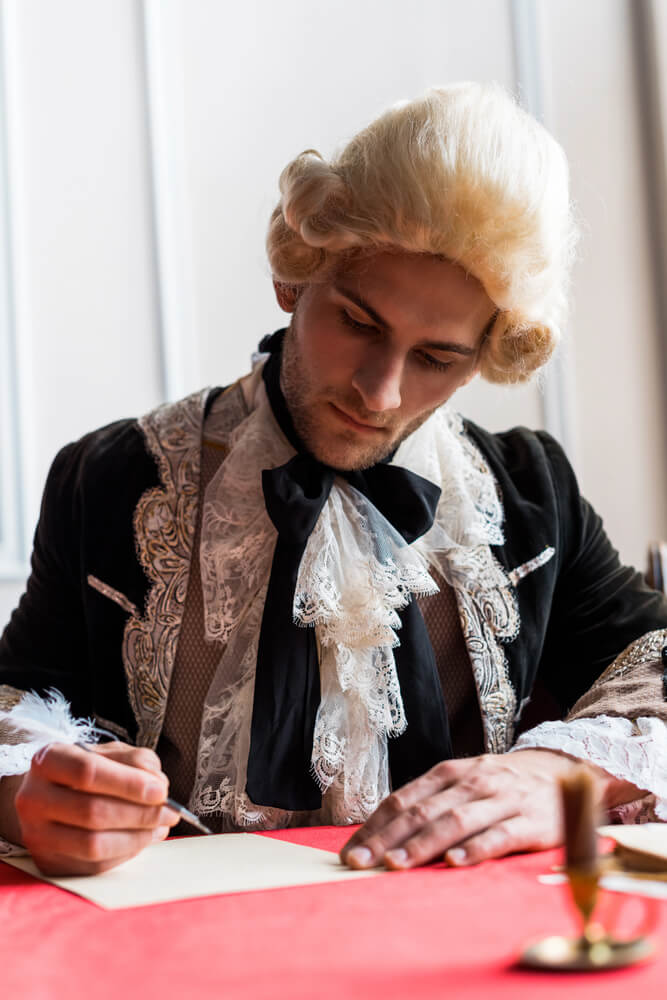
William Pitt’s government introduced the hair powder duty in 1795 to help pay for war with France. Anyone in Great Britain who wanted to wear powdered hair had to buy an annual certificate costing one guinea.
The royal household was exempt, as were poorer clergymen. Fashion responded faster than the Treasury expected. Whig aristocrats gave up powder in protest, cropped styles spread, and certificate holders were mocked as guinea pigs.
The duty stayed on the books for decades after the fashion died, collected mostly on behalf of liveried footmen whose employers insisted on the old look. By the time it was repealed in 1869, the yield was trivial.
The Stamp That Priced the Poor Out of News

Every newspaper sold in Britain had to carry a government revenue stamp, and from 1815 the duty stood at four pence a copy. That pushed the price of a paper to around seven pence, well beyond a laborer’s budget.
Radicals called it a tax on knowledge. Publishers such as Henry Hetherington printed unstamped papers in open defiance, and hundreds of street vendors went to prison for selling them during the 1830s.
The duty was cut to one penny in 1836 and abolished in 1855. Cheap daily papers appeared almost at once, and newspaper reading rooms, where working people had pooled money to share a single copy, slowly lost their purpose.
Trial by Combat, Legal Until 1819

In 1817 Abraham Thornton was acquitted of murdering Mary Ashford in Warwickshire. Her brother William then used an old procedure called an appeal of murder to bring the case again.
Thornton’s lawyers found an equally old answer. In court he threw down a gauntlet and demanded trial by battle, a medieval right that Parliament had never removed.
In 1818 the Court of King’s Bench, under Lord Ellenborough, held that the claim was good law. William Ashford, much the smaller man, declined to fight, and Thornton walked free.
Parliament abolished both wager of battle and appeals of murder the following year, before anyone else could try it.
No Marrying a Late Wife’s Sister

The Marriage Act of 1835 declared that any future marriage between a widower and the sister of his deceased wife would be void in England. The ban rested on a church doctrine that marriage made in-laws into blood relations.
It caused real hardship, because an unmarried sister was often the person who moved in to raise a dead woman’s children. Couples who could afford it married abroad, as the painter William Holman Hunt did in the 1870s.
Bills to repeal the rule were introduced in Parliament again and again for more than half a century. The Deceased Wife’s Sister’s Marriage Act finally passed in 1907.
Burial Shrouds Made of English Wool

Acts passed under Charles II in the 1660s and 1670s required every corpse in England to be buried in a shroud of pure English wool. A relative had to swear an affidavit that the rule had been followed, and failure brought a fine of five pounds.
The purpose was to prop up the wool trade against imported linen. Wealthy families often paid the fine as a funeral expense so their dead could wear linen or silk.
Enforcement faded during the late 1700s, yet the requirement remained law into the nineteenth century. Parliament ended the requirement with an act of 1814, and a statute law revision in 1863 swept away what was left.
Parish burial registers still carry the affidavit notes.
Paris Permits for Women in Trousers

A police ordinance issued in Paris on November 7, 1800, required any woman who wished to dress as a man to apply to the Prefecture of Police for a permit, usually supported by a medical certificate. The painter Rosa Bonheur held one so she could sketch at horse fairs and slaughterhouses without attracting attention.
Circulars in 1892 and 1909 relaxed the rule for women holding the handlebars of a bicycle or the reins of a horse. Nobody formally repealed it.
In January 2013 the French ministry for women’s rights confirmed that the ordinance was incompatible with the constitution and had no legal force, more than two centuries after it was written.
Japan’s Ban on Decorative Tattooing

Meiji Japan outlawed decorative tattooing in 1872. Officials worried that the practice would look backward to Western visitors at a moment when the country was renegotiating its place among foreign powers.
The law had an odd result. Foreigners were not covered, so tattooists in port cities such as Yokohama worked openly on sailors and tourists while their Japanese clients went to back rooms. Two future monarchs, later George V of Britain and Nicholas II of Russia, are documented as having been tattooed in Japan during the ban.
It lasted until 1948, when the prohibition was dropped under the postwar occupation. Social stigma has proved more durable than the statute.
The Edict That Disarmed the Samurai

On March 28, 1876, the Japanese government issued the Haitorei, an edict forbidding the wearing of swords in public. Exceptions were made for the military, the police and officials in ceremonial dress.
For the former samurai class the two swords had been a legal badge of rank for centuries, and an earlier edict in 1871 had already made the traditional topknot optional. The sword ban landed harder. An uprising in Kumamoto followed within months, and the much larger Satsuma Rebellion broke out in 1877.
Both failed. Many swordsmiths who lost their market turned to making kitchen knives, tools and scissors, a shift often credited as one root of the country’s modern cutlery trade.
An Ottoman Order to Wear the Fez

Sultan Mahmud II spent the 1820s remaking the Ottoman state, and headgear was part of the plan. After equipping his new army with the fez, he issued a regulation in 1829 ordering civil officials to wear it as well.
Turbans, which had signaled rank, profession and religion at a glance, were largely restricted to clerics. The idea was a uniform look for the sultan’s servants regardless of background, and the wider public soon followed.
History then reversed itself. In 1925 the Turkish Republic’s Hat Law banned the fez as a relic of the old empire, and men were prosecuted for wearing what had once been compulsory.
Canada’s Clause on Pretending to Practice Witchcraft

Canada’s first Criminal Code, enacted in 1892, borrowed a clause from older British law that made it a crime to pretend to exercise witchcraft, sorcery, enchantment or conjuration. It also covered telling fortunes for payment and claiming occult skill to find lost or stolen goods.
Lawmakers targeted the pretense because, by then, the law assumed the powers were not real. That code also criminalized challenging someone to a duel. Both provisions survived every revision for more than 120 years.
Police in Ontario laid witchcraft charges as late as 2018 in alleged fraud cases, just before Parliament removed the section in a cleanup of obsolete crimes that December.
Kentucky’s Oath Against Dueling

Since 1849, Kentucky’s constitution has required public officials to swear that they have never fought a duel. The 1891 constitution, still in force, kept the clause as section 228.
Every officeholder and lawyer admitted to the bar must affirm that they have not fought a duel with deadly weapons, sent or accepted a challenge, or acted as a second, since the adoption of the present constitution. The rule was a practical answer to a real problem, since dueling had killed or disgraced a number of the state’s politicians.
Proposals to modernize the oath have surfaced from time to time, and governors continue to recite it at their inaugurations, usually to laughter.
Massachusetts and the Fifteen Gallon Minimum

Massachusetts tried in 1838 to end casual drinking without banning alcohol outright. A new law prohibited the retail sale of spirits in quantities under fifteen gallons, which shut down taverns and dram shops while leaving wealthier buyers free to purchase by the barrel.
Evasion was immediate. At a militia muster in Dedham that year, an enterprising vendor charged a small admission fee to view a striped pig and handed each visitor a complimentary glass of rum.
The striped pig became a national joke and a political slogan. Governor Edward Everett, who had signed the measure, narrowly lost the 1839 election, and the legislature repealed the law in 1840.
Maine Goes Dry in 1851

Nearly seven decades before national Prohibition, Maine banned the manufacture and sale of liquor statewide. The law of June 2, 1851, was the work of Neal Do
w, the mayor of Portland, and allowed exceptions only for medicinal and industrial use. About a dozen other states and territories copied it within four years, and temperance campaigners spoke of the Maine Law as a model for the country.
Dow’s own reputation suffered in 1855, when a crowd gathered outside Portland’s city hall over rumors that he was keeping a store of official alcohol. Militia fired on the crowd and one man was killed.
The legislature repealed the law the following year.
New Hampshire’s Pink Margarine Requirement

Dairy farmers in the late 1800s viewed margarine as a fraud in a butter wrapper, and state legislatures agreed. New Hampshire, in a provision carried in its Public Statutes of 1891, went further than most by requiring that any oleomargarine sold in the state be colored pink.
Lawmakers did not ban the product. They simply made it look unappetizing. In Collins v. New Hampshire, decided in 1898, the United States Supreme Court struck the statute down, reasoning that forcing a lawful food to be sold in a repellent color amounted to prohibiting it.
Other restrictions lasted far longer, and Wisconsin kept a ban on yellow margarine until 1967, which sent residents across state lines to shop.
Michigan’s Law Against Cursing Near Women and Children

In 1897 Michigan made it a misdemeanor to use indecent, immoral, obscene, vulgar or insulting language in the presence or hearing of any woman or child. The statute sat mostly unused until 1998, when a man named Timothy Boomer fell out of his canoe on the Rifle River and reacted loudly within earshot of a family.
A deputy ticketed him, and a jury convicted him the next year. The case made him known nationally as the cussing canoeist.
The Michigan Court of Appeals threw out the conviction in 2002, finding the law unconstitutionally vague. Legislators left the dead statute on the books until 2015, when it was repealed.
Ohio’s High Hat Law for Theaters
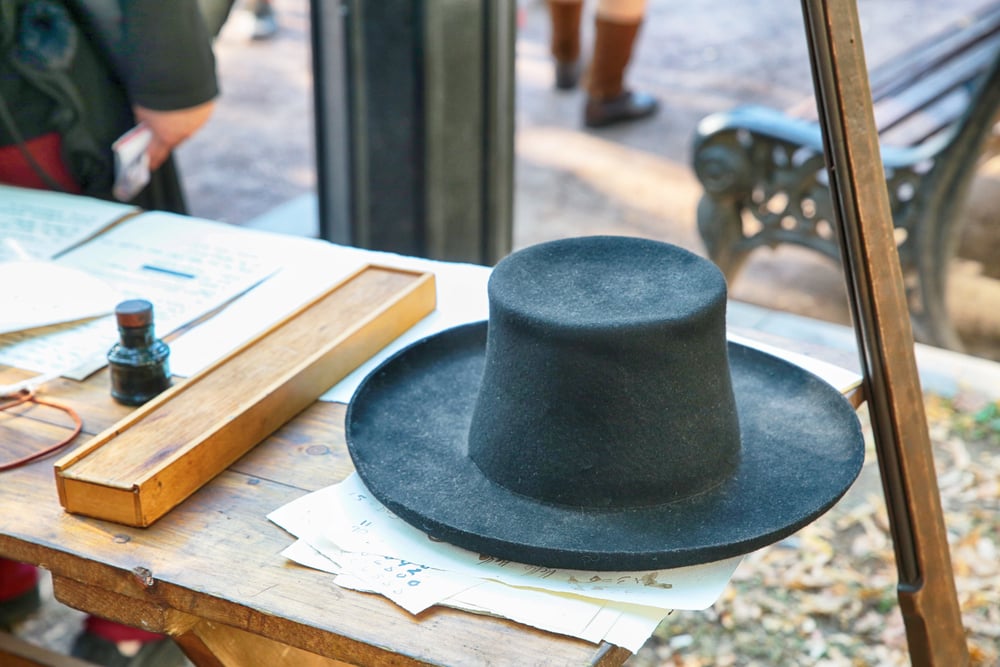
Women’s hats of the 1890s were tall, wide and heavily trimmed with feathers and artificial flowers, and people seated behind them at the theater saw very little of the stage. Ohio legislated.
A bill sponsored by a state representative from Cincinnati passed in 1896 and exposed theater managers to a fine of up to ten dollars if they allowed a woman to wear a hat large enough to obstruct the view of those behind her. Penalizing the manager spared lawmakers the awkwardness of fining the hat’s owner.
Cities elsewhere in the country passed similar ordinances over the next few years, and newspapers covered the high hat question with evident enjoyment.
New York’s Ban on Masks in Public

Tenant farmers in the Hudson Valley rebelled against a feudal leasing system in the 1840s, and they did it in costume. Bands calling themselves Calico Indians wore gowns and sheepskin masks while they blocked evictions and harassed rent collectors.
New York’s legislature answered in January 1845 with an act against appearing in public disguised and armed, later broadened into a general ban on gathering in masks. Exceptions for masquerade parties were added over time.
The law was applied to many groups across 175 years, including protesters of every political stripe. It was repealed in 2020, when the state was instructing residents to cover their faces for public health reasons.
How Arkansas Settled Its Own Name

By 1881 the pronunciation of Arkansas had become a matter of open dispute, with some residents sounding the final letter and others treating it as silent. The General Assembly resolved the question that year by concurrent resolution, drawing on advice from local historical societies.
The text declares that the name should be spoken in three syllables with the final s silent, and it discourages the alternative as an innovation. Popular lists of odd laws often claim that mispronouncing the name is illegal.
No penalty was ever attached. The resolution, which remains in the state code, is closer to an official style guide than a crime.
Indiana’s Bill to Redefine Pi

This one never became law, and that is the best thing about it. In 1897 an Indiana physician and amateur mathematician named Edward J. Goodwin persuaded a legislator to introduce House Bill 246, which endorsed his method of squaring the circle.
The mathematics implied that pi equaled 3.2. The House passed it 67 to 0 on February 5. Professor C. A. Waldo of Purdue University happened to be visiting the statehouse and explained the problem to senators, who postponed the bill indefinitely a week later.
Goodwin had offered the state free use of his discovery. Indiana’s schools were spared the bargain.
San Francisco’s Cubic Air and Queue Ordinances

Some nineteenth century laws were not foolish so much as targeted. San Francisco’s Cubic Air Ordinance of 1870 required 500 cubic feet of space for each person in a lodging house.
It was written as a health measure and enforced almost entirely against Chinese residents. When those arrested chose jail over paying fines, the city passed the Queue Ordinance, which ordered that every male prisoner’s hair be cut short.
The measure was aimed at the braided queue Chinese men wore. Mayor William Alvord vetoed it in 1873, but it was enacted in 1876.
Federal Justice Stephen Field struck it down in 1879 in Ho Ah Kow v. Nunan as unequal treatment.
Statutes Tell on the People Who Wrote Them

Nearly every law here answered a real complaint. Londoners were tired of dust in their faces, dairy farmers feared a cheaper rival, and governments from Istanbul to Tokyo wanted citizens who looked modern.
The absurdity usually comes from the remedy chosen and from how long it stayed in force after the complaint disappeared.
That lag is the common thread. Legislatures are quick to pass rules and slow to remove them, so a dueling oath or a ban on shaking rugs can sit quietly for a century or more.
A few of these measures were never harmless, and the people they targeted understood that long before the courts did. Today’s statute books are presumably collecting their own candidates for a future list.
More from Go2Tutors!

- The Romanov Crown Jewels and Their Tragic Fate
- 13 Historical Mysteries That Science Still Can’t Solve
- Famous Hoaxes That Fooled the World for Years
- 15 Child Stars with Tragic Adult Lives
- 16 Famous Jewelry Pieces in History
Like Go2Tutors’s content? Follow us on MSN.