14 Rare Photos of Early New York City
New York had a camera pointed at it almost from the moment the camera was invented. The pictures that survive show a city that looks half familiar, with famous streets lined by buildings that no longer exist and landmarks that were still scaffolding.
Some of these images were made by professionals with studios and reputations. Others came from curious amateurs who wandered the streets with a camera in hand, and each one is a window onto a block that has since been rebuilt.
The Oldest Known View of the City
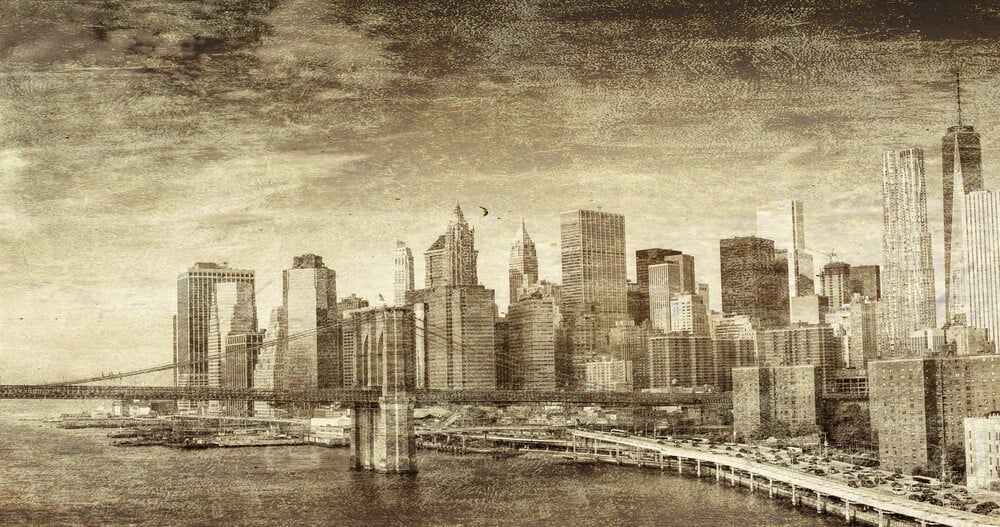
A photograph dated to about 1839 is often described as the oldest known image of New York City. That date falls in the very year the daguerreotype process was made public, so the city was in front of a camera almost as soon as photography existed.
Writers on the city’s visual history have disputed which picture deserves the title, and the debate itself shows how thin the earliest record is. Whichever image wins, the surviving examples show a city still built at the scale of a port town.
Lincoln Sits for Brady Before the Cooper Union Speech
Mathew Brady photographed Abraham Lincoln in New York on February 27, 1860, the same day Lincoln delivered his address at Cooper Union. Lincoln had not yet been nominated for president, and many Easterners knew him mainly from reports of his debates with Stephen Douglas.
Engravers copied the portrait, and prints based on it spread through the 1860 campaign. The Library of Congress holds a print of the image, which is why it turns up so often in books on the period.
A Brooklyn Bridge Tower Rises in 1873
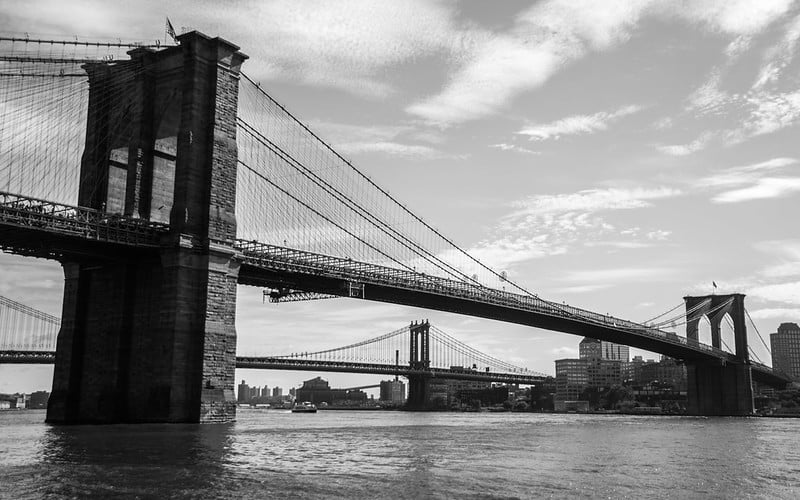
A photograph dated 1873 shows one of the Brooklyn Bridge’s stone towers under construction beside the East River. The bridge did not open until 1883, so the image sits near the middle of a project that lasted well over a decade.
Construction photographs of the bridge survive in the Roebling Collection at Rensselaer Polytechnic Institute, an archive that reflects how closely the engineering family documented its work. The towers were among the tallest structures in the city when they were finished.
The Statue of Liberty’s Arm Waits in Madison Square
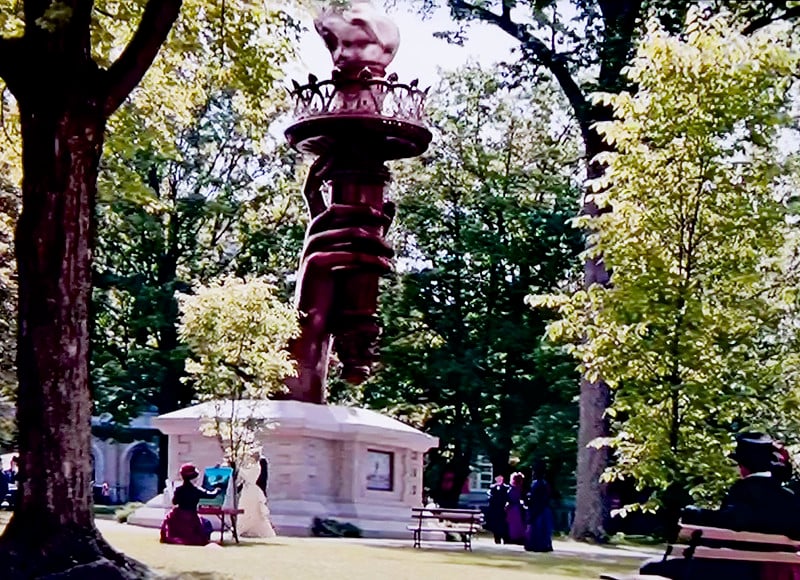
For several years in the 1870s and early 1880s, the Statue of Liberty’s torch-bearing arm stood in Madison Square Park, where visitors could see how large the finished monument would be. The arm had first been shown at the 1876 Centennial Exhibition in Philadelphia, then traveled to New York as part of the effort to raise money for the pedestal.
The statue itself was not dedicated until 1886. Photographs of the arm among the park’s trees record an odd sight: a fragment of a monument standing in the middle of the city before the monument existed.
Barnum’s Museum at Broadway and Ann Street
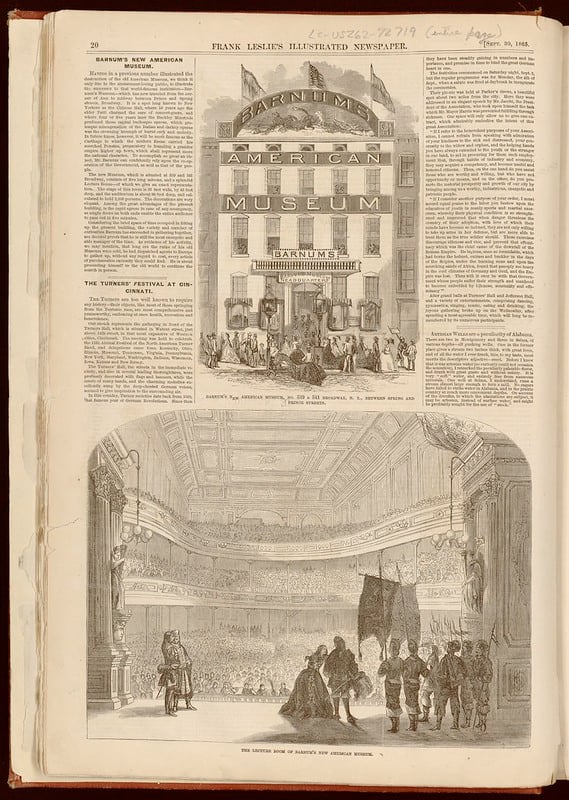
P. T. Barnum’s American Museum stood at Broadway and Ann Street in lower Manhattan and was one of the city’s busiest attractions. A fire destroyed it in 1865, and a second museum that Barnum opened on Broadway burned a few years later.
Photographs of the building’s Broadway front are among the few visual records of an institution that mixed exhibits, a theater, and sideshow attractions under one roof. Nothing of it survives on the site today.
Digging Out After the Blizzard of 1888
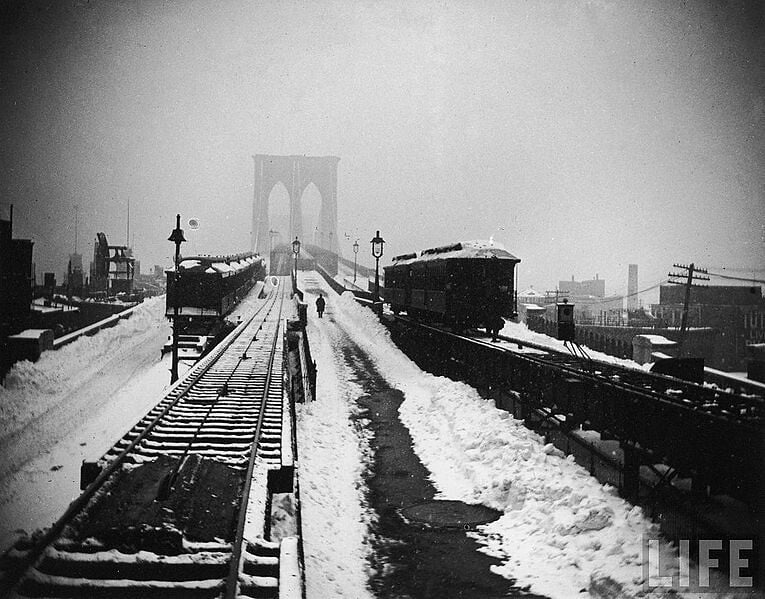
The Great Blizzard struck the Northeast in March 1888 and buried New York under deep snow, with drifts that stopped streetcars and trains. Telegraph and telephone wires came down across the city, and the storm is often cited as one reason officials began pressing for utility lines to be buried.
Photographs from the aftermath show streets reduced to narrow trenches between walls of snow. The digital library of the National Oceanic and Atmospheric Administration holds a number of these images.
Riis Photographs Bandits’ Roost
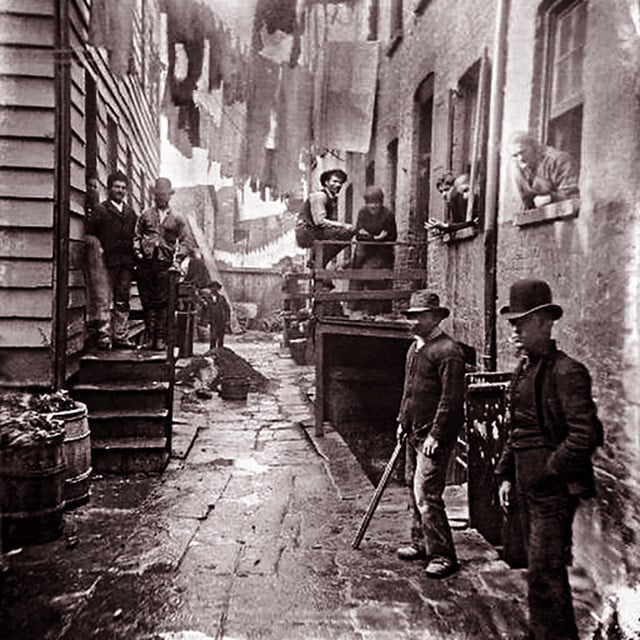
Around 1888, the journalist Jacob Riis photographed a narrow alley at 59 1/2 Mulberry Street known as Bandits’ Roost. He made such photographs with flash powder, which let him work indoors and in dark alleys.
Riis used the images in lectures and later in his 1890 book How the Other Half Lives. The ground around the alley was eventually cleared for a park.
Mulberry Bend Becomes a Park
A photograph from about 1905 shows Mulberry Bend Park on the Lower East Side, a green space that replaced one of the city’s most notorious tenement districts. Reformers pushed for clearing the blocks after Riis’s photographs and writing drew attention to conditions there.
The park opened in 1897 and was designed by Calvert Vaux with Samuel Parsons Jr. It was later renamed Columbus Park, the name it still carries.
A Policeman at Herald Square
Alice Austen, an amateur photographer from Staten Island, photographed a policeman at Herald Square as part of her mid-1890s series of New York street types. Herald Square took its name from the New York Herald, whose headquarters stood there.
Her subjects were working people she found on the street rather than clients in a studio. The National Gallery of Art holds prints from the series.
A Newsboy at Grand Central Depot
Another Austen photograph from the same series shows a newsboy at Grand Central Depot. The Depot opened in 1871 and was the predecessor of today’s terminal, which opened in 1913.
Newsboys were a fixture of the era, selling papers at train stations and street corners across the city. The series is valued today because it records clothing and routines that studio portraits often ignored.
Stieglitz Waits Out a Snowstorm on Fifth Avenue
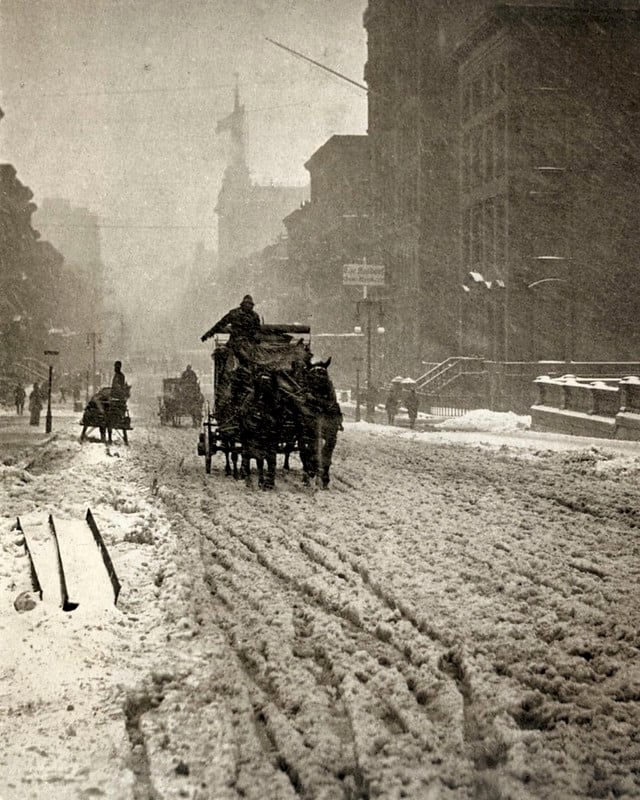
Alfred Stieglitz made Winter, Fifth Avenue in February 1893, and by his own account he waited about three hours in a snowstorm for the right moment. The picture shows a horse-drawn coach moving through a wintry avenue, its details softened by the weather.
It became a landmark of art photography. The National Gallery of Art holds prints of it.
A Steam Train on the Third Avenue El, 1878
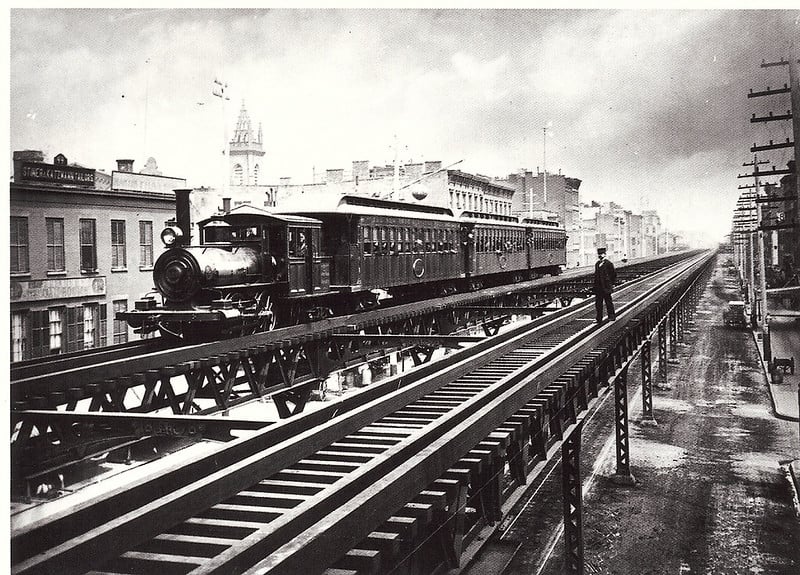
A photograph from 1878 shows a steam train on the Third Avenue elevated line in Manhattan. The line opened that year, adding a new layer of traffic above the street.
The locomotives burned coal and dropped cinders, and residents of the buildings along the route complained about the noise and falling debris.
The Manhattan section of the line was finally torn down in 1955.
The Flatiron Building Takes Shape in 1902
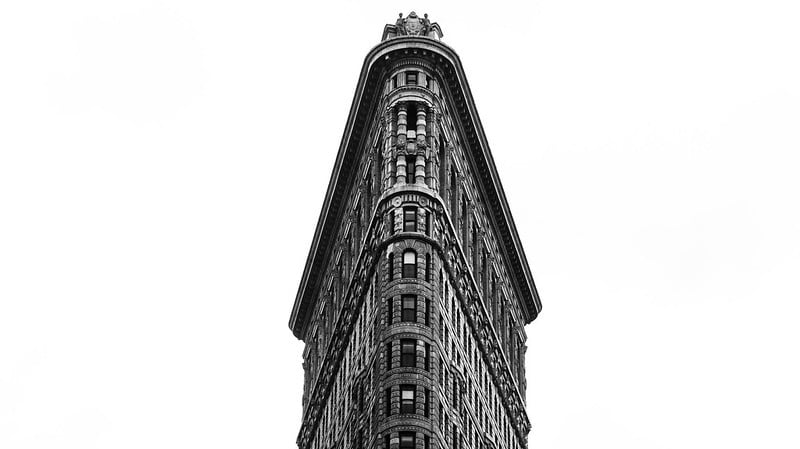
Photographs from 1902 show the Flatiron Building as a steel frame rising where Fifth Avenue meets Broadway. Its architect was Daniel Burnham, and the wedge-shaped site gave the building a form unlike any other tall building in the city.
The structure was formally called the Fuller Building, after the construction company, but the public nickname stuck almost immediately. Photographs of its frame are useful because they show how steel construction let a narrow lot rise to twenty-two stories.
Newspaper Row on Park Row in 1890
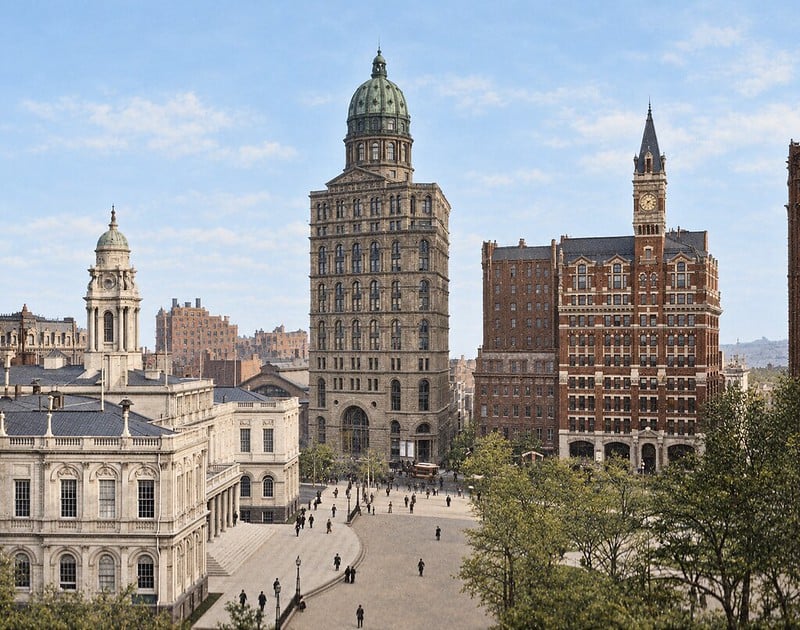
A photograph of Park Row from 1890 captures the street where several of New York’s major newspapers clustered across from City Hall Park. Joseph Pulitzer’s New York World building, finished that year, rose with a gold dome and stood as the tallest building in the city for several years.
The concentration of newsrooms and printing presses earned the street its nickname, Newspaper Row. Most of the old headquarters are gone, which makes the photograph a record of an ambition the street has since rebuilt.
A City That Keeps Erasing Itself
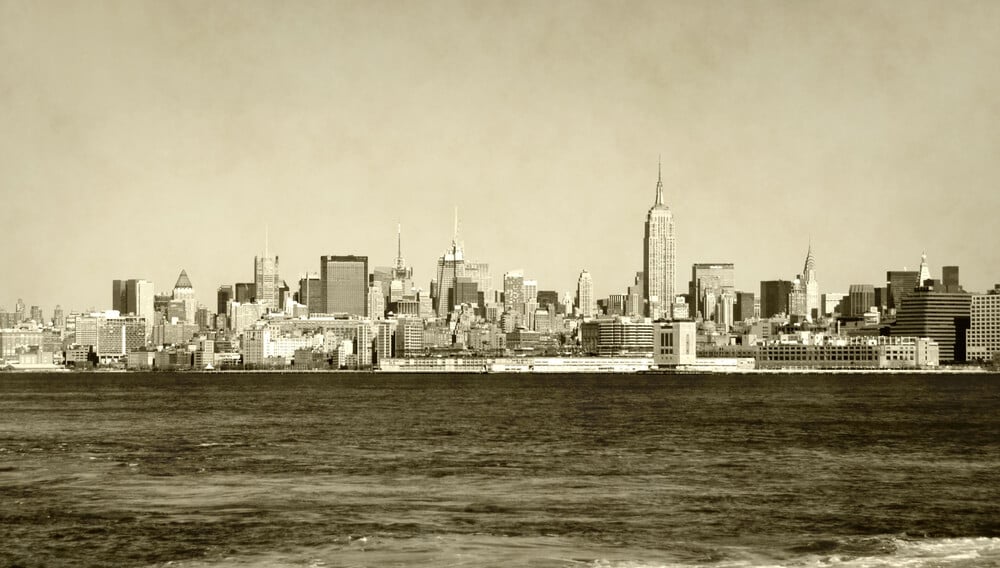
Looked at together, these images show a New York that was always being rebuilt, whether by bridge engineers, tenement reformers, or architects chasing height. Several of the subjects, including Barnum’s museum and the original Depot, have vanished entirely, which gives the photographs a documentary value that grows with every demolition.
The photographers varied widely. Brady, Riis, Austen, and Stieglitz worked for different reasons, from commerce to reform to art. Each left the same gift behind: proof of what once stood where.
More from Go2Tutors!

- The Romanov Crown Jewels and Their Tragic Fate
- 13 Historical Mysteries That Science Still Can’t Solve
- Famous Hoaxes That Fooled the World for Years
- 15 Child Stars with Tragic Adult Lives
- 16 Famous Jewelry Pieces in History
Like Go2Tutors’s content? Follow us on MSN.