16 Historical Photos of Families Traveling by Covered Wagon
The covered wagon is usually pictured on the Oregon Trail in the 1840s, but photographers were still capturing families on the move long after that era had ended. Cameras recorded Mormon emigrant trains, homesteaders lining up for land runs, immigrants crossing the Canadian prairie, and Depression-era families who revived the wagon out of necessity.
The photographs below come from public archives, including the Library of Congress and the National Archives. Each one shows a household carrying its belongings, and often its future, in a wagon box.
An Emigrant Family in the Loup Valley, 1886
Solomon Butcher photographed an emigrant family entering the South Loup Valley in Custer County, Nebraska, in 1886. The National Archives catalogs the image as a covered wagon of the Great Western Migration.
Butcher spent years documenting the settlers who built homes in the sandhills.
Mormon Emigrants in Echo Canyon
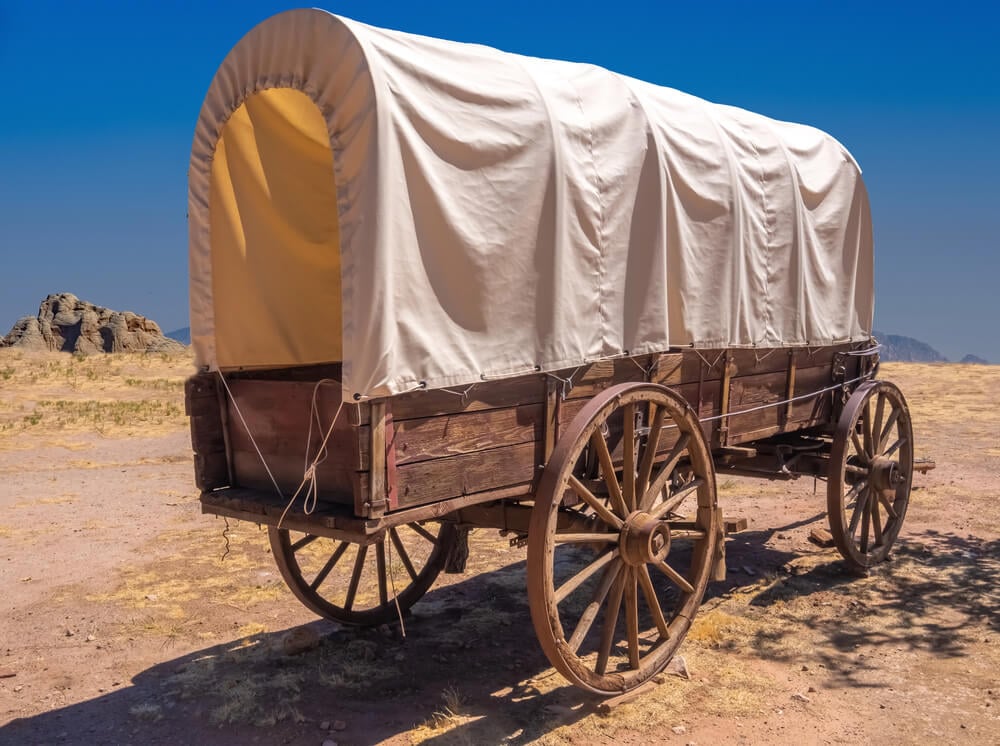
— Photo by njarvis
Charles W. Carter photographed a Mormon emigrant train in Echo Canyon, Utah, around 1870. The canyon was a long-used route into the Salt Lake Valley, and its red cliffs frame the line of wagons.
Mormon pioneers had been following the same route since the 1840s.
Mormon Emigrants, About 1879
A second Mormon emigrant image from around 1879 shows families camped beside their wagons. The photograph shows how closely the wagon served as shelter as well as transport.
It also shows that wagon travel into Utah continued well after the first overland journeys.
A Modern Covered Wagon Going West for Work
In 1936 Arthur Rothstein photographed a family in Pennington County, South Dakota, traveling in what the caption called a modern covered wagon. The family was heading west in search of work during the drought and the Depression.
The caption connects the image to an earlier generation’s westward journey.
Typical Immigrant Outfit in Central Oregon
A Library of Congress photograph dated December 5, 1910, shows a typical immigrant outfit in central Oregon. The caption identifies the wagon and its load of household goods.
By then, homesteaders were still arriving in the Oregon high desert with wagons, even as railroads crossed the country.
The Rassicot Family Leaving Kansas
A photograph from the late nineteenth century shows the A. A. Rassicot family leaving Ransom, Kansas, for St. Anne, Illinois. The family is traveling east rather than west, a reminder that not every wagon trip was headed toward new land.
Families moved back and forth across the Midwest as crops, jobs, and fortunes changed.
Just Before the Run
W. S. Prettyman and other photographers recorded the Cherokee Strip Land Run of September 16, 1893, which opened millions of acres in Oklahoma Territory to homesteaders. A picture by Croft titled Just Before the Run shows crowds assembled near Chilocco.
More than 100,000 people competed for roughly 40,000 homesteads.
On the Line, 8 A.M.
Another image from the Cherokee Strip run, titled On the Line, Sept 16 93, 8 AM, shows wagons and riders waiting at the boundary. The run began at noon, so the photograph captures hours of tense waiting.
Families brought their wagons to the line so that they could carry household goods onto their claims.
Camping on the Railroad
Prettyman photographed families camping along a railroad during the Cherokee Strip land rush. The railroad right-of-way offered a convenient place to wait near the boundary.
Wagons, tents, and cooking fires crowded the track side.
The Boomers’ Camp at Kingfisher
On April 15, 1892, a photographer named Forbes recorded a Boomers’ camp at Kingfisher, Oklahoma. The families were waiting for the opening of the Cheyenne and Arapaho lands.
Covered wagons lined the camp, and the photograph shows how many people gathered days before the run.
A Typical Boomer Family
A photograph titled A Typical Boomer Family shows a household awaiting the Oklahoma land run of 1889. The family stands beside a covered wagon with the team and household goods.
The image is one of the best-known depictions of the people who rushed to claim homesteads in the territory.
Barr Colonists at Saskatoon
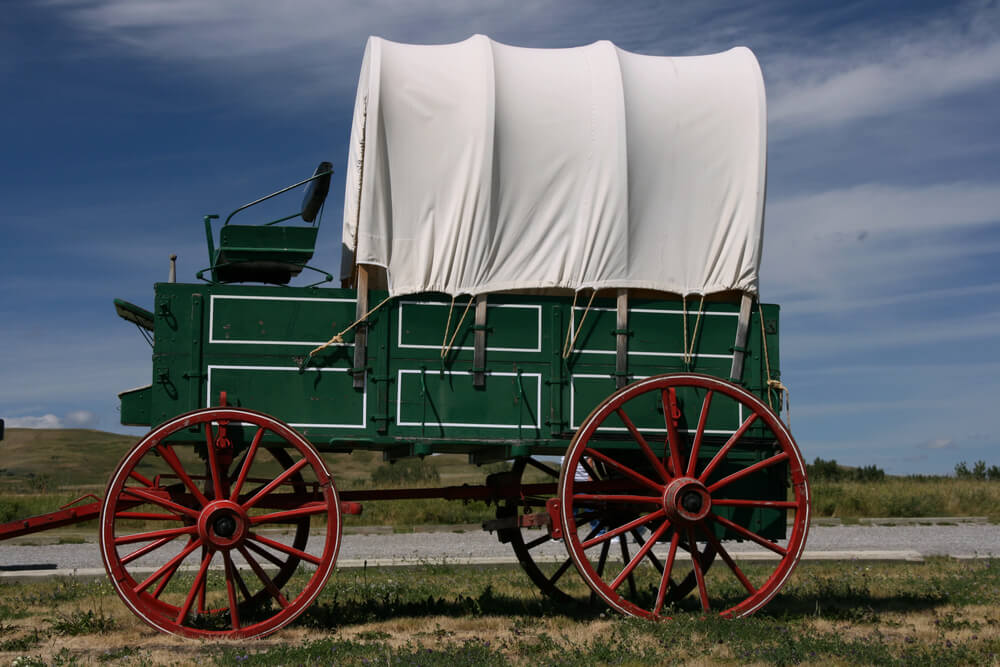
In April 1903, thousands of British settlers known as the Barr Colonists arrived at Saskatoon on their way to farm land in what is now Saskatchewan. A photograph shows wagons offered for sale in the rail yard.
Many of the newcomers had no experience with prairie travel and had to buy their wagons on arrival.
The Long Trek to Lloydminster
The Barr Colonists numbered about 2,000 people, and their journey from Saskatoon to the Lloydminster area was roughly 200 miles. Photographs show the Reverend Isaac Barr driving one of the wagons and long lines of wagons leaving town.
The settlers had been led to expect a smoother arrival than the one they got.
Refugees Leaving the Old Homestead
During the Civil War, photographer George Barnard recorded a family loaded in a wagon in 1862 under the title Refugees Leaving the Old Homestead. The family’s belongings are piled around them as they leave their home.
Their journey shows that wagons also carried people away from war.
Covered Wagon Trailer Homes in Oklahoma
In 1939 Russell Lee photographed covered-wagon trailer homes near Tullahassee, Oklahoma. These homemade vehicles were part of the Depression-era response to losing farms and jobs.
They combined the shape of the old wagon with newer chassis and wheels.
Again the Covered Wagon
In 1935 the magazine Survey Graphic published an article by Paul Taylor titled Again the Covered Wagon, illustrated with photographs by Dorothea Lange. The piece described families driven off the land by drought and hard times, and it showed them traveling in wagons and old cars.
The title argued that the old migration had returned.
Home on Four Wheels
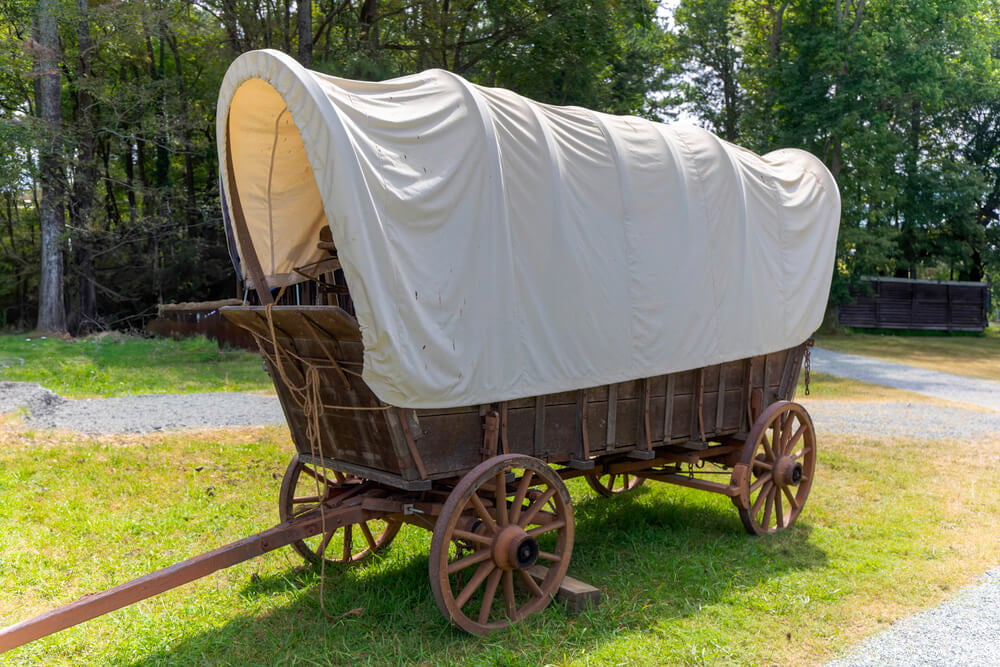
The photographs span almost eighty years, and the vehicles inside them change from horse-drawn wagons to trailer homes. What stays the same is the household packed into a small space, moving toward a rumor of opportunity.
A wagon box could hold a stove, a few chairs, and the entire family. The images also show how misleading the single picture of the Oregon Trail can be.
Wagons carried settlers into Utah, boomers into Oklahoma, immigrants across the prairie, and refugees away from war. The covered wagon lasted because it was the simplest form of a home that could travel.
More from Go2Tutors!

- 27 Silver Dollars and Half Dollars Worth Keeping
- 28 Restaurant Menu Items Nobody Orders Anymore
- 17 Places Built in Seemingly Impossible Spots
- 27 Vintage Rings Worth More Than They Look
- 25 Restricted Sites Tourists Can’t Enter
Like Go2Tutors’s content? Follow us on MSN.