Instruments Stranger Than Fiction
When most people think of musical instruments, guitars, pianos, and drums come to mind. These are the workhorses of modern music, reliable and familiar.
But venture beyond the mainstream and you’ll discover a world where instruments harness fire, lightning, and even water to create sound. Some look like they belong in a science fiction movie, while others seem plucked from a fever dream.
The creativity and ingenuity behind these instruments prove that when it comes to making music, human imagination knows no bounds. Here is a list of 16 instruments that challenge everything you thought you knew about making music.
Theremin

Imagine playing an instrument without ever touching it. The theremin makes this possible through two metal antennas that sense where your hands are positioned in the air around them.
Moving one hand controls the pitch while the other adjusts volume, creating those eerie, otherworldly sounds you’ve heard in countless science fiction films. Invented by Russian physicist Leon Theremin in 1920, this electronic pioneer became the soundtrack to alien encounters and supernatural mysteries, proving that sometimes the most haunting music comes from thin air.
Glass Armonica

Benjamin Franklin wasn’t content with just discovering electricity and helping found a nation. He also invented a musical instrument that produces hauntingly beautiful tones by rubbing moistened fingers across rotating glass bowls of different sizes.
The glass armonica captivated audiences in the late 18th century, and composers like Mozart and Beethoven wrote pieces specifically for it. Despite urban legends claiming the instrument drove players mad, the real reason it fell out of favor was far more mundane—its delicate sound simply couldn’t compete with louder instruments in concert halls.
Like Go2Tutors’s content? Follow us on MSN.
Waterphone

If you’ve ever felt uneasy during a horror movie, chances are you’ve heard the waterphone at work. Richard Waters invented this instrument in 1975, and it’s become the secret weapon for creating spine-tingling atmospheres in film.
Picture a stainless steel bowl filled with a small amount of water, surrounded by bronze rods of varying lengths. When you bow or strike these rods, the water inside shifts and sloshes, creating sounds that seem to come from another dimension entirely.
The waterphone has even been used to communicate with whales off Canada’s west coast, which says something about how otherworldly its voice truly is.
Zeusaphone
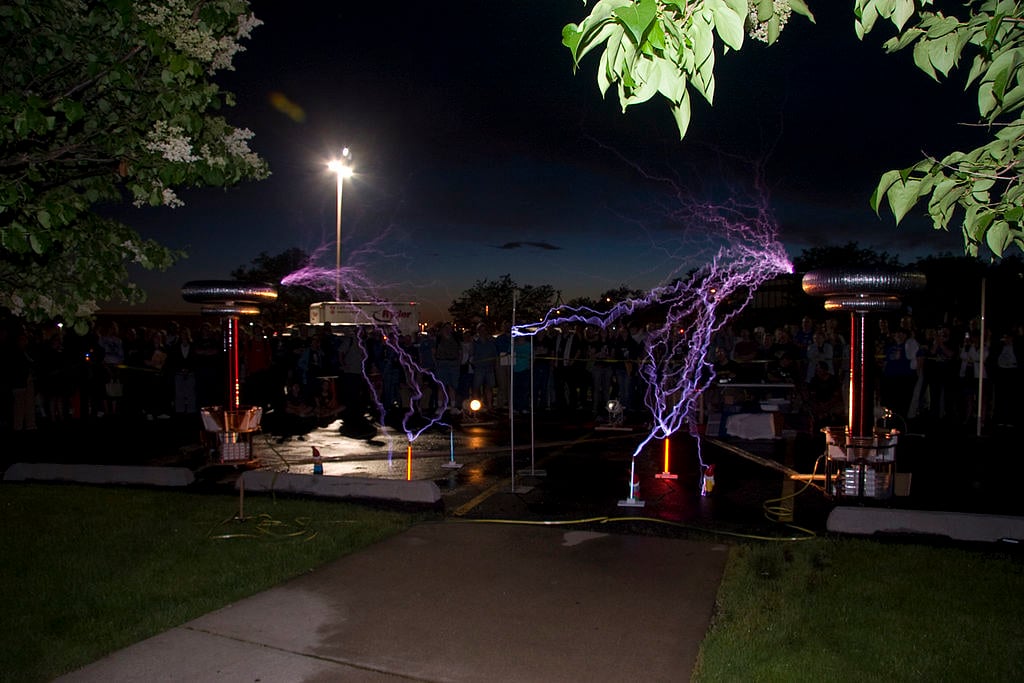
Music and lightning don’t usually mix, but someone decided to try anyway. The zeusaphone takes a Tesla coil—that mad scientist apparatus that shoots electrical arcs—and modifies it to play actual melodies.
As the instrument pulses electricity at different frequencies, the resulting lightning bolts vibrate the air to produce synthesizer-like sounds. Watching a zeusaphone performance means witnessing music you can see, with electrical arcs dancing several feet high in time with the melody.
Just don’t get too close—these things can generate up to 1.5 million volts.
Pyrophone

While the zeusaphone harnesses electricity, the pyrophone takes an even more dangerous route by using fire. This instrument looks like a church organ, but instead of compressed air moving through pipes, it uses gasoline or propane explosions to create musical notes.
Each pipe needs to be actively burning to produce sound, with combustion vibrating tubes of different lengths to generate specific pitches. Invented in the late 1800s by Georges Kastner, the pyrophone proves that some musicians really will set themselves on fire for their art.
Like Go2Tutors’s content? Follow us on MSN.
Serpent
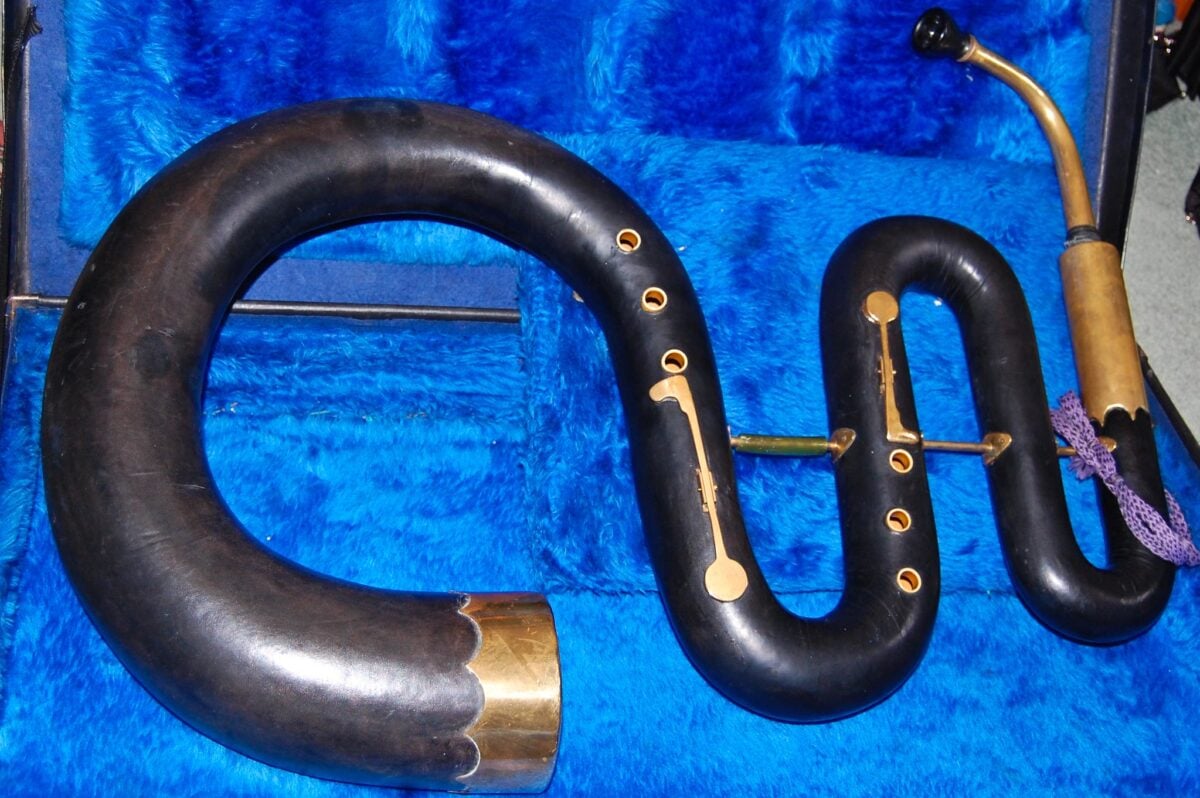
The serpent earned its name honestly—this bass wind instrument curves and twists like a snake trying to escape its own body. Created around 1590 by Canon Edmé Guillaume, it combines a brass mouthpiece with woodwind-style finger openings along its bizarrely shaped wooden body.
The instrument filled the bass role in military and church music for centuries before the tuba replaced it. Playing one requires not just musical skill but also the ability to wrangle what looks like a musical pretzel while maintaining enough breath control to coax out its deep, resonant tones.
Chapman Stick

Most guitarists use one hand to fret notes and another to pluck or strum. Emmett Chapman looked at this arrangement in the early 1970s and thought it was inefficient.
His solution was the Chapman Stick, an electric instrument with ten or twelve strings that you play by tapping both hands on the fretboard simultaneously. This technique lets a single musician play bass lines, chords, and melodies all at once, essentially becoming a one-person band.
The learning curve is steep, but players who master it can produce music that sounds like it requires at least three people.
Yaybahar

Electric instruments dominate modern music, so Turkish musician Gorkem Sen went in the opposite direction and created something completely acoustic that sounds electronic. The yaybahar uses strings stretched across a frame, connected to coiled springs that run down to drum membranes on each side.
When you bow the strings, vibrations travel through the springs to the drums, where they echo back and forth to create hypnotic, surround-sound effects. The whole contraption looks like a steampunk harp that escaped from a mad inventor’s workshop, yet it produces sounds that could easily be mistaken for synthesizers and digital effects.
Like Go2Tutors’s content? Follow us on MSN.
Wheelharp

Picture a violin section, a viola, a cello, and a bass—now imagine all those bowed string sounds coming from one person at a keyboard. The wheelharp makes this orchestral dream a reality through 61 strings that get bowed by a motor-driven wheel as you press keys.
Invented by Jon Jones and Mitchell Manger, this instrument debuted in 2013 and immediately turned heads at music trade shows. It gives solo performers the rich, layered sound of an entire string ensemble, though hauling one to gigs requires significantly more effort than carrying a violin case.
Nyckelharpa

Sweden’s contribution to unusual instruments dates back 600 years and looks like someone couldn’t decide between building a violin or a hurdy-gurdy. The nyckelharpa combines bowed strings with 37 keys that slide underneath them like guitar frets, allowing players to change notes while bowing.
The modern version sports 16 strings total, including sympathetic strings that vibrate in harmony with the ones being played. This keyed fiddle produces a sound that’s both medieval and surprisingly contemporary, making it a favorite in Scandinavian folk music and increasingly in experimental genres.
Hurdy-Gurdy

Despite what its name suggests, the hurdy-gurdy has nothing to do with street organs or monkeys. This medieval instrument uses a hand-cranked wheel coated in rosin to bow multiple strings simultaneously while keys change the pitch of the melody strings.
Think of it as a mechanical violin that plays itself while you work the keyboard and crank. Popular from the medieval period through the 18th century, the hurdy-gurdy fell out of fashion before experiencing a revival in folk music.
Recently, heavy metal bands discovered that cranking out riffs on a hurdy-gurdy sounds absolutely devastating.
Like Go2Tutors’s content? Follow us on MSN.
Hang

Sometimes called a handpan, the hang looks like a flying saucer made by skilled metalworkers rather than aliens. Swiss inventors Felix Rohner and Sabina Schärer created this instrument around 2000 by combining Caribbean steel drum techniques with the acoustic properties of Asian singing bowls.
The result is a convex steel shell with tuned tone fields that players strike with their hands. The hang produces deeply meditative, resonant sounds that seem to hang in the air—which might be intentional given its name means ‘hand’ in the Bernese dialect.
Its ethereal tones have made it a favorite for street performers and new age musicians alike.
Stylophone

Not every unusual instrument requires years of craftsmanship or advanced physics. The stylophone is essentially a tiny keyboard you play by touching it with a metal pen.
Invented by Brian Jarvis in 1967, this pocket-sized analog synthesizer became a novelty hit in the late sixties and early seventies. David Bowie famously used one on ‘Space Oddity,’ proving that even toy-like instruments can contribute to legendary recordings.
The stylophone’s buzzy, electronic sound is instantly recognizable, and modern versions have kept it alive in the age of digital music.
Ondes Martenot

French inventor Maurice Martenot created this early electronic instrument in 1928 after being inspired by accidental radio interference he heard during World War I. The ondes Martenot produces sound through electronic oscillators, but unlike most synthesizers, it uses a ring worn on the player’s finger to slide along a wire for pitch control, allowing for expressive, vocal-like swoops and glides.
Composer Olivier Messiaen championed the instrument, featuring it prominently in his orchestral works. The ondes Martenot bridges the gap between the theremin’s hands-off approach and traditional keyboard-based electronic instruments, offering control that feels almost supernatural.
Like Go2Tutors’s content? Follow us on MSN.
Pikasso Guitar

When jazz guitarist Pat Metheny wanted something special, luthier Linda Manzer delivered a guitar inspired by Pablo Picasso’s cubist paintings. The result was a 42-string monster with four necks, two sound openings, and a weight of almost fifteen pounds.
This instrument isn’t just visually striking—it actually produces remarkably beautiful music in Metheny’s hands. The multiple necks provide different tonal possibilities, sympathetic strings add harmonic richness, and the whole thing looks like several guitars had a collision and decided to work together.
Playing it requires not just technical skill but also serious upper body strength.
Great Stalacpipe Organ

Most organs use metal pipes, but Leland Sprinkle looked at the massive stalactites in Virginia’s Luray Caverns and saw potential. Over three years starting in 1954, he created the world’s largest musical instrument by attaching rubber mallets to ancient stalactites throughout the cave system.
When you press a key on the console, solenoids trigger mallets that tap specific stalactites, each carefully selected for its pitch. The sound resonates through the entire cave—covering 3.5 acres—turning the cavern itself into a massive stone bell.
It’s the only instrument where the concert hall and the instrument are essentially the same thing.
Where Sound Meets Innovation
These 16 instruments represent more than just unusual ways to make noise. They’re proof that musicians and inventors never stopped pushing boundaries, even when conventional instruments worked perfectly fine.
From harnessing natural phenomena like lightning and fire to reimagining how strings, keys, and even caves can produce music, each instrument on this list challenges our assumptions about what’s possible. The next time you hear something that sounds impossible in a movie soundtrack or experimental recording, remember that somewhere, someone probably built an instrument specifically to create that sound—and it’s likely stranger than anything you imagined.
More from Go2Tutors!

- 16 Historical Figures Who Were Nothing Like You Think
- 12 Things Sold in the 80s That Are Now Illegal
- 15 VHS Tapes That Could Be Worth Thousands
- 17 Historical “What Ifs” That Would Have Changed Everything
- 18 TV Shows That Vanished Without a Finale
Like Go2Tutors’s content? Follow us on MSN.



