30 Laws From History That Sound Made Up
Every legal system accumulates statutes that made perfect sense to the people who wrote them and almost none to anyone reading them later. Some of these laws stayed on the books for centuries after the reasoning behind them was forgotten. Others were repealed quickly, but not before leaving a paper trail that still reads like satire.
England’s Mandatory Archery Practice

A 1252 statute required English men to own a bow and practice archery regularly, a rule reinforced by later monarchs including Henry VIII, who in 1541 banned most other sports on Sundays specifically to keep men focused on the longbow. The law reflected a real military need for trained archers and stayed nominally in force for centuries.
The Window Tax

Britain imposed a tax on houses based on the number of windows they had beginning in 1696, prompting homeowners to brick up windows to reduce their bill. The practice left visible bricked-in window outlines on old buildings that survive today, and the tax was not repealed until 1851.
The Hearth Tax

Predating the window tax, England taxed households based on the number of fireplaces they had beginning in 1662, which led to inspectors physically counting hearths inside people’s homes. The intrusive enforcement made it deeply unpopular and it was repealed within decades.
Massachusetts’ Ban on Christmas

The Puritan-controlled colony of Massachusetts Bay outlawed the celebration of Christmas in 1659, fining anyone caught feasting or taking a day off work to mark the holiday. The ban lasted about twenty-two years before being repealed under pressure from England.
The Beard Tax

Russian Tsar Peter the Great imposed a tax on beards in 1698 as part of a broader effort to modernize Russian society along European lines, requiring men who paid to carry a token proving their beard was legal. Resistance was strongest among Orthodox clergy and traditionalists who saw facial hair as a religious obligation.
Sumptuary Laws Restricting Clothing

Numerous European jurisdictions passed laws in the medieval and early modern periods restricting what fabrics, colors, and styles of clothing people could wear based on their social rank, with commoners in some English statutes barred from wearing certain furs or silk. The laws aimed to keep visible class distinctions intact as trade made luxury goods more widely available.
The Corn Laws

Britain’s Corn Laws, in force from 1815 to 1846, placed tariffs on imported grain specifically to protect the incomes of large landowners, which kept bread prices artificially high for the general population. Their repeal followed years of public agitation and remains a landmark case study in trade policy history.
Georgia’s Original Ban on Lawyers

The founding charter of the colony of Georgia in 1735 prohibited paid legal representation, reflecting founder James Oglethorpe’s suspicion of the profession. The restriction was lifted within a couple of decades as the colony’s legal system matured.
Prohibition-Era Wine for Medicinal Purposes

The Volstead Act, which enforced Prohibition beginning in 1920, contained an exception allowing doctors to prescribe alcohol, specifically wine and spirits, for medical treatment, and pharmacies distributed millions of such prescriptions during the era. The exception was so widely used that some historians credit it with keeping the American wine industry alive.
Blue Laws Mandating Church Attendance

Several American colonies passed statutes requiring residents to attend church services, with Virginia’s early laws prescribing escalating penalties, including whipping, for repeated absence. Descendants of these laws, in far milder form restricting Sunday commerce, persisted in parts of the United States into the twenty-first century.
The Defense of the Realm Act Drinking Rules

Britain’s wartime Defense of the Realm Act of 1914 restricted pub opening hours and, in a lesser-known provision, made it illegal to buy a round of drinks for another person, a measure meant to slow wartime drinking. Restricted pub hours from the same law persisted in parts of Britain for decades after the war ended.
The Code of Hammurabi’s Reciprocal Penalties
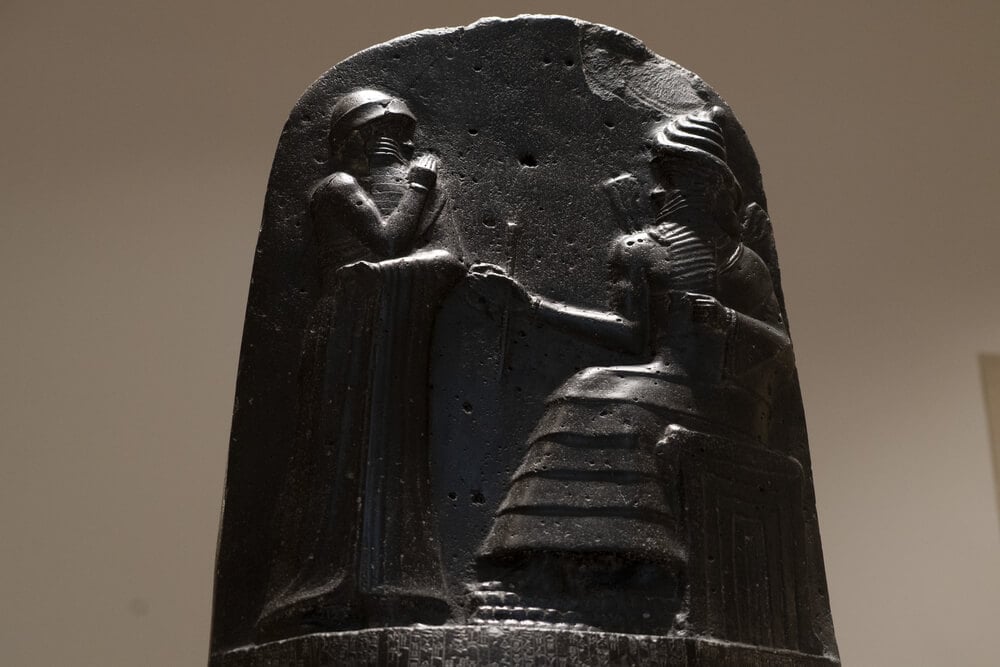
The ancient Babylonian legal code compiled under King Hammurabi around 1754 BCE prescribed literal reciprocal punishments for certain offenses, an eye for an eye and a tooth for a tooth among the most famous provisions. It stands as one of the earliest surviving comprehensive legal codes and shaped legal philosophy for millennia afterward.
Medieval Fish-Only Fridays

Various European kingdoms enforced religious dietary law through civil statute, making it a punishable offense to eat meat on Fridays or during Lent, with fines or worse for violators. England’s own fish laws were partly motivated by a desire to support the domestic fishing industry as much as by religious observance.
The Stamp Act

Britain’s 1765 Stamp Act required colonial Americans to purchase specially stamped paper for virtually every printed document, from newspapers to playing cards, taxing everyday paperwork directly for the first time. The backlash it produced is widely credited as a key spark toward the American Revolution.
Witch Trial Statutes

England’s Witchcraft Act of 1604 made practicing witchcraft a capital offense, and similar statutes across Europe and colonial America led to the execution of thousands of people, mostly women, over accusations that would not meet any modern evidentiary standard. Britain did not fully repeal its witchcraft laws until 1951.
The Window on Debtors’ Prisons

Britain and the early United States both operated a system of imprisonment for unpaid debt well into the nineteenth century, jailing people specifically because they could not pay, which of course made repayment even less likely. Reform movements on both sides of the Atlantic eventually dismantled the practice by the mid-1800s.
London’s Medieval Street Sport Restriction

King Edward II banned a rowdy street game resembling modern soccer from the streets of London in 1314, citing the noise and disorder it caused, one of the earliest recorded attempts by a government to restrict the sport that would later become the modern game. Similar bans were repeated by later English monarchs for the following two centuries.
The Wig Powder Tax

Britain taxed hair powder used to style the elaborate wigs fashionable in the eighteenth century, requiring anyone who wore powdered hair to purchase an annual certificate. The tax, introduced in 1795, effectively hastened the decline of the powdered wig as a fashion staple among people unwilling to pay it.
Bachelor Taxes

Various governments across history, including ancient Rome, imperial Russia, and several American states in the twentieth century, imposed additional taxes on unmarried men specifically to encourage marriage and childbearing. Missouri and other states experimented with such taxes as late as the 1820s and 1930s.
The Salem Witch Trial Statutes
Massachusetts prosecuted accused witches under special court procedures in 1692 that permitted so-called spectral evidence, testimony about dreams and visions, as grounds for conviction, resulting in the execution of twenty people. The colony formally reversed the convictions and offered restitution only decades later.
The Trial by Ordeal

Medieval European legal systems permitted trial by ordeal, in which an accused person’s guilt was determined by surviving a physically dangerous test, such as carrying a heated iron bar, on the theory that divine intervention would protect the innocent. The Fourth Lateran Council effectively ended the church’s involvement in the practice in 1215.
The Window Into England’s Witchcraft Repeal

When Britain finally repealed its Witchcraft Act in 1735, the new law did something almost stranger than the original: it made it a crime to claim to have magical powers at all, treating the claim itself as fraud rather than acknowledging that witchcraft was real. That framing stayed on the books until 1951.
Prohibition of the Coin-Operated Arcade Table

Several major American cities, including New York, banned coin-operated flipper machines for decades from the 1940s onward, on the theory that they were games of chance akin to gambling and prone to attracting organized crime. New York’s ban lasted until 1976, when a champion player demonstrated skill-based control of the machine before the city council to get it overturned.
The Flag Desecration Statutes

Numerous American states passed laws in the late nineteenth and twentieth centuries criminalizing the physical desecration of the national flag, some carrying significant prison terms. The Supreme Court struck down such laws as unconstitutional in a landmark 1989 First Amendment ruling.
Ancient Sparta’s Marriage Mandates

Spartan law required men to marry by a certain age and imposed social penalties, including a loss of certain civic privileges, on those who remained unmarried too long, reflecting the city-state’s preoccupation with producing soldiers. Some accounts describe unmarried men being publicly mocked as part of the enforcement.
The Cheese Tax Disputes

Britain’s excise laws in the eighteenth century extended to cheese production, prompting fierce resistance from dairy farmers who saw the levy as an intrusion into a traditional trade, and Parliament repealed the specific cheese duty within a matter of years after sustained protest. It stands as an early example of a narrowly targeted tax collapsing under organized industry pushback.
The Powder and Patch Tax Enforcement Certificates

Beyond the hair powder tax itself, Britain required certificate holders to display proof of payment, and enforcement included informants who could report unlicensed powder wearers for a share of the resulting fine. The system briefly created a minor cottage industry of powder-tax informants before public ridicule made it unenforceable.
The Real Property “Petty Treason” Law
English common law once classified the killing of a husband by his wife, or a master by a servant, as a distinct and more severely punished offense called petty treason, on the theory that it violated a natural hierarchy rather than being an ordinary killing. The category was not abolished until 1828.
The Massachusetts Ban on Actors

Massachusetts banned theatrical performances outright under a 1750 colonial law, reflecting Puritan hostility toward the stage as a corrupting influence, a restriction that stayed in force for decades even as theater flourished in other colonies. The law was not fully repealed until well after independence.
The Corn Law Sliding Scale

Beyond simply taxing imported grain, Britain’s Corn Laws used a sliding tariff scale that increased the tax as domestic prices fell, a mechanism explicitly designed to guarantee landowners a minimum price regardless of harvest conditions elsewhere. Economists at the time and since have pointed to the mechanism as a textbook case of regulatory capture.
The Statute Outlives the Reasoning

Almost none of these laws were written by fools. Each one solved a real problem for the people who passed it: a shortage of trained archers, a treasury that needed revenue, a social order its authors wanted to preserve. The absurdity only appears later, once the problem the law addressed has disappeared and the rule keeps operating on momentum alone.
That is really the lesson sitting underneath all thirty of these. Lawmakers rarely draft nonsense on purpose. They draft solutions to their own moment, and a moment, unlike a statute, does not last.
More from Go2Tutors!

- The Romanov Crown Jewels and Their Tragic Fate
- 13 Historical Mysteries That Science Still Can’t Solve
- Famous Hoaxes That Fooled the World for Years
- 15 Child Stars with Tragic Adult Lives
- 16 Famous Jewelry Pieces in History
Like Go2Tutors’s content? Follow us on MSN.



