Old Newspapers From Historic Days Worth Keeping
Every attic has a stack of yellowed newsprint that someone swore would be valuable one day. Most of it is worth about what it cost on the newsstand.
A small group of editions, though, captured a pivotal moment so squarely that collectors, libraries, and museums still hunt for them.
The editions below range from colonial broadsheets to modern front pages. Some are famous for being right, others for being spectacularly wrong, and a few for being almost impossible to find at all.
Publick Occurrences, the Paper Shut Down After One Issue
Benjamin Harris published Publick Occurrences Both Forreign and Domestick in Boston on September 25, 1690, intended as a regular newspaper for the colonies. Colonial authorities suppressed it after that single issue, objecting that it had been printed without a license.
No second issue ever appeared, and the one surviving copy is held in the British archives in London rather than in America. Anything claiming to be an original is a facsimile, and condition matters even for those.
The Boston News-Letter of 1704
The Boston News-Letter first appeared on April 24, 1704, under postmaster John Campbell, and it is generally regarded as the first continuously published newspaper in the American colonies. It kept going until 1776, which means the same masthead covered Queen Anne’s reign and the lead-up to the Revolution.
Surviving issues are rare and mostly held by institutions. Collectors who see one offered privately should expect heavy scrutiny of its authenticity and condition.
Franklin’s Join, or Die Issue of the Pennsylvania Gazette
On May 9, 1754, Benjamin Franklin’s Pennsylvania Gazette printed a woodcut of a snake sliced into pieces, each labeled for a colony or region, under the caption “Join, or Die.” It is among the earliest political cartoons published in an American newspaper.
The image was reused during the Revolution, long after the original French and Indian War context had faded. An authentic issue is a museum-level item, and later reproductions of the cartoon are plentiful.
The Boston Gazette Reports the Boston Massacre
The Boston Gazette of March 12, 1770, covered the shooting on King Street with heavy black borders and an engraving of four coffins marked with the initials of the dead. Paul Revere is credited with the coffin illustration, giving the issue a link to one of the most famous names in early American printmaking.
The paper was published by Edes and Gill, a firm closely aligned with the patriot cause. Its dramatic layout was an early example of newspaper design used for persuasion.
The Pennsylvania Evening Post of July 6, 1776
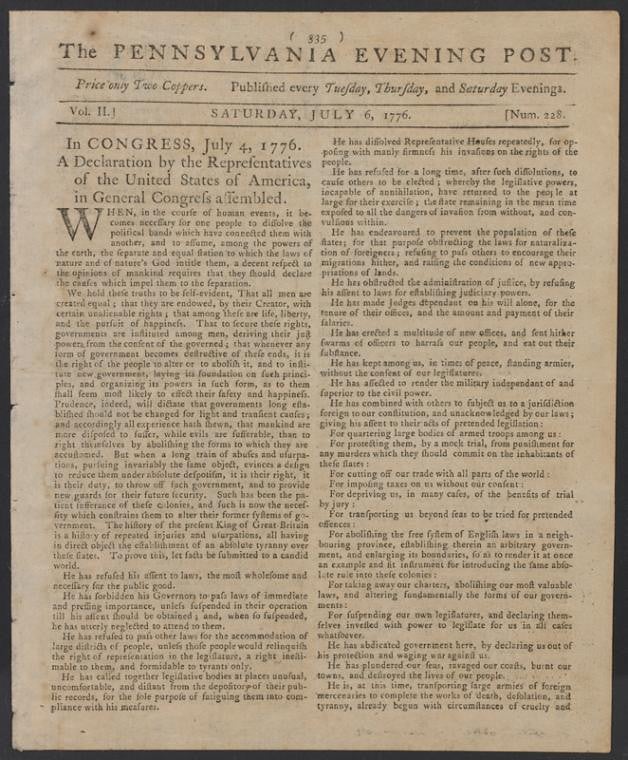
The Pennsylvania Evening Post, printed in Philadelphia by Benjamin Towne, carried the text of the Declaration of Independence on July 6, 1776. That made it the first newspaper to publish the document, just two days after Congress adopted it.
Towne later gained a reputation for shifting his politics to suit whoever controlled the city. Complete original copies are held mainly by museums, and a damaged or incomplete issue is worth a small fraction of a sound one.
The Harrisburg Paper That Dismissed the Gettysburg Address
In November 1863, the Patriot and Union of Harrisburg, Pennsylvania, covered Abraham Lincoln’s dedication speech at Gettysburg by writing that it would pass over “the silly remarks of the President.” The paper’s modern successor, the Patriot-News, formally retracted the editorial in November 2013, a full 150 years later.
The original edition is a favorite among Civil War collectors because it shows how uncertain the speech’s reputation was at the time. Folds, tears, and toning all affect what a buyer will pay.
The Tombstone Epitaph After the O.K. Corral
The Tombstone Epitaph of October 27, 1881, reported the previous day’s gunfight with the headline “Three Men Hurled Into Eternity in the Duration of a Moment.” The paper was founded by John Clum, who was also the mayor of Tombstone, and its account tended to favor the Earps.
Historians still cite it, with caution, when reconstructing what happened on Fremont Street. Authentic original copies are scarce, and the title has been reprinted many times in souvenir form.
The Virginian-Pilot and the Wrong Wright Brothers Story
On December 18, 1903, the Norfolk Virginian-Pilot reported on the flights at Kitty Hawk under a headline claiming a flying machine had soared three miles. The real longest flight of that day covered 852 feet and lasted 59 seconds.
The story also muddled other details, which helped explain why the press largely failed to grasp what had happened. The issue is a prized example of a world-changing event being reported inaccurately.
The New York Times Reports the Titanic Sinking
The New York Times of April 16, 1912, led with a banner headline stating that the Titanic had sunk four hours after hitting an iceberg. Some papers had briefly reported earlier that the liner was being towed to Halifax with everyone safe, which makes the confusion of those first hours part of the story.
Because newspapers across the country published editions on the disaster, a collector should check the date, the edition, and the paper’s condition before assuming rarity.
The New York Times Announces Lindbergh
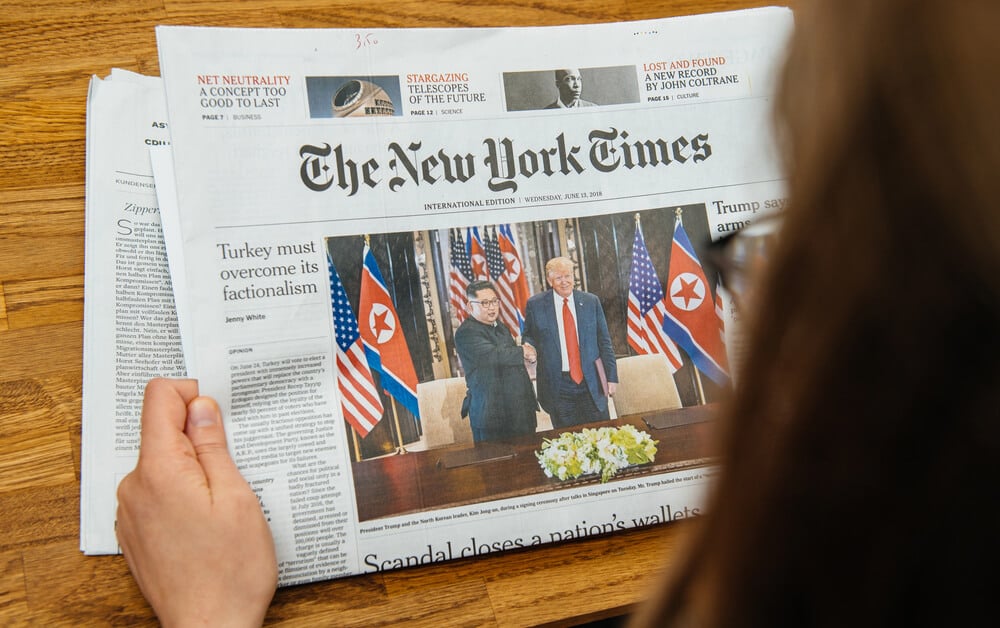
The New York Times of May 22, 1927, announced “Lindbergh Does It!” after Charles Lindbergh landed at Le Bourget outside Paris in the Spirit of St. Louis. The flight from New York had taken about 33 and a half hours.
Papers around the world ran the story, and many printed special editions, so the date and edition are what separate a keepsake from a common copy. Brittle newsprint from this era is especially vulnerable to damage from light and moisture.
Variety’s Wall St. Lays an Egg
Variety, the show business trade paper, ran the headline “Wall St. Lays an Egg” on October 30, 1929, in the aftermath of the stock market crash. The line is credited to Claude Binyon, and it borrowed theatrical slang in which an egg meant a flop.
Unlike the front pages of major dailies, the issue is remembered for its wit rather than its reporting. Condition and completeness drive collector interest, since a loose cover page is worth much less than an intact issue.
The Honolulu Star-Bulletin Extra of December 7, 1941
The Honolulu Star-Bulletin rushed out an extra on December 7, 1941, with the headline “War! Oahu Bombed by Japanese Planes.” The paper put out several extras over roughly a day, so there are multiple distinct editions with different headlines and details.
Collectors pay close attention to which extra they are looking at, and reprints made for anniversaries are common. An original with sound paper and no heavy folding is the version most serious buyers want.
The Chicago Tribune That Declared Dewey the Winner
The Chicago Daily Tribune of November 3, 1948, carried the headline “Dewey Defeats Truman,” printed before the election results were in. A printers’ strike had forced the paper to go to press early.
Harry Truman posed holding a copy at the St. Louis train station the next day, which turned a newsroom mistake into one of the most reproduced photographs in American politics. Many copies in circulation are reprints, so the print run and paper type should be checked.
The New York Times and the Moon Landing
The New York Times of July 21, 1969, announced the Apollo 11 landing with the headline “Men Walk on Moon.” The subhead noted that the astronauts had landed on a plain, collected rocks, and planted a flag.
Millions of copies were sold and kept, so most surviving examples are not especially scarce. Pristine, uncreased copies with white paper and an unfaded masthead are the exception.
The Washington Post and Nixon Resigns
The Washington Post of August 9, 1974, ran the two-word headline “Nixon Resigns” across its front page. The paper had been central to uncovering the Watergate scandal through reporters Bob Woodward and Carl Bernstein, which gave its edition a particular place in the story.
Like other major event issues, it exists in enormous numbers. Collectors usually look for clean copies, complete sections, and a signature from someone connected to the coverage.
Ink That Outlived Its Deadline
Few of these papers were meant to last beyond a day. They were printed fast, on cheap paper, by people racing a clock, and their errors are part of what makes them interesting.
A wrong headline or an early press run can tell more about a moment than a polished retrospective ever will. The practical lesson is that value follows scarcity and condition, not age alone.
A common edition from a famous day may be worth little, while a damaged copy of a rare one can still matter to a library. Anyone buying should verify the edition, check for reprints, and store the paper flat, away from light and moisture.
More from Go2Tutors!

- The Romanov Crown Jewels and Their Tragic Fate
- 13 Historical Mysteries That Science Still Can’t Solve
- Famous Hoaxes That Fooled the World for Years
- 15 Child Stars with Tragic Adult Lives
- 16 Famous Jewelry Pieces in History
Like Go2Tutors’s content? Follow us on MSN.