Old Photos of Department Stores Before Escalators
Before the moving staircase, shopping meant climbing. Customers rode caged elevators run by uniformed operators, followed stairways wide enough for a parade, and watched clerks send their payments overhead in canisters.
Photographs of these stores show a different idea of retail. Floors were rooms to be admired, ceilings were part of the sales pitch, and a central court could hold an organ, a fountain, or a crowd waiting beside a statue.
A Marble Palace on Lower Broadway
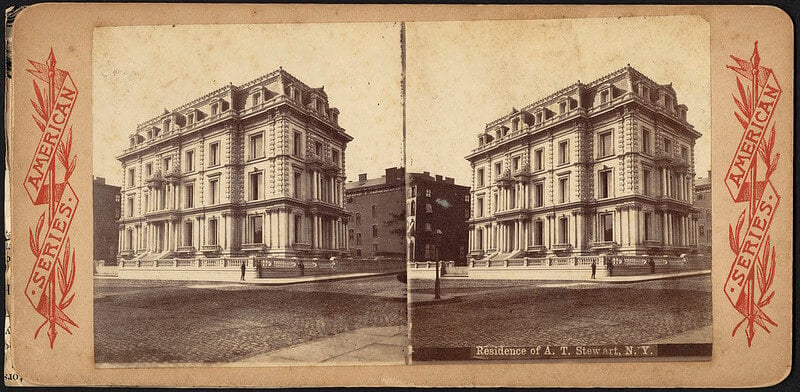
Alexander Turney Stewart opened his white marble store at Broadway and Chambers Street in 1846, and New Yorkers promptly called it the Marble Palace. The Italianate building gave a dry goods merchant the look of a bank or a courthouse, which suited a man who wanted customers to feel they were entering an institution.
Stewart favored fixed prices and let shoppers browse, a habit that struck rivals used to haggling as almost rude. Old photographs show a stately facade lined with arched windows, and the building still stands downtown, long since converted to other uses.
Cast Iron Rising Above Ninth Street
Stewart’s second great store rose in 1862 on Broadway between Ninth and Tenth Streets, a cast iron giant meant to catch the carriage trade moving uptown. John Kellum designed it around a central court lit from above, so daylight reached counters far from the street windows.
John Wanamaker bought the building in the 1890s and ran it as his New York store, which is why later photographs show Wanamaker’s name over Stewart’s ironwork. A fire destroyed the block in 1956, ending one of the grandest cast iron fronts in the country.
The Big Store on Sixth Avenue
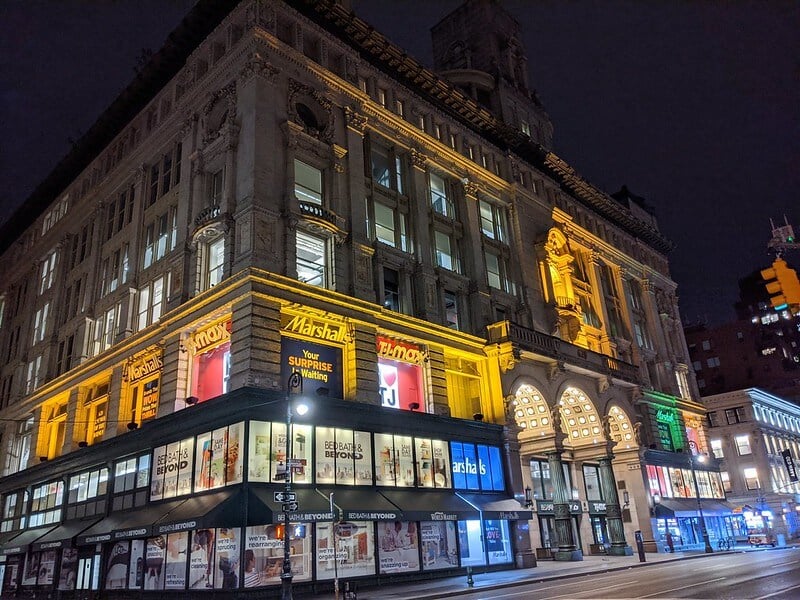
Siegel-Cooper opened in 1896 on Sixth Avenue between Eighteenth and Nineteenth Streets, and its advertising simply called it the Big Store. Inside the main entrance stood a fountain topped by a copy of Daniel Chester French’s statue of the Republic, first seen at the Chicago world’s fair of 1893.
Shoppers adopted a standing arrangement of meeting at the fountain for appointments, which turned a sales floor into a public square. Photographs of the court show customers ringing the basin like pilgrims at a shrine, with wide staircases rising behind them.
Wanamaker’s Grand Court in Philadelphia
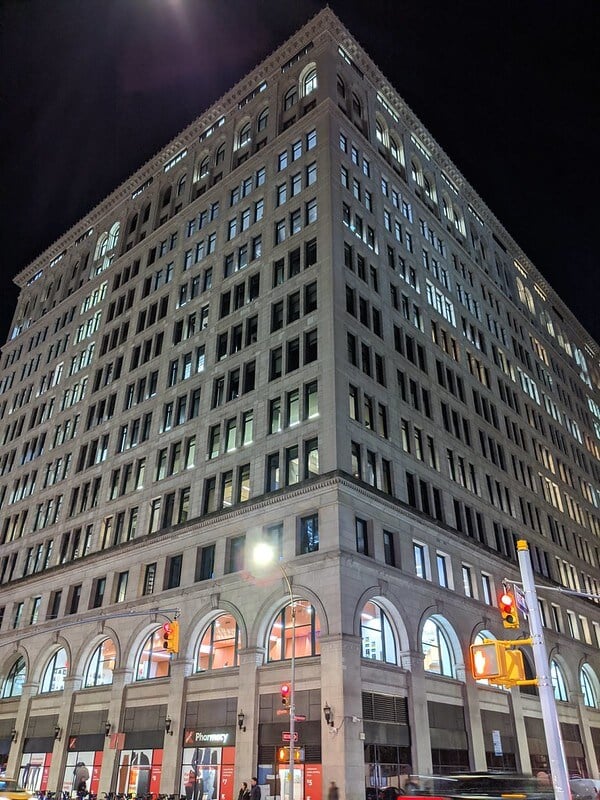
The Philadelphia store designed by Daniel Burnham was completed in 1911, and its Grand Court rose through the building like an indoor cathedral nave. The great pipe organ at one end had been built for the 1904 world’s fair in St. Louis, then hauled east by rail and enlarged for its new home.
A bronze eagle by the German sculptor August Gaul, also bought after that fair, stood on the floor below. Generations of Philadelphians arranged to meet beneath the bird, and photographs of the court are crowded with hats and handbags gathered around its talons.
Marshall Field and Company on State Street
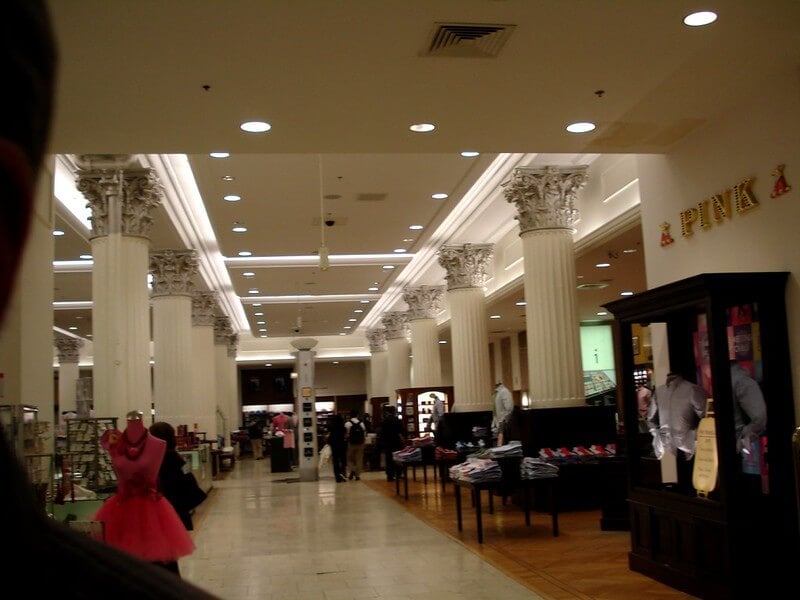
The Chicago flagship filled a full block of State Street, a granite giant assembled in sections by the firm of Daniel Burnham. Two bronze clocks on the sidewalk became favorite meeting points, and photographs often catch shoppers standing under them with parcels in hand.
Inside, a mosaic vault of glass made by Louis Comfort Tiffany’s studio capped the south court, with tiny tiles in shades that shifted under the skylights. Few department stores offered such a ceiling, and fewer still let customers look up at it while deciding between gloves.
Louis Sullivan’s Showpiece for Carson Pirie Scott
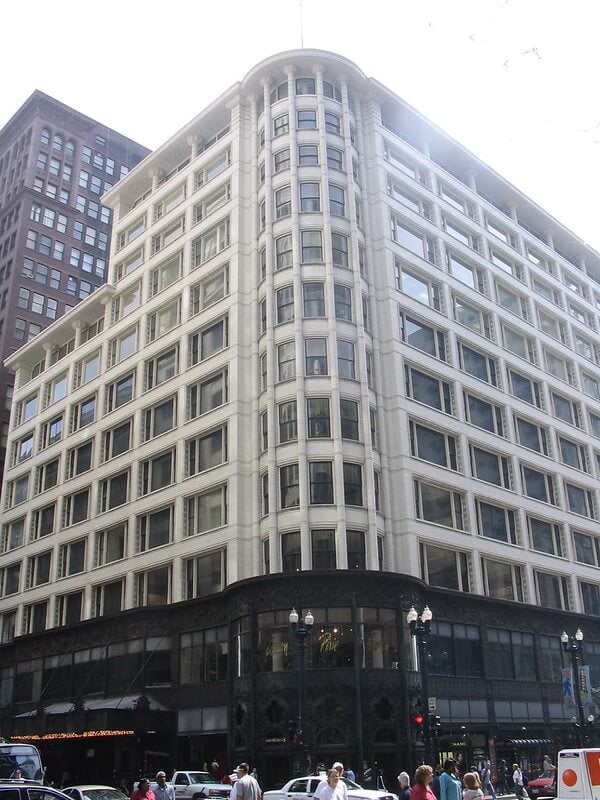
Louis Sullivan designed the Chicago building that became the Carson Pirie Scott store, and its first section opened in 1899 on State Street. The rounded corner entrance at Madison Street is wrapped in cast iron ornament, a thicket of curling leaves that Sullivan sketched with an almost obsessive hand.
Above that decoration, the upper floors are a plain grid of wide windows, which let clerks and customers see merchandise by daylight. Early photographs show awnings and delivery wagons beside the corner, proof that architecture history was also parking trouble.
Macy’s Moves Uptown to Herald Square
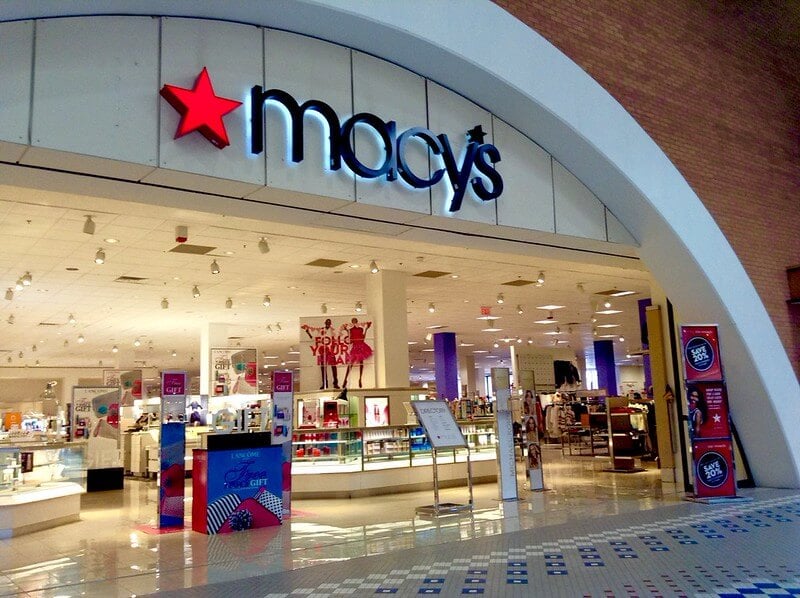
Macy’s left Fourteenth Street in 1902 and rebuilt itself at Herald Square, a site named for the old New York Herald newspaper building nearby. The move pulled a famously democratic store toward the theater district and the rail terminals, which made it easier to reach from every borough.
Its red star logo is said to come from a tattoo Rowland Macy acquired as a young whaler, a story that has been retold in the company’s own history. Photographs of the early Herald Square building show a block of tall windows hung with banners and crowded sidewalks below.
Lord and Taylor Settles on Fifth Avenue
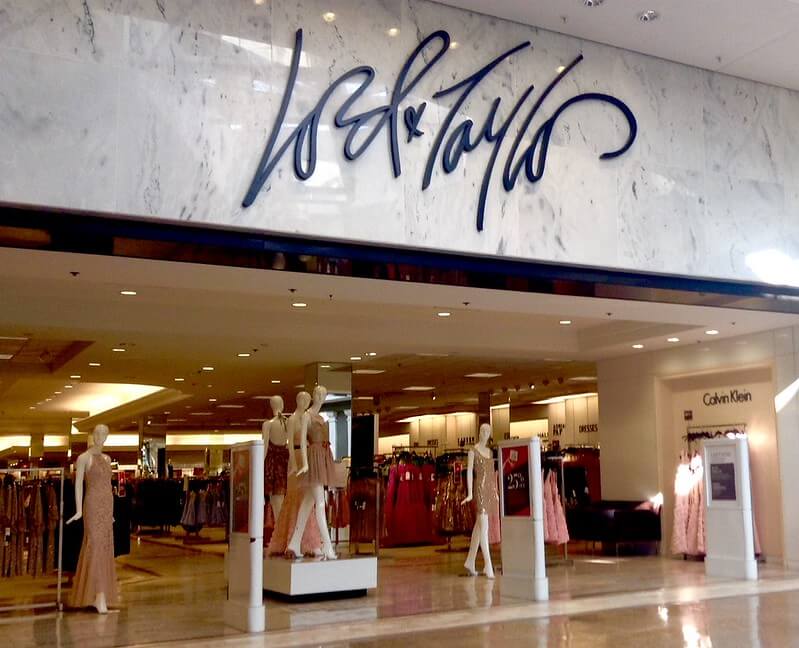
Lord and Taylor began in 1826 as a small dry goods shop on Catherine Street in Lower Manhattan, founded by the English-born Samuel Lord and his wife’s cousin, George Washington Taylor. The firm followed fashionable New York northward for decades, and its Fifth Avenue building at 38th Street opened in 1914.
Photographs of that flagship show a limestone front with tall display windows, more like a private club than a counter-lined emporium. The store later became known for lavish Christmas windows, but the early images record a quieter, more genteel style of selling.
B. Altman and the Italian Renaissance
Benjamin Altman founded his store in 1865 and eventually moved it to Fifth Avenue at 34th Street, where a new building opened in 1906. Trowbridge and Livingston designed the limestone block in an Italian Renaissance style, giving the avenue something close to a palazzo for hats and lace.
Altman was a serious art collector, and when he died in 1913 he left his collection to the Metropolitan Museum of Art. Photographs from the period show carriages pulling up to a facade that looked as if it belonged on a Florentine street.
Gimbels Plants a Flag Across from Macy’s
Adam Gimbel opened his first shop in Vincennes, Indiana, in 1842, and the family business grew through Milwaukee and Philadelphia before reaching New York. The Herald Square store opened in 1910 at 33rd Street, a block from Macy’s, and the two firms spent decades trading barbs in newspaper advertising.
That rivalry was famous enough to earn a joke in the 1947 film Miracle on 34th Street. Pictures of the early store show a plain, deep building crowded with counters, built more for volume than for ornament.
Hudson’s Grows Along Woodward Avenue
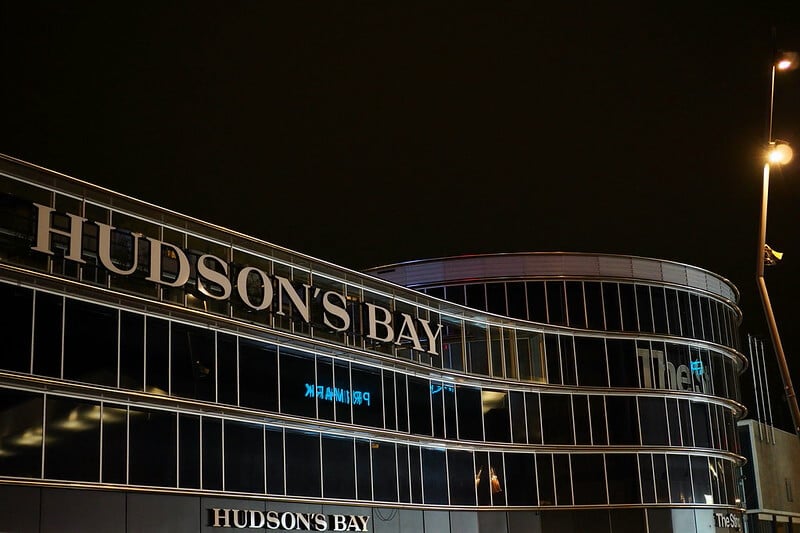
Joseph Lowthian Hudson founded his Detroit store in 1881, and it expanded by additions into a huge block along Woodward Avenue. Shoppers in the early twentieth century moved between wings by stairway and elevator, and photographs show wide aisles packed with clerks in dark suits.
The company began sponsoring a Thanksgiving parade down Woodward Avenue in 1924, one of the earliest big department store parades in the country. Detroit families treated the store as a destination, with the parade, the toy floors, and a downtown lunch all folded into a single outing.
Jordan Marsh and the Boston Muffin
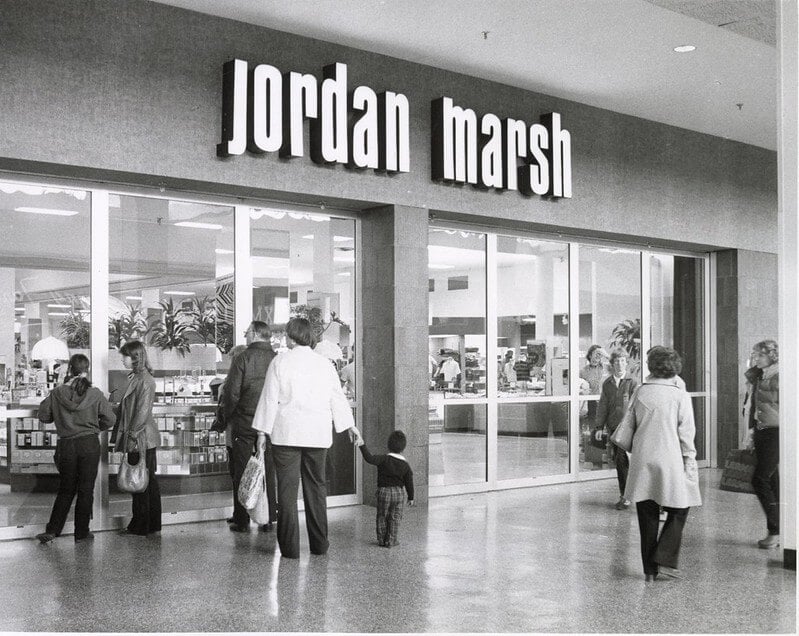
Eben Jordan and Benjamin Marsh opened their Boston dry goods business in 1851, and it grew into one of the great New England stores on Washington Street. Photographs of the building show a stately wall of windows over a street full of streetcars and pedestrians in heavy coats.
The store became just as famous for its blueberry muffin, which customers could buy in the bakery and carry home still warm. Many Bostonians recall the muffin before they recall a single coat or sofa, a rare victory for the snack counter over the dress department.
Filene’s Basement Below the Floors
Filene’s Basement opened in 1908 beneath the Boston department store on Washington Street, run by Edward Filene’s family firm. Its automatic markdown system cut prices on a fixed schedule the longer an item sat unsold, and goods that never moved were eventually given to charity.
Photographs show crowds in coats and hats leaning over tables piled with merchandise, patiently searching for a bargain. The basement drew bargain hunters up and down the social ladder, proving that a low ceiling could attract as many shoppers as a marble one.
Hutzler’s Palace on Howard Street
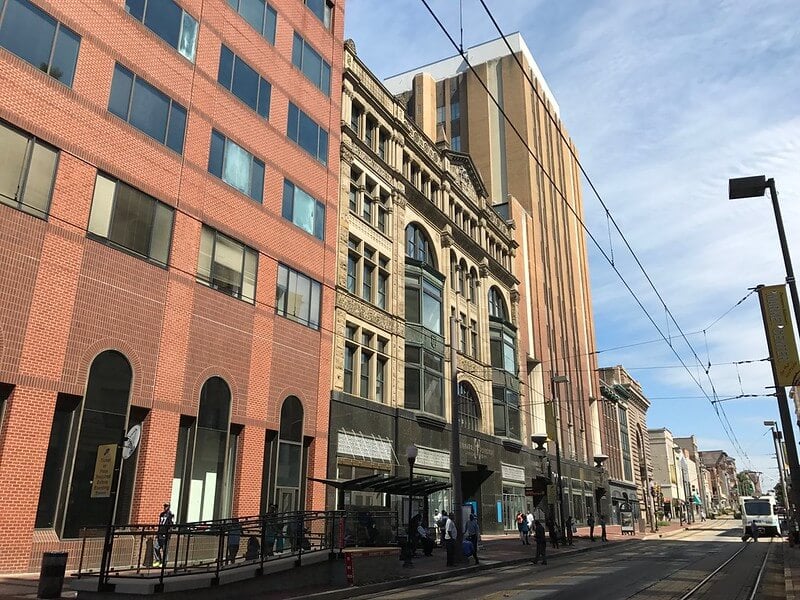
Abram Hutzler founded his Baltimore business in 1858, and the Palace Building on Howard Street became its showplace in the 1880s. The ornate commercial building is listed on the National Register of Historic Places, a mark of how much it mattered to the city’s downtown.
Baltimoreans packed the tearoom and the toy floor during the holidays, and old photographs show Howard Street thick with shoppers crossing between Hutzler’s and its neighbors. The name stayed on the block for a century, long enough for several generations to learn it by heart.
Woodies on F Street
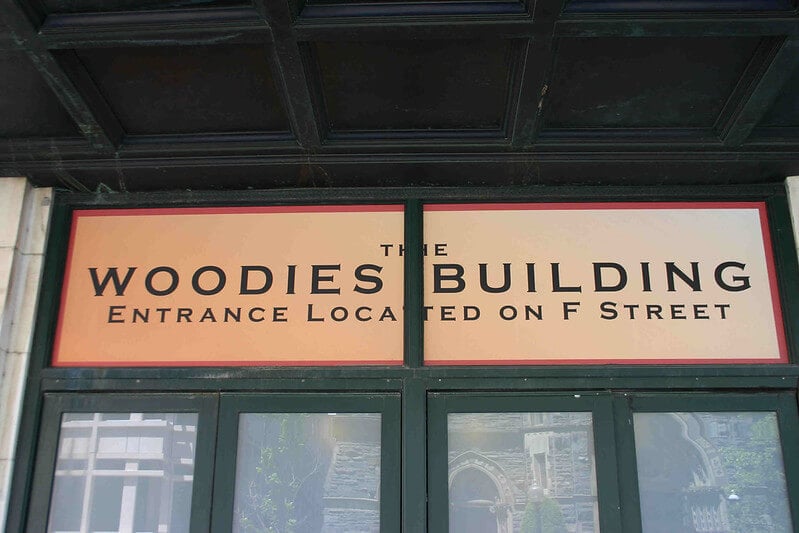
Woodward and Lothrop opened in Washington in 1880 and became so beloved that residents simply called it Woodies. The F Street flagship drew congressional families, government clerks, and tourists, all moving through a polished interior of wood and glass counters.
A surviving 1937 menu from the store’s tea room shows a dining service aimed at shoppers who wanted a proper lunch between floors. Photographs of the building at holiday time show a window display so elaborate that crowds gathered at the curb to watch it.
Rich’s and the Pink Pig
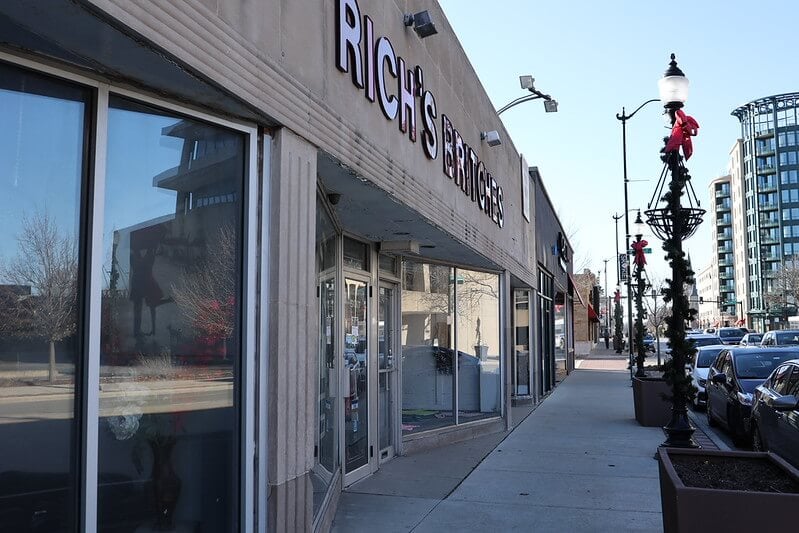
Morris Rich founded his Atlanta store in 1867, and it grew into the Southern city’s most beloved retailer. The Magnolia Room tea room fed generations of shoppers, and the store lit a towering Christmas tree each year that became a civic ritual.
In 1953 the store introduced the Pink Pig, a small monorail ride that carried children above the toy department. Old photographs show families queued up for a pig-shaped train, a sight that many Atlantans remember more clearly than the merchandise they actually bought.
The Emporium Rebuilt on Market Street
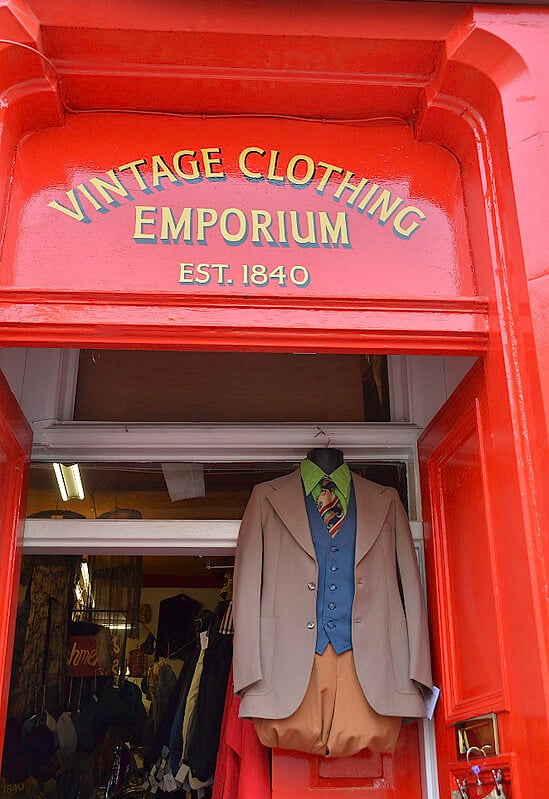
San Francisco’s Emporium opened on Market Street in 1896 under a domed rotunda that became the building’s signature. The earthquake and fire of 1906 gutted the structure, and the store was rebuilt on the same site and reopened for business.
Photographs from the era show the dome above a ring of balconies, with salespeople working beneath a ceiling of glass and plaster. Locals still speak of the building’s heyday, particularly the holiday season when children waited in line to see Santa Claus.
Those lines wound through floors that had to be rebuilt, restocked, and reopened within a few years of disaster, which says plenty about the city’s appetite for shopping.
Timothy Eaton’s One Price Store in Toronto
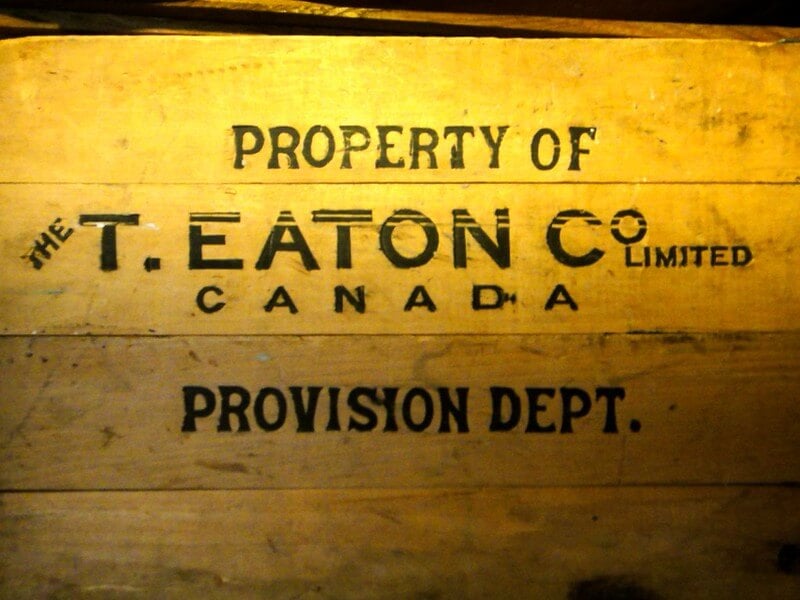
Timothy Eaton opened his Toronto dry goods store on Yonge Street in 1869 and shocked competitors by selling for cash at one price. His slogan promising satisfactory goods or money refunded was unusual at the time, and it built a reputation for honesty across Canada.
The firm launched its mail order catalog in 1884, carrying that reputation into farmhouses far from the city. Photographs of the early Toronto stores show wooden counters, hanging gas lamps, and customers in long skirts and bowler hats browsing across a plain floor.
Harrods and the Terracotta Landmark
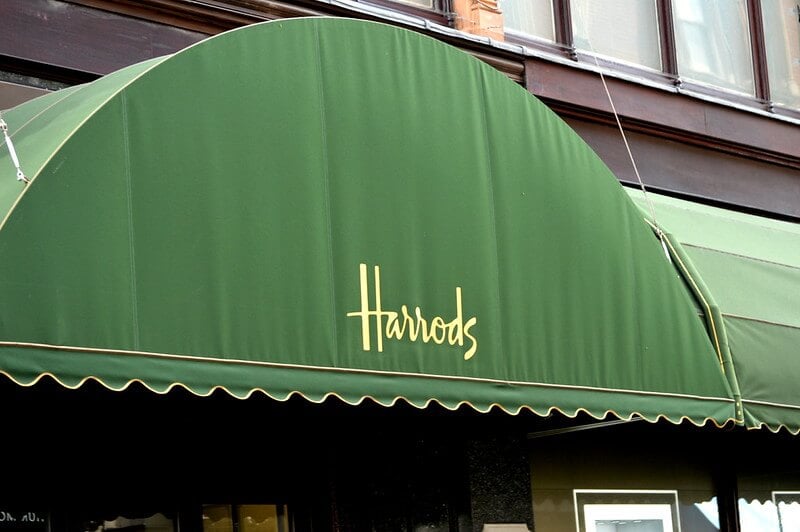
Charles Henry Harrod began trading in 1834 and settled his shop in Knightsbridge in 1849, then watched it swell into a retail empire. The present terracotta building, completed in 1905, replaced a cluster of smaller premises after a fire destroyed an earlier structure.
Its Egyptian Hall and cream facade appear in early postcards, framed by horse-drawn carriages and top-hatted gentlemen. Inside, London shoppers entered a world of departments so varied that a grand piano and a pound of tea could be bought under one roof.
The motto of the house promised to supply everything for everyone, and the sheer size of the place made that boast feel believable.
Selfridges Opens on Oxford Street
Harry Gordon Selfridge, an American who had risen through Marshall Field and Company in Chicago, opened his London store on Oxford Street in March 1909. A row of tall Ionic columns marched across the facade, and Daniel Burnham was among the architects involved in its early design.
Photographs from opening week show a vast crowd pressed against the plate glass windows, eager to see what an American merchant had built. The store invited Londoners to wander without buying, an idea that astonished British shopkeepers raised on counter service.
Rooms Built for Lingering
The stores in these photographs were designed to hold people in place. A fountain, a clock, or an organ gave shoppers a reason to arrive early and leave late, and a tearoom or a toy floor kept families inside for the afternoon.
Before moving stairs, the climb from floor to floor was a pause, and merchants filled it with things to look at. When escalators arrived, they carried customers upward faster and rewarded stores for packing in more goods.
The old photographs record the opposite instinct, a retail world that expected people to sit, wait, wander, and meet someone beside a statue. Whether or not those stores earned more money, they left behind pictures of crowds that seem to be enjoying themselves.
More from Go2Tutors!

- 27 Silver Dollars and Half Dollars Worth Keeping
- 28 Restaurant Menu Items Nobody Orders Anymore
- 17 Places Built in Seemingly Impossible Spots
- 27 Vintage Rings Worth More Than They Look
- 25 Restricted Sites Tourists Can’t Enter
Like Go2Tutors’s content? Follow us on MSN.