Forgotten Technologies that Predicted the Future
Consider your smartphone to be state-of-the-art.
In actuality, many of the “revolutionary” technologies of today were conceived and developed decades or even centuries before they were adopted by the general public.
These were more than just wild thoughts scrawled in notebooks.
They were functional systems, working prototypes, and sincere attempts to alter the world, but they came too soon for their time.
Because the necessary infrastructure was not yet in place, some failed.
Others were simply unlucky, too costly, or too complicated.
However, in retrospect, it’s amazing to see how well these lost innovations foresaw the modern world.
15 forgotten technologies that anticipated the future before the rest of us did are listed here.
The Antikythera Mechanism
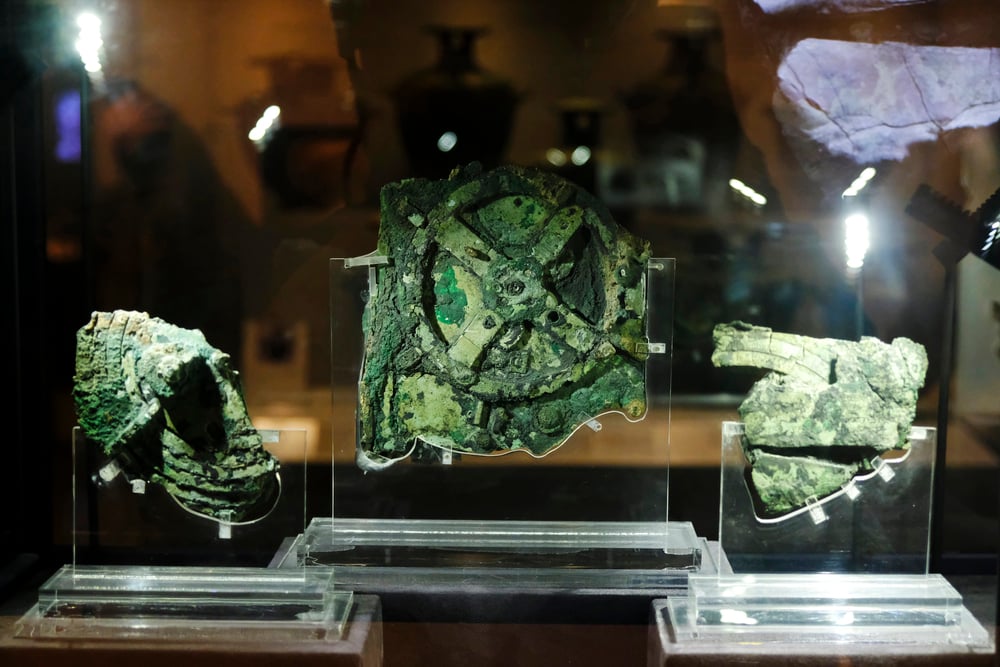
Greek engineers built what’s essentially an ancient computer around 150 to 100 BCE, and nobody knew about it until divers found the corroded remains in a shipwreck off the coast of Antikythera in 1901.
This shoebox-sized bronze device contained at least 37 interlocking gears that could predict astronomical positions, track eclipses, and even countdown to the Olympic Games. Modern X-ray tomography revealed it could track the Metonic cycle spanning 19 years, calculate solar and lunar eclipses, and chart planetary positions using intricate Greek inscriptions.
The level of mechanical sophistication wouldn’t be seen again for over a thousand years, making you wonder what other ancient tech got lost to history.
Early Electric Vehicles

Scottish inventor Robert Anderson built an electric carriage somewhere between 1832 and 1839, decades before gasoline cars became a thing.
These early electric vehicles were quiet, didn’t spew foul exhaust, and were actually easier to operate than their gas-guzzling competitors.
By 1900, electric vehicles made up roughly one-third of all cars in the United States.
They were especially popular with urban drivers who appreciated not having to hand-crank an engine to start their car.
The decline came after Charles Kettering invented the electric starter in 1912, making gasoline cars just as easy to operate, combined with cheap oil and Henry Ford’s assembly line pushing gas vehicles to dominance.
Like Go2Tutors’s content? Follow us on MSN.
AT&T’s Picturephone

AT&T spent hundreds of millions of dollars developing video calling technology from the 1940s through the 1970s, first demonstrating the Picturephone at the 1964 World’s Fair before launching commercial service in Pittsburgh on June 30, 1970.
The Mod II Picturephone was actually a technological marvel with a camera, zoom lens, and a screen that let you see the person you were talking to in real-time.
The problem wasn’t the technology—it was everything else.
The service cost $160 per month plus 25 cents per minute for calls, which is equivalent to about $950 monthly in today’s money.
Fewer than 500 units were installed nationwide before the whole thing fizzled out.
Turns out AT&T was just 50 years too early, because now we video chat constantly without thinking twice about it.
Nikola Tesla’s Wireless Power

Tesla wasn’t just inventing cool electrical gadgets—he was trying to beam power through the air without any wires at all.
Between 1899 and 1900, he built massive towers in Colorado Springs to test wireless energy transmission, successfully sending electricity across short distances in his lab.
His ambitious Wardenclyffe Tower on Long Island, constructed between 1901 and 1917, was designed to transmit both communications and power wirelessly.
Financier J.P. Morgan initially invested over $150,000 but withdrew support in 1905, and the tower was eventually demolished in 1917.
Today we have wireless charging pads for phones, which is basically Tesla’s dream in miniature form.
Charles Babbage’s Analytical Engine
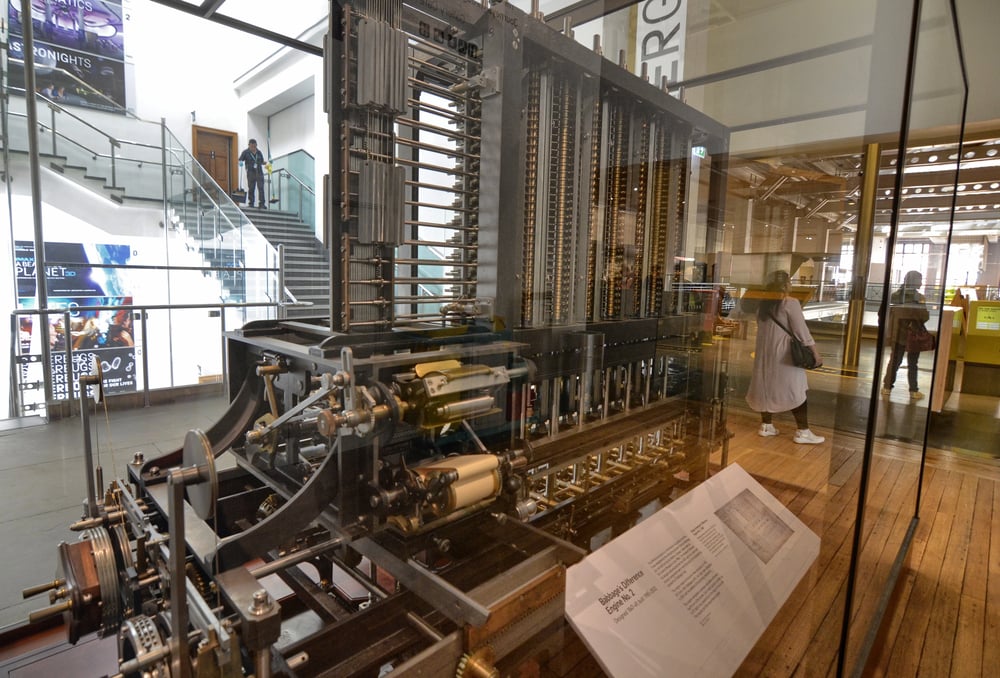
English mathematician Charles Babbage began designing a mechanical computer in 1837 that could store programs, make decisions, and print results—basically everything modern computers do, just powered by steam and punch cards instead of electricity.
The Analytical Engine was never fully built during Babbage’s lifetime because the manufacturing capabilities and funding weren’t there, but his designs were eerily prescient.
The Science Museum London later completed partial prototypes of his smaller Difference Engine No. 2 in 1991 and 2002, proving his concepts would have actually worked.
Ada Lovelace, who worked with Babbage, even wrote what many consider the first computer program for the machine.
Like Go2Tutors’s content? Follow us on MSN.
The Memex

In July 1945, scientist Vannevar Bush published an article in The Atlantic Monthly called ‘As We May Think,’ describing a theoretical desktop device called the Memex that would store vast amounts of information and let users navigate through it using associative links.
Sound familiar? Bush essentially predicted personal computers, hypertext, and the internet decades before any of them existed.
His article directly inspired pioneers like Douglas Engelbart and Ted Nelson, who later created hypertext systems.
The Memex was never built, but the ideas behind it became the foundation for how we interact with digital information.
Jules Verne’s Electric Submarine

French author Jules Verne published ‘Twenty Thousand Leagues Under the Seas’ in 1870, featuring Captain Nemo’s submarine Nautilus powered by electricity.
At the time, submarines existed but they were clunky vessels that used primitive steam engines.
Verne based the Nautilus’s specifications on contemporary French naval experiments like the Plongeur from 1863, but imagined a far more advanced version that could travel vast distances underwater.
His fictional creation closely resembles the modern submarines that wouldn’t become reality until the 20th century. Verne had a knack for technical accuracy that made his science fiction feel less like fantasy and more like a preview of things to come.
Leonardo da Vinci’s Flying Machines

Da Vinci sketched detailed designs for flying machines in the late 15th century, over 400 years before the Wright brothers got their plane off the ground.
His ornithopter designs showed a remarkable understanding of aerodynamics and lift, even though he never had the materials or engine technology to actually build a working aircraft.
His ‘Codex on the Flight of Birds’ from around 1505 analyzed wing motion and center of gravity in what became the earliest known aerodynamic studies.
Da Vinci studied birds obsessively, trying to understand the mechanics of how wings created lift, and translated those observations into technical blueprints that would make sense to modern engineers.
Like Go2Tutors’s content? Follow us on MSN.
Edward Bellamy’s Credit Card Vision

Edward Bellamy’s 1888 novel ‘Looking Backward’ described a future society where people used a card to make purchases instead of cash.
This was decades before credit cards existed, and Bellamy imagined it as part of a utopian vision of how technology could improve daily life.
The concept sounded absurd at the time—how could a piece of cardboard replace actual money?
Yet here we are, tapping cards and phones to buy coffee without carrying a single coin.
Bellamy got the basic concept right, even if the specific implementation turned out differently than he imagined.
H.G. Wells and Automatic Doors

H.G. Wells described doors that automatically opened as people approached them in his 1899 novel ‘When the Sleeper Wakes,’ writing about portals that jerked open to reveal passages beyond.
This simple idea wouldn’t become common in buildings until 1954 when Stanley Works installed the first real automatic doors.
Wells had a talent for imagining everyday technological conveniences that seemed magical in his era but became totally mundane once engineers figured out how to build them.
Automatic doors are so ubiquitous now that we barely notice them, but someone had to imagine them first.
The Knight Newspaper Tablet

In 1994, the Knight-Ridder Information Design Lab created a tablet prototype that predicted exactly how we’d consume digital media 15 years before the iPad launched.
Their concept device featured touch navigation, digital subscriptions, and multimedia content integration displayed on a portable flat screen.
Demonstrations appeared on the TV program Future Focus in 1995, showing a vision that was spot-on.
The technology to actually build it at a reasonable cost didn’t exist yet, so the project never made it to market.
But watching old footage of their demonstrations is eerie—they basically nailed what tablets would look like and how people would use them.
Like Go2Tutors’s content? Follow us on MSN.
H.G. Wells and the Atomic Bomb

Wells published ‘The World Set Free’ in 1914, coining the phrase ‘atomic bomb’ and describing weapons that caused devastating explosions and left dangerous radiation lingering afterward.
This was over 30 years before the first nuclear weapon was detonated in 1945.
The physicist Leo Szilard read the novel in 1932, and it directly inspired his work on nuclear chain reactions—he even patented the first nuclear chain-reaction design in 1934.
Wells even predicted that these weapons would first be used in 1956, which was only 11 years off from the actual date.
The accuracy is genuinely unsettling.
E.M. Forster’s Video Communication

E.M. Forster wrote a short story called ‘The Machine Stops’ that appeared in The Oxford and Cambridge Review in November 1909, featuring people living in isolation and communicating through screens that transmitted both video and audio.
The story was meant as a warning about technology-dependent societies, but Forster accidentally predicted video calling, remote work, and pretty much our entire pandemic experience over a century early.
People in his story conducted their entire lives through these screens, rarely meeting face-to-face.
Digital-culture historians have repeatedly cited this story’s eerily accurate vision of isolation through screens.
Hugo Gernsback’s Radar Prediction

Hugo Gernsback serialized a novel called ‘Ralph 124C 41+’ in Modern Electrics magazine between 1911 and 1912 that described a technology for detecting distant objects using radio waves.
Gernsback called it ‘pulsating polarized ether waves’ and described how it could locate objects far away, which prefigured the pulse radar technology that Britain’s Chain Home system would use in 1935.
His description was remarkably similar to how actual radar works, appearing three decades before it was developed during World War II.
His contributions to predicting future technology were so significant that science fiction’s most prestigious award, the Hugo Award, was named after him.
Like Go2Tutors’s content? Follow us on MSN.
The Baghdad Battery

Discovered near Khujut Rabu, Iraq, in 1936, this ancient artifact dating from around 150 BCE to 250 CE looks suspiciously like a primitive battery, complete with a clay jar, copper cylinder, and iron rod.
Some researchers believe it could have generated small electric charges, suggesting that ancient civilizations might have understood and used electricity long before the modern era.
The theory remains controversial—many archaeologists believe it was simply a storage jar for scrolls rather than an actual power cell.
Still, if the electrical theory is correct, it means people were experimenting with electrical concepts literally millennia before Benjamin Franklin flew his famous kite.
Technologies That Arrived Too Soon

These developments demonstrate that technology frequently fails because the environment isn’t prepared, not because it is impossible.
Early construction by visionaries causes their work to be forgotten until a new generation rediscovers it and refers to it as innovation.
For centuries, the manufacturing precision needed for the Antikythera Mechanism was lost.
Better batteries and more affordable electricity were required for electric vehicles.
The infrastructure required by the Picturephone would not be available for decades.
These technologies are intriguing not only because they functioned but also because they demonstrated that someone had a clear vision for the future and made an effort to create it when no one else was prepared.
More from Go2Tutors!

- 16 Historical Figures Who Were Nothing Like You Think
- 12 Things Sold in the 80s That Are Now Illegal
- 15 VHS Tapes That Could Be Worth Thousands
- 17 Historical “What Ifs” That Would Have Changed Everything
- 18 TV Shows That Vanished Without a Finale
Like Go2Tutors’s content? Follow us on MSN.



