Natural Formations That Became Cultural Icons
Some rocks, mountains, and landforms transcend geography. They show up on postcards, currency, and logos.
They inspire songs, paintings, and pilgrimage. These aren’t just pretty places—they’ve worked their way into the collective imagination of entire cultures and beyond.
What makes a natural formation iconic? Sometimes it’s the shape. Sometimes it’s the stories that accumulate around it.
Often it’s both, plus the right combination of accessibility and timing. You can’t manufacture this kind of cultural staying power.
It just happens when the right place meets the right moment in history.
The Red Heart of Australia

Uluru rises 348 meters from the flat desert, and its color shifts throughout the day. The rock glows orange at sunrise, deepens to rust by afternoon, and burns crimson at sunset.
For the Anangu people, this sandstone monolith has been sacred for tens of thousands of years. For everyone else, it became the visual shorthand for the Australian outback—appearing on everything from airline advertisements to the Sydney 2000 Olympic ceremonies.
A Perfect Cone Against the Sky

Mount Fuji’s symmetry makes it instantly recognizable. The volcano has appeared in Japanese art for centuries, most famously in Hokusai’s woodblock prints.
That iconic image of a wave with Fuji in the background? You’ve probably seen it reproduced thousands of times.
The mountain features in poetry, religion, and national identity. Climbing it once was a religious pilgrimage.
Now about 300,000 people make the trek each year, turning a sacred journey into a bucket-list item that somehow still feels meaningful.
The Scar That Draws Millions

The Grand Canyon forces you to reckon with time in a way few places can. Those layers of rock represent nearly two billion years of Earth’s history, exposed and visible in a single glance.
Theodore Roosevelt called it “the one great sight which every American should see.” The park draws six million visitors annually, but the canyon’s influence extends far beyond tourism.
It’s become a symbol of conservation, geological education, and the American West itself.
Ancient Stones with Modern Mystery

Nobody knows exactly how they got there, which only adds to the appeal. Stonehenge started as a simple earthwork around 3000 BCE, but the massive sarsen stones that define it today came later—transported somehow from 25 miles away.
The monument has been claimed by druids, studied by archaeologists, and mythologized by countless writers. Its silhouette alone signals ancient Britain, mystery, and the pull of prehistory.
The Mountain That Brands Chocolate
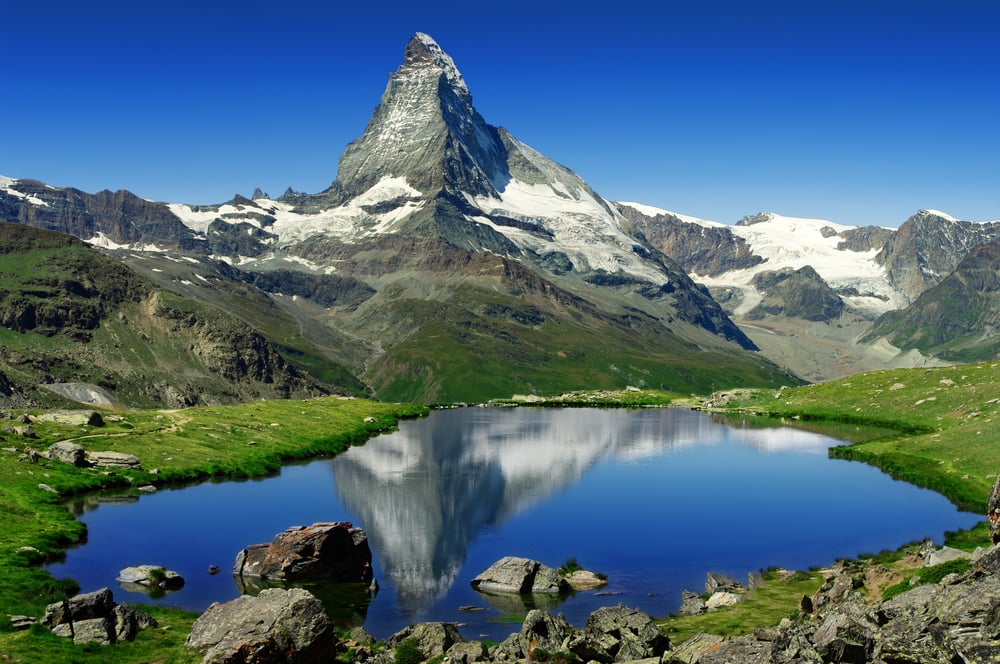
You can spot the Matterhorn’s distinctive pyramid shape on Toblerone packaging and Paramount Pictures logos. The Swiss-Italian peak rises 4,478 meters, with faces so steep they can’t hold snow.
Early mountaineers considered it unclimbable. When Edward Whymper’s team finally reached the summit in 1865, four members died on the descent.
That tragedy only cemented the mountain’s reputation. Now it represents both achievement and risk—the ultimate alpine challenge.
The Smoke That Thunders

Local people called it Mosi-oa-Tunya long before David Livingstone “discovered” it in 1855. Victoria Falls stretches more than a mile wide and drops 108 meters, creating a mist that rises hundreds of feet into the air.
The falls sit on the border of Zambia and Zimbabwe, and both countries feature them on their currency. The roar can be heard from 40 kilometers away.
When the Zambezi River runs high, the falls become the largest sheet of falling water on Earth.
The Flat Top That Defines a City

Table Mountain stands behind Cape Town like a natural billboard. The plateau stretches three kilometers long, with cliffs dropping nearly straight down on most sides.
A tablecloth of clouds often spills over the edge, created by moisture from the Atlantic meeting the summit. The mountain appears on South Africa’s flag and coat of arms.
For sailors approaching from the sea, it marked safety and supplies. For prisoners held on Robben Island, it represented the mainland they couldn’t reach.
Utah’s Natural Arch in Every Photo

Delicate Arch sits alone on a sandstone ridge, framing the La Sal Mountains beyond. The freestanding arch is only 60 feet tall, but its isolation and graceful curve make it instantly photogenic.
Utah put it on license plates. Outdoor brands use its silhouette in logos.
It’s become shorthand for the American Southwest and the appeal of wild spaces. Thousands hike the 3-mile trail each day just to see it, especially at sunset when the rock glows orange.
Yosemite’s Granite Sentinel

Half Dome rises nearly 5,000 feet above the valley floor, with one face sheared away so perfectly it looks deliberate. The granite formation challenged climbers for decades.
George Anderson finally reached the summit in 1875 by drilling and driving in eye bolts. Now a cable route allows hikers to ascend during summer months, though the permits stay competitive.
Ansel Adams photographed Half Dome repeatedly, and those black-and-white images helped define American wilderness photography.
Hexagonal Columns That Sparked Legends

Giant’s Causeway looks manufactured. The basalt columns fit together so precisely that locals once believed giants built a path across the sea to Scotland.
Volcanic activity actually created the formations about 60 million years ago, cooling lava crystallizing into these perfect hexagonal shapes. The causeway inspired myths, poems, and pilgrimages.
It’s become synonymous with Northern Ireland’s dramatic coastline. The formation even shows up in Led Zeppelin album artwork—a testament to its visual power beyond geography.
Rio’s Sugarloaf Rising from the Bay

You reach Sugarloaf Mountain by cable car, rising 396 meters above Guanabara Bay. The granite peak offers 360-degree views of Rio de Janeiro, and its distinctive shape makes it unmistakable from almost anywhere in the city.
The peak appears in countless films set in Rio, often in the opening shot to establish location. It’s the backdrop for Christ the Redeemer photos, tourist selfies, and New Year’s Eve fireworks.
The mountain has become inseparable from Rio’s identity.
White Walls Facing the Continent

The White Cliffs of Dover rise up to 110 meters, their chalk faces visible from 20 miles across the English Channel. These cliffs represented safety for British sailors returning home, and they became a symbol of defenses during World War II.
Vera Lynn’s song “The White Cliffs of Dover” turned geology into poetry, linking landscape with longing. The cliffs appear in literature from Shakespeare to Ian Fleming.
They’re England at its most literal edge, white against the gray sea.
Africa’s Highest Point Alone on the Plain

Kilimanjaro sits alone, climbing up 5,895 meters straight from the grassy plains around it. This layered volcano carries snow on top even though it’s close to the equator – but that frost is slowly fading away.
Seeing icy ridges high above Africa’s flatlands feels unreal. Hemingway mentioned it.
Yet many adventurers still try climbing it. While Tanzania features it on their money.
Though the peak now stands as a sign of Africa – pretty, tough, yet shifting with weather patterns.
Where Landscape Becomes Identity

These shapes have more in common than just looking good. One after another, they’ve moved from wild landscapes into human stories – turning into icons loaded with deeper messages.
Just seeing a picture tells you what they mean. No climbing needed to sense their power.
The mountains, canyons, or strange stone shapes we end up recognizing? They’re not just spots people visit.
These places change how locals think about home – also how others picture those areas. They hold onto legends, spark paintings and songs, plus stand tall during big historical turns. Certain stones matter way beyond what science explains.
More from Go2Tutors!

- The Romanov Crown Jewels and Their Tragic Fate
- 13 Historical Mysteries That Science Still Can’t Solve
- Famous Hoaxes That Fooled the World for Years
- 15 Child Stars with Tragic Adult Lives
- 16 Famous Jewelry Pieces in History
Like Go2Tutors’s content? Follow us on MSN.