13 American Street Scenes Before Electric Lighting
In April 1879, Charles Brush’s arc lamps lit Cleveland’s Public Square, and the American street began its long slide toward permanent brightness. Before that, a city after dark belonged to gas jets, oil lamps, and whatever the moon allowed.
The scenes below were recorded in that earlier world by daguerreotypists, stereograph makers, and lithographers. Each shows a real street, square, or landing that waited years for its first electric lamp.
Brattle Street From a Boston Studio Window
Albert Sands Southworth and Josiah Johnson Hawes ran one of the most admired daguerreotype studios in the country, and the Metropolitan Museum of Art holds their view down Brattle Street from the studio at 5 1/2 Tremont Row. The picture is a rare case of the photographers pointing the camera away from a sitter and out the window.
Boston at mid-century was a gaslit city of brick and horse traffic, and this plate keeps a narrow slice of it. The street outlived the studio, but the vantage point did not.
Cincinnati’s Public Landing in Eight Plates
In 1848, Charles Fontayne and William Porter joined eight daguerreotype plates into a panorama of the Cincinnati riverfront. The Public Library of Cincinnati and Hamilton County preserves the set, which shows the public landing on the Ohio River crowded with steamboats and warehouses.
The work is often cited as one of the earliest large panoramas of an American city. Gas lamps and a commercial river trade defined the place then, and the first electric streetlights were still decades away.
Montgomery Street and the Daguerreian Rooms of 1855
San Francisco’s Montgomery Street was the commercial spine of the Gold Rush city, and photographers set up shop along it almost at once. A photograph of Johnson’s Daguerreian Rooms at 138 Montgomery Street dates to 1855 in the Pat Hathaway archive.
George Eastman Museum also holds a north view of the street, and Carleton Watkins documented the same corridor in later years. The boomtown wore its commerce on its storefronts, and it did so by oil and gas light.
Pennsylvania Avenue in the Week of the Grand Review
A photograph titled Penn Ave May 1865 records Washington’s grandest thoroughfare in the month Union armies marched down it. The avenue ran between the Capitol and the White House, which made it the natural parade ground for a victory.
The scene belongs to a gaslit capital, years before electric lamps reached its streets.
Meeting Street, Charleston, in 1865
George N. Barnard photographed Charleston in 1865 for his album Photographic Views of Sherman’s Campaign, and the Nelson-Atkins Museum of Art holds his View in Meeting Street. The city had been shelled and burned, and its streets were quiet in a way few photographs of the old port ever show.
Meeting Street had been lit by gas before the war and went dark in places during it. The view is a record of a main avenue waiting for repairs.
King Street Seen From Beaufain
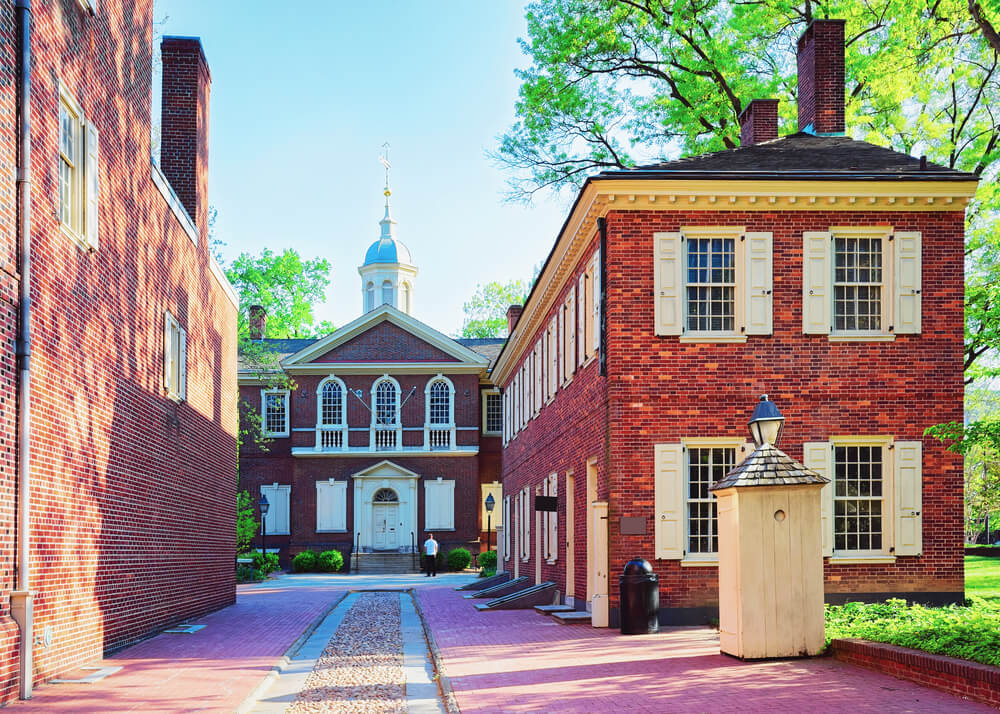
Another Barnard plate, View of King Street From Beaufain, Charleston, S.C., looks along the city’s chief shopping street in the same postwar season. The Nelson-Atkins Museum holds this print too, along with views of the ruined railroad depot and the new capitol at Columbia.
King Street was where Charleston bought its dry goods and hardware, and its storefronts line the frame like a row of closed ledgers. No electric wire crosses the sky above it.
Chestnut Street, Philadelphia, by William G. Mason
Philadelphia photographer William G. Mason recorded Chestnut Street near Second Street, and the images now circulate through collections such as Lost New England. The Free Library of Philadelphia also keeps a view of Chestnut Street running from Front to Second.
Chestnut Street was the city’s premier shopping and banking address, and its sidewalks carried a steady stream of pedestrians. The stereograph era gave it a patient chronicler, and the gaslit blocks remain legible in his frames.
The 800 Block of Canal Street in 1864
A photograph of the 800 block of Canal Street, New Orleans, dated 1864, shows the wide boulevard under Union occupation. The view comes from a time when city streets still relied on the lamps of an earlier century.
Electric light was still years away from the boulevard.
The St. Louis Levee in 1858
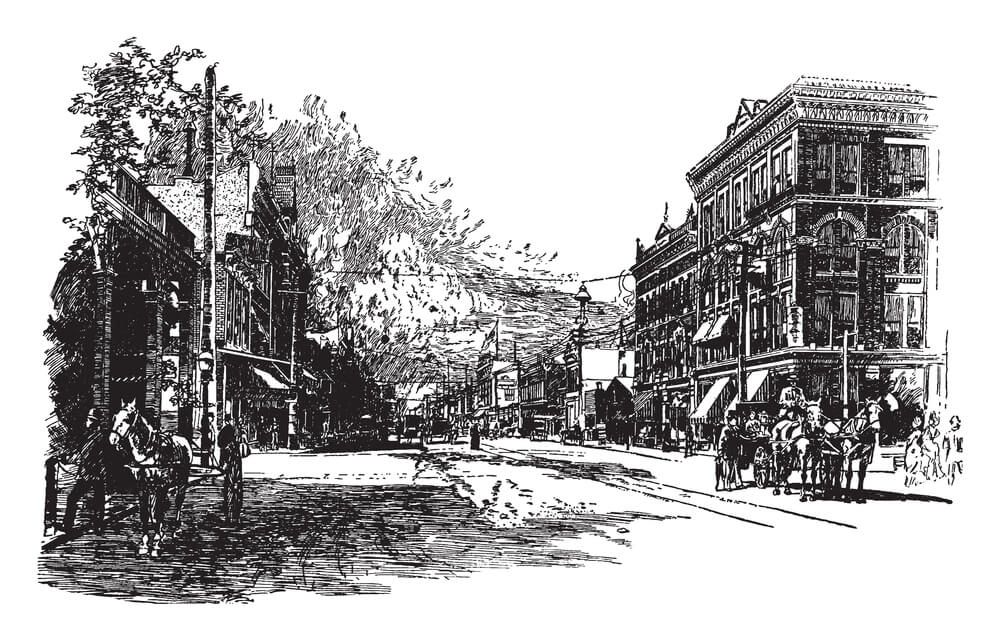
Thomas Easterly made daguerreotypes of St. Louis between 1848 and 1870, and a photograph dated 1858 shows the city’s levee crowded with steamboats along the Mississippi. The riverfront was the economic engine of the city, and ships, wagons, and cargo pressed against one another along its length.
Boats loaded and unloaded around the clock. Work at the water’s edge depended on lanterns and the glow of gas lamps rather than on any central electric supply.
Broad-Way, New York, in Lithograph
The Metropolitan Museum of Art holds a print titled Broad-Way, New York, in which artist Augustus Kollner drew the great avenue at mid-century. Omnibuses, pedestrians, and shopfronts crowd the street in the manner of a printmaker who wanted every detail accounted for.
The city was already a major gaslit metropolis, and Broadway was its shop window. Electric arc lamps would come to the street only after the publisher had long stopped selling prints like this one.
Larimer Street, Denver, at the Start of the City
Denverite reported that a photograph probably taken at Larimer Square is likely the earliest photo of Denver. The image shows a frontier settlement of rough buildings on a dirt street, with a hand-built look that no later view could match.
Denver would eventually become a lit and wired city, but the first photograph belongs to a town too new to have either gas or electricity as a civic habit. The earliest streetscape of Colorado’s capital is a study in darkness waiting to be solved.
J Street, Sacramento, During the Flood of 1862
The Great Flood of 1862 put Sacramento’s streets under water, and a photograph titled Flood of 1862 on J Street, looking east from levee, preserves the moment. The USGS also publishes an image of the Sacramento flood from that year.
The picture shows a downtown street in the middle of a disaster, years before electric lamps arrived.
Broadway at Fulton Street, 1850
An image of Broadway at Fulton Street dated 1850 shows the lower end of the avenue where St. Paul’s Chapel and the Astor House stood. The corner sat at the heart of a city that lit its streets with gas.
Arc lights reached Broadway only after the corner had changed beyond recognition.
The Last Dark Streets
These thirteen scenes share one quiet feature: none of them was composed for the lamps that lit it. The photographers wanted the buildings, the boats, the avenues, and the people, and the lighting came along as background.
That accident makes the pictures valuable now, because they record an urban night that was never meant to be preserved.
Electricity did not erase the older city so much as bury it under brighter habits. A lamplighter, a gas jet, a lantern at a landing: each was ordinary until it became rare.
The photographs are what remain of an American street that expected darkness and planned around it.
More from Go2Tutors!

- 27 Silver Dollars and Half Dollars Worth Keeping
- 28 Restaurant Menu Items Nobody Orders Anymore
- 17 Places Built in Seemingly Impossible Spots
- 27 Vintage Rings Worth More Than They Look
- 25 Restricted Sites Tourists Can’t Enter
Like Go2Tutors’s content? Follow us on MSN.