15 Events From the 1920s You Didn’t Learn in School
The 1920s were so much more than prohibition and flappers. This social revolution decade, technological revolution decade, and cultural revolution decade molded America into the country we recognize today. From World War I to the Great Depression, these early years changed everything from the rights of women to entertainment and transportation.
Here are 15 of the most fascinating things that occurred during the 1920s that likely were not covered in your history books.
The Thompson Submachine Gun Goes Public

Despite its intended use, the notorious “Tommy gun” swiftly came to be linked with organized crime after it was originally introduced to the public in 1921 as the “Anti-Bandit Gun.” Without asking, Auto Ordnance Corporation sold these weapons to anyone with $200, or around $3,000 in today’s currency. The first major federal gun control legislation was passed in the 1930s as a result of the weapon’s popularity among gangsters during the Prohibition era.
The First Robot Debuts

The world was first exposed to “robots” in 1921 when Czech playwright Karel Čapek wrote R.U.R. (Rossum’s Universal Robots). Derived from the Czech word “robota,” which means forced labor, the name swiftly spread around the world. These early fictional robots were artificial biological entities designed to assist humans rather than being mechanical. A concept that would pervade science fiction for the following century was established by the play’s conclusion, in which the robots rebelled against their human creators.
Insulin Treatment Begins

Before 1922, a diabetes diagnosis was essentially a death sentence. That changed when Canadian researchers Frederick Banting and Charles Best successfully isolated insulin and administered it to a 14-year-old boy dying from diabetes. Within 24 hours, the boy’s dangerous blood sugar levels normalized, marking one of medicine’s most dramatic breakthroughs. Banting and his team sold the patent for insulin to the University of Toronto for just $1, hoping to ensure affordable access for all patients.
The Tomb of Tutankhamun Discovery
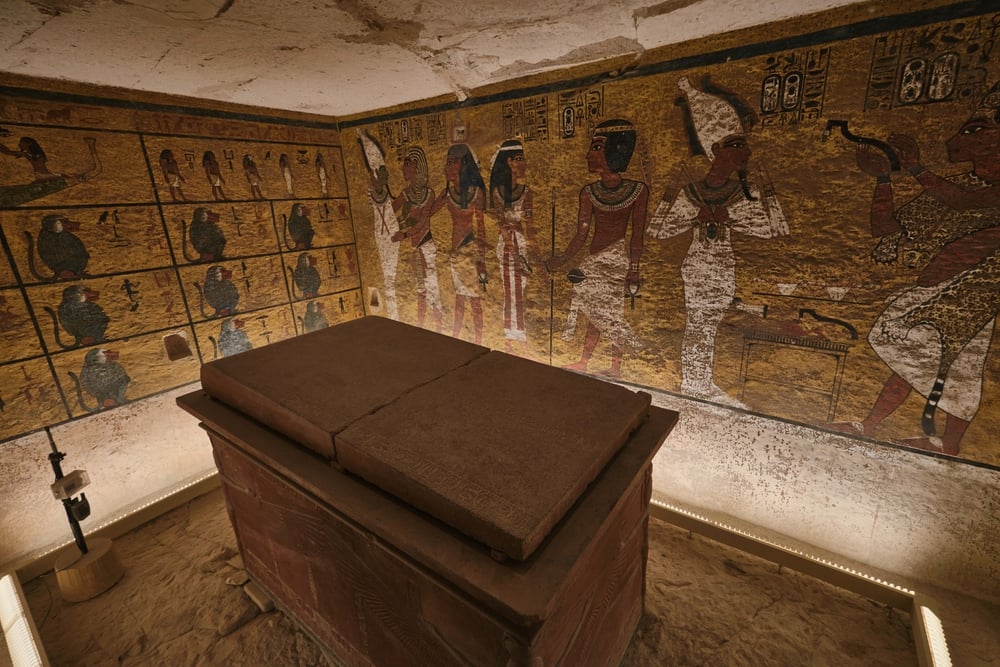
When British archaeologist Howard Carter opened the nearly intact tomb of Tutankhamun in 1922, it sparked a worldwide Egyptian revival. The unprecedented discovery captured global imagination, influenced fashion, architecture, and design throughout the decade. The excavation team spent nearly a decade cataloging over 5,000 artifacts, including the famous golden death mask. Rumors of a ‘mummy’s curse’ spread after several team members died in the years following the discovery, adding a supernatural element to the archaeological achievement.
The Equal Rights Amendment First Proposal
In 1923, suffragist Alice Paul drafted the Equal Rights Amendment, declaring that “men and women shall have equal rights throughout the United States.” Though women had won voting rights in 1920, this amendment sought to eliminate all legal distinctions between the sexes. Despite being introduced in every congressional session since 1923, the ERA still hasn’t been ratified almost a century later. The amendment came closest to passing in the 1970s, but fell three states short of the required 38 for a constitutional amendment.
The Teapot Dome Scandal

President Warren G. Harding’s administration became synonymous with corruption after the Teapot Dome scandal broke in 1923. Secretary of the Interior Albert Fall secretly leased government oil reserves in Wyoming and California to private companies in exchange for personal loans and gifts worth over $400,000. This marked the first time a presidential cabinet member went to prison for crimes committed while in office. The scandal’s name comes from a Wyoming oil reserve shaped like a teapot and became shorthand for government corruption for decades.
The First Winter Olympics

While the modern Summer Olympics began in 1896, the first official Winter Olympics weren’t held until 1924 in Chamonix, France. Originally called “International Winter Sports Week,” the event featured just 16 events in five sports with 258 athletes from 16 nations. Norway dominated the medal count with 17 total medals. The United States sent 24 athletes and won only four medals, a far cry from today’s massive Olympic delegations. These games established winter sports as a legitimate international competition separate from their summer counterparts.
The Scopes Monkey Trial

In 1925, Tennessee biology teacher John Scopes was prosecuted for teaching evolution, violating the state’s Butler Act prohibited the teaching of any theory contradicting biblical creation. The ensuing “Monkey Trial” featured famed attorney Clarence Darrow defending Scopes against three-time presidential candidate William Jennings Bryan prosecuting. The trial was broadcast on the radio nationwide, making it America’s first major media event. Though Scopes was found guilty and fined $100, the publicity significantly damaged the anti-evolution movement’s credibility among educated Americans.
The First Television Demonstration

Scottish inventor John Logie Baird demonstrated the first working television system in 1926, transmitting moving silhouette images. While primitive by today’s standards, this mechanical television system represented a technological breakthrough that would transform communication and entertainment. Baird’s system used a rotating disk with holes to capture and display images, creating a crude but recognizable picture. The first broadcast showed the face of a ventriloquist’s dummy nicknamed “Stooky Bill” before demonstrating with a human face.
The Great Mississippi Flood

The most destructive river flood in American history occurred in 1927 when the Mississippi River broke through levees in 145 places, flooding over 27,000 square miles across seven states. The disaster displaced over 700,000 people and killed approximately 500, though the actual death toll was likely much higher. The flood disproportionately affected African Americans, who made up the majority of those displaced and were often forced at gunpoint to work on levees. Herbert Hoover’s effective management of relief efforts helped propel him to the presidency the following year.
Philo Farnsworth’s Electronic Television

While mechanical television systems existed earlier, 21-year-old Philo Farnsworth demonstrated the first all-electronic television system in 1927. His system had no mechanical parts and transmitted images using electrons, the foundation for all modern televisions. Remarkably, Farnsworth conceived the idea when he was just 14 years old while plowing his family’s Idaho farm, realizing electrons could scan images line by line, similar to how a farmer plows a field. After years of legal battles with RCA, Farnsworth eventually received credit and compensation for his groundbreaking invention.
The First Academy Awards

The inaugural Academy Awards ceremony took place in 1929, though it bore little resemblance to today’s elaborate production. The event was a private dinner at the Hollywood Roosevelt Hotel with just 270 guests who paid $5 each to attend. The entire ceremony lasted 15 minutes, with winners having been announced three months earlier. ‘Wings’ won the first Outstanding Picture award (now Best Picture), while German film ‘Sunrise’ won for ‘Unique and Artistic Production,’ a category discontinued after the first ceremony.
The First Color Television Broadcast
While regular color television wouldn’t become standard until decades later, the first color television broadcast occurred in 1928. Bell Telephone Laboratories transmitted images of an American flag, a bouquet of roses, and a woman’s face from Washington D.C. to New York City. This experimental system used three separate channels to transmit the primary colors, which were then combined at the receiving end. The technology was too complex and expensive for commercial use, but it demonstrated that color television was theoretically possible.
The Saint Valentine’s Day Massacre

One of the most notorious events of the Prohibition era occurred on February 14, 1929, when seven members of Chicago’s North Side Gang were lined up against a garage wall and executed by men posing as police officers. The massacre, likely ordered by Al Capone to eliminate rival George ‘Bugs’ Moran, shocked the nation with its brutality. The event turned public opinion against gangsters who had sometimes been romanticized as Robin Hood figures and increased pressure on law enforcement to address organized crime.
The Stock Market Crash

The decade ended with the catastrophic stock market crash of October 1929, marking the beginning of the Great Depression. While most know about ‘Black Tuesday,’ few realize the crash actually unfolded over several days, beginning with ‘Black Thursday’ on October 24th. The market lost over 25% of its value in just four days, wiping out billions in wealth. Many factors contributed to the crash, including excessive margin buying, overproduction, weak banking systems, and rampant speculation. Within three years, the stock market had lost nearly 90% of its value, setting the stage for a decade of economic hardship.
The Decade That Shaped Modern America
The 1920s represented a crossroads between America’s agrarian past and its industrial, urbanized future. These fifteen events highlight how this transformative decade introduced technologies we still use, cultural tensions we still debate, and economic lessons we continue to study. Far from being just a frivolous interlude between World War I and the Great Depression, the 1920s fundamentally altered American society in ways that continue to influence our daily lives almost a century later.
More from Go2Tutors!

- The Romanov Crown Jewels and Their Tragic Fate
- 13 Historical Mysteries That Science Still Can’t Solve
- Famous Hoaxes That Fooled the World for Years
- 15 Child Stars with Tragic Adult Lives
- 16 Famous Jewelry Pieces in History
Like Go2Tutors’s content? Follow us on MSN.



