Optical Illusions That Have Fooled Scientists and Still Can’t Be Fully Explained
The brain does not passively receive images. It processes, predicts, and constructs what it believes it is seeing based on a lifetime of assumptions about how the world behaves.
Optical illusions are the places where those assumptions fail — often dramatically, in ways that persist even when you know exactly what the trick is. Knowing that two squares are the same color does not make them look the same color.
Knowing that the dancer has no actual depth does not stop your brain from committing to a direction of rotation. Some of the most studied illusions in visual science have been examined for over a century and still lack a complete explanation that everyone agrees on.
The mechanisms are partially understood; the full account is not. For objects this simple — arrows, circles, tiles, shadows — the fact that they can still divide expert opinion is its own kind of remarkable.
The Müller-Lyer Illusion — Two Lines, One Debate
First described in 1889, the Müller-Lyer illusion is one of the most widely studied phenomena in visual perception. Two lines of identical length are presented — one with arrowheads pointing inward, one with arrowheads pointing outward — and virtually everyone perceives the outward-arrow line as longer.
The most cited explanation invokes the “carpentered world hypothesis,” suggesting that people raised in environments with right angles and rectangular rooms learn to associate outward angles with receding corners (farther away, therefore larger) and inward angles with approaching corners (closer, therefore smaller). Significantly, a 1963 cross-cultural study found that Kalahari hunter-gatherers were far less susceptible to the illusion than Americans and Europeans, which supports this theory.
What researchers have not resolved is exactly why the illusion persists even after being explained — even for people who know exactly what is happening and why, the lines still appear unequal.
The Checker Shadow Illusion — Same Color, Different Color
MIT vision scientist Edward Adelson published this illusion in 1995 and it remains one of the most persuasive demonstrations of how radically context shapes color perception. A checkerboard with a cylinder casting a shadow contains two squares — labeled A and B — that are identical in color when measured by any instrument.
Square A, in the light, appears dark gray. Square B, in the shadow, appears light gray.
They are the same shade. The explanation involves the brain’s automatic compensation for lighting: the visual system “knows” that shadows make surfaces appear darker than they are and adjusts accordingly, making the shadowed square appear lighter.
What isn’t fully explained is the mechanism by which this correction happens and why it overrides direct sensory evidence so completely that even pointing at the squares with a color-picker tool doesn’t destroy the illusion once you look away.
The Spinning Dancer — No Right Answer
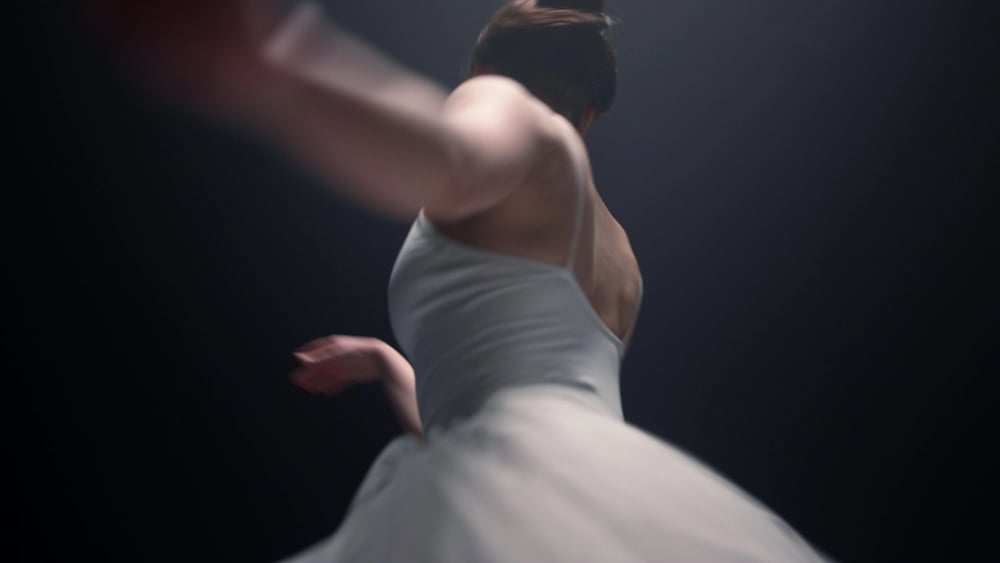
Created in 2003 by web designer Nobuyuki Kayahara, the Spinning Dancer is a silhouette of a figure rotating in place. Some viewers see her spinning clockwise; others see counter-clockwise.
Many people find that their perception flips spontaneously — sometimes mid-observation — from one direction to the other. The silhouette lacks depth cues, so the brain cannot determine the figure’s orientation and commits to one of two equally valid interpretations.
What is not understood is why individual viewers differ so dramatically in their initial perception, why some people can flip it consciously and others cannot, and what the spontaneous flipping reveals about how the brain arbitrates between competing visual interpretations. fMRI studies have identified activity in the parietal lobe during direction-switching, but the neural account of what triggers the switch remains incomplete.
The Café Wall Illusion — Perfectly Straight Lines That Appear to Slope
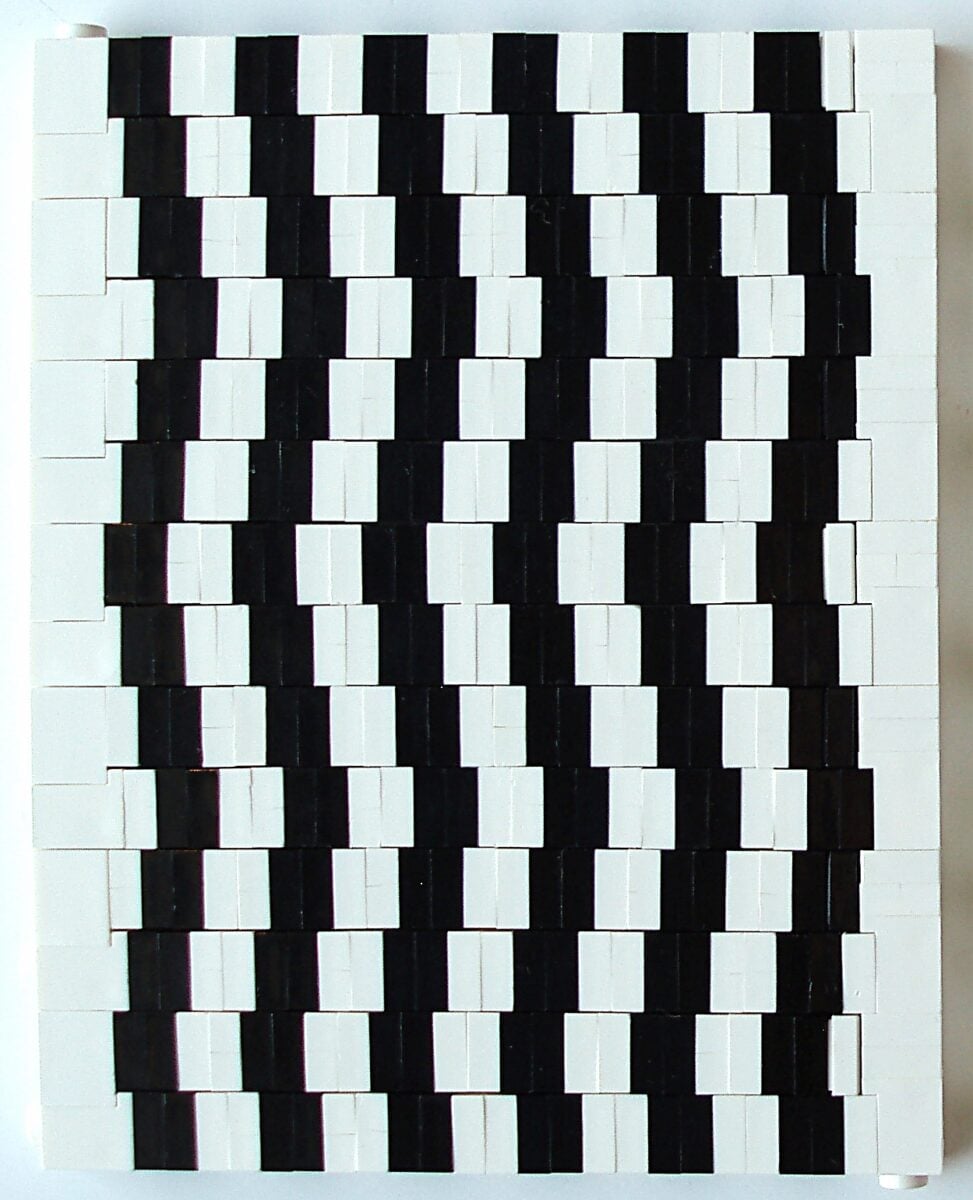
Discovered in 1973 when a vision scientist named Richard Gregory noticed the tiles of a café in Bristol, England, seemed to produce diagonal distortions in what he knew were straight horizontal lines, the café wall illusion occurs when rows of offset black and white tiles create the strong impression that the horizontal mortar lines between rows are sloping alternately in opposite directions. They are perfectly horizontal.
The leading explanation involves luminance contrast: the staggered tiles create local gradients that the brain’s edge-detection processes interpret as slanted. But the precise neural pathway by which luminance contrast produces an orientation error this pronounced — and this persistent — has not been mapped in complete detail.
The Ames Room — Two People, Two Different Sizes
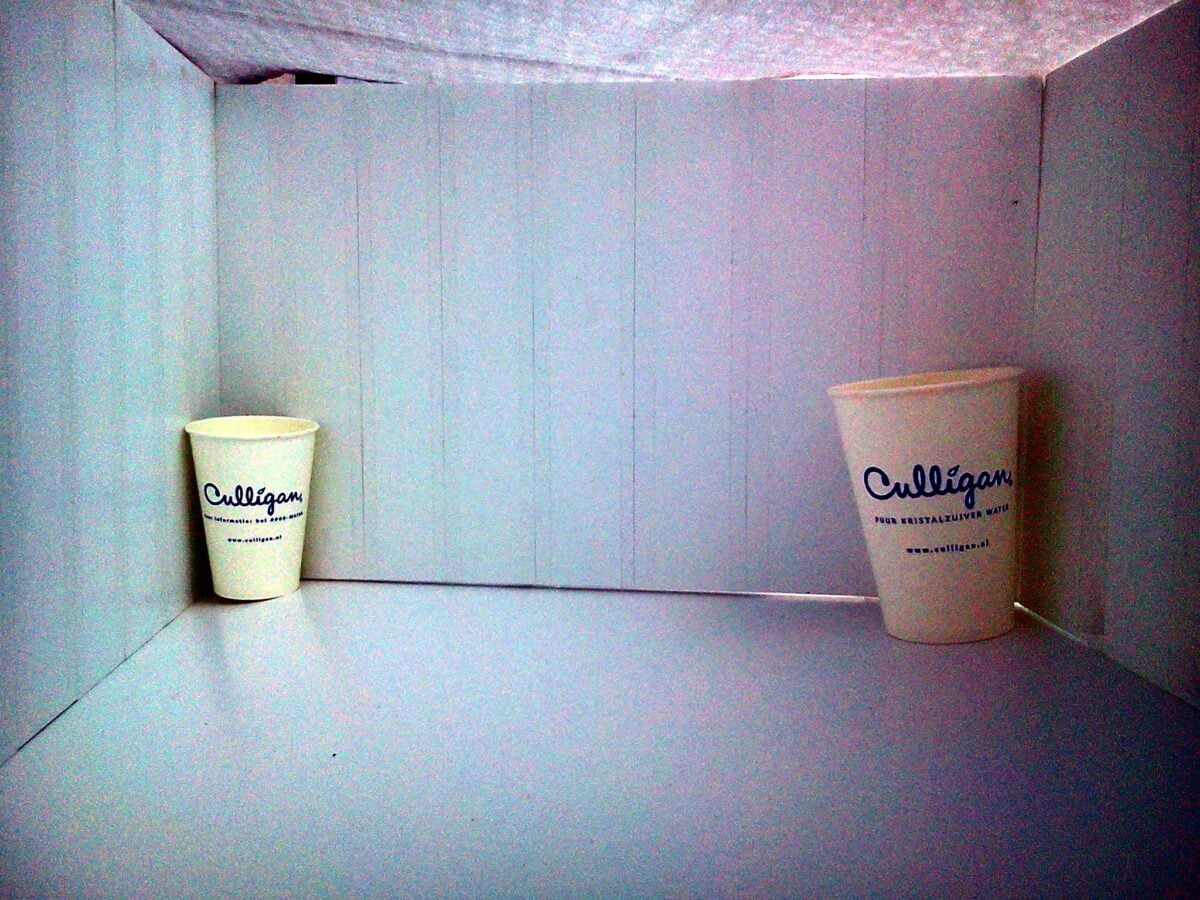
Designed by American ophthalmologist Adelbert Ames Jr. in the 1940s, the Ames Room is a physical space built to look like an ordinary rectangular room from a specific viewing angle, but which is in fact radically distorted: the floor slopes, the ceiling is angled, and the walls lean in unusual directions. When viewed through a peephole at the designed angle, the room looks normal — and people standing in different corners appear to dramatically change size as they walk across it, with one person appearing to shrink and another to grow.
The illusion exploits the brain’s assumption that rooms are rectangular: confronted with contradictory information, the brain chooses to preserve the room shape and distort the people. What is interesting to researchers is that the illusion weakens significantly when observers are familiar with the people inside the room — emotional connection to a person partially overrides the geometric deception.
The Troxler Effect — Things That Disappear When You Stare at Them
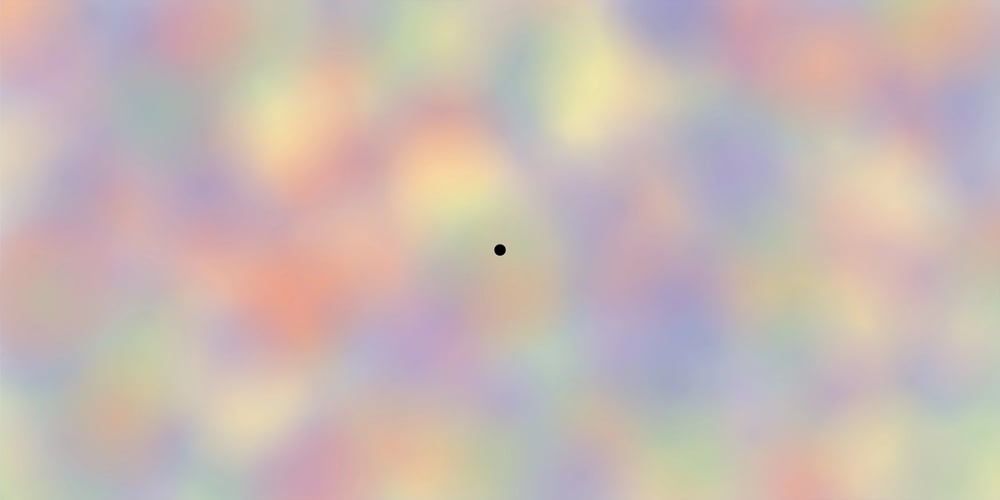
First documented by Swiss physician Ignaz Paul Vital Troxler in 1804, the Troxler Effect describes the fading of an unchanging visual stimulus in the peripheral field when the viewer fixates on a central point. The peripheral stimulus — a blurred colored shape, a fuzzy patch — simply disappears from perception after a short period of fixation.
The brain stops processing visual information that isn’t changing, effectively deciding the unchanged peripheral information isn’t worth the neural resources. What makes the Troxler Effect scientifically interesting is how extreme it can be — entire colored rings can disappear completely — and how poorly the exact level of neural processing at which the fading occurs has been established.
Research suggests it happens at least partly in the brain rather than exclusively in the retina, but the precise locus is still studied.
The Ebbinghaus Illusion — Circles That Change Size Based on Their Neighbors

Two circles of identical size appear different — one larger, one smaller — based on the sizes of the circles surrounding them. When surrounded by large circles, the central circle appears smaller than when surrounded by small circles.
The Ebbinghaus Illusion is widely used in research because it interacts with other cognitive systems in unexpected ways: it influences how much food people put on plates (smaller plates make portions look larger), and it appears to affect motor behavior differently from conscious size perception, suggesting the illusion may affect the perception pathway but not the action pathway equally. That dissociation — between what you see and what your hand reaches for — is one of the most actively studied aspects of the illusion, and the relationship between the two pathways remains an open research question.
The Ponzo Illusion — Depth Cues That Override Reality
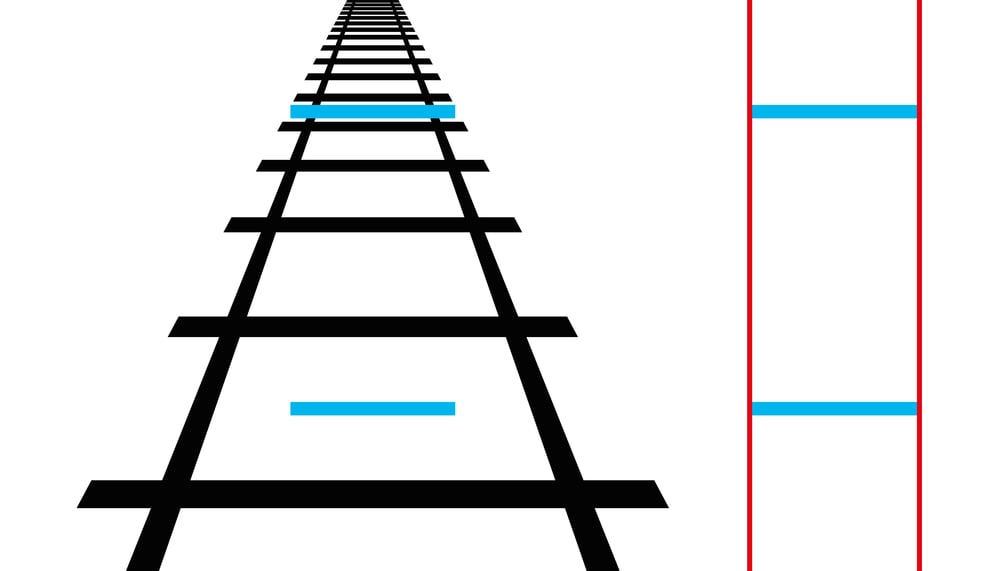
Two horizontal lines of equal length are placed across a pair of converging lines (like railway tracks receding into the distance). The upper line appears longer. The explanation involves the brain applying depth perception logic to a two-dimensional image: in a three-dimensional scene, the upper line would be farther away and therefore, to subtend the same angle on the retina, would have to be larger.
The brain applies this logic automatically, making the upper line appear larger even though it isn’t. The Ponzo Illusion demonstrates that size constancy — the brain’s mechanism for perceiving consistent sizes despite varying distances — can be triggered by implied depth cues rather than actual depth, and the degree to which this is automatic rather than learned remains studied.
The Lilac Chaser — Dots That Vanish and Turn Green
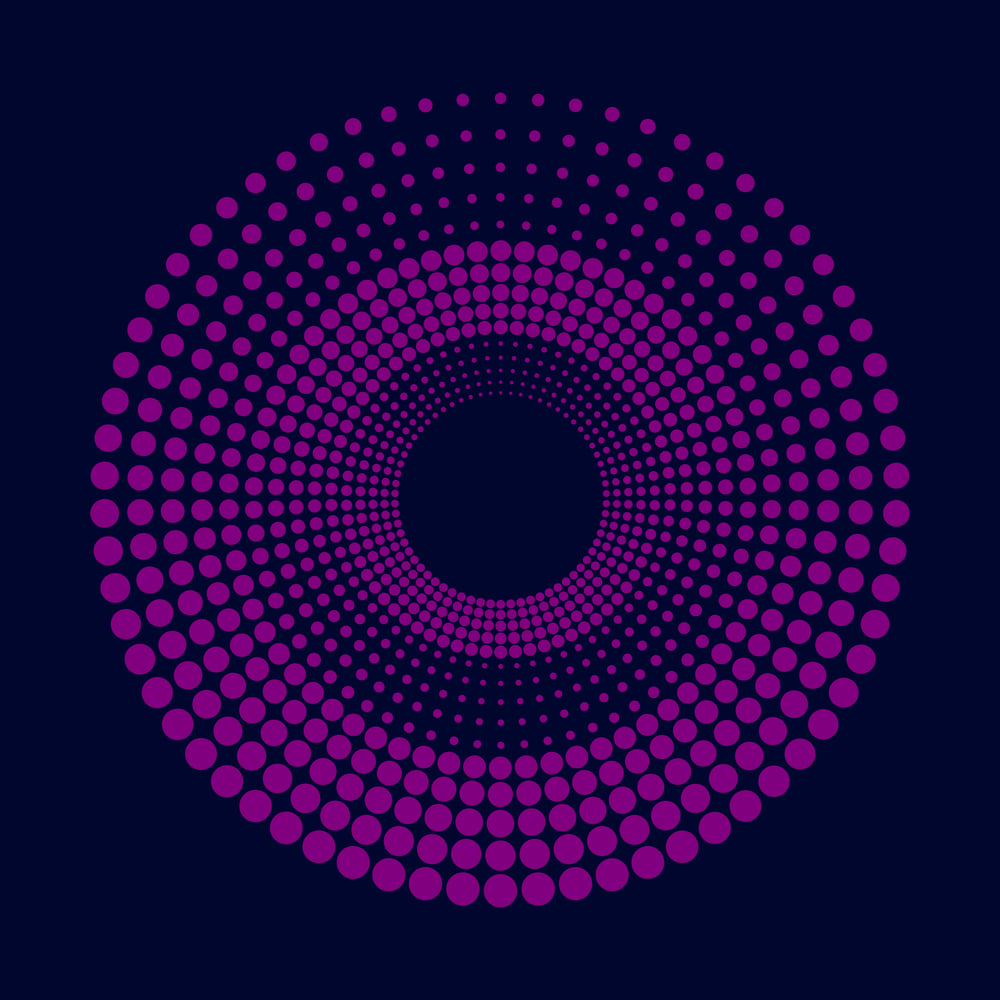
Twelve lilac dots arranged in a circle around a central fixation cross blink off one at a time in a clockwise sequence. After a few seconds of fixation, two things happen that should not be happening.
First, the remaining lilac dots begin to fade and disappear due to the Troxler Effect. Second, the dot that blinks off appears to be replaced by a moving green dot — the complementary color afterimage of lilac — which then appears to chase around the circle like a traveling light.
The full experience involves two separate perceptual phenomena operating simultaneously, producing an emergent effect that is more than the sum of either part. The interaction between the afterimage and the fading effect, and exactly how the brain synthesizes them into a single traveling green dot experience, is not completely resolved.
The Necker Cube — The Brain Refuses to Commit
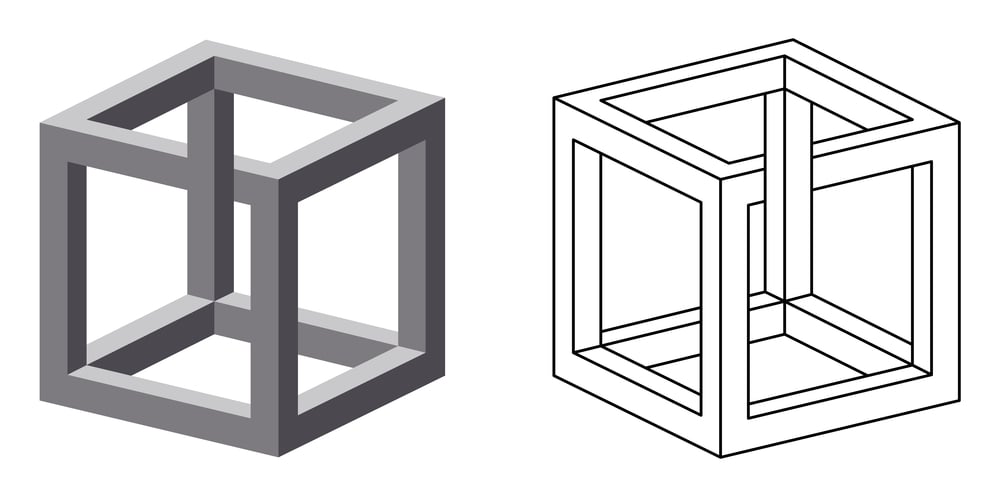
A simple line drawing of a cube — twelve edges, no shading, no depth cues — is perceived as a three-dimensional object by virtually all observers. The ambiguity is that the cube can be interpreted as projecting forward-left or forward-right, and the brain spontaneously alternates between the two interpretations.
First described by Swiss crystallographer Louis Albert Necker in 1832, the Necker Cube is one of the oldest studied ambiguous figures and remains one of the most used in consciousness research because the flip between interpretations is believed to represent genuine competition between neural processes for perceptual dominance. The speed at which individual observers’ percepts flip — and what determines that speed — varies considerably and is still studied in relation to attention, fatigue, and individual neural architecture.
The Hering Illusion — Straight Lines That Bow
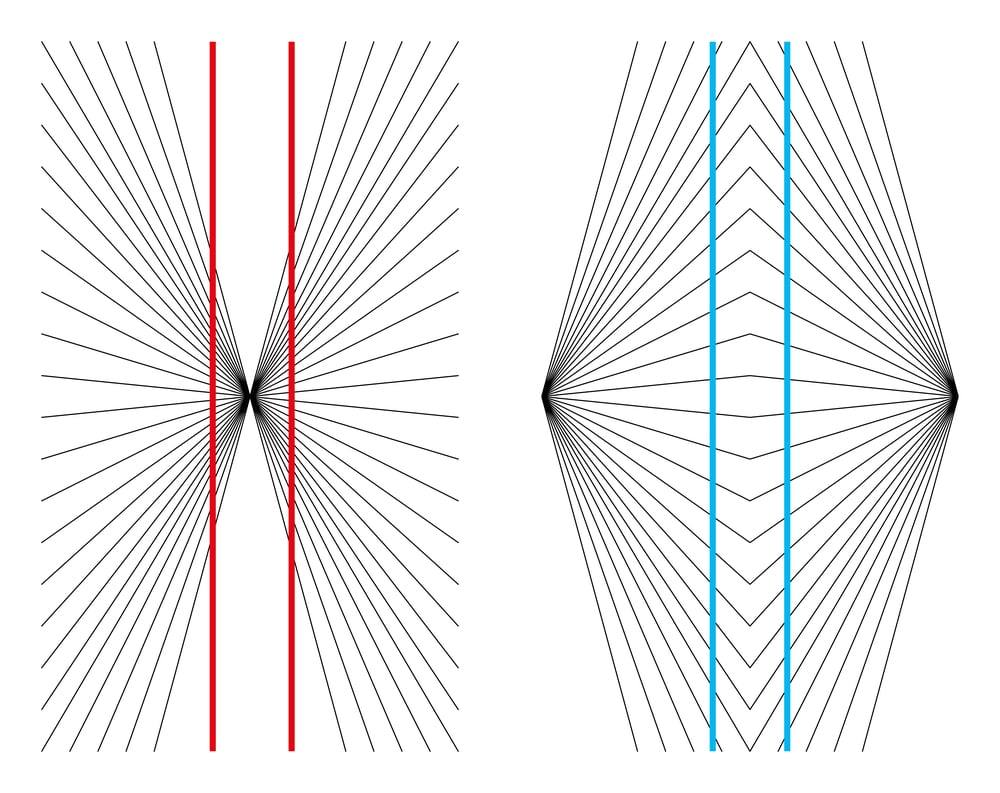
Two perfectly straight and parallel vertical lines are placed in front of a starburst of radiating lines. The parallel lines appear to bow outward, curving away from each other at the center. First described by German physiologist Ewald Hering in 1861, the illusion is thought to involve the visual system’s angular orientation detectors being influenced by the surrounding radiating pattern.
The exact mechanism by which radial background patterns produce orientation errors in straight lines — and why the brain’s orientation-detection system is susceptible to this kind of interference rather than filtering it out — remains an active area of investigation.
The Fraser Spiral — Circles That Appear to Spiral
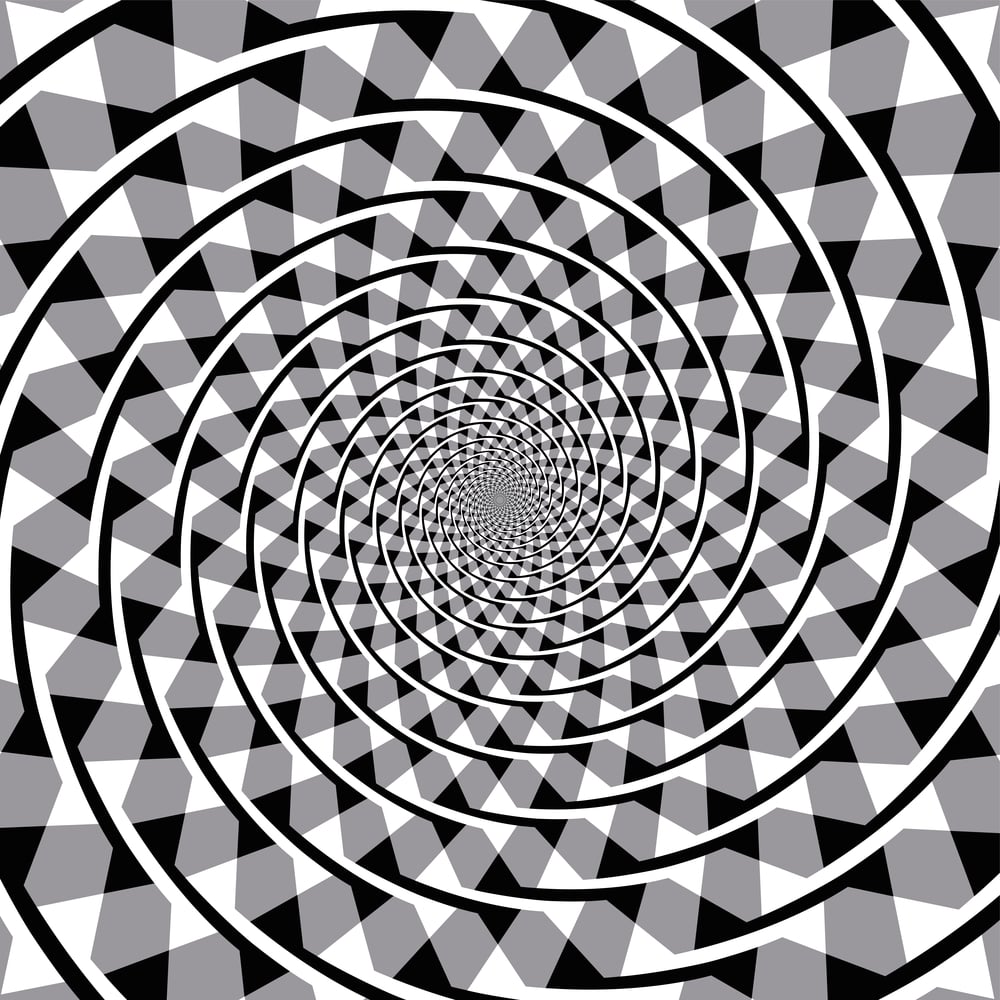
A pattern of overlapping twisted cords arranged concentrically is perceived as a continuous inward spiral rather than a series of independent concentric circles. Tracing any single ring with a finger confirms it is a closed circle that never spirals anywhere. The illusion was first described by British psychologist James Fraser in 1908 and has been studied as an example of how local orientation cues in a pattern can override the brain’s ability to correctly perceive global shape.
The visual system’s tendency to integrate local orientation signals into global percepts in ways that contradict the actual geometry of the image is still being examined in the context of how early and late visual processing interact.
The Kanizsa Triangle — Shapes That Aren’t There
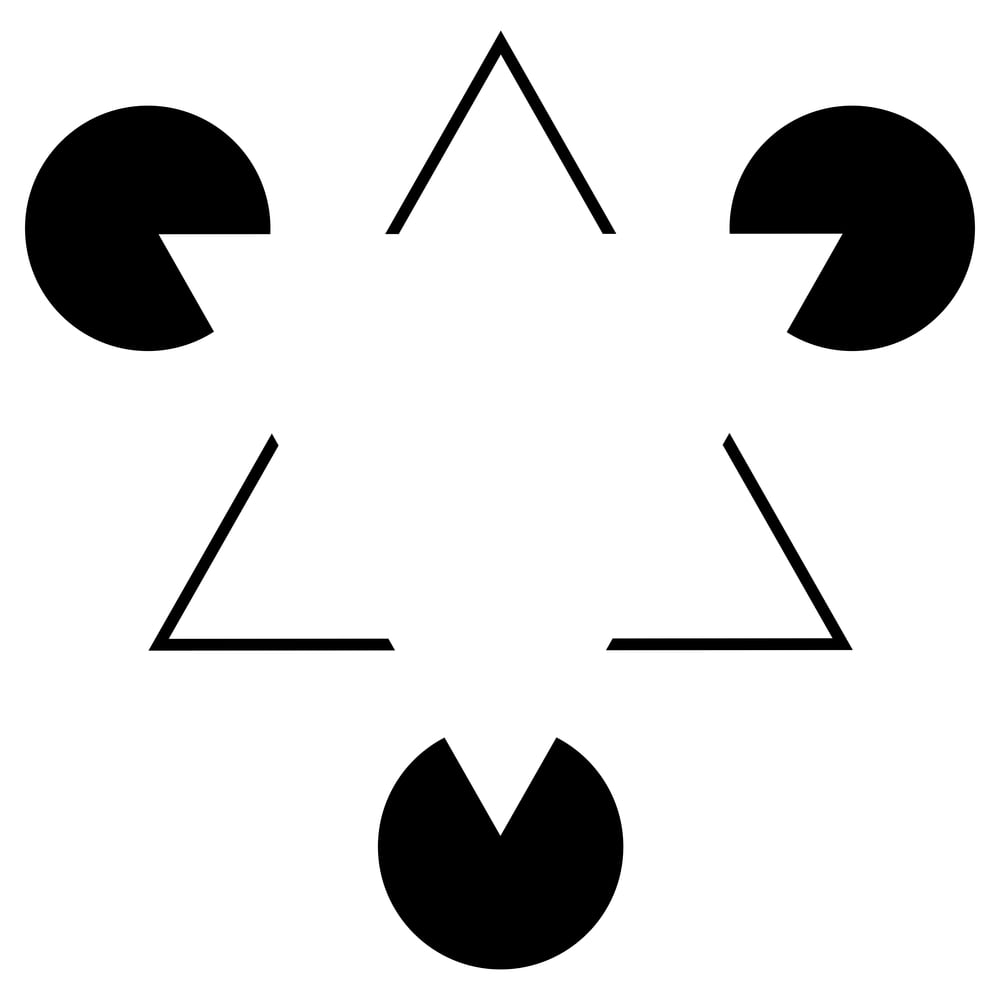
Three “Pac-Man” shapes arranged at the corners of an imaginary triangle produce a vivid perception of a bright white triangle overlaid on the image, complete with apparent edges that do not physically exist. The triangle is so compellingly present that most observers report it as brighter than the background, despite the fact that the white of the “triangle” area and the white of the background are identical.
The brain constructs the triangle as a perceptual hypothesis — a coherent object that explains the three gaps in the Pac-Man shapes. The exact mechanisms of this “illusory contour” construction are studied as a model for how the visual system completes partial information, but the degree to which this involves early versus later visual processing areas, and why the illusory surface appears brighter than the identical background, is still actively debated.
The McCollough Effect — An Illusion That Lasts for Days
One of the most unusual aftereffects in visual science, the McCollough Effect is induced by staring alternately at red-and-black horizontal stripes and green-and-black vertical stripes for several minutes. After this exposure, looking at black-and-white grating patterns produces a dramatic color perception: horizontal patterns appear greenish, vertical patterns appear reddish. The effect can last for hours, and in some cases for days, making it fundamentally different from the brief afterimages produced by other color adaptation phenomena.
Why an effect that persists for days occurs, what neural structures maintain it across sleep and normal visual experience, and why the duration varies so enormously between individuals are questions that distinguish the McCollough Effect from every other afterimage in vision science.
The Dress — When Half a Population Saw Something Different
In February 2015, a photograph of a striped dress went globally viral because observers disagreed irreconcilably about its colors: roughly 70 percent saw it as white and gold, and 30 percent saw it as blue and black. It is actually blue and black.
The disagreement was not cultural or random — it reflected genuine differences in how individual visual systems were interpreting the ambiguous lighting in the photograph, with some brains discounting the blue light as shadow and some not. Neurologists immediately noted that this was the only known naturally occurring ambiguous color image to produce a genuine population split rather than individual-level perceptual switching.
What determines whether any given visual system defaults to assuming the image is in shadow or in light — and why this assumption varies between people — is still being investigated.
What Illusions Show That Vision Cannot

The consistent finding across two centuries of illusion research is that vision is not a recording. The brain does not faithfully capture what the eyes receive. It filters, predicts, completes, adjusts, and sometimes overrides sensory data entirely in favor of what it believes should be there based on prior experience.
That predictive construction is enormously useful — it is why you can recognize a face in poor lighting, read a partially obscured word, or catch an orb in motion. The cost of the predictive system is the illusion: the moment when the prediction conflicts with reality and the brain chooses the prediction.
The most instructive thing about these illusions is not that they fool people — it is that knowing how they work does not stop them from working. Every expert in visual perception who studies the Müller-Lyer illusion still sees the unequal lines.
Every vision scientist who knows Adelson’s squares are the same shade still sees them as different colors. The brain applies its shortcuts before conscious knowledge has a chance to intervene, which is probably exactly why we’re still here to study any of this at all.
More from Go2Tutors!

- The Romanov Crown Jewels and Their Tragic Fate
- 13 Historical Mysteries That Science Still Can’t Solve
- Famous Hoaxes That Fooled the World for Years
- 15 Child Stars with Tragic Adult Lives
- 16 Famous Jewelry Pieces in History
Like Go2Tutors’s content? Follow us on MSN.



