Bridges Connecting Two Countries
Some bridges connect entire nations in addition to spanning rivers. They combine architectural genius with cultural cohesion, serving as symbols of collaboration, trade, and shared history.
These structures, which range from tropical border links to icy northern crossings, serve as a reminder of how infrastructure can literally unite people worldwide. Building bridges between countries requires more than just steel and concrete; it also requires vision, trust, and a common future. Here are the tales of fourteen amazing bridges that span two nations.
Øresund Bridge (Denmark and Sweden)

Stretching nearly five miles across the Øresund Strait, this engineering marvel connects Copenhagen, Denmark to Malmö, Sweden. Opened in 2000, it’s part bridge, part tunnel, and part artificial island—an ambitious design that allows both road and rail traffic to move seamlessly between nations.
Before its construction, travel between the two cities required a ferry, making daily commutes time-consuming and weather-dependent. The Øresund Bridge revolutionized Scandinavian travel, letting commuters live in one country and work in another.
It’s also a symbol of Nordic cooperation—showing how shared goals can bridge even the deepest waters. The connection sparked a cultural exchange between Swedes and Danes, with Malmö’s housing boom driven by Danes seeking affordable living just across the strait.
Ambassador Bridge (United States and Canada)

Linking Detroit, Michigan to Windsor, Ontario, the Ambassador Bridge is one of North America’s busiest international crossings. Opened in 1929, it has weathered decades of economic shifts and remains vital to trade between the two nations.
Around 25% of all U.S.-Canada trade passes over this single bridge—proof of how critical it is to both economies. Despite its industrial appearance, it’s a symbol of endurance and interdependence, representing almost a century of partnership.
It also sparked debates about infrastructure modernization, eventually leading to plans for a new Gordie Howe International Bridge nearby to ease traffic congestion. For millions of travelers and truckers, the Ambassador isn’t just steel—it’s opportunity.
Friendship Bridge (Brazil and Paraguay)

Built over the Paraná River, this bridge connects Foz do Iguaçu in Brazil to Ciudad del Este in Paraguay. Opened in 1965, it serves as a key artery for trade and tourism between the two nations.
Known locally as Ponte da Amizade—the Bridge of Friendship—it’s aptly named. Every day, tens of thousands of people cross it for work, shopping, or leisure. Ciudad del Este thrives as a bustling commercial hub, partly because of this easy access to Brazil’s markets.
Though traffic can be chaotic, the bridge remains a living, breathing symbol of cooperation in South America’s heart. It shows how a shared structure can spark shared prosperity.
Peace Bridge (United States and Canada)

When the Peace Bridge opened in 1927, it wasn’t just about travel—it was about symbolism. Built to mark a century of peace between the United States and Canada after the War of 1812, it connected Buffalo, New York to Fort Erie, Ontario.
The name was chosen through a public contest, reflecting both countries’ desire to celebrate unity. The bridge’s graceful arches and nightly illuminations turn it into a civic landmark, not just a border checkpoint.
Over the years, it has hosted parades, ceremonies, and light shows that reinforce its message: peace and cooperation can be built, quite literally, one beam at a time.
Tienditas Bridge (Colombia and Venezuela)

Completed in 2016, the Tienditas Bridge links Cúcuta, Colombia, with Táchira, Venezuela. Though designed to ease congestion and boost trade, the bridge became an unintended political symbol when border tensions prevented it from opening fully.
Despite being blocked for years, it remains a powerful metaphor for potential—proof that infrastructure alone can’t unite nations without mutual goodwill. In recent years, reopening talks have revived hope that the bridge may soon serve its original purpose.
For locals, it stands as a quiet reminder that roads and rivers don’t divide people—politics does.
Sault Ste. Marie International Bridge (United States and Canada)

Few crossings are as scenic as the Sault Ste. Marie Bridge connecting Michigan and Ontario. Opened in 1962, it stretches across the St. Marys River near the Great Lakes’ Soo Locks, which are among the busiest inland waterways in the world.
The bridge links two communities that share more than a name—they share a way of life rooted in shipping, fishing, and northern hospitality. During winter, it glistens under snow and ice, while summer brings lines of tourists heading north.
Economically, it supports vital trade, but culturally, it connects families and traditions across the border.
Europa Bridge (Austria and Italy)
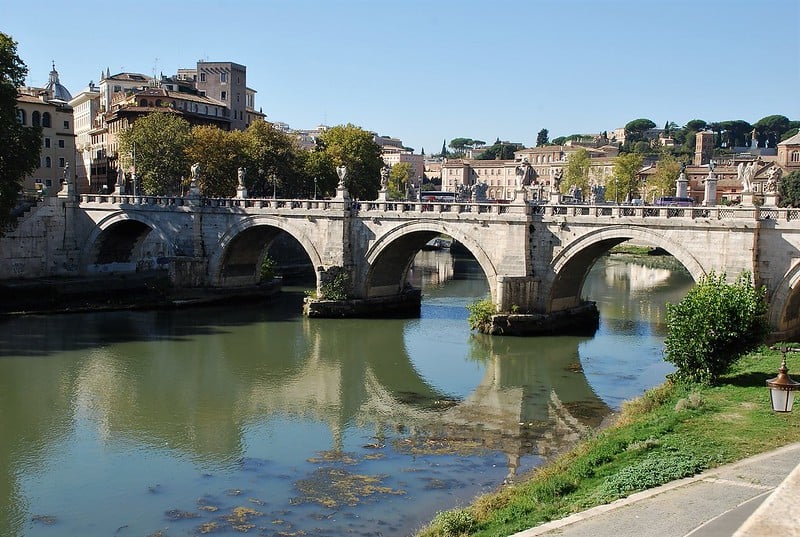
Rising high over the Sill River Valley, the Europa Bridge stands as a literal gateway between northern and southern Europe. Completed in 1963, it soars more than 600 feet above the ground, offering breathtaking views of the Alps.
As part of the Brenner Pass highway, it’s one of Europe’s busiest routes for freight and tourism alike. Its name—Europabrücke—captures its spirit: uniting people, trade, and ideas across borders.
During its construction, it represented postwar unity and the dream of a connected continent, long before the European Union came into being. Even today, drivers crossing it can sense that blend of beauty, engineering, and meaning.
Friendship Bridge (Thailand and Laos)

The first Thai-Lao Friendship Bridge, funded by Australia, opened in 1994 to connect Nong Khai, Thailand, with Vientiane, Laos. Before it existed, ferries carried passengers across the Mekong River—a slow, unpredictable process.
The new bridge transformed regional trade and gave Laos greater access to Southeast Asia’s economy. Its success inspired additional Friendship Bridges, each strengthening political and economic ties.
More than infrastructure, these bridges represent Southeast Asia’s gradual shift from isolation to integration.
Hong Kong–Zhuhai–Macau Bridge (China)

This 34-mile bridge-tunnel system links Hong Kong with Macau and mainland China, making it one of the world’s longest sea crossings. Completed in 2018, it includes a remarkable underwater tunnel section that allows ships to pass above.
The project took almost a decade to build and cost billions, but its scale and ambition are unmatched. It reduced travel time from three hours to just 30 minutes, connecting major economic hubs into a single super-region.
While it showcases China’s engineering might, it also reflects the country’s broader push toward regional integration and connectivity.
International Railway Bridge (United States and Mexico)

Running across the Rio Grande between Laredo, Texas, and Nuevo Laredo, Mexico, this bridge has carried freight trains since 1889. It’s one of the oldest active international crossings in North America.
Every day, long trains rumble across carrying cars, produce, and industrial goods—vital trade that supports both economies. Though it’s less glamorous than other bridges, it plays a crucial role in NAFTA-era commerce.
For border communities, it’s both a lifeline and a symbol of enduring partnership, proof that the relationship between neighbors is built on movement and trust.
King Fahd Causeway (Saudi Arabia and Bahrain)
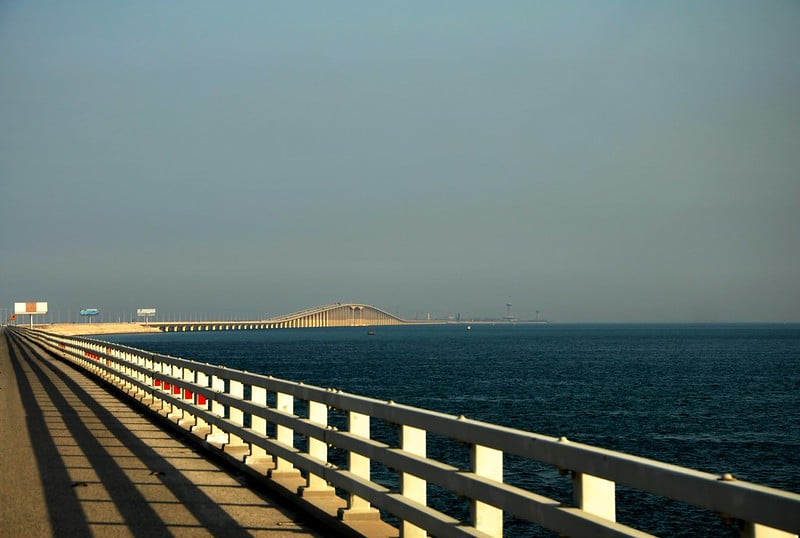
Opened in 1986, the King Fahd Causeway stretches 16 miles across the Arabian Gulf, linking Saudi Arabia to Bahrain. It’s a lifeline for Bahrain’s economy and a vital connection for Saudi travelers seeking leisure across the water.
The mid-point border island is fitted with customs and immigration centers, restaurants, and panoramic viewpoints, offering one of the best sea vistas in the Gulf. Beyond trade and travel, the causeway embodies Gulf cooperation—an example of how infrastructure can reinforce both friendship and stability in a rapidly modernizing region.
Sixaola River Bridge (Costa Rica and Panama)

Opened in 2021, this modern bridge replaced an old railway link between Costa Rica and Panama. The new design includes lanes for vehicles, pedestrians, and cyclists, creating a safe and efficient connection for border communities.
Funded jointly by both governments with international support, the project improved trade logistics and boosted eco-tourism in the region. Its opening marked a milestone for Central America—proof that cooperation and shared vision can modernize even the most remote crossings.
Kazungula Bridge (Zambia and Botswana)

Completed in 2021, the Kazungula Bridge connects Zambia and Botswana over the Zambezi River. Its striking curve and cable-stayed design replaced a slow ferry system, dramatically improving transport efficiency.
The bridge also forms part of a larger trade corridor linking several African countries, helping reduce congestion at regional borders. It’s a powerful example of modern Africa investing in its own connectivity.
By easing the flow of goods and people, the bridge supports economic growth while promoting unity in southern Africa.
Where Steel Meets Diplomacy

More than just automobiles, these bridges represent shared progress, hope, and trust. They demonstrate how architecture has the same power to influence international relations as politics or diplomacy.
These crossings demonstrate how engineering can act as a unifying language, showcasing both Scandinavia’s elegant designs and Africa’s daring inventions. Every concrete and steel span also makes the statement that collaboration creates stronger foundations than isolation ever could.
There will always be avenues for connection as long as bridges are being built between nations, demonstrating that humanity is, at its best, able to transcend boundaries.
More from Go2Tutors!

- The Romanov Crown Jewels and Their Tragic Fate
- 13 Historical Mysteries That Science Still Can’t Solve
- Famous Hoaxes That Fooled the World for Years
- 15 Child Stars with Tragic Adult Lives
- 16 Famous Jewelry Pieces in History
Like Go2Tutors’s content? Follow us on MSN.