Cars With Design Mistakes You’ll Notice
Automotive design seems straightforward enough on paper.
Make it look appealing.
Ensure it functions properly.
Avoid creating something that might accidentally kill people or make them regret their purchase.
Yet somehow, throughout automotive history, car manufacturers have managed to bungle even these basic requirements with stunning regularity.
From poorly placed buttons that turn off engines mid-drive to structural designs that transform vehicles into rolling hazards, the industry’s track record includes some truly baffling decisions.
Some mistakes were subtle oversights that only revealed themselves after thousands of units hit the road.
Others were so glaringly obvious that you wonder how they ever made it past the initial design review.
Here’s a closer look at some of the most notable automotive design blunders that drivers couldn’t help but notice.
Pontiac Aztek
The Pontiac Aztek started with promise as a concept dubbed ‘Bear Claw’ that aimed to blend the handling of a Camaro with the practicality of a Blazer.
Corporate penny-pinching forced designers to slap the design onto an existing minivan platform.
What emerged in 2000 looked like several different vehicles welded together by someone who’d never actually seen a car before.
The production version featured odd proportions completely different from the concept.
It had hideous 18-inch plastic cladding around the base, a redesigned hood somewhat uglier than the concept, and comically small three-spoke wheels.
The Aztek didn’t just fail market research—it scored dead last, with respondents saying they wouldn’t take it as a gift.
Yet GM pushed forward anyway, thanks to a management culture that silenced critics and rejected negative feedback.
Sales never reached the 30,000 level needed to make money, and production abruptly ended after just a few years.
The Aztek has since become automotive shorthand for design failure, referenced in software engineering textbooks as an example of what happens when you compromise quality from the start.
Lincoln MKC Start Button

Imagine cruising down the highway, reaching to adjust your radio or engage sport mode, and accidentally shutting off your engine entirely.
The 2015 Lincoln MKC positioned its engine start/stop button directly underneath the shift button options, causing drivers to accidentally turn off their cars while trying to work controls.
This wasn’t just inconvenient—it was genuinely dangerous.
Losing power while moving at highway speeds creates a hazardous situation where steering becomes difficult and brake assistance disappears.
Lincoln eventually issued a recall to relocate the button, but the damage to the brand’s reputation was done.
It’s the sort of flaw that makes you question whether anyone actually test-drove the vehicle before sending it to dealerships.
Sometimes the simplest design choices—like where to place a button—matter more than all the luxury features combined.
Reliant Robin

The British-made Reliant Robin had a certain charm with its affordable price and the fact you only needed a motorcycle license to drive it in Britain.
Its three-wheel design made it unstable around curves.
This instability wasn’t just a minor handling quirk—it was a fundamental physics problem that no amount of driver skill could fully overcome.
The vehicle became infamous for tipping over during routine maneuvers that would pose no problem for a conventional four-wheeled car.
Even one of the Robin’s original designers listed its flaws: steering wheels that would detach, cracking doors, and an inability to back up.
When your own designer admits the steering wheel might come off in your hands, you know there’s a problem.
The Robin has since achieved cult status as a rolling monument to questionable engineering choices, immortalized in comedy sketches showing it tumbling over at every turn.
Volkswagen Fox Seat Mechanism

Most cars don’t require warning labels about potential finger amputation, but the Volkswagen Fox wasn’t most cars.
The Fox injured many people’s fingers as they tried to lower a backseat to enlarge the compact car’s trunk space.
The cars had to be recalled for a fix.
The mechanism apparently had sharp edges or pinch points that could catch unwary hands during what should have been a routine adjustment.
It’s a peculiar failure that highlights how even small details matter in automotive design.
Seat folding mechanisms exist on countless vehicles without incident, yet somehow VW managed to create one that doubled as a finger guillotine.
The recall addressed the issue, but not before earning the Fox a reputation as the car that literally bit back at its owners.
Early Audi TT Rear Instability

After at least five deaths were confirmed to be caused by the early Audi TT’s lack of rear-end stability, Audi was forced to scramble for mechanical fixes.
These included redesigned rear suspension components and a strategically designed spoiler.
The sleek, aerodynamic design that made the TT so visually appealing apparently created dangerous lift at highway speeds, particularly during sudden maneuvers.
The problem was most prominent in European markets where autobahn speeds regularly exceeded 100 miles per hour.
Audi’s response included offering an early electronic stability control system and making the mechanical fixes standard under recall.
The controversy affected Audi globally, even in markets where the high-speed instability was less likely to manifest.
It served as a stark reminder that aesthetic appeal means nothing if the car becomes unpredictable when driven enthusiastically—exactly what sports car buyers tend to do.
Subaru Head Gasket Failures

Older Subaru boxer-four motors blew head gaskets like it was their job.
Head gasket replacement became a mandatory consideration when shopping for a high-mileage Subaru as a winter beater.
This wasn’t a random defect affecting a small batch—it was a widespread, predictable failure that Subaru owners came to accept as inevitable.
The horizontal boxer engine configuration, while offering benefits like a lower center of gravity, apparently made proper head gasket sealing more challenging than conventional vertical engine designs.
Prospective buyers learned to immediately ask whether head gaskets had been replaced already.
This turned what should have been a reliability advantage into a known liability.
Subaru eventually addressed the issue in newer models, but for years, the head gasket problem was simply part of the ownership experience.
It’s the automotive equivalent of a chronic condition—not immediately catastrophic, but guaranteed to drain your wallet eventually.
Nissan GT-R Launch Control Warranty Denial

Early Nissan GT-R owners felt betrayed when their transmissions began to fail after using launch control a couple of times and Nissan denied them warranty coverage.
The GT-R was marketed as a performance vehicle designed to deliver supercar acceleration, with launch control as a featured capability.
Yet actually using this advertised feature apparently destroyed transmissions with alarming regularity, and Nissan refused to cover repairs.
It created a bizarre situation where owners paid premium prices for performance capabilities they couldn’t actually use without voiding their warranty.
The logical question became: why install launch control if using it breaks the car?
Nissan eventually adjusted their position, but not before alienating customers who reasonably expected their performance vehicle to handle performance driving.
It’s a reminder that engineering features and actually making them reliable are two different challenges.
Porsche IMS Bearing Failures

All Boxsters, Caymans, and 911s from 1999-2008 (except turbo and GT3 models) had some version of intermediate shaft bearing failures that could cause potentially catastrophic engine damage.
This design flaw affected what should have been the golden era of accessible Porsche sports cars.
The IMS bearing, tucked deep inside the engine, could fail without warning, destroying the entire motor and requiring a complete rebuild.
This flaw is one of the prime reasons you can find 996-generation 911s and early Boxsters so cheap.
What looks like a bargain on paper comes with the sword of Damocles hanging over every drive—will today be the day the bearing lets go?
Many owners preemptively replaced the bearing at significant cost, turning routine maintenance into major surgery.
It’s a cautionary tale about how a single small component can torpedo the value and reputation of an entire model range.
Alfa Romeo Timing Belt Design

Thanks to poorly designed timing systems with short, weak timing belts that came out of tension easily, certain Alfa Romeo V6 engines were prone to rebuilds from early on.
Owners lived in fear every time they parked on steep hills.
The timing belts were so prone to failure that something as routine as parking could potentially trigger catastrophic engine damage if the handbrake failed and the car rolled.
This created a uniquely Italian ownership experience where passion for the brand was tested by engineering decisions that defied explanation.
Timing belts are meant to be routine maintenance items, not ticking time bombs.
Yet Alfa somehow managed to create a system so fragile that gravity itself became a threat.
It’s the sort of flaw that builds character in owners—or sends them fleeing to more reliable German or Japanese competitors.
Tesla Model 3 Control Issues

The 2024 Tesla Model 3 has the highest number of complaints relative to sales.
Turn signal buttons on the steering wheel sometimes fail, and horns become muffled or stop entirely after rain or snow exposure.
For a vehicle marketed as the future of automotive technology, having basic safety features like turn signals and horn malfunction is particularly troubling.
The touchscreen, which controls most functions, can freeze or crash, disrupting navigation, climate control, and other features.
Tesla’s minimalist interior design philosophy may look sleek, but it created single points of failure that affect multiple critical systems.
When your horn stops working because it got wet, you’re dealing with fundamentally poor weatherproofing.
When turn signals become unreliable, you’re gambling with basic road safety.
The Model 3 proves that advanced technology doesn’t excuse fundamental engineering oversights that conventional automakers solved decades ago.
Chevrolet Vega Quality Issues
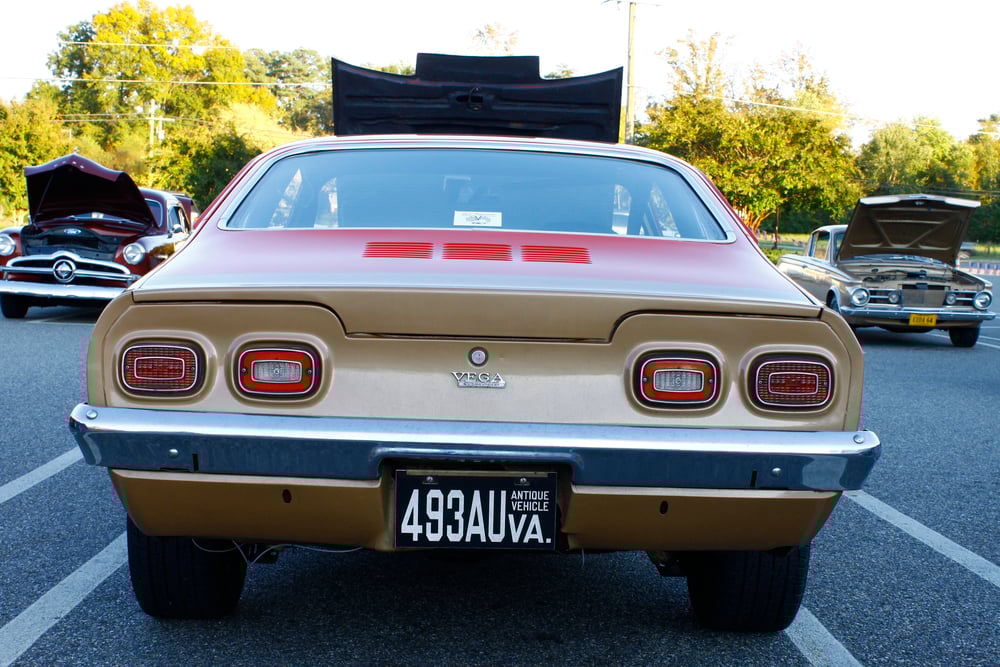
The Chevrolet Vega had a big rust issue.
Its engine frequently failed.
It drank oil like it was dying of thirst.
Since the Vega sold so strongly—almost 2 million were built before it left production after 1977—hundreds of thousands of buyers were having awful experiences with the car.
This created a generation of disappointed Chevrolet customers who learned the hard way that attractive styling doesn’t compensate for fundamental quality problems.
The Vega’s failures were particularly damaging because they were so widespread and consistent.
This wasn’t a batch of defective parts—it was systematic problems affecting nearly every vehicle produced.
Owners dealt with rust appearing within the first year, engines that consumed quarts of oil between changes, and mechanical failures that started embarrassingly early in the vehicle’s life.
The Vega became a textbook case of how cost-cutting and rushing to market can destroy a brand’s reputation for years.
Looking Back, Moving Forward

These design failures share common threads that manufacturers hopefully learned from.
Many stemmed from corporate pressure to cut costs or rush production schedules.
Others emerged from design-by-committee approaches where too many voices diluted vision into compromise.
Some failures were simply engineering oversights that should have been caught during testing but somehow slipped through.
More from Go2Tutors!

- The Romanov Crown Jewels and Their Tragic Fate
- 17 Halloween Costumes Once Considered Taboo
- Famous Hoaxes That Fooled the World for Years
- 15 Child Stars with Tragic Adult Lives
- 16 Famous Jewelry Pieces in History
Like Go2Tutors’s content? Follow us on MSN.