Classic Sitcom Sets and Where They Are Now
We want to travel to the worlds that sitcoms on television create.
Viewers welcomed these made-up places into their living rooms for decades, following characters as they lived in homes, bars, and apartments that were just like our own.
In our collective memory, the coffee shops, kitchens, and couches became iconic.
But what happened to these cherished sets after the laugh tracks faded and the cameras stopped rolling?
While some were demolished and forgotten, others were resurrected as tourist attractions, and a handful experienced incredible metamorphoses that restored their prominence.
The journey of these iconic sets tells us as much about the practical realities of television production as it does about our relationship with nostalgia.
These are the locations of some of the most iconic sitcom scenes.
Friends and Central Perk

The actual Central Perk set from Friends is currently on display at Warner Bros. Studio Tour Hollywood in Burbank, California, housed inside Stage 48.
Visitors can sit on the famous orange couch and order coffee at a functioning Central Perk cafe that serves drinks in branded cups.
Everything on the set except for the mugs, fake food, and Phoebe’s guitar were used during the show’s original run.
The studio tour has become one of the most popular attractions for Friends fans, offering a chance to experience the coffeehouse that served as the gang’s hangout for ten seasons.
The preservation of this set represents a shift in how networks think about television history.
Rather than dismantling everything once a show wraps, Warner Bros. recognized the enduring appeal of these spaces and invested in maintaining them as permanent attractions.
For fans who grew up watching the show, sitting on that orange couch offers something streaming services can’t replicate — a physical connection to a fictional world that shaped their understanding of friendship and young adulthood.
Seinfeld’s Apartment

The apartment building used for exterior shots of the main character’s home stands at 757 South New Hampshire Avenue in Los Angeles’ Koreatown neighborhood, not on Manhattan’s Upper West Side where the show was supposedly set.
The five-story building, known in real life as the Shelley, was built in 1928 and remains relatively unchanged from its appearance on the show.
Passing by without prior knowledge, you’d likely miss its television significance entirely — the tight framing used in establishing shots makes the full building nearly unrecognizable.
The actual apartment interiors were filmed on a soundstage at CBS Studio Center and were dismantled after production ended in 1998.
In 2015, a pop-up Seinfeld exhibit in New York’s Meatpacking District recreated the apartment for five days when the show began streaming on Hulu.
The recreation captured the look and feel of the original set, giving fans a chance to experience the space where so many iconic moments unfolded.
The temporary nature of that display underscores how Seinfeld’s production team, unlike some later shows, didn’t preserve the sets for permanent exhibition.
Tom’s Restaurant on Broadway still operates as the real-world counterpart to Monk’s Cafe, serving customers who recognize it from countless exterior shots.
Cheers Bar
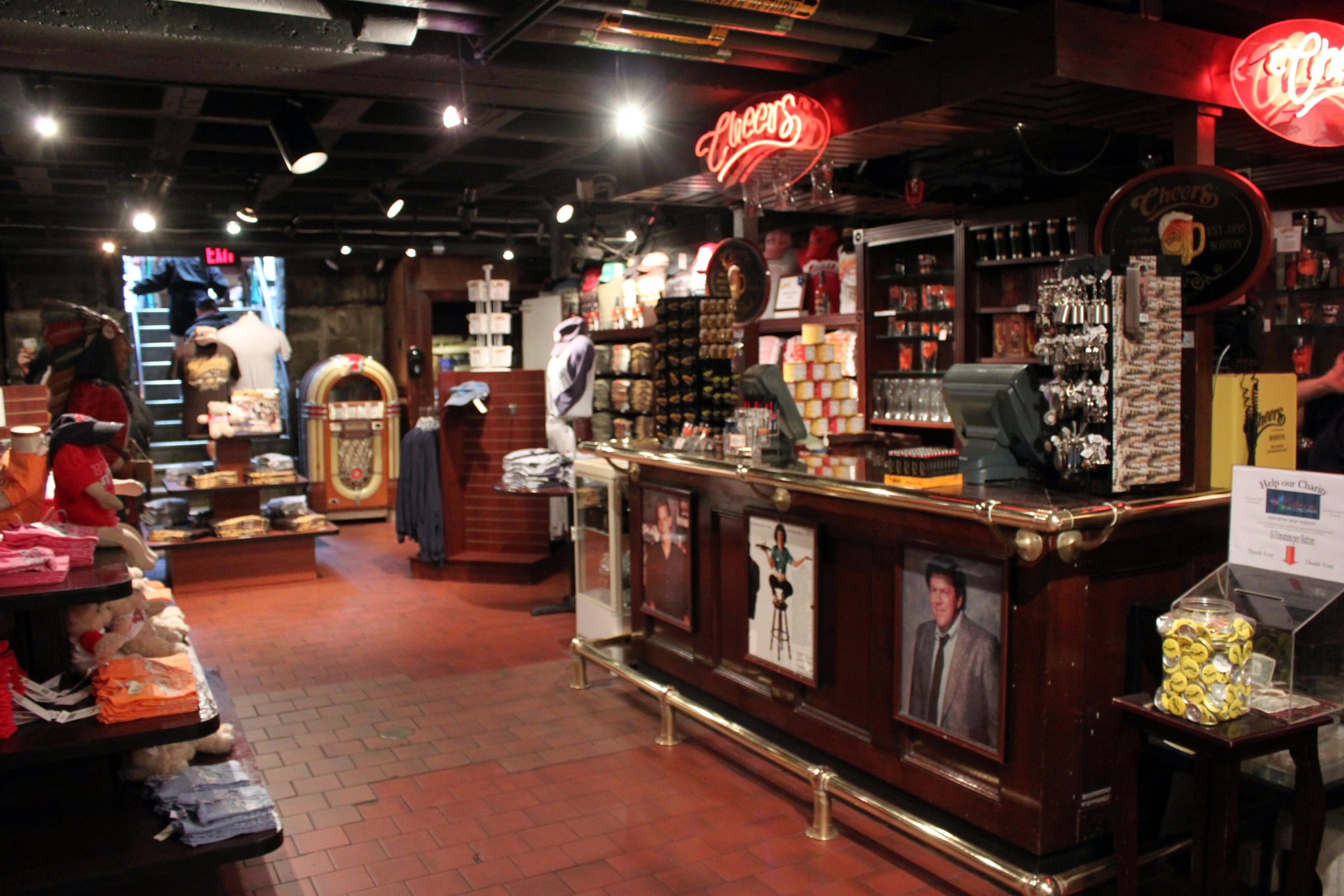
The Bull & Finch Pub in Boston, which inspired Cheers and provided its exterior shots, changed its name to Cheers Beacon Hill in 2001 as part of a licensing deal with CBS Studios.
The pub is located at 84 Beacon Street across from Boston Public Garden and has become one of Boston’s major tourist destinations.
The basement pub’s interior never resembled the spacious TV set, leading the owner to add a ground-floor replica bar that matches the on-screen version fans remember.
The licensing agreement allows the pub to sell Cheers-branded merchandise, and that deal has proven lucrative for decades.
Tourists purchase everything from shot glasses to apparel emblazoned with the show’s logo.
The actual bar set from the television show had a different fate — while some props were displayed in temporary exhibits over the years, the complete set wasn’t preserved as a permanent installation.
Even so, the Boston pub continues thriving, drawing steady crowds of visitors who want to visit the place where everybody knows your name — or at least pretends to.
The Brady Bunch House

HGTV purchased the Brady Bunch house in Studio City, California for $3.5 million in 2018, then spent an additional $1.9 million transforming its interior to match the TV set that had only ever existed on a Paramount Studios soundstage.
The renovation team had to add over 2,000 square feet of space and dig into the foundations to create the iconic open staircase, since the original 1959 house was a single-story structure.
The resulting transformation drew 8.1 million viewers for the premiere of ‘A Very Brady Renovation’ — an all-time record for HGTV.
The house sold again in 2023 for $3.2 million to collector Tina Trahan, who stated she plans to use it for charitable events and fundraisers rather than as a residence.
The property draws constant visitors to the quiet Studio City neighborhood at 11222 Dilling Street.
Security guards manage the steady stream of fans who drive by hoping to glimpse the split-level facade that represents 1970s domestic bliss.
The house remains a private residence, though its cultural significance far exceeds its function as mere real estate.
What Happened to the Rest

Not every beloved sitcom set survived into the present.
Many were simply dismantled once production wrapped, their pieces scattered or destroyed.
The Golden Girls filmed its exterior shots on the Disney backlot, which was later used for Desperate Housewives — that facade was demolished in 2003, over a decade after the show ended.
The interior sets were struck after the final episode in 1992, with no effort made to preserve them.
What remains exists only in photographs and reruns.
Full House’s iconic San Francisco Victorian is located at 1709 Broderick Street.
The real house has different owners who’ve dealt with tourist traffic for decades, while the interior sets vanished long ago when production wrapped.
The Fresh Prince of Bel-Air mansion presents a similar case.
The exterior shots featured a real Brentwood estate at 251 North Bristol Avenue, but the interior was entirely a soundstage creation.
Neither has been preserved for public viewing, though the exterior house occasionally makes headlines when it changes hands in real estate transactions.
I Love Lucy’s apartment set, despite being one of television’s first iconic domestic spaces, was dismantled after the show ended in 1957.
Some props and costumes ended up in museums, but the complete set disappeared into television history.
The same fate befell countless other shows from television’s early decades, before anyone recognized these sets might have value beyond their immediate production needs.
Why Some Survived

The difference between preservation and destruction often came down to timing and corporate ownership.
Friends and The Brady Bunch benefited from networks and production companies recognizing the enduring value of these properties long after the shows ended.
Warner Bros. maintained the Friends set as part of its studio tour infrastructure, understanding that nostalgia could drive tourism revenue for decades.
HGTV’s Brady Bunch renovation proved that iconic television properties could generate massive audiences and justify significant investment even 50 years after a show’s premiere.
Earlier shows like Cheers succeeded through a different path — the real-world location became so associated with the series that it essentially became the set, regardless of how little the actual filming happened there.
The Bull & Finch Pub capitalized on that association, transforming itself into the thing it had only inspired.
Still, even with careful planning and preservation, the longevity of these sets isn’t guaranteed.
They require ongoing maintenance, continued public interest, and owners willing to treat them as cultural artifacts rather than mere real estate.
Where Memory Lives

There is more to these preserved sets than just nostalgia tourism.
They serve as tangible reminders of shared memory and evidence that the virtual worlds we saw on TV had some foundation in three dimensions.
A connection to locations that influenced millions of people’s perceptions of friendship, community, and domestic life is something that photos cannot capture.
This is what it is like to stand in Central Perk or see the Brady Bunch house.
Someone realized the sets were more than just paint and carpentry, which is why they survived.
They are time capsules that preserve not only the aesthetics of certain eras’ designs but also the relationships and ideals those areas stood for.
The physical sets offer a concrete link to television history, even as younger generations learn about these series through streaming services.
They serve as a reminder that actual artisans were creating something that was supposed to feel like home behind every fictional setting.
Whether meticulously preserved in studio warehouses or converted into operational businesses, these areas continue to fulfill their original function of giving us a sense of belonging, even if that place never really existed as we recall it.
More from Go2Tutors!

- The Romanov Crown Jewels and Their Tragic Fate
- 13 Historical Mysteries That Science Still Can’t Solve
- Famous Hoaxes That Fooled the World for Years
- 15 Child Stars with Tragic Adult Lives
- 16 Famous Jewelry Pieces in History
Like Go2Tutors’s content? Follow us on MSN.



