Images Of Ancient Weapons Ahead Of Their Time
Old stories sometimes make early humans seem plain, yet nothing could be less accurate. Long-ago fighters carried gear built with clever designs, surprising even today’s engineers.
Far beyond mere pointed wood or rock, their arms revealed deep know-how. Back then, tools of war looked like they came from another time.
Just take a look at these few odd ones – clear proof folks long ago thought up things smarter than we often imagine.
Greek Fire
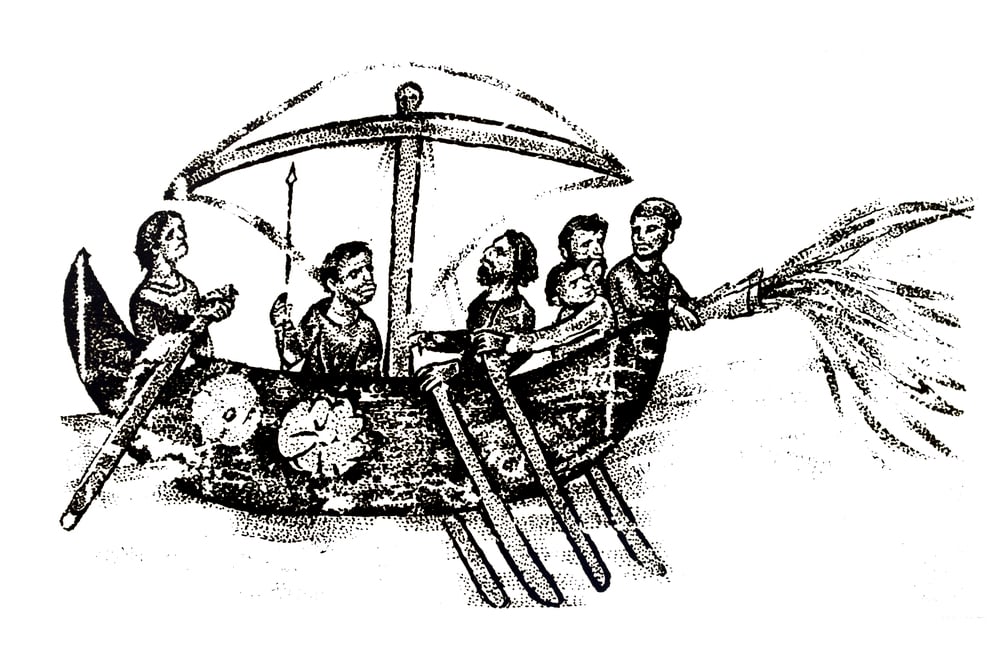
A strange fire clung to everything, refusing to die – especially not when doused by sea spray. What made it burn underwater stayed locked behind imperial lips, never written down.
Vessels soaked in the stuff became moving torches, turning naval battles into nightmares before swords clashed. Men ran at the sight of its glow, hearts pounding louder than war drums.
The formula vanished, buried under silence and time.
The Claw Of Archimedes

Over the harbor once swung a towering machine, dreamed up by Syracuse’s sharpest mind. From stone walls it reached like a giant arm, snatching warships with iron fingers.
Once caught, boats dangled – tilted halfway into open air – then crashed down under their own weight. Seeing ropes rise above the city made Roman crews turn away, hearts pounding at what might come next.
Built when elephants still roamed Sicily, this marvel used balance and force in ways thought impossible for its time. Few believed such cleverness existed back then – until wood met claw and lost.
Chinese Repeating Crossbow

Not long after Europe relied on one-at-a-time arrows, China already wielded a crossbow firing many bolts fast. Sitting above, a small case carried around ten ready shots while a moving part snapped each into place when the handle shifted.
With practice, someone could empty those ten in under fifteen seconds flat. First seen in the chaos of warring kingdoms, it kept serving through dynasties without pause – proof enough of its worth.
What has lasted the past two thousand years must have done something right.
Roman Corvus Boarding Bridge
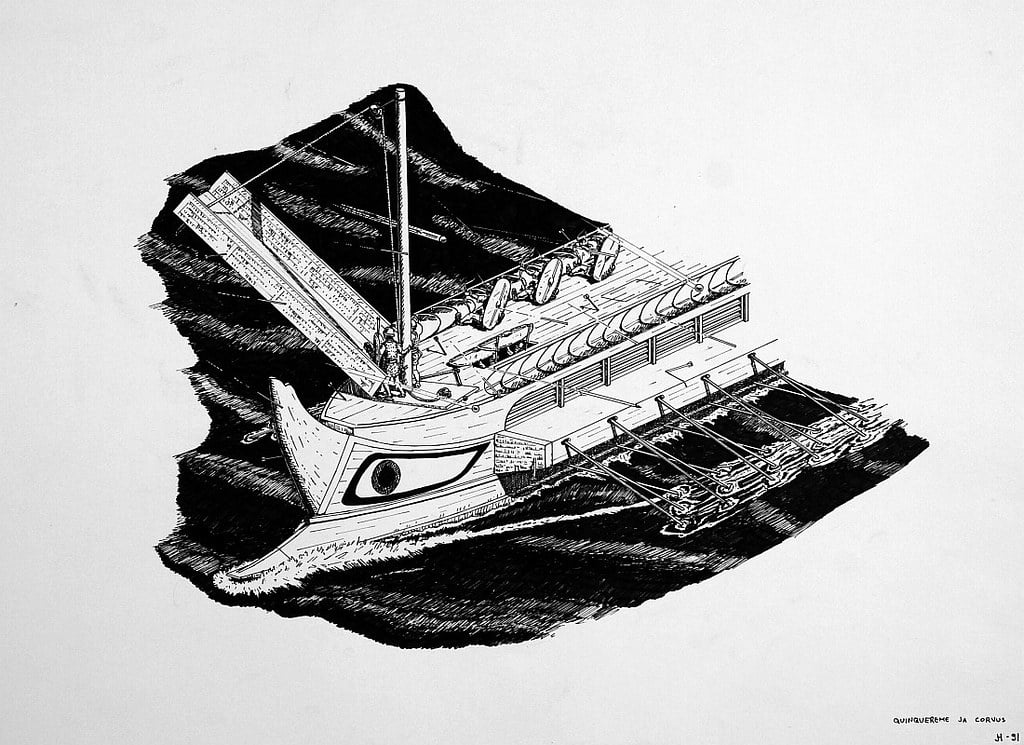
Out on the water, things looked tough for Rome – Carthage handled ships far better. Then came a plank tipped with iron, swinging suddenly across the waves.
Locked tight between vessels, what followed played right into Roman hands. Fighting now felt familiar, more like fields than sea swells.
That metal tip bit deep, fixed firm into wooden planks below. People started calling it the raven, since its strike reminded them of a bird snapping downward.
Victory after victory rose from this one sharp idea during those early war years.
Damascus Steel Blades
Blades made across the Middle East from 1100 to 1700 AD had traits modern science can’t quite match. Cutting through European steel and armor was possible because they stayed bendable without breaking.
Those rippling designs in the metal? More than decoration – born from a rare crystal arrangement formed by forgotten methods.
Crafted long ago, their internal makeup included surprises only recent tech revealed. Under powerful scopes, experts spotted carbon nanotubes inside, something never expected in objects so old.
Hwacha Multiple Rocket Launcher

Korea developed a mobile launching platform in the 1400s that could fire 200 rocket-propelled arrows at once. Each arrow had a small gunpowder charge attached, turning the weapon into an early form of multiple rocket launcher.
The device sat on a wheeled cart that troops could move into position, aim, and then unleash a devastating barrage that would blanket enemy forces. Korean armies used the hwacha to great effect against Japanese invasions, and the psychological impact of 200 flaming arrows filling the sky often broke enemy formations before they even landed.
Archimedes Heat Ray

The same inventor who created the claw also supposedly built an array of bronze shields that focused sunlight onto Roman ships to set them on fire. Modern experiments have shown this could actually work under the right conditions, though it remains one of history’s most debated weapons.
Whether Archimedes actually deployed this device or not, the fact that someone conceived of using focused light as a weapon in 212 BC shows remarkable understanding of optics. The concept wouldn’t become militarily practical again until lasers appeared in the 20th century.
Hunnic Composite Bow

The Huns terrified Europe in the 4th and 5th centuries partly because of their advanced bow technology. These weapons combined different materials like wood, horn, and sinew in layers that created incredible power in a compact size.
A Hun could shoot arrows over 500 yards with enough force to pierce armor, all while riding at full gallop. The construction process took over a year, but the result outperformed European bows by such a margin that it gave the Huns a massive tactical advantage.
This technology actually came from Central Asian steppe cultures and represented centuries of refinement.
Indian Wootz Steel

Before Damascus became famous for steel, Indian metalworkers had already mastered the creation of ultra-high carbon steel called wootz. This material formed the basis for those legendary Damascus blades, but its origins lay in India where craftsmen developed the smelting techniques around 400 BC.
The steel had such a reputation that Alexander the Great requested Indian swords as gifts, and Arab traders built entire routes to transport it. The process created a metal that could hold an edge longer than anything else available in the ancient world.
Leonardo Da Vinci’s Giant Crossbow

Though never built in his lifetime, da Vinci designed a crossbow in 1485 that would have stood 27 yards wide. The plans showed intricate details of how the mechanism would work, including a gear system for drawing back the massive bowstring and a release trigger.
While this weapon came from the Renaissance rather than deeper antiquity, it was built directly on ancient crossbow designs. The engineering drawings demonstrate that people in that era could conceptualize weapons on a scale that wouldn’t become practical for another few centuries.
Scythed Chariots

Persian and other ancient armies attached long blades to chariot wheels, creating mobile slicing machines that could tear through infantry lines. These weapons worked best on flat, open ground where chariots could build up speed and momentum.
The psychological effect often exceeded the physical damage, as soldiers would break formation and scatter rather than face the spinning blades. Accounts from ancient battles describe these chariots cutting through enemy ranks like farmers harvesting wheat, though disciplined troops who held their ground could sometimes stop them.
Ancient Flamethrowers

Long before Greek fire, the Byzantines’ predecessors used hand-pumped devices that sprayed burning liquid at enemies. These early flamethrowers appeared in various forms across different cultures, from China to the Middle East.
The Chinese version used gunpowder-based mixtures starting around 900 AD, while Mediterranean versions relied on petroleum products. Operators had to get relatively close to targets, making it a dangerous job, but the terror these weapons inspired often made that risk worthwhile.
Celtic Carnyx War Trumpet

The Celts created tall bronze trumpets shaped like animal heads that stood over six feet high. When blown, these instruments produced harsh, dissonant sounds that Roman writers compared to the roaring of wild beasts.
Celtic warriors would line up dozens of these trumpets before battles and blast them simultaneously to intimidate enemies. The sound carried for miles and combined acoustic warfare with psychological tactics in a way that modern military theorists recognize as quite sophisticated.
Romans admitted that the noise alone could shake their troops’ resolve before combat even began.
Trebuchet Siege Engine

Medieval armies inherited this weapon from earlier times, but its origins trace back to ancient China around 400 BC. The trebuchet used a counterweight system to hurl projectiles much farther and with more force than traditional catapults.
Engineers could adjust the counterweight and sling length to fine-tune the trajectory, showing a practical understanding of physics that let them hit targets over 300 yards away. Some versions could throw stones weighing 300 pounds, enough to smash through fortress walls that had stood for generations.
Chu Ko Nu Poison Bolt System

Beyond the rapid-fire capability, some Chinese military units combined their repeating crossbows with poisoned bolts for even deadlier effect. The bolts themselves were often dipped in toxic substances derived from plants or animals, turning even a minor wound into a potentially fatal injury.
This combination of mechanical innovation and chemical warfare gave Chinese armies capabilities that European forces wouldn’t match until much later. The compact design meant soldiers could carry the crossbow and extra magazines of poison-tipped bolts without being weighed down.
Where Ingenuity Meets Necessity

Ancient weapons designers worked without computers, modern materials, or advanced mathematics, yet they created devices that sometimes took centuries to improve upon. These inventors understood principles of physics, chemistry, and engineering through observation and experimentation.
The loss of some techniques, like the exact composition of Greek fire or the forging methods for true Damascus steel, reminds everyone that progress isn’t always linear. Looking at these ancient innovations makes it clear that human creativity and problem-solving have always been pretty impressive, regardless of the era.
More from Go2Tutors!

- The Romanov Crown Jewels and Their Tragic Fate
- 13 Historical Mysteries That Science Still Can’t Solve
- Famous Hoaxes That Fooled the World for Years
- 15 Child Stars with Tragic Adult Lives
- 16 Famous Jewelry Pieces in History
Like Go2Tutors’s content? Follow us on MSN.



