Largest statues in the world
Figures carved in rock show up again and again across time. Long before clocks or maps, leaders shaped stone faces under open skies.
Today’s large sculptures rise not just from ego but from shared purpose. When a form looms overhead, its scale speaks louder than words ever could.
Some of today’s biggest statues take that urge way further than before. Thanks to better techniques and stronger stuff, people now make towering figures seen far off in the distance.
It is not only about how tall they stand. What matters is how these forms show what each culture values, recalls, or wants noticed across the land.
A fresh view of giant statues around the globe – what they stand for matters just as much as their size. Each one tells a story shaped by culture, history, or belief.
Towering figures rise in different countries, built to honor ideas bigger than stone. Some mark spiritual devotion, others celebrate national identity.
Their height draws eyes upward, but meaning keeps people looking longer. Not every massive figure is famous for artistry alone – it’s often the purpose that lasts.
From mountain sides to city edges, these forms shape skylines and memories alike.
Statue of Unity

Standing in western India, the Statue of Unity is currently the tallest statue in the world. At roughly 597 feet tall, it depicts Vallabhbhai Patel, a key figure in India’s independence movement and the country’s first deputy prime minister.
The statue’s height was deliberately chosen to surpass all others, making its ambition unmistakable.
What sets the Statue of Unity apart is not only its size but its symbolism. Patel is remembered for unifying hundreds of princely states into a single nation after independence.
The monument reflects that legacy, standing in a remote region as a physical expression of cohesion and national identity. Still, its location and cost have sparked debate, showing how monumental art often invites as much discussion as admiration.
Spring Temple Buddha

Before the Statue of Unity claimed the top spot, the title belonged to the Spring Temple Buddha in central China. This massive representation of Vairocana Buddha reaches about 420 feet, excluding its lotus base.
Completed in the early 2000s, it was built during a period of renewed interest in large-scale Buddhist monuments.
The statue’s presence is deeply tied to spiritual and cultural revival. It sits near a scenic valley, framed by mountains, creating an environment meant to inspire reflection rather than spectacle.
Even so, its immense scale ensures it commands attention. The Spring Temple Buddha illustrates how modern monument-building can blend ancient religious symbolism with contemporary ambition.
Laykyun Sekkya
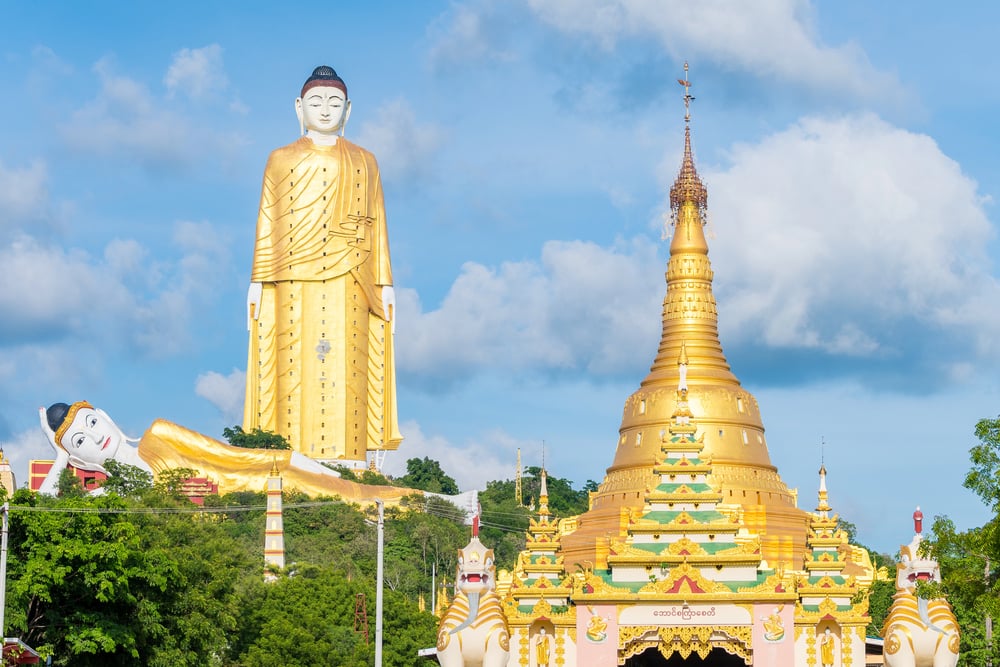
In central Myanmar rises the Laykyun Sekkya, one of the tallest standing Buddha statues in the world. At approximately 380 feet tall, it dominates the surrounding plains, its golden surface visible from a great distance.
Construction began in the 1990s and took over a decade to complete.
This statue reflects Myanmar’s long-standing Buddhist traditions and the role of religious devotion in public life. Nearby stands a massive reclining Buddha, reinforcing the area’s spiritual focus.
Together, the statues transform the landscape into a place of pilgrimage and contemplation, demonstrating how size can amplify sacred presence rather than overwhelm it.
Ushiku Daibutsu

Japan’s Ushiku Daibutsu offers a slightly different approach to monumental scale. Standing around 394 feet tall, it depicts Amitabha Buddha and was completed in the 1990s.
For years, it held the title of the tallest statue in the world.
What makes Ushiku Daibutsu distinctive is its accessibility. Visitors can enter the statue, ride an elevator inside, and look out from observation decks built into the figure itself.
This blend of monument and experience reflects Japan’s tendency to combine reverence with thoughtful design. The statue feels less like an unreachable icon and more like an invitation to engage.
Sendai Daikannon

Also in Japan, the Sendai Daikannon stands at about 330 feet tall. Dedicated to Kannon, the Buddhist figure associated with compassion, it was completed in the early 1990s.
At the time, it was among the tallest statues on Earth.
Sendai Daikannon’s pale, almost serene appearance contrasts with its massive size. Inside, visitors move through multiple levels that display religious imagery and teachings.
The statue’s quiet presence shows how monumental scale does not always need dramatic posture or intense symbolism. Sometimes stillness is the point.
The Motherland Calls

While many of the world’s largest statues are religious, monumental figures also appear in political and historical contexts. Russia’s The Motherland Calls stands just over 280 feet tall and commemorates the Battle of Stalingrad during World War II.
Unlike the calm expressions of many Buddha statues, this figure is dynamic and urgent. With an outstretched arm and flowing form, it captures motion and emotion in a way few statues attempt at this scale.
Built in the 1960s, it was an engineering marvel of its time and remains a powerful symbol of sacrifice and resilience.
How scale shapes meaning

What unites these statues is not just their height, but the intent behind it. Size amplifies the message.
A towering figure can express unity, devotion, remembrance, or defiance without a single word. It changes how people experience space, turning ordinary landscapes into places of significance.
At the same time, scale invites scrutiny. Large monuments often raise questions about cost, purpose, and relevance.
These conversations are part of the monument’s life, shaping how it is perceived long after construction ends. In that way, the statue continues to evolve, even while standing perfectly still.
Why they still matter

Biggest statues on Earth show building monuments isn’t something only old civilizations did. Today’s cultures continue shaping stone and metal to reflect what they value.
Old ways of making grand symbols now meet new tech and bold visions.
From far away, these structures seem just about size and how they were built. Yet when you step nearer, something shifts – they speak of pride, loss, why people build to last.
Even once numbers change, it is the quiet meaning inside them that holds on longest.
More from Go2Tutors!

- The Romanov Crown Jewels and Their Tragic Fate
- 13 Historical Mysteries That Science Still Can’t Solve
- Famous Hoaxes That Fooled the World for Years
- 15 Child Stars with Tragic Adult Lives
- 16 Famous Jewelry Pieces in History
Like Go2Tutors’s content? Follow us on MSN.