Most Stunning Libraries Worldwide
There is something almost sacred about walking into a grand library. The smell of aged paper, the hush of contemplation, the sight of thousands of spines lined up like soldiers of knowledge.
Libraries have always been more than storage spaces for books. They are monuments to human curiosity, architectural statements of what a society values, and quiet sanctuaries where the past whispers to the present.
Some libraries achieve this through sheer antiquity and Baroque excess. Others do it with glass, steel, and a vision of what learning might look like in the digital age.
What follows is a journey through some of the most visually arresting libraries on the planet. These are not just places to borrow a novel or look up a fact.
They are destinations in their own right, spaces that make visitors stop, look up, and remember why humanity has always felt compelled to gather knowledge in beautiful rooms. Here is a closer look at nine libraries that redefine what it means to house a book collection.
The Long Room at Trinity College Dublin

Ireland’s largest library sits in the heart of Dublin, and its centrepiece is the Long Room, a barrel-vaulted chamber that stretches nearly 213 feet and houses roughly 200,000 of the library’s oldest books. Built between 1712 and 1732, the room originally had a flat ceiling and only a single level of shelving.
By the 1850s, the collection had grown so large that architects raised the roof and added the soaring upper gallery that visitors marvel at today. Marble busts of philosophers, writers, and figures connected to Trinity College line the central aisle, their pale faces watching over readers and tourists alike.
The library is also home to the Book of Kells, a ninth-century illuminated manuscript of the four Gospels that draws over a million visitors annually. The manuscript’s intricate Celtic knotwork and vivid pigments have survived more than a thousand years, and seeing it in person feels like peering through a window into medieval Ireland.
The Long Room itself has become one of the most photographed interiors in the country, its dark oak shelves and diffused light creating an atmosphere that feels both scholarly and cinematic. A major restoration project is currently underway, temporarily relocating many of the books, but the space remains open and as awe-inspiring as ever.
Admont Abbey Library

Tucked into the Austrian Alps in the small town of Admont, this Benedictine monastery holds the largest monastic library in the world. The library hall, completed in 1776 under architect Josef Hueber, stretches 230 feet in length and rises through a series of seven domed cupolas, each painted with frescoes by Bartolomeo Altomonte.
The artist was over eighty years old when he undertook the project, working through two consecutive summers to complete the ceiling’s depiction of human knowledge progressing toward divine revelation. The colour palette is deliberately light.
White shelves trimmed with gold leaf reflect the natural light streaming through 48 windows, and the marble floor below uses over 7,000 small diamonds in white, red, and grey to create geometric patterns that play tricks on the eye. Beneath the central dome stand four imposing sculptures by Josef Stammel representing the ‘Four Last Things’: death, judgement, heaven, and hell.
The figures are expressive almost to the point of being unsettling, a reminder that for the monks who built this place, knowledge was inseparable from spiritual reckoning. Around 60,000 volumes line the visible shelves, with the abbey’s total collection numbering closer to 200,000, including manuscripts dating back to the eighth century.
Strahov Monastery Library
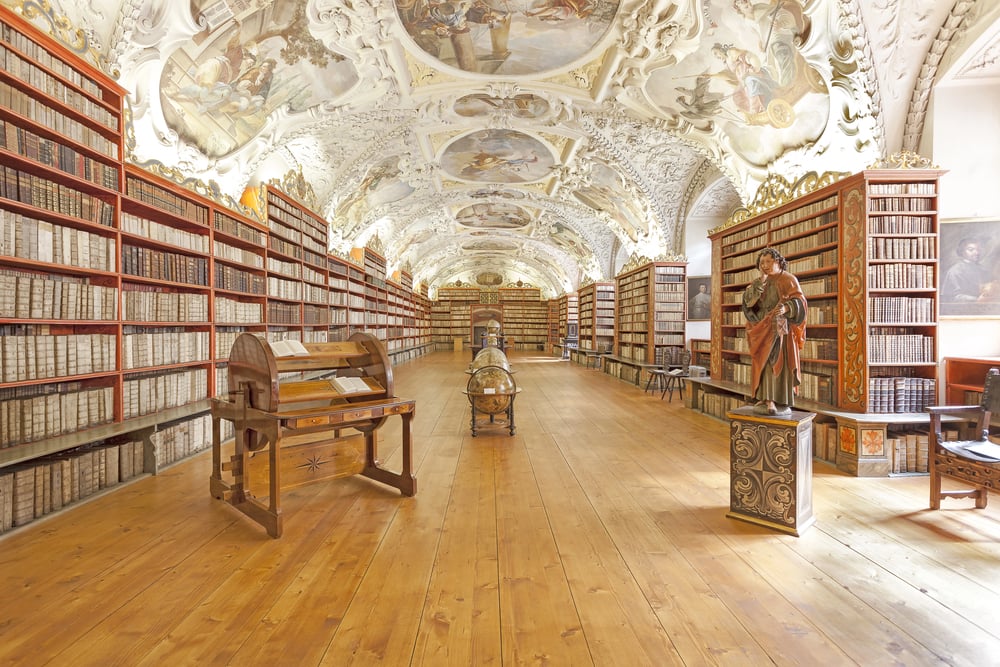
Perched on a hill overlooking Prague Castle, Strahov Monastery has been home to Premonstratensian monks since 1143. The library consists of two main halls, each a masterclass in Baroque decoration.
The Theological Hall, completed in 1679, is the older of the two, its low curved ceiling covered in elaborate stucco work and painted cartouches depicting proverbs from the Bible. Astronomical and geographical globes from the seventeenth century sit at intervals along the room, their brass fittings still gleaming.
The Philosophical Hall came a century later and is the showstopper. Its ceiling fresco, painted by Franz Anton Maulbertsch in 1794, depicts the history of mankind’s intellectual development in sweeping, dramatic strokes.
The two-storey hall holds over 42,000 volumes on subjects ranging from law and history to astronomy and alchemy. Visitors today can only view the halls from the doorways, as the delicate frescoes and ancient bindings are sensitive to humidity.
Even from a distance, though, the effect is overwhelming. A corridor between the two halls contains a ‘cabinet of curiosities,’ a collection of natural oddities and scientific instruments that served as a precursor to modern museums.
It is a reminder that libraries were once places not just of reading but of wonder.
Royal Portuguese Cabinet of Reading
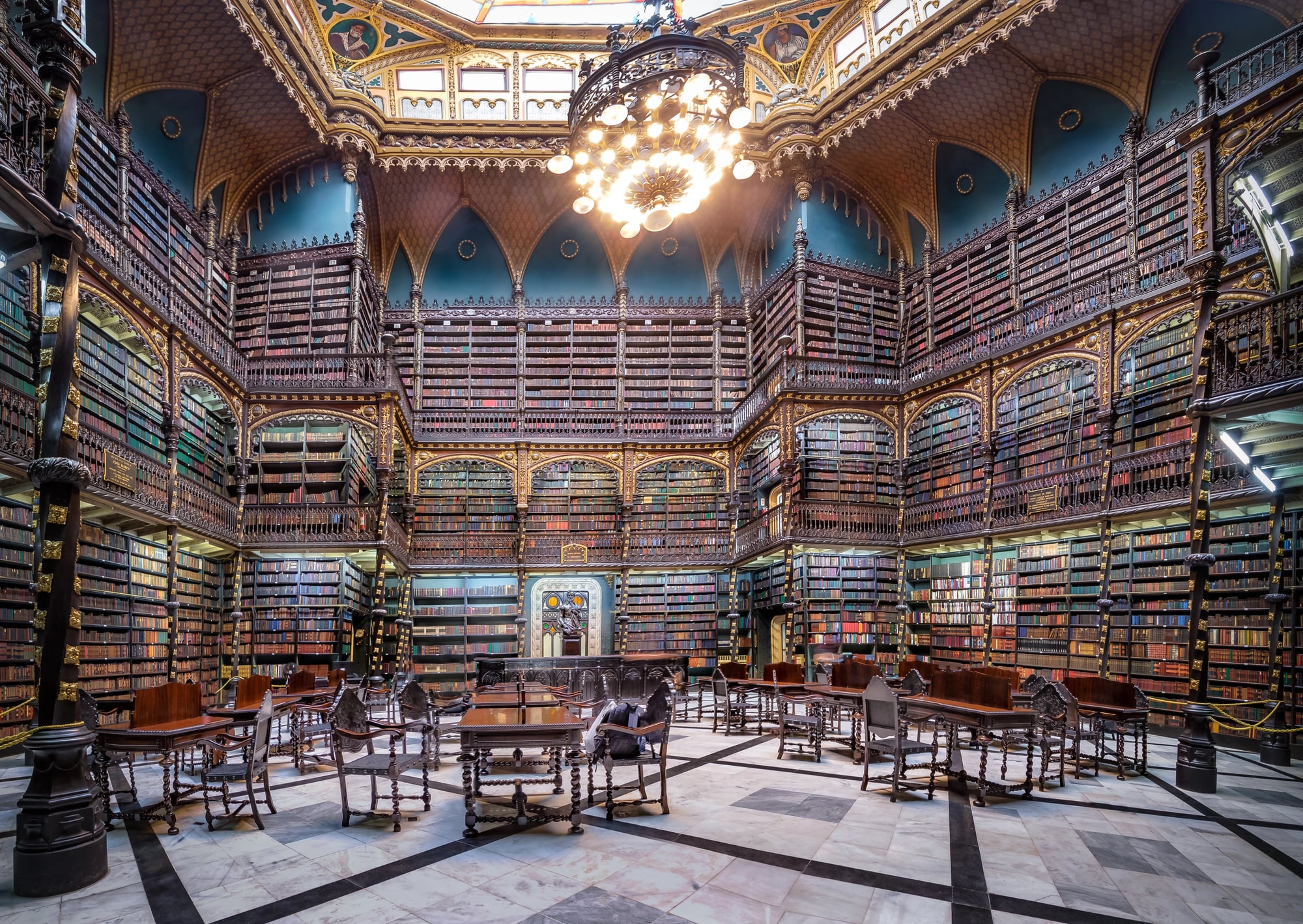
In downtown Rio de Janeiro, behind an unassuming façade on a busy street, sits a library so ornate that visitors often compare it to a scene from a fantasy film. The Royal Portuguese Cabinet of Reading was founded in 1837 by a group of Portuguese immigrants and political refugees who wanted to preserve their literary heritage in Brazil.
The current building, completed in 1887, was designed by architect Rafael da Silva e Castro in the Neo-Manueline style, a revival of the Gothic-Renaissance architecture that flourished during Portugal’s Age of Discovery. The exterior façade was carved from Lisbon limestone and shipped across the Atlantic, its intricate details depicting explorers like Vasco da Gama and Pedro Álvares Cabral.
Inside, the reading room soars upward through four storeys of dark wooden shelves, all pointing toward a cast-iron skylight and chandelier that bathe the space in soft golden light. The collection holds around 350,000 volumes, making it the largest repository of Portuguese literature outside of Portugal.
Rare items include a first edition of Luís de Camões’ ‘Os Lusíadas” from 1572 and manuscripts by Machado de Assis. Time magazine once named it the fourth most beautiful library in the world, and standing beneath that skylight, it is easy to see why.
Seattle Central Library
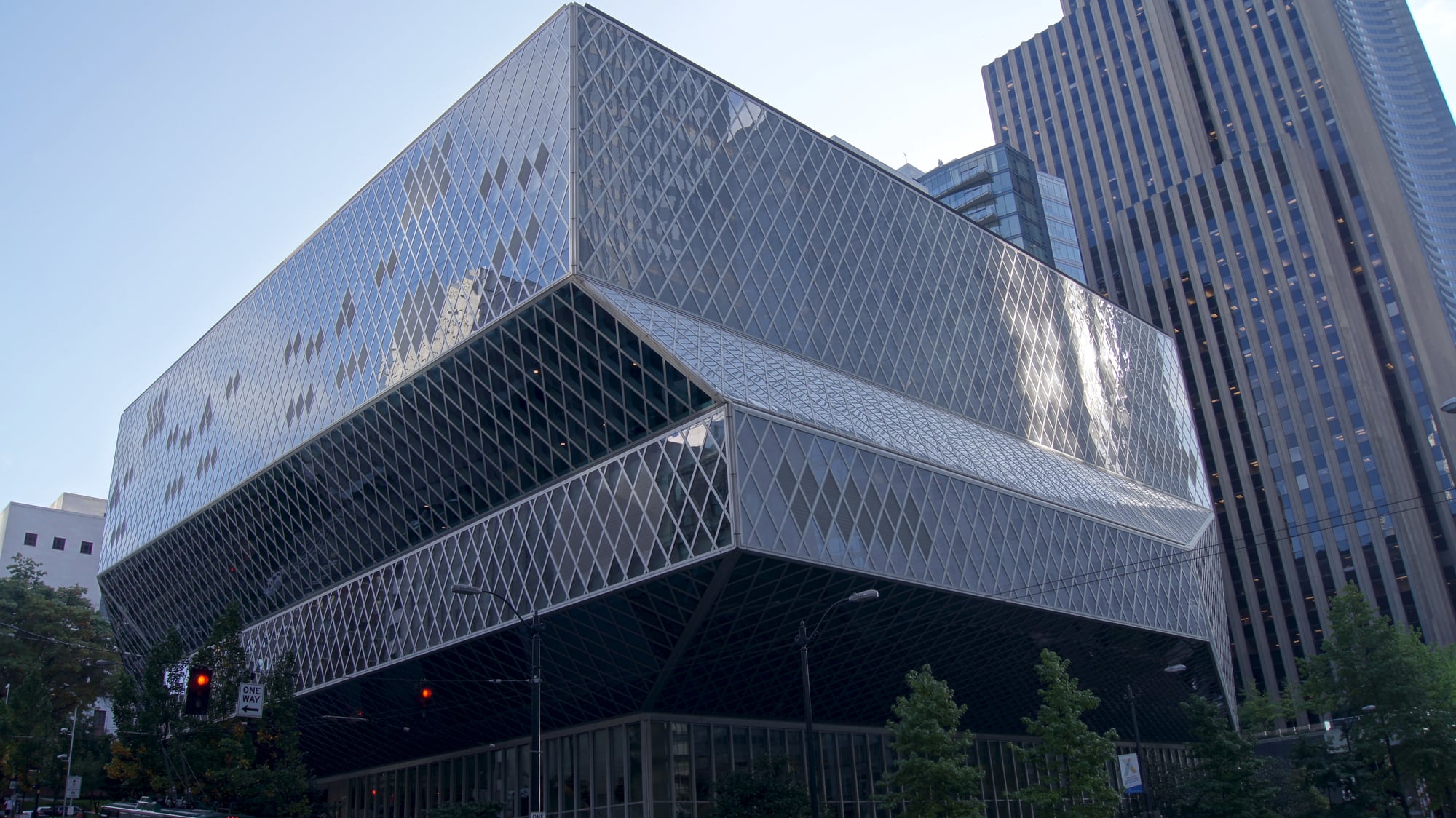
When Dutch architect Rem Koolhaas and his firm OMA unveiled their design for Seattle’s new central library in the early 2000s, not everyone was convinced. The building looked like a stack of glass boxes that had been nudged slightly out of alignment, wrapped in a diamond-patterned steel exoskeleton.
Critics called it a ‘crystal frog’ and a ‘lumpy Christmas package.’ Yet when the library opened in May 2004, more than 25,000 people lined up on the first day. The New York Times’ architecture critic called it one of the most exciting buildings he had ever reviewed.
The eleven-storey structure covers nearly 363,000 square feet and was conceived as a library for the digital age, a place where books, computers, and community space could coexist. Its most celebrated feature is the Books Spiral, a continuous ramp that winds through four floors and allows the entire nonfiction collection to be shelved in unbroken Dewey Decimal order.
No stairs interrupt the sequence, which means a reader can wander from philosophy to zoology without ever losing the thread. Elsewhere, the building includes a towering ‘living room’ with 50-foot ceilings, a bright red ‘mixing chamber’ where librarians help patrons navigate information, and views of Puget Sound and the Olympic Mountains.
Twenty years after opening, it remains one of the most visited and photographed public buildings in the Pacific Northwest.
Tianjin Binhai Library
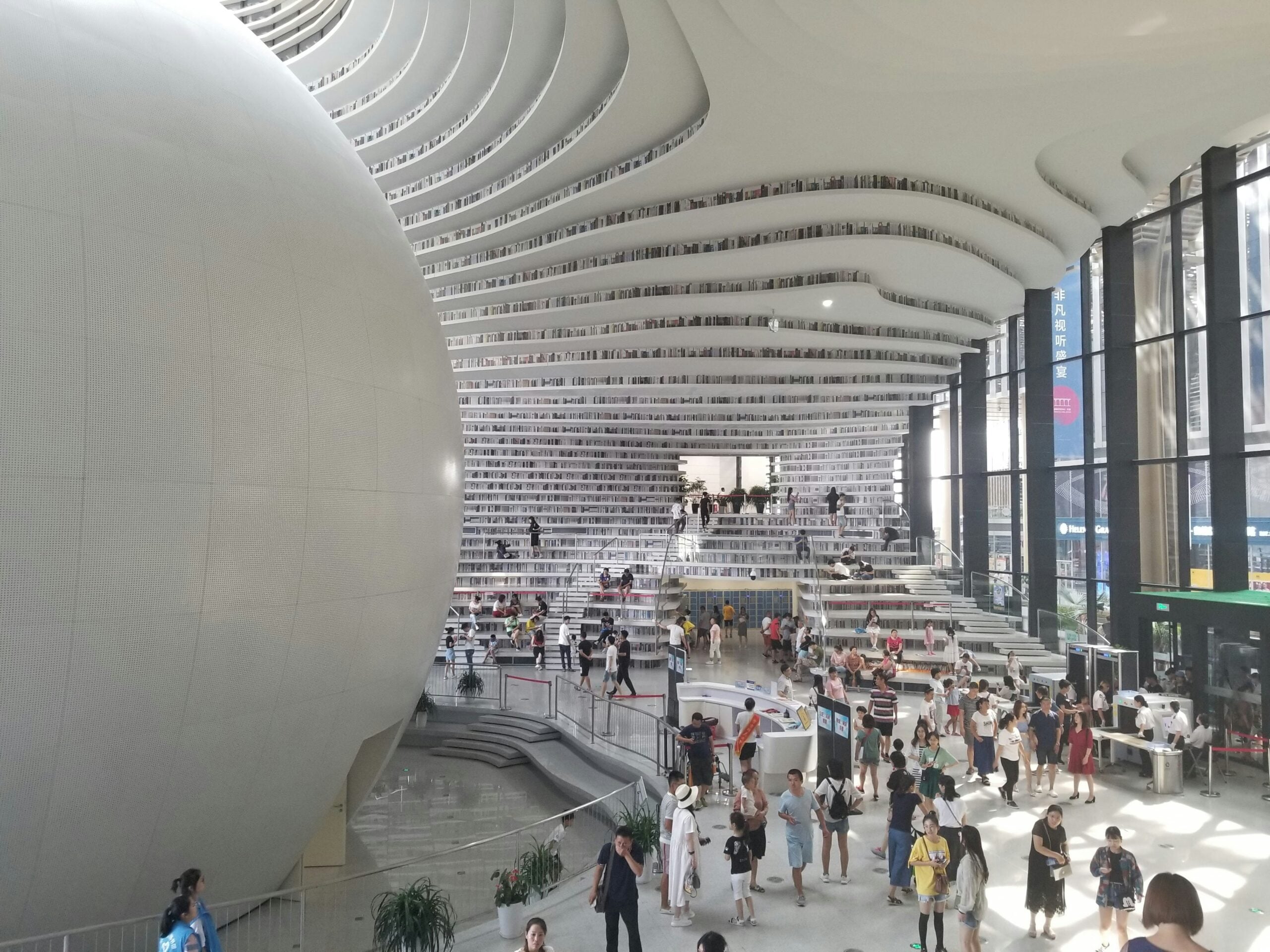
If the Seattle library reimagined what a library could be, the Tianjin Binhai Library reimagined what a library could look like. Designed by the Rotterdam firm MVRDV in collaboration with local architects, the building opened in 2017 as part of a new cultural district in the Chinese coastal city of Tianjin.
Its defining feature is a five-storey atrium dominated by a luminous white sphere that serves as an auditorium. When viewed from outside through the building’s glass façade, the sphere resembles an enormous eye, earning the library the nickname ‘The Eye.’
Surrounding the sphere, terraced bookshelves cascade upward in undulating waves, creating the impression of a topographical landscape carved from books. Visitors can sit on the shelves, climb them, or simply stand in the middle and gaze upward at the swirling white forms.
The library can hold 1.2 million books, though a rushed construction schedule meant that many of the upper shelves were fitted with printed images of book spines rather than actual volumes. It is a detail that has drawn some criticism, but it does little to diminish the visual impact.
In the first week after opening, roughly 10,000 people visited each day, causing queues to snake around the building. The space functions less as a traditional library and more as a public monument to the idea of reading itself.
Oodi Helsinki Central Library
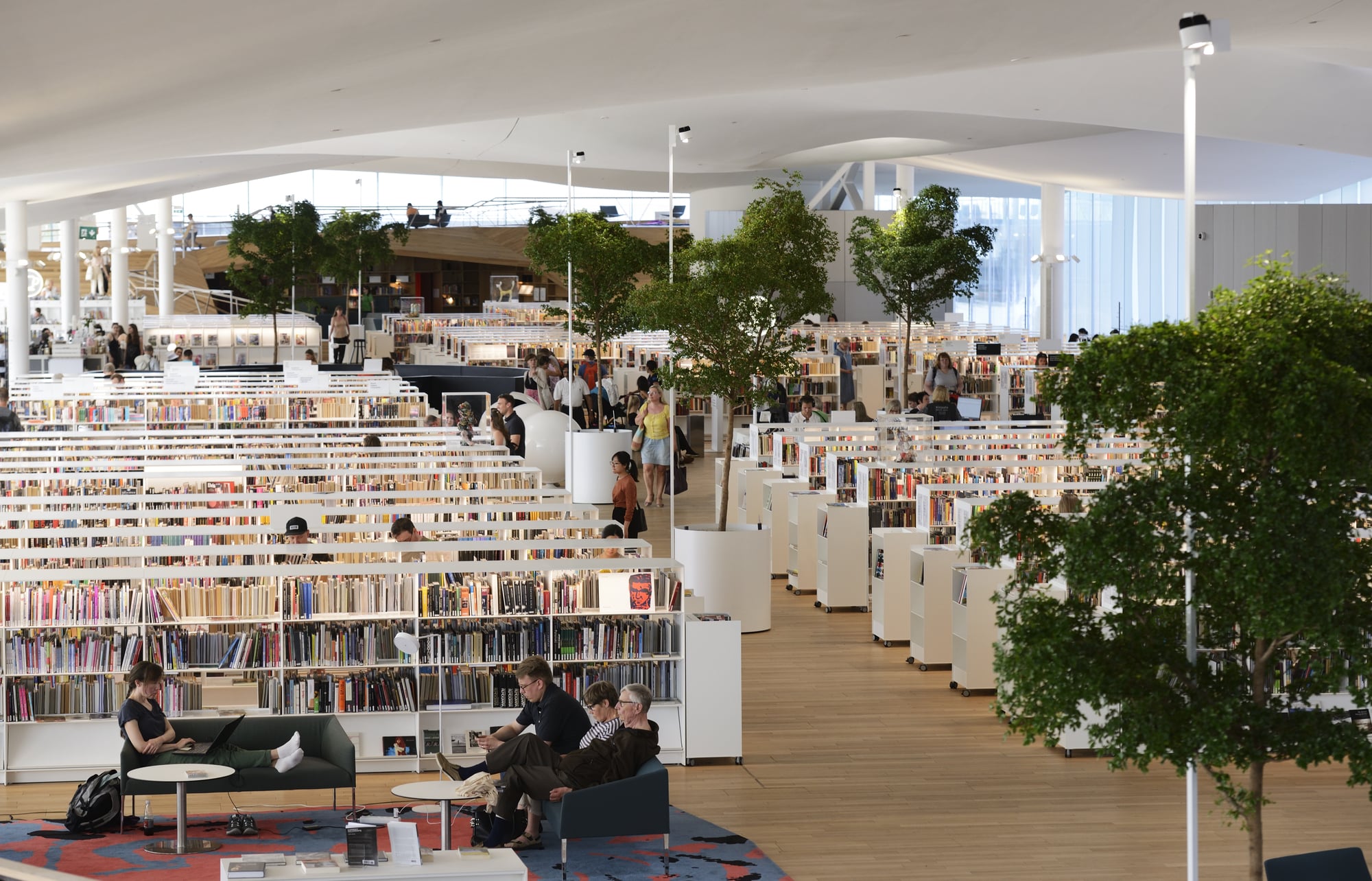
Finland opened this library in December 2018, one day before the country celebrated its 101st anniversary of independence. The timing was deliberate. Oodi was conceived as a gift from the government to its citizens, a statement about what Finland values: literacy, democracy, and public space.
Designed by the Helsinki firm ALA Architects, the 17,250-square-metre building sits directly across from the Finnish Parliament, its swooping timber-clad form arching over a public plaza like a wave frozen mid-crest. The interior is divided into three distinct levels.
The ground floor is a bustling public square with a café, cinema, and event spaces. The middle floor houses workshops for sewing, 3D printing, music recording, and other maker activities.
The top floor, nicknamed ‘Book Heaven,’ is where the actual library lives, a serene open-plan space with white walls, blonde wood, and floor-to-ceiling windows offering views of the city. Only about a third of the building is dedicated to traditional book storage, a reflection of how libraries in Finland have evolved into multifunctional community hubs.
Oodi welcomed its one-millionth visitor within three months of opening, and on busy days, foot traffic can top 20,000. It has since won multiple architectural awards and become a model for libraries around the world.
George Peabody Library

Baltimore’s George Peabody Library is often described as a ‘cathedral of books,’ and the comparison is apt. Completed in 1878 and designed by local architect Edmund G. Lind, the library’s main reading room rises 61 feet to a latticed skylight, its five tiers of ornamental cast-iron balconies creating a dizzying sense of verticality.
The floor below is black and white marble arranged in geometric patterns, and gold-scalloped columns catch the light filtering down from above. The library was funded by George Peabody, a Massachusetts-born philanthropist who made his fortune in Baltimore and wanted to give something back to the city that had welcomed him.
The collection of 300,000 volumes focuses on nineteenth-century subjects, with particular strengths in religion, British art, architecture, and American history. Today the library is part of Johns Hopkins University but remains open to the public, in keeping with Peabody’s original vision.
It has also become a popular venue for weddings and events, its neo-Grec grandeur providing a backdrop that few other spaces can match. A recent restoration of the skylight has ensured that natural light continues to flood the atrium, preserving the ethereal quality that has made this room famous for nearly 150 years.
Abbey Library of Saint Gall
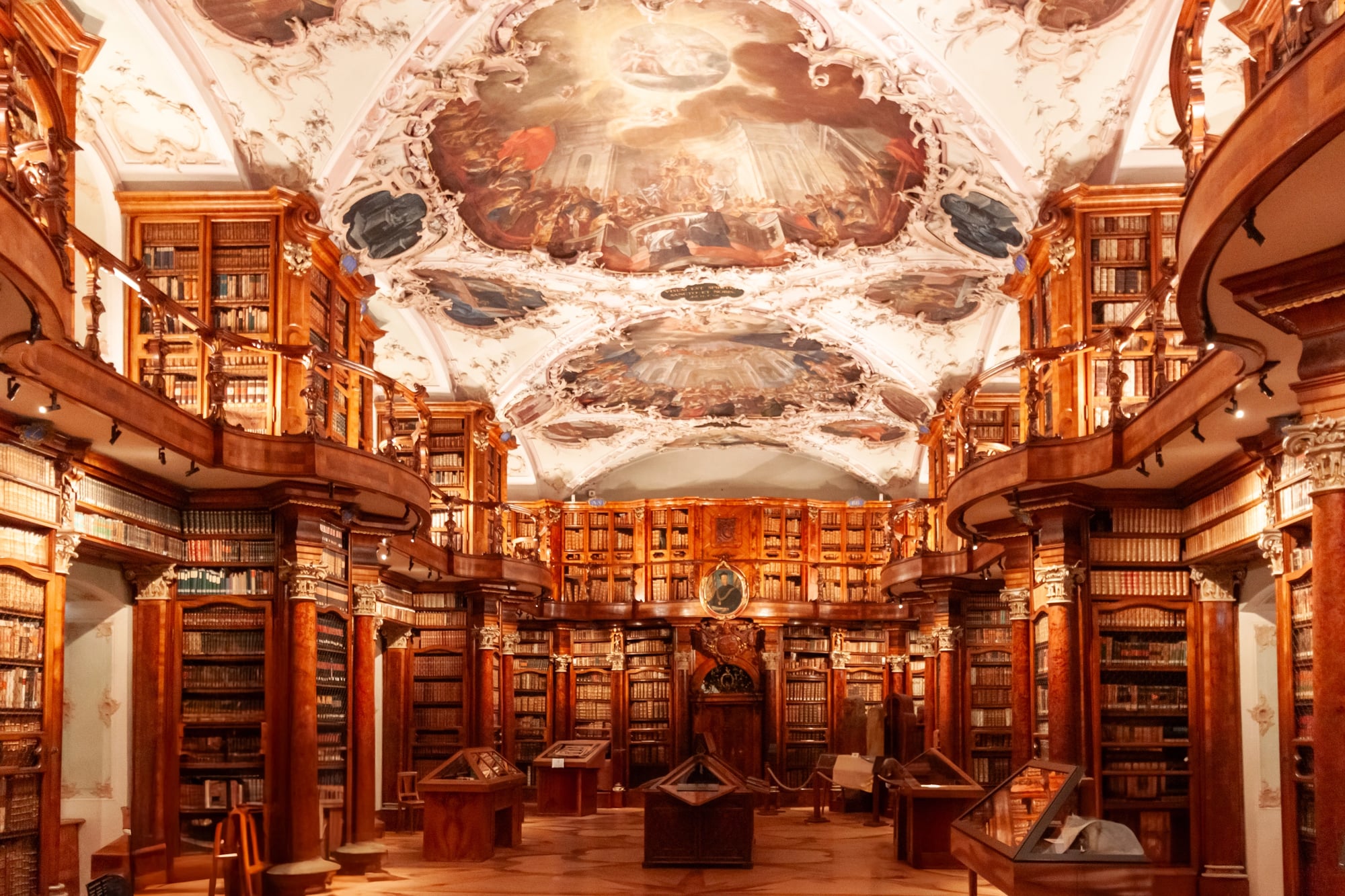
The Swiss town of St. Gallen is home to one of the oldest monastic libraries in the world. The Abbey of Saint Gall was founded in the eighth century, and its library has been accumulating manuscripts ever since.
The current Rococo hall dates from 1758 and is a UNESCO World Heritage Site, recognised for both its architectural beauty and the significance of its collection. The ceiling features elaborate frescoes, and the walls are lined with intricately carved wooden shelving holding around 160,000 volumes.
What sets Saint Gall apart is the age and rarity of its holdings. The library contains approximately 2,100 manuscripts, some dating back over a thousand years, including early medieval texts on theology, science, and law.
One of the most famous items is the Plan of Saint Gall, a ninth-century architectural drawing that provides a detailed blueprint for an ideal Benedictine monastery. Visitors must wear felt slippers to protect the parquet floors, a small ritual that adds to the sense of entering a space where time moves differently.
The library remains a working institution, used by scholars from around the world, but it welcomes tourists as well, offering a glimpse into the intellectual life of medieval Europe.
Why These Spaces Endure
It would be easy to dismiss grand libraries as relics, beautiful but obsolete monuments to a time before search engines and e-readers. Yet the crowds at Trinity College, the queues at Tianjin, and the foot traffic at Oodi suggest otherwise.
People still want to be in these spaces. They want to feel the weight of accumulated knowledge around them, to look up at a painted ceiling or a latticed skylight and sense that they are part of something larger than their own moment.
Libraries have always adapted. Medieval scriptoriums became Baroque halls, which became steel-and-glass public squares with 3D printers and recording studios.
What remains constant is the impulse to gather knowledge in a space that honours it. The libraries on this list span centuries and continents, but they share a common purpose: to remind us that learning is not just useful but beautiful, and that the places we build for it say something about who we aspire to be.
More from Go2Tutors!

- The Romanov Crown Jewels and Their Tragic Fate
- 13 Historical Mysteries That Science Still Can’t Solve
- Famous Hoaxes That Fooled the World for Years
- 15 Child Stars with Tragic Adult Lives
- 16 Famous Jewelry Pieces in History
Like Go2Tutors’s content? Follow us on MSN.