Musicians Who Play Homemade Instruments
Most musicians walk into a store and buy their instruments. They choose from what manufacturers offer. They learn to work within those parameters.
Some musicians take a different path. They build what they need from whatever they can find.
These aren’t hobbyists making toys in their garages. These are professional performers who tour, record albums, and play festivals using instruments they constructed themselves.
Some became famous playing instruments built from fireplace mantels or cig boxes. Others fashion entire orchestras from trash and abandoned materials.
The reasons vary. Sometimes it’s about money.
Sometimes it’s about sound. Often it’s about creating something that doesn’t exist yet—an instrument that can make music nobody else can produce.
Brian May and the Fireplace Guitar

Brian May couldn’t afford a Fender or Gibson when he was 16. His family didn’t have that kind of money. So in 1963, he and his father Harold started building a guitar from scratch in their home.
The neck came from a fireplace mantel that was about a hundred years old. A family friend was throwing it away.
May hand-shaped it, filling worm pits with matchsticks as he worked. The body came from an old oak table. The tremolo arm was made from a bike saddlebag holder.
The tip of the arm was a plastic knitting needle. They called it the Red Special.
May used it on every Queen album. He played it at every concert.
When he performed on the roof of Buckingham Palace for the Queen’s Golden Jubilee in 2002, he played the Red Special. The guitar even has its own bodyguard on tour.
Engineers told May and his father it would never work. They said a homemade guitar couldn’t compete with professional instruments.
Then Queen went into the studio. The guitar made exactly the sounds May wanted.
He designed it to feed back intentionally after seeing Jeff Beck manipulate sound by moving his guitar in front of an amplifier. Fifty years later, May still plays the original.
The guitar has never been refretted. Those are the same frets he and his father installed in the early 1960s.
Bo Diddley’s Cig Box Tradition

Bo Diddley built guitars from cig boxes. This wasn’t his invention—sharecroppers had been doing it for generations.
They needed instruments and couldn’t afford them, so they made guitars from cheap materials. Diddley kept the tradition alive and made it famous.
His signature rectangular guitar came directly from that cig box design. He had hits on Chess Records in the 1950s playing instruments he’d fashioned himself.
When The Beatles arrived in America in 1964, John Lennon was asked what he most wanted to see. He answered immediately: Bo Diddley.
The cig box guitar had become part of American music history, and Diddley was its most visible ambassador.
Jason Sanford and Neptune’s Metal Sculptures

Jason Sanford studied sculpture at the University of Massachusetts in the early 1990s. He got tired of making static sculptures that just sat there. He wanted something interactive.
So he started building instruments. His first performance was supposed to be a one-off.
But the musicians he gathered created what he called a lumbering, disjointed musicality from the instruments. One performance led to more. Neptune was born.
Sanford builds wire-frame guitars, electric thumb pianos, and otherworldly oscillators. He made a feedback organ that generates feedback at various fixed pitches using microphones, foam tubes, and speakers.
The instruments are functional sculpture—art that makes sound. The band performs on instruments made from sheet metal, repurposed VCR cases, and metal chairs.
Sanford admits it goes wrong more often than not. Sometimes he thinks everything looks better than it sounds.
But the failures are part of the process. Starting from scratch and engaging with every step means making music nobody else could create.
John Hardin’s Electric Didgeridoo

John Hardin went off-grid about 20 years ago in the remote forests of Southern Humboldt County, California. He bought solar panels, a charge controller, battery, and inverter.
Suddenly the amount of power his gear required became important. Loud tube-driven guitar amplifiers were off the table.
He had to rethink everything. So he started building instruments from recycled materials and found objects.
Some came from debris left by former marijuana growers in the area. His project Electric Earth Music features an electric didgeridoo.
That’s not a typo. An electric didgeridoo creates dance grooves and rhythmic patterns.
The album includes an assortment of instruments made from materials that would otherwise be trash. Hardin sees it as an environmental choice as much as a musical one.
Electronic gear contains toxic materials that are hard to dispose of. Circuit-bending discarded toys into instruments appeals to him.
The gear should last a lifetime.
Washington Phillips and the Manzarene

In 1907, a Texas newspaper described Washington Phillips’ instrument as the most unique they’d ever seen. It was a box about two by three feet, six inches deep.
Phillips had strung violin strings on it, something like an autoharp. He called it Manzarene.
He used both hands to play all sorts of melodies. The instrument had a distinctive sound that showed up on his gospel recordings.
Nobody knows exactly how he built it or why he chose that particular design. Phillips wasn’t trying to make history.
He just needed an instrument and made one that worked for what he wanted to play.
Don Moser’s Hurricane Katrina Guitar

Don Moser built his Voodoo Guitar from debris left by Hurricane Katrina in 2005. The guitar is now housed in the Smithsonian National Museum.
Moser plays with a band called The Swamp Kats. He constructed it from salvaged instrument parts along with pieces of copper, brass, tin, plastic, and fabric.
He decorated it with rhinestones and a picture of Marie Laveau, the Voodoo Queen of New Orleans. An engraving celebrates the spirit of the city.
Moser wanted to give people a look inside the supernatural world as it exists in the south. He also wanted to keep celebrating African-American traditional folk music.
The guitar became a memorial and a working instrument at the same time.
La Resonante BasuBand and Trash Orchestra

La Resonante BasuBand is a Spanish collective of musicians and educators. They host workshops where students build instruments from household items and trash.
They make handmade versions of traditional instruments—pan flutes, thumb pianos, mini drum kits, and guitars. The point isn’t just making music.
It’s teaching people that they can create instruments from what’s around them. Musical instruments don’t have to be expensive or store-bought.
You can make them from materials most people throw away. The collective performs regularly with their homemade creations.
They prove the instruments work in professional settings, not just classrooms.
Jug Bands and Making Do

Early jug bands started appearing in Kentucky and Tennessee in the 1920s and 1930s. Many were African American musicians from vaudeville or traveling medicine shows.
Some were just people at home making their own instruments. They didn’t have money for instruments.
They couldn’t always access them. So they picked up jugs, washboards, spoons, and anything else they could find.
They modified these objects to make music for themselves and their communities. You play a jug by buzzing into it with your lips, like playing a trumpet. It’s not intuitive.
Most people assume you blow across the opening like a flute. But jug band players developed their own technique.
The washtub bass, washboard, and spoons completed the ensemble. Each instrument was repurposed from daily household items.
The music that came out of these makeshift orchestras influenced folk and blues for decades.
Kraftwerk’s Homemade Synthesizers

Kraftwerk built their own synthesizers in the early 1970s. Electronic instruments existed, but the band wanted specific sounds they couldn’t get from commercial equipment.
So they made what they needed. Their homemade gear helped define the electronic music sound.
Other bands and musicians followed. Building custom synthesizers became part of experimental music culture.
You didn’t just play electronic music—you built the tools to make it. The DIY approach to electronics opened up possibilities.
If you could design and construct your own instruments, you weren’t limited by what manufacturers thought musicians needed.
Iner Souster’s Trash Instruments
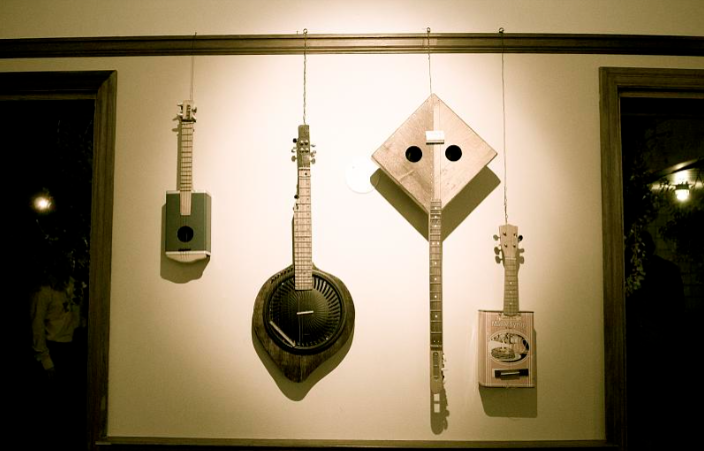
Iner Souster builds experimental musical instruments from trash, found materials, and salvaged parts. He lives in Toronto and creates one-string instruments, thumb pianos, and more complicated contraptions.
One of his instruments is called the Bowafridgeaphone. The name gives you an idea of his approach.
He’s not trying to recreate traditional instruments. He’s making new ones from whatever he finds.
Souster is also a visual artist, musician, and filmmaker. The instruments serve multiple purposes—they’re functional, they’re art objects, and they challenge assumptions about what musical instruments should be.
Yuichi Onoue’s Modified Traditions

Japanese multi-instrumentalist Yuichi Onoue builds experimental instruments that modify traditional designs. He created the Kaisatsuko, a two-string instrument like a fretless violin combined with a hurdy-gurdy.
He also developed a deeply scalloped electric guitar for microtonal playing techniques. The modifications allow for sounds and techniques that standard guitars can’t produce.
Onoue isn’t abandoning tradition—he’s pushing it into new territory. His instruments bridge the gap between experimental music and classical techniques.
They look unusual but they’re based on principles that have existed for centuries.
Jesse Fuller’s Fotdella

Jesse Fuller developed the Fotdella in the early 1950s. It’s a foot-operated string bass.
Fuller needed to play bass while performing solo on other instruments. Commercial options didn’t work for his setup.
So he designed and built an instrument he could operate with his foot, leaving his hands free for guitar and harmonica. The Fotdella became part of his one-man-band performances.
Fuller’s approach was practical. He had a musical problem and solved it by building the tool he needed.
The instrument worked well enough that other musicians took notice.
The Endless Variations

Ken Butler makes guitar-like instruments from trash, rifles, and other found materials. He builds violins in unusual shapes.
Cor Fuhler created the keyolin in the 1990s—a two-string violin played via a mechanical keyboard. Mark Deutsch invented the bazantar, a five-string double bass with 29 sympathetic strings and four drone strings.
The melodic range covers five octaves. He worked on the design from 1993 to 1997.
The Blue Man Group experimented with percussive instruments made from PVC pipes. They needed a specially constructed studio to record their first album because standard equipment couldn’t handle what their homemade instruments produced.
California band Motograter invented their namesake instrument to replace the bass guitar. It’s made from two large industrial springs mounted on a metal platform.
The sound is unique—chunky with a strong grinding quality that conventional bass guitars can’t replicate.
Why Build Instead of Buy
Some musicians build instruments because they can’t afford commercial ones. Others build because what they want doesn’t exist.
A few do it because the process itself matters as much as the result. When you build an instrument from scratch, you understand every aspect of how it works.
You make choices about materials, construction, and design that directly affect the sound. The instrument becomes uniquely yours in ways a store-bought guitar or synthesizer never could.
There’s also something about starting with raw materials and ending with music. The connection between object and sound becomes tangible when you’ve shaped every piece yourself.
Still Being Built

Musicians continue building homemade instruments today. The tradition hasn’t faded. Technology changes the tools available—CNC machines and computer-aided design make some aspects easier.
But the core impulse remains the same. Someone wants a sound they can’t get any other way.
Or they want to make music with what’s immediately available rather than waiting to afford professional equipment. Or they’re curious about what happens when you approach instrument-building without formal training.
Brian May’s Red Special gets preserved and protected like the historical artifact it is. But somewhere right now, another teenager is building a guitar from whatever they can find around the house.
Another musician is circuit-bending discarded electronics into something that makes unexpected sounds. Another collective is teaching kids to build instruments from trash.
The results vary wildly. Some become famous. Most don’t.
But the instruments get played and the music gets made, and that’s the point.
More from Go2Tutors!

- The Romanov Crown Jewels and Their Tragic Fate
- 13 Historical Mysteries That Science Still Can’t Solve
- Famous Hoaxes That Fooled the World for Years
- 15 Child Stars with Tragic Adult Lives
- 16 Famous Jewelry Pieces in History
Like Go2Tutors’s content? Follow us on MSN.