Optical Illusions That Trick the Brain
Your eyes send information to your brain constantly, and most of the time, everything works perfectly. You see a chair, your brain recognizes it as a chair, and you sit down without thinking twice.
But sometimes, the system breaks down in fascinating ways. Optical illusions expose the shortcuts and assumptions your visual system uses to make sense of the world around you.
The Grid That Creates Dots From Nothing

Stare at a white grid on a black background, and you’ll see gray dots flickering at the intersections. The Hermann Grid illusion happens because your retina processes visual information in layers.
When you look directly at an intersection, your peripheral vision picks up more white from the surrounding grid lines. This contrast makes your brain fill in gray dots that don’t actually exist.
The dots vanish when you focus on them directly, proving they were never there to begin with.
Lines That Bend Without Moving
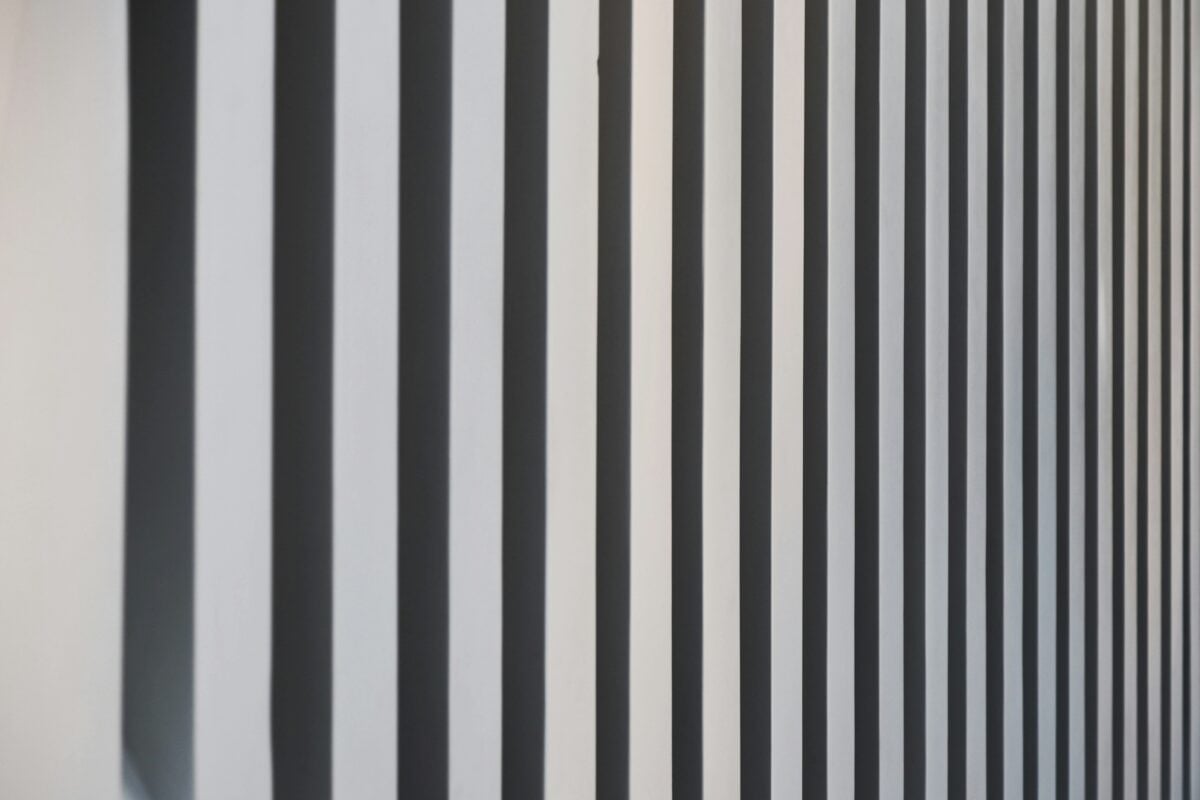
The Hering illusion shows two perfectly straight parallel lines overlaid on radiating lines that spread out from a central point. The parallel lines appear to bow outward, bending away from each other.
Your visual system interprets the radiating lines as depth cues, similar to railroad tracks extending into the distance. This makes your brain perceive the straight lines as curved, even though a ruler would prove otherwise.
The Triangle Your Mind Builds
Kanizsa’s triangle demonstrates how aggressively your brain fills in missing information. Three pac-man shapes arranged in a triangle formation create the illusion of a bright white triangle sitting on top of three black circles.
No triangle actually exists in the image. Your brain constructs the shape because it expects objects to be complete and whole.
This expectation is so strong that you can even see the edges of the phantom triangle more clearly than the actual shapes creating it.
Motion Where Everything Stays Still
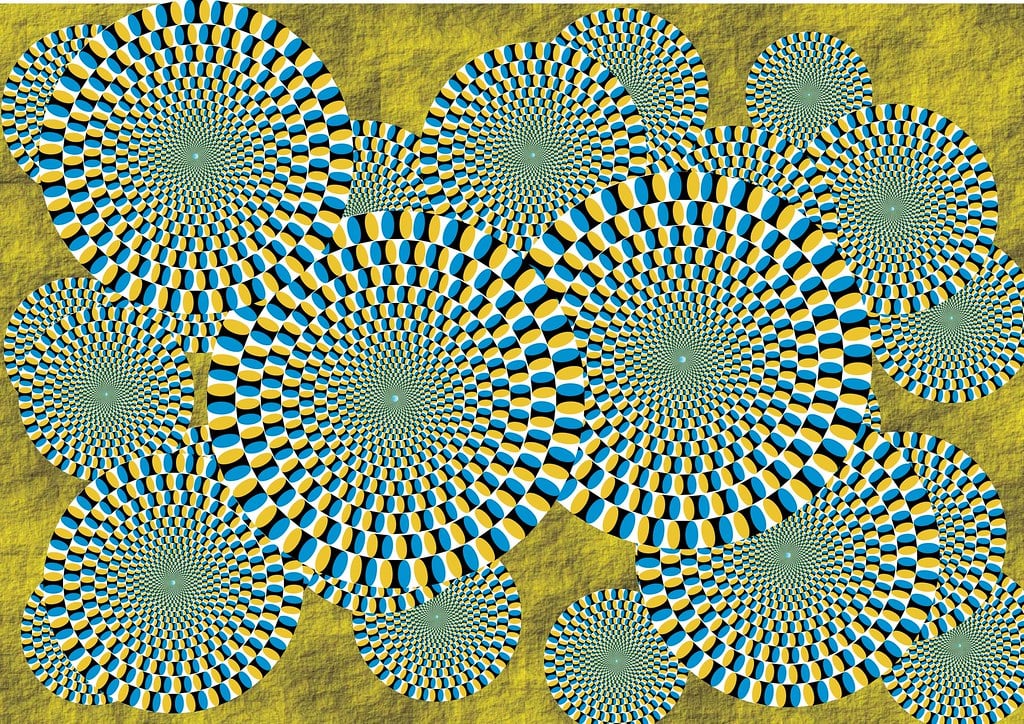
The rotating snakes illusion uses carefully arranged patterns of colors and shapes to create the sensation of movement. Nothing in the image actually moves, but the pattern tricks the neurons in your visual cortex that detect motion.
The effect gets stronger when you move your eyes around the image, and it disappears when you stare at one spot. Your peripheral vision is particularly susceptible to this type of illusion because it’s designed to detect movement and changes rather than fine details.
Size Comparisons Your Brain Gets Wrong
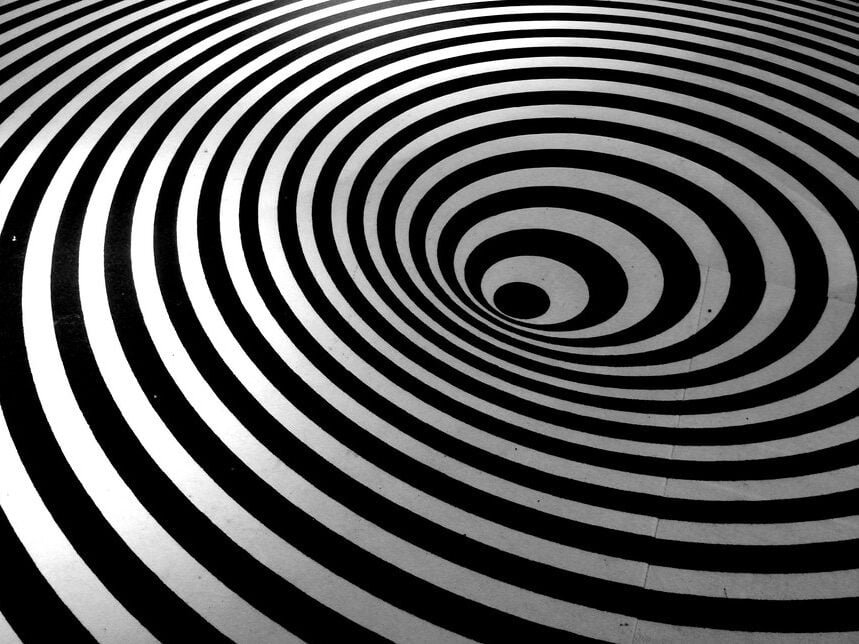
The Ebbinghaus illusion places two identical circles in different contexts. One circle sits surrounded by large circles, while the other is surrounded by small circles.
The circle surrounded by large shapes appears smaller, and the one surrounded by small shapes appears larger. Your brain doesn’t judge absolute size well.
Instead, it relies heavily on comparing objects to their surroundings. This relative judgment system usually helps you navigate the world efficiently, but it fails spectacularly when the surrounding context is manipulated.
The Dress That Broke the Internet

Some people saw a dress as blue and black, while others insisted it was white and gold. This wasn’t just a difference of opinion. The controversy revealed how much your brain interprets color based on assumptions about lighting conditions.
Your visual system constantly adjusts colors based on whether you think an object is in shadow or bright light. People who assumed the dress was in shadow saw blue and black. Those who assumed it was in bright light saw white and gold.
Both groups were using the same neural mechanisms, just with different starting assumptions.
Faces That Appear in Random Places

Pareidolia is your brain’s tendency to find faces in random patterns. You see faces in clouds, toast, and the front of cars.
This happens because your brain has specialized neural circuits dedicated to face recognition, and these circuits are incredibly sensitive. They evolved to help you quickly identify other humans, an ability crucial for social interaction and survival.
The system is so sensitive that it sometimes fires when faced with vague patterns that only slightly resemble a face. Your brain would rather see a face that isn’t there than miss a face that is there.
That’s why you can’t unsee faces once you’ve spotted them in everyday objects.
Impossible Staircases That Loop Forever

The Penrose stairs create an impossible object that appears to ascend or descend in a continuous loop. M.C. Escher famously used this concept in his artwork. The illusion works because your brain tries to construct a three-dimensional object from a two-dimensional drawing.
Each individual section of the staircase looks plausible, but when you try to follow the entire structure, you realize it can’t exist in physical space. Your brain struggles to reconcile the local details with the global impossibility.
Colors That Change When You Look Away

Afterimages occur when you stare at a colored shape for about 30 seconds, then look at a white surface. You’ll see the same shape in the opposite color.
This happens because the cone cells in your retina that detect specific colors get fatigued. When you look away, the unfatigued cones respond more strongly, creating an inverted color image.
The effect demonstrates that color vision isn’t just about light hitting your eyes. It’s about the relative activity of different types of cells and how your brain interprets their signals.
The Moon That Shrinks When It Rises

The moon illusion makes the moon appear much larger when it’s near the horizon than when it’s high in the sky. This has puzzled people for thousands of years.
The moon doesn’t actually change size, and the effect persists even in photographs, which rules out atmospheric effects. The most accepted explanation involves depth perception.
When the moon sits near the horizon, your brain has familiar reference points like trees and buildings. These cues make your brain interpret the moon as being farther away, so it inflates the perceived size to compensate.
High in the sky, the moon lacks these reference points. Your brain perceives it as closer and therefore smaller.
Shadows That Reverse Without Warning

The hollow face illusion takes a concave face mask and makes it appear convex. Even when you know the face is hollow and curving inward, your brain insists on seeing it as a normal face bulging outward.
This illusion is nearly impossible to override because your brain’s face-processing systems are so dominant. The assumption that faces are convex is so deeply embedded that it overrides even clear contradictory information from lighting and shadows.
Patterns That Hide What’s Right in Front of You

Camouflage works by exploiting your brain’s reliance on detecting edges and boundaries. When patterns break up the outline of an object, your visual system struggles to separate the figure from the background.
Military camouflage doesn’t make soldiers invisible. It just makes them harder to distinguish from their surroundings by disrupting the continuous edges your brain uses to identify objects.
Animals have been using this principle for millions of years. The patterns on a zebra, for instance, make it difficult for predators to track individual animals when the herd is moving.
Multiple Images Hidden in Plain Sight

Ambiguous images like the duck-rabbit contain two distinct interpretations within the same set of lines. Your brain can see either a duck or a rabbit, but typically not both at the same time.
These images reveal that perception involves making choices. Your visual system has to commit to one interpretation, and it can switch between alternatives when presented with ambiguous information.
The switch happens suddenly and completely, demonstrating that you don’t perceive raw visual data. You perceive your brain’s best guess about what that data represents.
Distance Cues That Shrink Giants

The Ames room creates a distorted space where people appear to dramatically change size as they walk from one corner to another. The room is actually trapezoidal, with one corner much farther from the viewer than the other.
But the room is constructed so that when viewed from a specific point, it appears rectangular. Your brain assumes the room is a normal rectangular space and interprets size differences as actual changes in the people’s height.
This illusion shows how dependent your depth perception is on assumptions about the environment.
The Flicker That Reveals Hidden Motion

Spinning wheels seem frozen or move backwards in film clips. Because each picture snaps at set moments, gaps form where movement hides.
Nearly completing a spin before the next snapshot tricks your eye into seeing reverse turns. What you perceive as smooth motion is just stills shown fast – yet confusion slips in when timing matches wrong.
Helicopter rotors vanish midair on screen through that very quirk.
What These Tricks Reveal About Perception

Vision isn’t a window but a guess. What reaches your eyes gets shaped by what came before.
Illusions reveal how much is stitched together behind the scenes. A fragment becomes whole thanks to old patterns pulled from memory.
Most days this works so smoothly you never notice the seams. Movement feels fluid because predictions match reality often enough.
Distance seems clear even though it’s inferred, not seen outright. The world appears stable only because errors stay small and rare.
Yet tricks expose cracks in the setup. Where beliefs crumble appears when paths cut too quickly.
Grasping those slips won’t sharpen sight – still reveals how fiercely the mind labors nonstop shaping smooth scenes assumed easy.
More from Go2Tutors!

- The Romanov Crown Jewels and Their Tragic Fate
- 13 Historical Mysteries That Science Still Can’t Solve
- Famous Hoaxes That Fooled the World for Years
- 15 Child Stars with Tragic Adult Lives
- 16 Famous Jewelry Pieces in History
Like Go2Tutors’s content? Follow us on MSN.