Surprising Science Behind Optical Illusions
Your brain is lying to you right now.
Not maliciously, and not because something’s wrong with it.
It’s doing exactly what evolution designed it to do, making split-second decisions about the world based on incomplete information.
Optical illusions expose these shortcuts, revealing the fascinating machinery working behind the scenes every time you open your eyes.
What seems like simple trickery is actually a window into one of the most complex systems in nature.
Scientists have been studying optical illusions for centuries, and what they’ve discovered challenges the basic assumption that we see reality as it truly is.
We don’t.
We see what our brains construct from electrical signals, educated guesses, and a whole lot of pattern recognition.
Here’s a closer look at the surprising science that explains why our brains get fooled.
Your eyes are just the beginning

Light enters your eyes and hits the retina, where specialized cells called rods and cones convert it into electrical signals.
These signals travel along the optic nerve through a structure called the thalamus and arrive at the visual cortex at the back of your brain.
That’s where the real work begins.
The brain doesn’t simply record what the eyes see like a camera.
It actively interprets, predicts, and sometimes invents visual information to create a coherent picture of the world.
The Hermann grid mystery
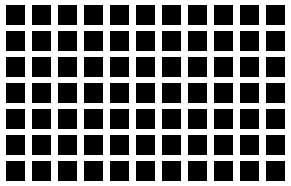
Stare at a grid of black squares on a white background and you’ll see ghostly gray blobs appearing at the intersections of the white lines.
Look directly at any intersection and the blob vanishes.
This is the Hermann grid illusion, first described by German physiologist Ludimar Hermann in 1870.
For decades, scientists explained this through lateral inhibition, where cells in the retina compete with each other.
That explanation seemed solid until researchers discovered the illusion disappears completely when you make the grid lines wavy instead of straight, forcing scientists to look toward processing in the visual cortex itself.
Lines that aren’t what they seem

The Müller-Lyer illusion presents two identical lines, one with inward-pointing arrows and one with outward-pointing arrows.
Almost everyone perceives the line with outward arrows as longer, even after measuring confirms they’re the same.
The leading explanation involves misapplied size constancy.
We live in a ‘carpentered world’ full of corners and rectangular structures.
Our brains interpret the outward-pointing arrows as the far corner of a room and compensate by making that line appear longer.
Studies comparing responses across cultures support this.
American children and urban Zambian children show strong susceptibility, while rural Zambian children raised in circular huts with fewer right angles show much less.
Waterfalls that flow upward

Aristotle noticed something strange over two thousand years ago.
After watching water flow for a while, he’d look at stationary rocks nearby and they’d appear to move in the opposite direction.
This motion aftereffect happens because specific neurons in your brain get tired.
When you watch downward-flowing water for about a minute, the ‘downward motion’ neurons adapt and reduce their activity.
When you then look at stationary rocks, the ‘upward motion’ neurons have relatively higher activity compared to the adapted downward neurons.
Your brain interprets this imbalance as upward movement, even though nothing’s actually moving.
When motion freezes position

Something particularly odd happens with the waterfall illusion that tells us a lot about how the brain works.
The rocks appear to move upward, but they never seem to get closer to the top.
They move without changing position.
This suggests the brain processes motion and position separately, using different neural pathways.
Rare cases of brain injury support this idea.
Some patients lose the ability to see motion while still perceiving changes in position.
One patient described flowing water as looking like a glacier, frozen in time despite knowing intellectually that it should be moving.
The rubber hand that feels real

The rubber hand illusion demonstrates how easily the brain can be fooled about what belongs to your body.
Participants sit with one hand hidden and a rubber hand visible in front of them.
When researchers simultaneously stroke the visible rubber hand and the hidden real hand, something remarkable happens within about fifteen seconds.
Most people begin to feel ownership of the fake hand.
Even stranger, the temperature of their actual hand typically drops, as if the brain no longer considers it part of the body.
Brain imaging studies show increased activity in the premotor cortex during the illusion, particularly in regions that integrate visual, tactile, and proprioceptive information.
Color constancy and bananas

Your brain makes constant adjustments to help you perceive a stable world despite dramatically changing lighting conditions.
A banana looks yellow whether you see it in daylight or under fluorescent lights, even though the actual wavelengths bouncing off it change significantly.
Your brain automatically compensates for the color of ambient light.
This same mechanism explains the famous dress illusion that broke the internet.
People’s brains made different assumptions about the lighting in the photograph, leading some to see white and gold while others saw black and blue.
Neither group was wrong.
They were seeing the results of their visual system’s best guess.
Why illusions matter
Optical illusions aren’t just parlor tricks or amusing curiosities.
They’re valuable scientific tools that reveal how our visual system actually works.
By studying what tricks the brain uses and why, researchers have mapped out the neural pathways involved in vision and identified which brain regions handle specific tasks.
Every illusion represents a processing strategy the brain uses to interpret ambiguous information.
They’ve also proven useful in understanding conditions like stroke and chronic pain, where altered perception plays a role.
What your brain really does

The traditional view of perception suggested we passively receive information from our senses, like a camera recording reality. Modern neuroscience paints a very different picture.
Your brain constantly makes predictions about what it expects to see based on past experience.
When sensory information arrives, it’s compared against these predictions.
Optical illusions exploit this system by presenting situations where the brain’s predictions don’t match reality.
The gray blobs, the unequal lines, the upward-flowing waterfall—they’re all products of a brain doing its job efficiently, just encountering unusual input it wasn’t designed to handle.
Understanding that we don’t see reality directly but rather a constructed interpretation helps explain not just illusions, but the entire nature of conscious experience itself.
More from Go2Tutors!

- The Romanov Crown Jewels and Their Tragic Fate
- 13 Historical Mysteries That Science Still Can’t Solve
- Famous Hoaxes That Fooled the World for Years
- 15 Child Stars with Tragic Adult Lives
- 16 Famous Jewelry Pieces in History
Like Go2Tutors’s content? Follow us on MSN.



