The Most Bizarre Unsolved Mysteries in History
Some mysteries stick around not because they’re impossible to solve, but because the solutions we come up with sound more ridiculous than the mystery itself. History is littered with events so strange that even our best explanations feel like educated guesses wrapped in wishful thinking.
These aren’t your typical whodunit puzzles where the butler did it in the library with a candlestick. These are the cases that make you wonder if reality occasionally takes a coffee break and lets something else run the show for a while.
The Dancing Plague of 1518
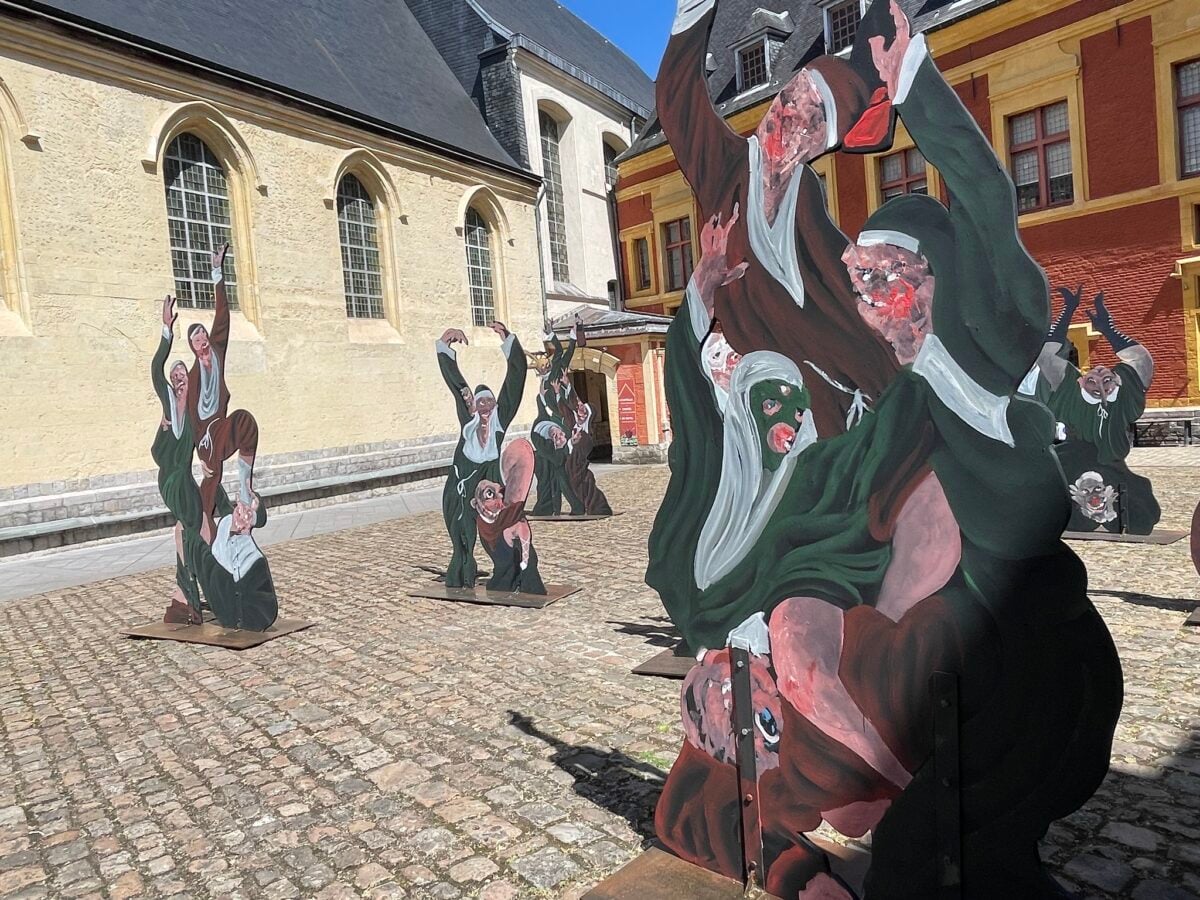
In July 1518, a woman named Frau Troffea stepped into the streets of Strasbourg and began dancing. She didn’t stop for days.
Within a week, dozens had joined her — and not in some joyful celebration, but in what appeared to be uncontrollable, frenzied movement that continued until some collapsed from exhaustion. The local authorities, displaying the kind of medical insight you’d expect from the 16th century, decided the cure was more dancing.
They hired musicians and built stages. More people joined the dance.
By the end of the month, around 400 people were trapped in this bizarre choreographed nightmare, with reports that some danced themselves to death. Theories range from ergot poisoning (a fungus that grows on grain and can cause hallucinations) to mass psychogenic illness — basically, collective hysteria.
But here’s what makes it truly strange: this wasn’t an isolated incident. Similar dancing plagues had erupted across Europe for centuries, suggesting either a recurring environmental cause nobody understood, or something about human psychology that we still don’t fully grasp.
The Voynich Manuscript

Picture this: you’re a rare book dealer in 1912, and you stumble across a manuscript that looks like it was written by aliens who had a passing familiarity with medieval European aesthetics but decided to freestyle the whole language situation. The pages are filled with elaborate illustrations of plants that don’t exist, astronomical diagrams that make no sense, and women bathing in green pools connected by an intricate system of pipes (because apparently even mysterious manuscripts need plumbing).
The text — and there’s lots of it, 240 pages worth — is written in a script that resembles no known language, living or dead. It has the statistical properties of real language (certain letter combinations appear more frequently than others, the way “th” and “ing” do in English), but nobody has managed to decode a single word with any certainty, despite nearly a century of cryptographers, linguists, and computer scientists taking their best shots at it.
Carbon dating places it in the early 15th century, which only makes it more confusing. Who had the time and resources to create such an elaborate hoax in medieval Europe? And why would they bother?
Some scholars think it’s an elaborate cipher. Others believe it’s a made-up language created by someone with too much time and parchment.
A few optimists still think it might contain actual lost knowledge about medicine or astronomy, locked away in a code we haven’t cracked yet. But honestly? At this point, the manuscript has probably earned the right to keep its secrets.
The Antikythera Mechanism
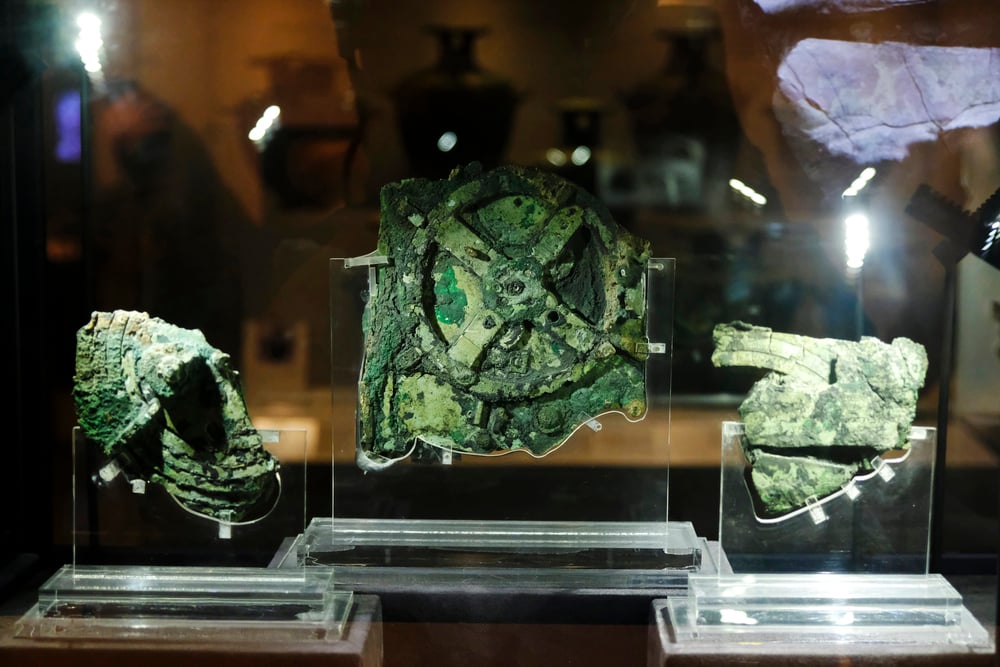
Imagine finding a smartphone in Shakespeare’s attic. That’s roughly the feeling archaeologists had when they discovered the Antikythera mechanism in a shipwreck off the Greek island of Antikythera in 1901.
This bronze device, built around 100 BCE, is essentially an ancient computer designed to predict the positions of celestial bodies with startling accuracy. The mechanism contains at least 37 meshing bronze gears housed in a wooden case about the size of a shoebox.
Turn a handle, and the gears calculate and display the positions of the sun, moon, and known planets, predict eclipses, and even track the four-year cycle of the Olympic Games. The level of mechanical sophistication rivals clockwork that wouldn’t appear in Europe for another 1,400 years.
Here’s what bothers historians: this wasn’t some one-off invention by a mechanical genius. The craftsmanship is too refined, suggesting a tradition of making such devices.
Yet no other examples have survived, and no ancient texts describe anything remotely similar. It’s as if an entire branch of advanced technology existed in the ancient world and then vanished without a trace, leaving behind a single artifact that reads like science fiction.
The Wow! Signal
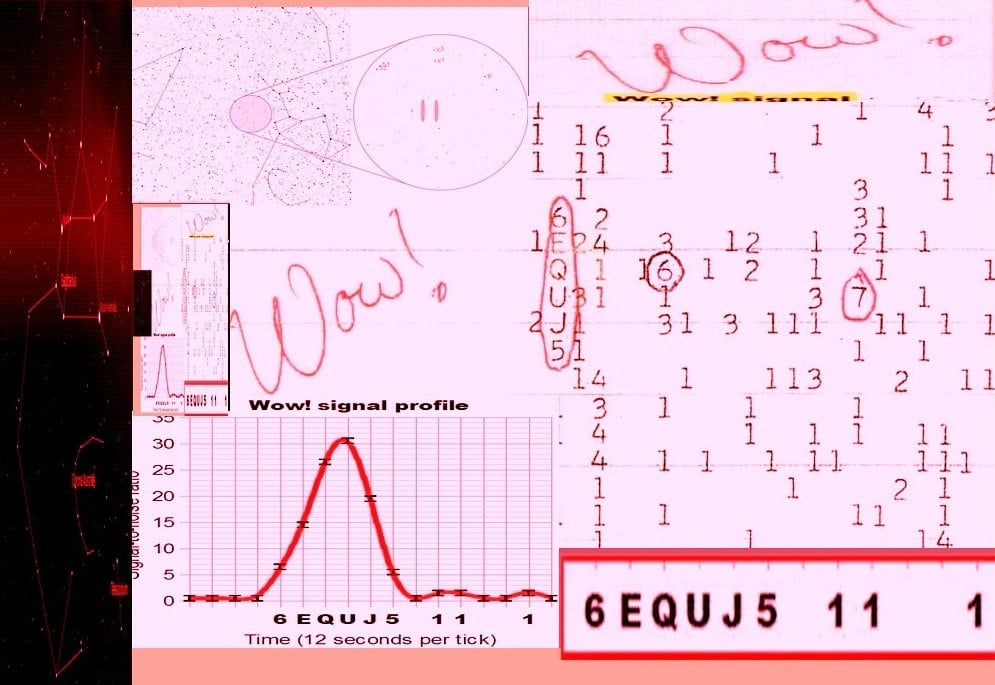
On August 15, 1977, astronomer J. Ehman was reviewing data from Ohio State University’s Big Ear radio telescope when he spotted something that made him grab a red pen and write “Wow!” in the margin. The signal was a strong, narrowband radio transmission that lasted 72 seconds and came from the direction of the constellation Sagittarius.
What made it remarkable wasn’t just its strength — it was 30 times more powerful than typical deep space background noise — but its characteristics. The signal appeared to be coming from empty space, far from any known star or planet. Its frequency was close to 1420 MHz, the natural emission frequency of hydrogen and a wavelength that many scientists consider an obvious choice for interstellar communication because any technologically advanced civilization would know about it.
The Big Ear telescope never detected the signal again, despite repeated attempts to relocate it. Other radio telescopes have searched the same area of sky and found nothing. Various explanations have been proposed — reflections from space debris, signals from Earth satellites, even emissions from comets — but none fully account for all the signal’s characteristics.
So we’re left with the tantalizing possibility that for 72 seconds in 1977, someone or something tried to get our attention. We just don’t know who, or if they’re still trying.
The Taos Hum

The people of Taos, New Mexico, live with a sound that shouldn’t exist (yet here I am, having to avoid the word that rhymes with “sound” – let’s call it persistent audible annoyance). Since the early 1990s, roughly 2% of the town’s population has reported hearing a low-frequency humming sound that seems to come from everywhere and nowhere at once.
It’s described as similar to the sound of a diesel engine idling in the distance, except there’s no engine. Government investigations have turned up nothing.
The sound doesn’t show up on recording equipment, which means it’s either so low-frequency that standard microphones can’t pick it up, or it’s somehow generated internally by the people who hear it. But here’s the strange part: those who hear it aren’t imagining things.
They describe remarkably consistent characteristics — the same frequency range, the same time patterns, the same inability to pinpoint its source. Similar unexplained humming sounds have been reported in other locations worldwide, from Bristol, England, to Bondi, Australia.
Theories range from tinnitus to underground geological activity to military experiments with extremely low-frequency radio transmissions. But the Taos version remains the most studied and the most inexplicable.
The people who hear it are otherwise healthy, and many report that it’s loud enough to interfere with sleep and concentration. Something is making that sound. We just can’t figure out what.
The Lead Masks Case

Brazil, 1966: two electronics technicians are found dead on a hill overlooking the city of Niterói, wearing matching lead eye masks and formal suits. Next to their bodies, investigators discover a notebook with the cryptic instruction: “16:30 be at agreed place, 18:30 ingest capsules, after effect protect metals await signal mask.”
The men, Manoel Pereira da Cruz and Miguel José Viana, had told family members they were going to buy materials for work. Instead, they purchased the lead masks and caught a bus to the remote hilltop where they died.
Autopsies were delayed so long that any traces of poison had decomposed, leaving the cause of death undetermined. The lead masks suggest they were trying to protect themselves from radiation or bright lights — but from what? The carefully planned nature of their trip, the formal clothing, and the reference to “await signal” in their note all point to some kind of deliberate appointment or experiment.
But with whom, and for what purpose? UFO enthusiasts point to several reported sightings in the area around the time of the deaths, but skeptics note that the men were electronics hobbyists who might have been conducting their own amateur experiments with dangerous equipment. Either way, two men climbed a hill with lead masks and never came back down alive.
The hill isn’t telling.
The Sodder Children Disappearance

Midnight Believer
The Sodder family house burned down on Christmas Eve, 1945, in Fayetteville, West Virginia. George and Jennie Sodder escaped with four of their ten children, but five children — Maurice, Martha, Louis, Jennie, and Betty — were presumed to have perished in the flames. Except no remains were ever found in the ashes, despite extensive searching.
Strange details started piling up immediately. The phone lines had been cut.
The family’s truck wouldn’t start, even though it had worked fine the day before. The fire department took seven hours to respond to a fire just two and a half miles away.
A bus driver later reported seeing the missing children watching the fire from a vehicle on the night of the blaze, but this wasn’t reported to police for several days. The Sodders became convinced their children had been kidnapped, and they spent the rest of their lives searching.
They hired private investigators, put up billboards, and followed leads across the country. In 1968, they received a photograph showing a young man who resembled their son Louis, with a note on the back: “Louis Sodder. I love my brother Frankie.
Ilil Boys. A90132 or 35.” The photo was sent for analysis but disappeared from the detective’s office before any results were obtained.
The case officially remains unsolved, and the missing Sodder children would be in their eighties or nineties today if they survived.
The Dyatlov Pass Incident

Nine experienced hikers died in the Ural Mountains in February 1959, and the circumstances of their deaths read like a horror story written by someone with a very specific and disturbing imagination. The group, led by Igor Dyatlov, was found weeks after they failed to return from their expedition.
Their tent had been cut open from the inside, and the hikers had fled into the freezing wilderness wearing minimal clothing. The bodies were discovered scattered across the mountainside.
Some had died of hypothermia, which makes sense given the circumstances, but others showed signs of massive internal trauma — broken ribs, skull fractures — with no external injuries to explain them. One victim was missing her tongue and eyes.
Their clothes showed traces of radiation, though not at lethal levels. The Soviet government classified the investigation and concluded the deaths were caused by an “unknown compelling force.”
Theories have ranged from avalanche to military weapons testing to infrasound-induced panic (low-frequency sound waves that can cause anxiety and disorientation). But none fully explain why experienced mountaineers would abandon their shelter and flee inadequately clothed into deadly cold, or what could cause such severe internal injuries without corresponding external damage.
The case was officially reopened in 2019, with authorities concluding it was an avalanche, but many details remain unexplained.
The Max Headroom Broadcast Intrusion

Television programming was interrupted twice on November 22, 1987, in Chicago, when an unknown person wearing a Max Headroom mask hijacked the airwaves. The first intrusion occurred during the evening news on WGN-TV and lasted about 25 seconds, showing the masked figure bobbing silently against a rotating background.
The second, more elaborate incident happened later that night during a broadcast of “Doctor Who” on WTTW. The second intrusion lasted 90 seconds and included audio — a distorted voice making bizarre references, humming, and ending with the figure being spanked with a flyswatter while shouting.
The hijacker demonstrated sophisticated knowledge of broadcast technology, managing to overpower the signals of two major television stations without being traced. Despite FBI investigations and numerous amateur attempts to identify the perpetrator, the case remains unsolved.
The technical expertise required suggests someone with professional broadcasting knowledge, but the bizarre content of the interruptions defies obvious explanation. It wasn’t a political statement, commercial advertisement, or clear prank — just a surreal performance broadcast to hundreds of thousands of viewers for reasons known only to the person behind the mask.
The Piri Reis Map
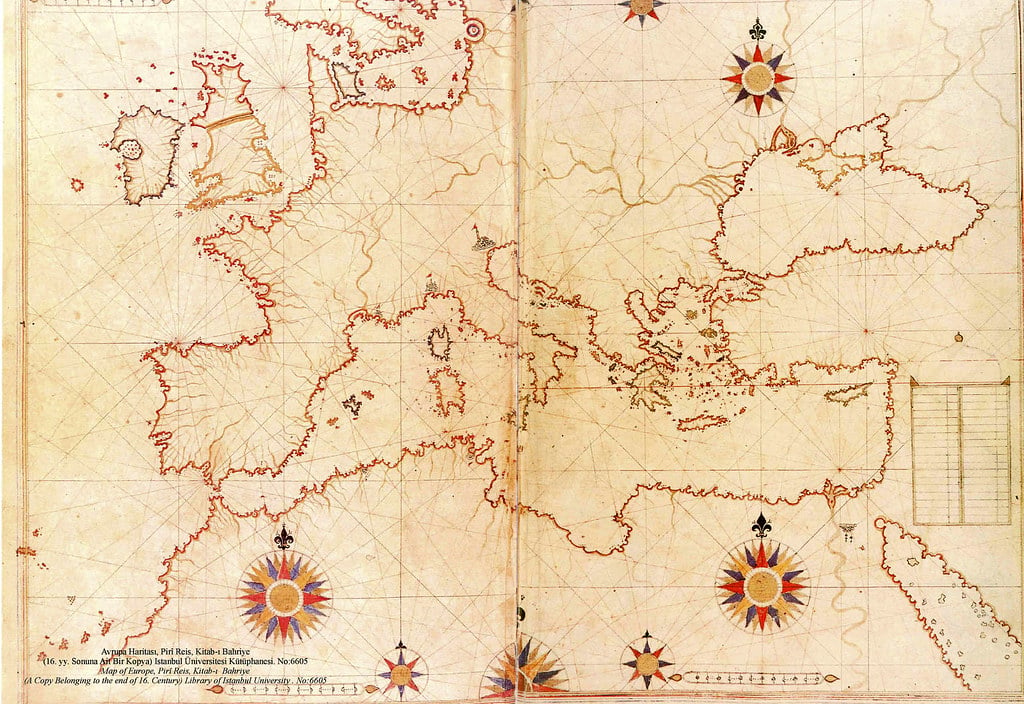
In 1929, scholars discovered a map drawn by Ottoman admiral Piri Reis in 1513 that shows the coastlines of Europe, Africa, and the Americas with remarkable accuracy for its time. But the map also appears to show the northern coast of Antarctica — which wasn’t officially discovered until 1820, and more puzzling, it shows the coast as it would appear without ice coverage.
The map was compiled from various sources, some dating back to ancient times, according to Piri Reis’s own notes. But how could ancient cartographers have known about Antarctica, let alone what it looked like beneath its ice sheet? Modern geological surveys confirm that the coastline shown on the map closely matches the actual geography of Antarctica under the ice.
Conventional explanations suggest the map shows the coastline of South America, possibly distorted through copying errors over time. But this doesn’t account for the remarkable geographic details that seem to match Antarctic features. The map raises uncomfortable questions about what ancient civilizations might have known about global geography, and how they could have acquired such knowledge without the technology we assume was necessary for polar exploration.
The Kentucky Meat Shower

On March 3, 1876, chunks of meat fell from a clear sky onto the property of Allen Crouch in Bath County, Kentucky. Mrs. Crouch was making soap in her yard when pieces of fresh meat, ranging in size from small flakes to chunks several inches square, rained down around her for several minutes, covering an area roughly 100 yards long and 50 yards wide.
Two men who tasted the meat (because apparently someone always volunteers for this job) declared it either mutton or venison. Samples were sent for analysis to various institutions, with results identifying the meat as lung tissue from either a horse or a human infant — a distinction that probably mattered quite a bit to someone, though the reports don’t specify who.
The most widely accepted explanation involves turkey vultures, which can regurgitate their stomach contents when startled or threatened while flying. But this theory requires assuming a large flock of vultures simultaneously threw up while flying over the Crouch property, which seems like an oddly coordinated response.
Alternative theories involving atmospheric updrafts carrying meat from distant locations don’t explain how the meat remained fresh enough to be identified and sampled. Sometimes the sky drops meat on Kentucky. Nobody knows why.
The Hessdalen Lights
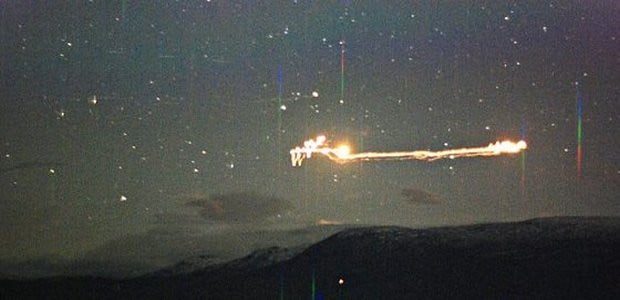
Since the 1940s, residents of the Hessdalen valley in Norway have reported unexplained lights appearing in the sky with remarkable consistency. The phenomena peaked in the 1980s, when lights were observed several times per week, but continue to this day with observations occurring 10-20 times per year.
The lights appear in various forms — sometimes as bright white or blue orbs that move slowly across the sky, other times as flashing lights that appear and disappear rapidly. They can last anywhere from a few seconds to over an hour.
Unlike typical UFO reports, the Hessdalen lights have been extensively documented by scientific instruments, including radar, cameras, and spectrum analyzers. Project Hessdalen, an ongoing scientific study, has recorded hundreds of observations and collected data showing that the lights emit radio waves and can be tracked on radar.
The lights appear to be genuine physical phenomena, not optical illusions or atmospheric effects. Various theories have been proposed — including piezoelectric effects from tectonic stress, ionized gas, and even exotic physics involving the interaction of the valley’s unique geology with the Earth’s magnetic field — but none fully explain all the observed characteristics.
The lights continue to appear on schedule, as if the valley has a standing appointment with something that prefers to remain unidentified.
The Pollock Twins Case

In 1957, two sisters, Joanna and Jacqueline Pollock, aged 11 and 6, were killed in a car accident in Hexham, England. A year later, their parents had twin daughters, Jennifer and Gillian.
What happened next challenged conventional ideas about memory, identity, and the nature of consciousness itself. The twins began displaying knowledge they couldn’t possibly have acquired.
Jennifer, despite being the younger twin, showed protective behavior toward Gillian that mirrored Jacqueline’s relationship with Joanna. When the family moved back to Hexham (they had relocated after the accident), the twins, who had never lived there, began pointing out landmarks and asking to visit places their deceased sisters had frequented.
Jennifer was born with a birthmark on her forehead that matched the location of a scar Jacqueline had received in a fall. Both twins recognized toys that had belonged to their deceased sisters, calling them by name and arguing over who they belonged to, exactly as Joanna and Jacqueline had done.
They also displayed an inexplicable fear of cars and would panic when vehicles approached, despite having no reason to associate cars with danger. The behaviors gradually faded as the twins grew older, disappearing almost entirely by age five.
Skeptics point to the possibility of unconscious coaching by grieving parents, but the specificity and consistency of the twins’ knowledge remains difficult to explain through conventional means. The case was extensively documented by Dr. Ian Stevenson, a psychiatrist who spent decades studying similar phenomena, but no definitive explanation has emerged.
The Curious Case Continues

These mysteries share a common thread that makes them particularly maddening — they’re all well-documented events with multiple witnesses, physical evidence, or scientific observation, yet they resist explanation despite decades or centuries of investigation. They suggest that reality occasionally operates according to rules we haven’t figured out yet, or that our understanding of what’s possible needs some significant revisions.
Perhaps that’s what makes them endure. They remind us that for all our scientific progress and technological sophistication, the world still holds secrets that refuse to be solved by conventional thinking.
These cases don’t ask us to believe in anything supernatural — just to acknowledge that the natural world is far stranger and more complex than we usually give it credit for being.
More from Go2Tutors!

- The Romanov Crown Jewels and Their Tragic Fate
- 13 Historical Mysteries That Science Still Can’t Solve
- Famous Hoaxes That Fooled the World for Years
- 15 Child Stars with Tragic Adult Lives
- 16 Famous Jewelry Pieces in History
Like Go2Tutors’s content? Follow us on MSN.