Why Lake Baikal is a global treasure
Deep in the heart of Siberia lies one of our planet’s most extraordinary natural wonders. Lake Baikal isn’t just another large body of water—it’s a living museum of evolution, a massive freshwater reserve, and an ecosystem so unique that scientists compare it to the Galápagos Islands. This ancient lake has been quietly shaping life on Earth for millions of years, creating conditions found nowhere else on the planet.
From its record-breaking depths to its crystal-clear waters teeming with species that exist nowhere else, Baikal represents something truly special in our natural world. Yet this treasure faces mounting challenges that threaten its delicate balance.
Here is a list of reasons why Lake Baikal stands as one of our planet’s most precious natural treasures.
Earth’s Ancient Water Keeper

Lake Baikal holds the remarkable distinction of being the world’s oldest existing freshwater lake, with an estimated age of 25 to 30 million years. While most lakes disappear within a few thousand years due to sediment buildup, Baikal has persisted through geological ages because of its unique position in an active rift zone. The lake is unique among large, high-latitude lakes, as its sediments have not been scoured by overriding continental ice sheets, preserving an unbroken record of Earth’s climate history spanning millions of years.
The Deepest Lake on Earth

At over 1,642 meters (5,387 feet) deep, Lake Baikal is the world’s deepest lake, plunging further down than the height of four Empire State Buildings stacked on top of each other. This incredible depth, combined with its vast surface area, creates a three-dimensional ecosystem with distinct zones from surface to bottom. Despite the lake’s great depth, its water is well-oxygenated throughout creating unique biological habitats. The deep waters maintain a constant temperature year-round, providing stable conditions for specialized deep-water species.
The World’s Largest Freshwater Reserve
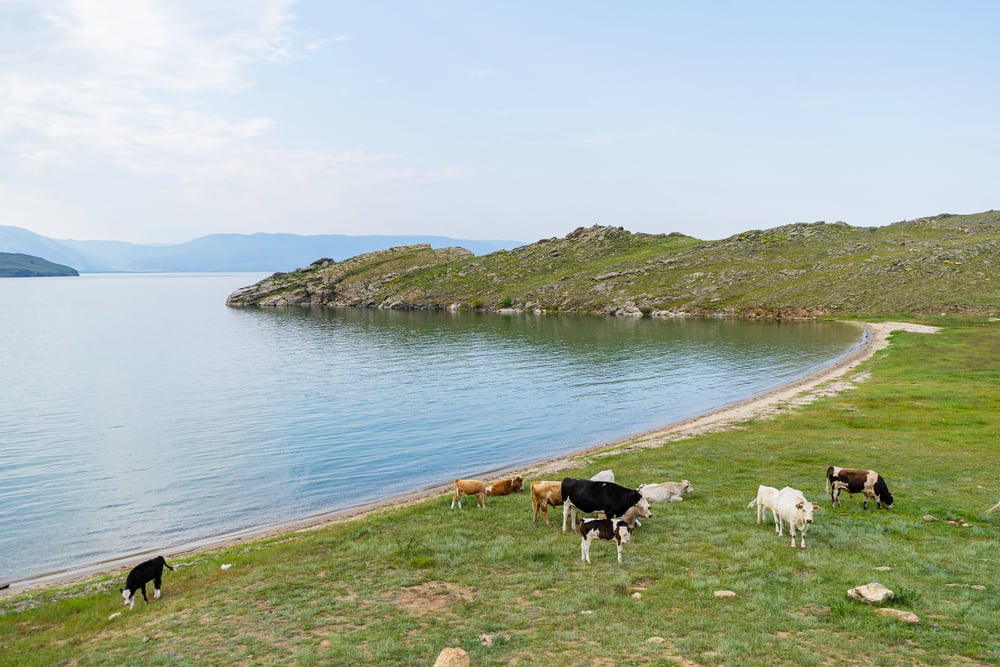
Lake Baikal contains 23,000 cubic kilometers of water, representing roughly 20 to 23 percent of the world’s total unfrozen freshwater. It contains as much fresh water as the Great Lakes of North America combined. This massive volume of pristine water represents a critical global resource, especially as freshwater scarcity becomes an increasingly pressing worldwide concern. The lake’s water is so pure that calcium carbonate does not survive in the fossil record due to the extremely low mineral content.
Crystal Clear Waters

The transparency of Lake Baikal’s water can reach up to 40 meters in winter, making it one of the clearest natural bodies of water on Earth. This pristineness is made possible by the lake’s particular ecosystem, where many species filter the water. Tiny zooplankton called epischura play a crucial role in maintaining this clarity by feeding on microscopic algae and particles. The exceptional transparency allows sunlight to penetrate deep into the water, supporting photosynthesis even under thick winter ice and creating the foundation for the lake’s complex food web.
The Galápagos of Russia

Known as the ‘Galapagos of Russia’, Lake Baikal’s age and isolation have produced one of the world’s richest and most unusual freshwater faunas. Of more than 1,500 plant and animal species living in the lake and its environs, as many as two-thirds are thought to be endemic. This means they evolved specifically in Baikal and exist nowhere else on Earth. The long isolation of the lake has allowed species to develop unique adaptations to its specific conditions, creating evolutionary pathways found nowhere else in the world.
Unique Marine Life in Fresh Water

Lake Baikal hosts several species that seem almost impossible for a freshwater environment. The one mammal species is the Baikal seal, or nerpa (Phoca sibirica), the world’s only freshwater seal species. These seals somehow adapted to life in fresh water thousands of miles from any ocean. Unique to the lake is a fish called the golomyanka, of the family Comephoridae, which gives birth to live young. These transparent, oil-rich fish can comprise up to 70% of the lake’s total fish biomass and live at depths where few other fish can survive.
Three Complete Endemic Fish Families

The families Abyssocottidae (deep-water sculpins), Comephoridae (golomyankas or Baikal oilfish), and Cottocomephoridae (Baikal sculpins) are entirely restricted to the lake basin. Having three entire families of fish that exist nowhere else on Earth demonstrates the extraordinary evolutionary processes at work in Baikal. Twenty-two species permanently inhabit depths over 300 meters or spend some stages of their life there, showing how the lake’s great depth has created specialized deep-water communities found in few other freshwater systems.
A Living Climate Archive

Russian, U.S., and Japanese cooperative studies of deep-drilling core sediments in the 1990s provide a detailed record of climatic variation over the past 6.7 million years. The lake’s sediments contain uninterrupted layers that tell the story of Earth’s climate history, including ice ages, volcanic eruptions, and environmental changes. Studies of sedimentary environments in Lake Baikal provide important opportunities to establish ground truth for general circulation models used to understand climate change.
UNESCO World Heritage Recognition
— Photo by Klodien
Lake Baikal was designated as a UNESCO World Heritage Site in 1996 based on multiple criteria recognizing its exceptional natural beauty, geological significance, ecological importance, and biodiversity conservation value. Lake Baikal’s UNESCO World Heritage Site designation came due to its valuable and unique natural qualities according to four UNESCO criteria including its status as an exceptional natural phenomenon and its importance for evolutionary science.
Scientific Research Laboratory

— Photo by mors74
The lake serves as a natural laboratory for studying evolution, ecology, and climate science. Very little data exist for long-term climate change from continental interiors; most of the data record derives from the marine or maritime environments, making Baikal’s continental climate record particularly valuable. Scientists study how species adapt to extreme conditions, how ecosystems maintain stability over geological time, and how climate changes affect large freshwater systems.
Threats to a Natural Wonder

Despite its protected status, Lake Baikal faces severe consequences that arise from global climate change and increasing human pressure. Mass tourism has grown exponentially across the last decade, bringing nearly 2 million tourists to Baikal’s sparsely populated shores. Algal blooms appeared in Lake Baikal in the early 2010s, and their continued expansion threatens the biodiversity that the lake currently supports. The environmental condition of the property is deteriorating, notably due to the long-term degradation of the water quality.
Economic and Cultural Importance

Beyond its ecological value, Lake Baikal supports local communities and represents significant economic potential through sustainable tourism and research. Although fishing plays only a minor role in the local economy, the lake has been drawing increasing tourism dollars to the region. The lake also holds deep spiritual significance for indigenous Buryat peoples, who have lived around its shores for centuries and consider it sacred.
Conservation Challenges and Hope
The joint threats of uncontrolled tourism development and global climate change will continue to threaten Lake Baikal and its thousands of endemic species unless decisive actions are taken. However, the lake’s recognition as a global treasure has mobilized international scientific cooperation and conservation efforts. Russian environmentalist groups are attempting to combat this issue by promoting the development of sustainable tourism in the Lake Baikal region.
Nature’s Irreplaceable Masterpiece

Lake Baikal represents more than just superlatives—it’s a window into Earth’s deep history and a laboratory of evolution that continues to teach us about life’s adaptability. Its combination of extreme age, extraordinary depth, and pristine conditions has created an ecosystem so unique that losing it would mean losing irreplaceable knowledge about our planet’s past and future. As we face global environmental challenges, protecting treasures like Baikal becomes not just an environmental imperative, but a commitment to preserving the natural wonders that make Earth extraordinary. The lake reminds us that some things in nature are genuinely irreplaceable—and worth every effort to protect.
More from Go2Tutors!

- The Romanov Crown Jewels and Their Tragic Fate
- 13 Historical Mysteries That Science Still Can’t Solve
- Famous Hoaxes That Fooled the World for Years
- 15 Child Stars with Tragic Adult Lives
- 16 Famous Jewelry Pieces in History
Like Go2Tutors’s content? Follow us on MSN.



