15 Photos of London During the 1940s Blitz
London, September 1940. The city that had stood for centuries now looked up at skies filled with the drone of German aircraft.
For eight months — from that first terrible Saturday in September to a final, devastating raid in May 1941 — Londoners lived under the constant threat of bombs. More than a million homes were damaged or destroyed.
Over 20,000 civilians in the city alone lost their lives. But photographs survived.
And through them, you can see something that the Luftwaffe never managed to destroy: the stubborn, sometimes baffling, deeply human refusal of ordinary people to stop living.
These are 15 of those photographs.
The Day It All Started: German Bombers Over the Thames
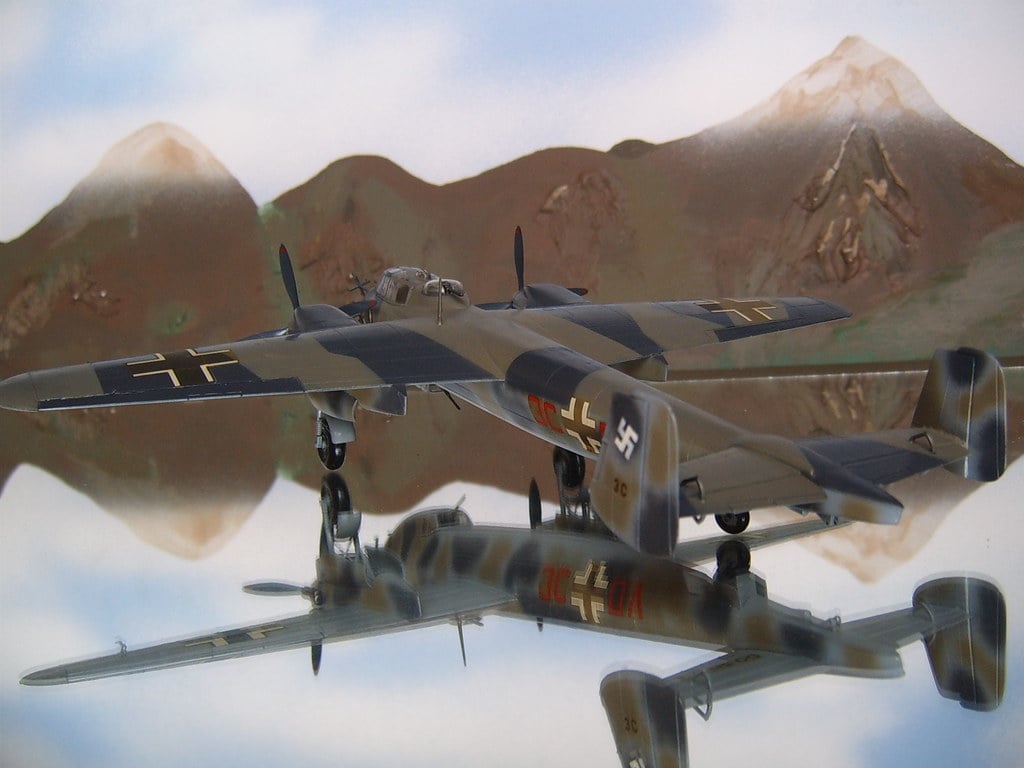
On 7 September 1940, two Dornier Do 217 bombers were photographed flying over the south-east of London. Below them, the Surrey Docks were already burning.
This was the first day of the Blitz — and those planes were just two of hundreds that arrived that afternoon. Looking at the photo now, what strikes most people isn’t the planes.
It’s how ordinary the sky looks around them. Blue. Almost peaceful.
The horror is entirely below the frame.
St. Paul’s Stands in the Fire

On the night of 29–30 December 1940, photographer Herbert Mason climbed to the roof of the Daily Mail’s offices on Tudor Street and waited for the smoke to clear. When it finally did, he captured what would become the defining image of the Blitz: St. Paul’s Cathedral rising through a wall of fire and smoke, completely intact.
The raid that night became known as the Second Great Fire of London. More than 160 people died, over 500 were injured, and hundreds of buildings were destroyed.
But the cathedral stood. The photograph ran on the front page of the Daily Mail on 31 December 1940 under the caption “War’s Greatest Picture.”
It’s hard to argue with that.
The Milkman on the Rubble
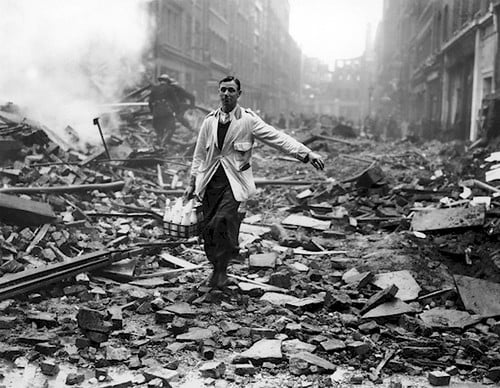
Fred Morley captured this one on 9 October 1940, and it became an instant symbol of British stubbornness. A milkman, bottles in hand, picks his way through a street buried in broken brick and shattered glass.
He looks entirely unbothered. This is the photo that people mean when they talk about “Blitz spirit.”
Whether or not that phrase has been romanticised over the decades, the milkman was real. The bottles were real.
And someone at the end of that ruined street got their milk that morning.
A Bus at the Bottom of a Pit
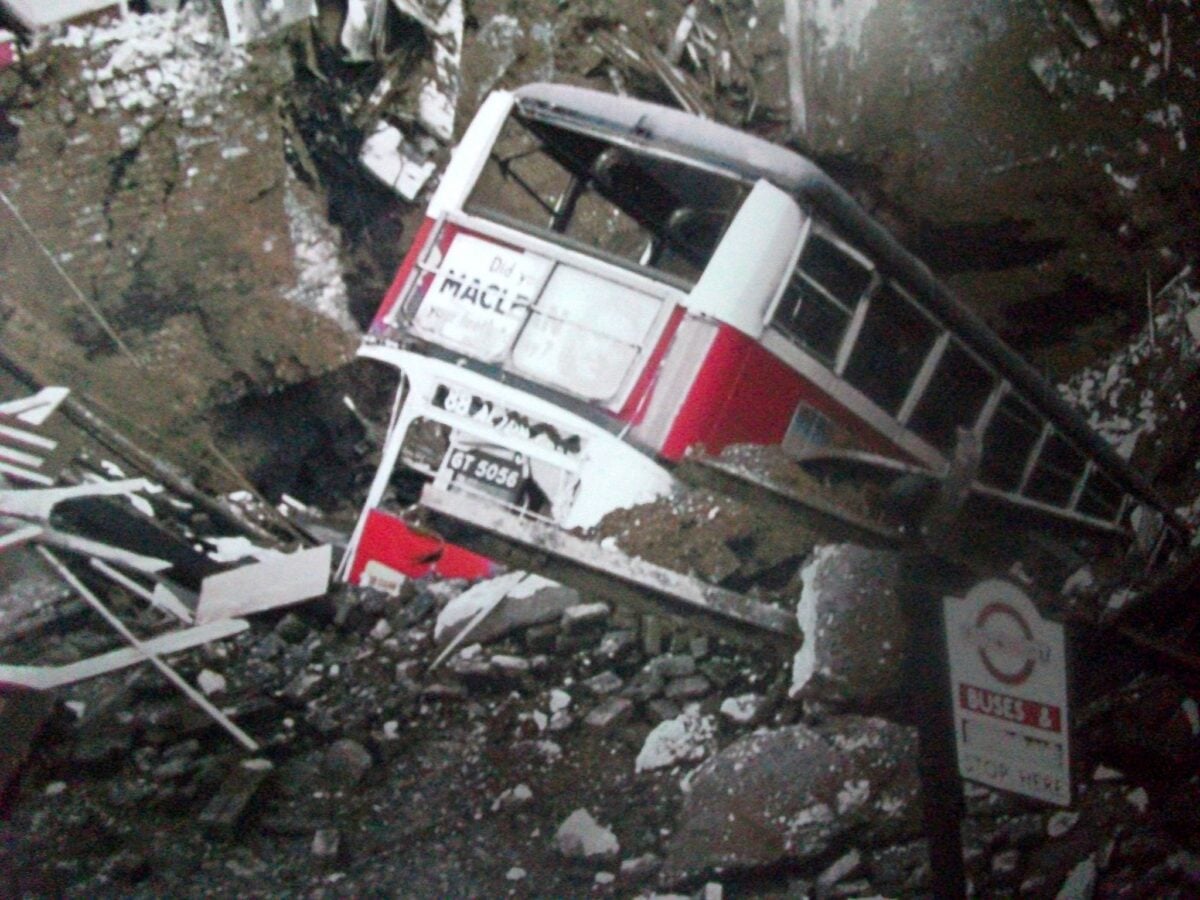
A London double-decker bus sits at the bottom of a massive crater in Balham, south London. The road simply swallowed it.
London Transport attempted to keep things running during the war, but many buses were damaged and routes made impassable by craters and fallen debris. There is something almost absurd about this image — the cheerful red bus, tilted at an angle, surrounded by nothing but earth.
It captures how quickly the familiar could become impossible.
The Readers in the Ruined Library
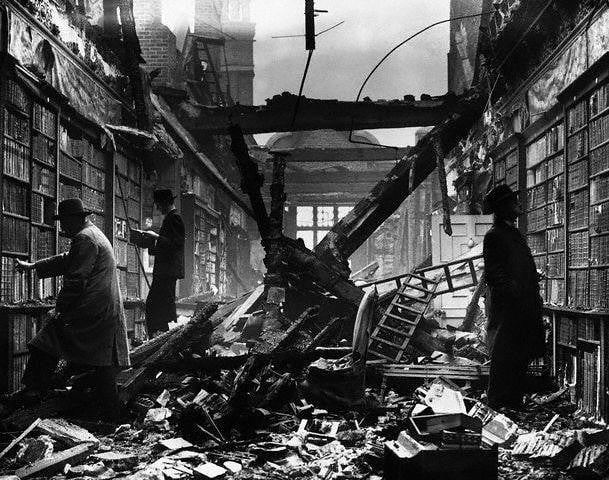
On 23 October 1940, three men were photographed browsing books in the ruins of the Holland House library, shortly after it was destroyed by a bombing raid. The roof is gone.
The walls are shattered. The shelves somehow still stand.
The men look like they’re in a perfectly ordinary library. One has a book open in his hands.
None of them appear to be in any particular hurry. It’s one of the most quietly powerful images of the entire war.
Sleeping on the Escalators
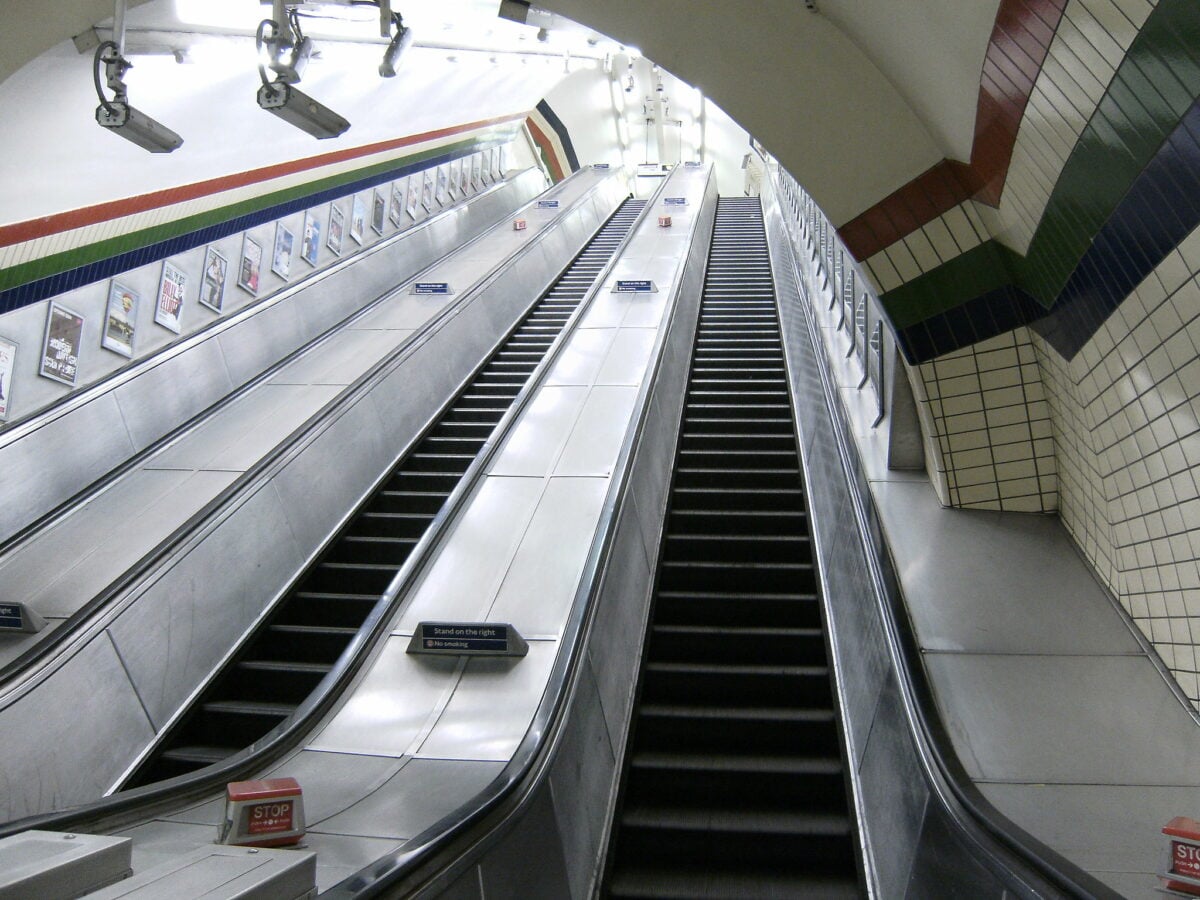
By the end of September 1940, over a hundred thousand people were sleeping overnight in London’s Underground stations. Photographs taken at Piccadilly Circus station show bodies draped across escalator steps, heads on rolled coats, children tucked against their parents.
It wasn’t comfortable. The stations were overcrowded and noisy, privacy was impossible, and sleep was difficult on the hard floor.
People came anyway, night after night, because the alternative was lying in their beds while bombs fell.
Life in the Tunnels
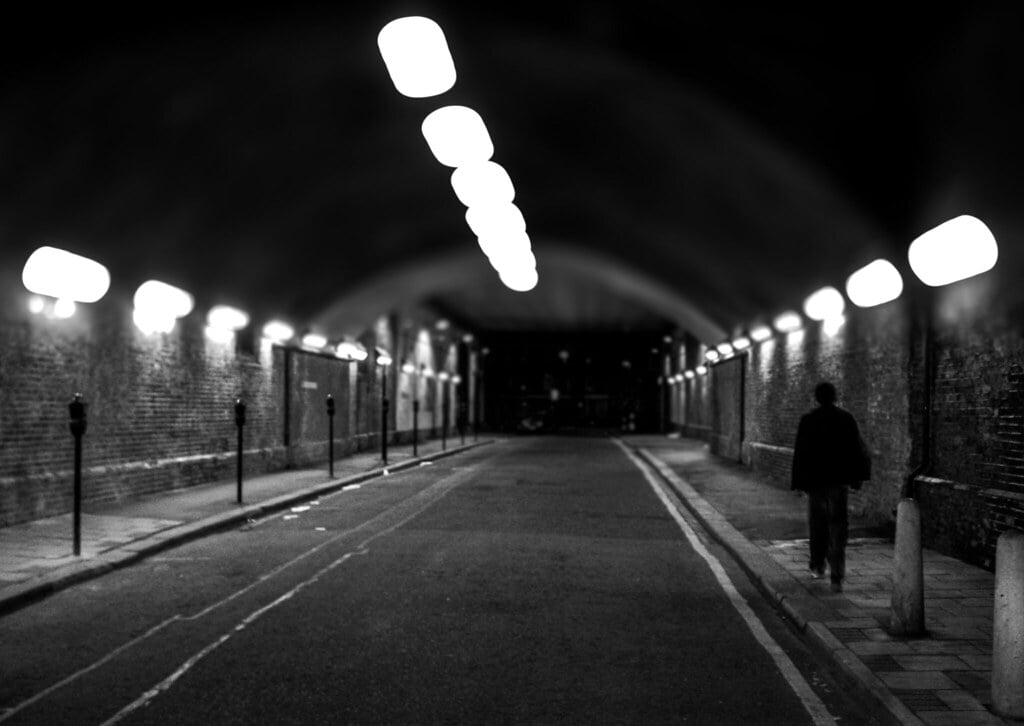
Deeper still, in the actual rail tunnels rather than the platforms, Londoners made their beds on the tracks.
Once the bombings began, people started sheltering in Tube stations by simply buying tickets and refusing to leave. The government eventually began regulating the Underground as an official nighttime shelter.
One photograph shows a long row of people lying end to end between the rails, wrapped in coats and blankets, the tunnel curving away into darkness behind them. In the morning, most of them got up and went to work.
Children With Gas Mask Boxes
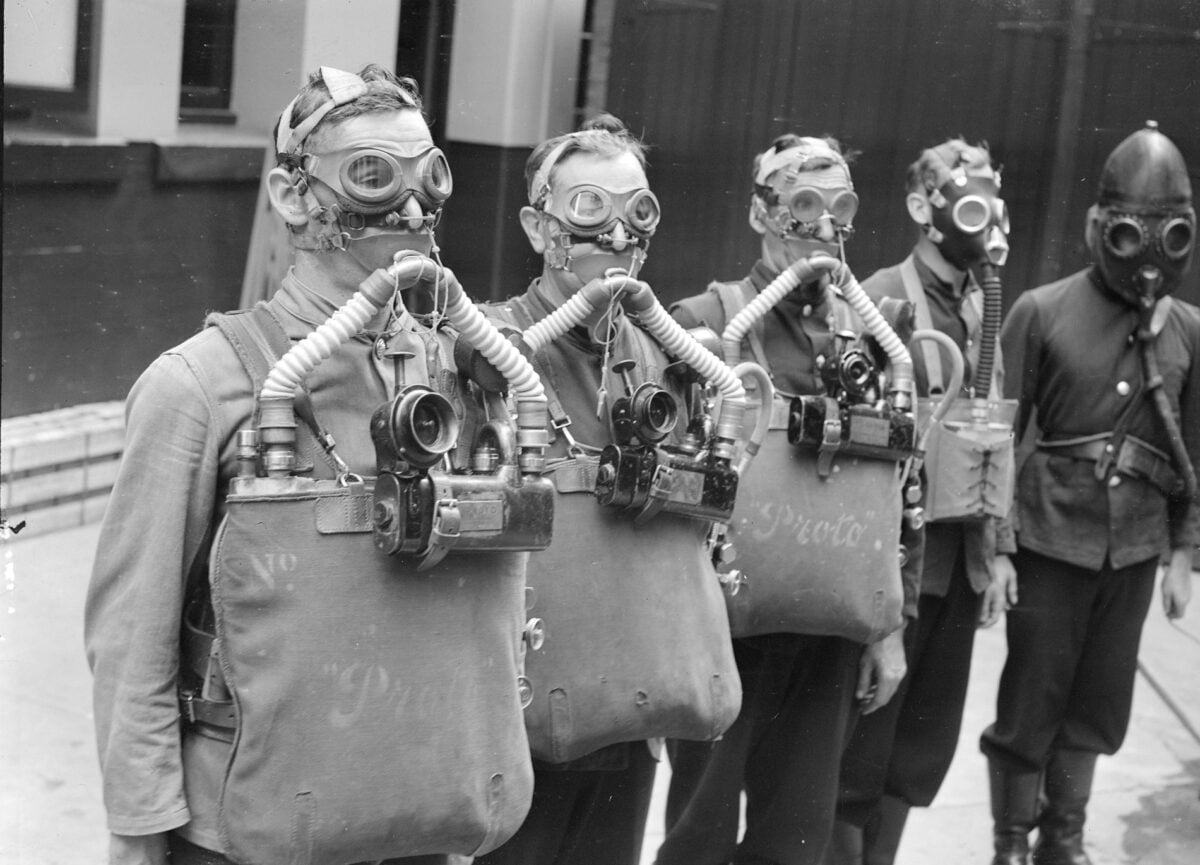
A shelter draws closer as two kids move across the cracked pavement. Behind them, the boy holds a stiff cardboard case, its corners worn, holding his gas mask inside.
His face turns slightly, eyes meeting the lens – not quite afraid, not quite calm, but caught in something quieter. The moment hangs without sound.
Growing up in wartime meant childhood ended early. Sirens wailed, day after day, while kids learned how to wear gas masks like second nature.
Homes shook, yet people found each other in the dark, passing bread from one flat to another. After bombs fell, repair began without waiting for orders.
Still, when you study those old pictures, something stays off – their eyes hold stillness that games rarely bring.
The King and Queen at Buckingham Palace

King George VI and Queen Elizabeth inspected bomb damage at Buckingham Palace after it was hit during the Blitz. The photograph shows them talking to workers in the damaged grounds, the Queen in her signature coat and pearls, the King slightly behind her.
The Palace was hit nine times during the war. Rather than evacuate, the Royal Family stayed in London.
Queen Elizabeth reportedly said it made her feel she could look the East End in the face. That decision — to stay, to be seen, to stand in the rubble — mattered enormously to Londoners at the time.
Red Sunday: The Fires on Newgate Street

On 29 December 1940 — the same night Herbert Mason photographed St. Paul’s — firefighters were pictured working through the morning on Newgate Street. Known as Red Sunday, it was among the worst raids of the Blitz.
Almost all of the buildings on the south side of the street were destroyed. The photograph shows firefighters silhouetted against smouldering ruins, hoses trailing through the debris.
The scale of destruction was so vast that water supply alone became a critical problem.
The Crater at Bank Station

On the night of 10 January 1941, a bomb fell directly in front of the Royal Exchange and straight through to the booking hall of Bank Underground station. Fifty Londoners sheltering in the tunnels were killed.
The photograph taken the following morning shows a crater of staggering size cut into the middle of one of the city’s busiest intersections. Within three weeks, the crater was cleared and spanned by a temporary steel bridge.
Three weeks. The city simply got back to work.
Churchill in the Wreckage

Winston Churchill toured the bombed streets of London multiple times throughout the Blitz. Photographs from these visits show him in his signature overcoat and hat, picking through rubble, stopping to speak with survivors, often flashing the V for Victory sign to crowds that gathered around him.
“These were the times,” he later wrote, “when the English, and particularly the Londoners, who had the place of honour, were seen at their best.” These photos were deliberate propaganda, but that doesn’t make the sentiment false.
Churchill knew what these visits meant, and he kept making them.
The Open-for-Business Sign

A blast hit the East End late that September day in 1940. One shop owner hung a hand-lettered notice over what remained of his storefront.
Glass shards littered the street where windows once stood. Part of the building lay collapsed into heaps. Still, there it stayed – the sign – firm in place.
This picture showed up in British papers, then American ones too. Though they did not expect it, German observers questioned why London kept enduring attacks while showing no hint of giving in.
Almost like a silent answer, this photo stands as the nearest anyone got to understanding.
Cricket With Gas Masks
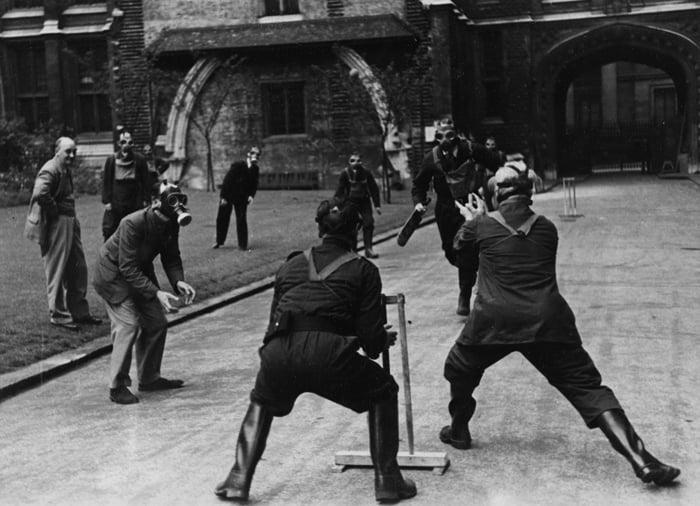
Workers at the National Archives found themselves with time between air raids, so they took to the grounds and played cricket — wearing their gas masks. The photograph shows two men mid-game, the masks giving them the look of creatures from another world, the bat and orb entirely incongruous against their surroundings.
It is both absurd and completely human. The British relationship with cricket bordered on the ceremonial, and even German bombers were not going to interrupt a good innings.
East End Families in September 1940

Come September 1940, right after the Blitz began, pictures captured East London families left without homes due to air raids. Among scattered belongings – an old chair, tied-up clothes, a small doll – people are seen sitting on rubble.
Some faces show deep tiredness; others hold a stillness too quiet for sorrow, as if grief hasn’t caught up yet. Seventy-one raids scarred London during the conflict – more than any other place in Britain.
Hit hard, the East End held tight rows of homes for laborers, near the wharves where ships unloaded. Real people fill these images behind the numbers.
What the Camera Kept

The Blitz lasted eight months. The photographs lasted forever.
What’s remarkable, looking at them now, is not the destruction — although the destruction was immense. It’s the evidence of life continuing in the gaps.
The milkman. The cricket match.
The man with his book in the ruined library. These images weren’t accidents.
People chose to keep doing ordinary things because to stop entirely would have meant something much worse than a bombed street.
London was not broken. The photographs prove it, frame by frame, across eight months of darkness that the city decided, collectively and sometimes absurdly, to simply get through.
More from Go2Tutors!

- The Romanov Crown Jewels and Their Tragic Fate
- 13 Historical Mysteries That Science Still Can’t Solve
- Famous Hoaxes That Fooled the World for Years
- 15 Child Stars with Tragic Adult Lives
- 16 Famous Jewelry Pieces in History
Like Go2Tutors’s content? Follow us on MSN.



