15 Scientific Theories That Sound Like Fiction
Science keeps throwing curveballs at us. Some of today’s most respected theories in physics and cosmology sound absolutely nuts—like something a screenwriter dreamed up after too much coffee, yet these aren’t Hollywood fantasies. They’re serious scientific proposals backed by math, observations, and sometimes actual experiments.
The weird thing is how thin the line has gotten between what scientists believe and what storytellers imagine. Here is a list of 15 scientific theories that sound like they belong in a movie script rather than a peer-reviewed journal.
Many-Worlds Interpretation

Choose coffee or tea this morning? The universe just split in two, according to this quantum mechanics interpretation.
One version of you picked coffee—another grabbed tea—while both universes are completely real. Hugh Everett III came up with this crazy idea back in 1957, though physicists still argue about it today.
Makes you wonder what the other versions of you are up to right now.
Holographic Principle

Everything around you—your house, your pet, even you—might be a projection from information stored on some distant two-dimensional surface. Think of those shimmery holograms on credit cards that look 3D but aren’t really, except this time the hologram is your entire reality.
Some physicists think our whole universe works this way—like we’re living inside the ultimate optical illusion.
Eternal Inflation
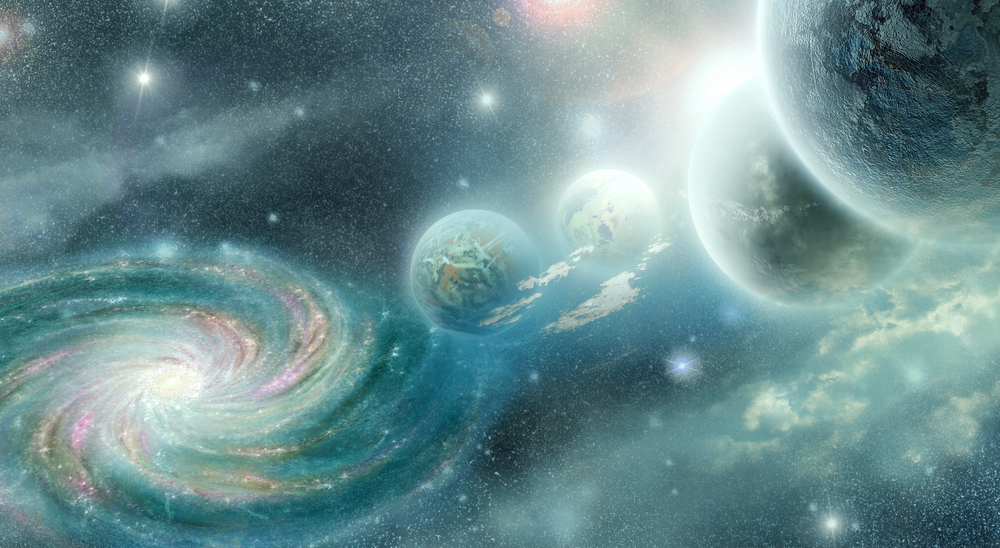
Our universe probably isn’t special. It’s more like one soap bubble in a bathtub full of infinite bubbles—each one a brand-new universe—whereas the Big Bang’s rapid expansion phase never stopped everywhere.
Other regions keep inflating and creating fresh universes with their own laws of physics. Talk about cosmic real estate development on steroids.
Simulation Hypothesis

What if we’re all just characters in some advanced civilization’s video game? Philosopher Nick Bostrom did the math and found something unsettling: if anyone can create realistic simulations of conscious beings—they’d probably make tons of them.
That means fake people would outnumber real ones by a massive margin, though statistically speaking, we’re probably the NPCs.
String Theory
Forget everything you know about particles being tiny dots. They’re actually microscopic vibrating strings—so small they make atoms look like planets—while these strings wiggle in up to 11 dimensions.
Different vibration patterns create different particles, yet the universe basically operates like a cosmic guitar with reality as its song.
Panpsychism

Your coffee mug might have feelings. This theory suggests consciousness isn’t something that magically appears in complex brains—it’s a basic property of all matter, like mass or electric charge—whereas electrons, photons, even rocks could have some form of inner experience.
Don’t worry, your phone probably isn’t plotting revenge, though it might be having a very simple form of thoughts.
Block Universe Theory
Yesterday, today, and tomorrow all exist right now in a four-dimensional block where time is just another direction like up, down, or sideways. Dinosaurs are still roaming around somewhere in this block—just not in our particular time-slice—while Einstein loved this idea and said our sense of flowing time is basically a persistent hallucination.
Pretty depressing if you think about it too hard.
Quantum Entanglement

Two particles can become cosmically connected twins—measure one, and you instantly affect its partner—even if it’s on the other side of the galaxy. Einstein hated this ‘spooky action at a distance’ and spent years trying to prove it wrong, though he lost.
Experiments keep confirming that entangled particles really do behave like magical coins that always land on opposite sides—no matter how far apart you flip them.
Multiverse Theory

Somewhere out there, another version of you is reading this sentence but became a professional basketball player instead of whatever you actually do. The multiverse theory says every possible variation of history exists somewhere—different breakfast choices, different career paths—whereas different outcomes to World War II all happen in parallel realities.
It’s like reality is an infinite library containing every possible story—including all the versions where you made different choices.
Quantum Consciousness

Your brain might be a quantum computer hooked directly into the universe’s operating system. Physicists Roger Penrose and Stuart Hameroff think consciousness comes from quantum effects in tiny structures inside brain cells called microtubules—rather than just electrical signals—while your thoughts might involve the same weird quantum mechanics that govern particle behavior.
Makes meditation seem a lot more profound.
Time Travel Paradoxes

Physics might actually allow time travel, but the universe has safeguards against paradoxes. Try to go back and prevent your own birth, and reality would somehow rearrange events to make sure you still exist, though some theories suggest the universe has built-in error correction.
Time travel might be possible, whereas changing the past might not be.
Zero-Point Energy
Empty space isn’t empty—it’s packed with energy from virtual particles constantly popping in and out of existence. One cubic centimeter of this ’empty’ space supposedly contains more energy than all the visible matter in the universe, yet the trick is figuring out how to harvest this infinite energy source without breaking the fundamental laws of physics.
Free energy is literally everywhere, though getting to it remains impossible.
Anthropic Principle

The universe seems suspiciously well-tuned for life. Gravity, electromagnetism, and other fundamental forces are set to exactly the right values to allow stars, planets, and eventually conscious beings to form, whereas change any of these constants by a tiny amount and atoms couldn’t hold together.
Either we’re incredibly lucky, or something deliberately fine-tuned reality for life. Scientists are still debating which option is weirder.
Dark Matter and Dark Energy
About 95% of the universe is made of stuff we can’t see, touch, or directly detect. Dark matter keeps galaxies from flying apart, while dark energy is accelerating the universe’s expansion, though we’re like deep-sea fish trying to understand an ocean where we can only perceive 5% of the water.
The rest is completely invisible to every instrument we’ve invented so far.
Quantum Tunneling

Particles can walk through walls that should be completely solid, like a pinball rolling through a concrete barrier instead of bouncing off. This quantum weirdness is why the sun shines—hydrogen nuclei tunnel through the electrical force that should keep them apart—whereas there’s even a tiny chance you could quantum tunnel through your bedroom wall.
You’d have to wait trillions of years for it to happen though.
Where Science Meets Wonder

Reality consistently outweighs imagination in the weirdness department, as these theories prove. Previous generations thought atoms, great abyss, and expanding universes were pure fantasy—until they weren’t—while today’s seemingly impossible ideas about parallel universes, conscious particles, and simulated realities might become tomorrow’s textbook facts.
Science keeps reminding us that truth really is stranger than fiction, and we’re probably just getting started with the strange stuff.
More from Go2Tutors!

- The Romanov Crown Jewels and Their Tragic Fate
- 13 Historical Mysteries That Science Still Can’t Solve
- Famous Hoaxes That Fooled the World for Years
- 15 Child Stars with Tragic Adult Lives
- 16 Famous Jewelry Pieces in History
Like Go2Tutors’s content? Follow us on MSN.