26 Nineties Toys Now Sold as Collectibles
The toy aisle of the 1990s has become an auction category. Items that once cost a few dollars at a discount store now change hands for hundreds, driven by nostalgia, scarcity, and the simple fact that most of these things were never built to survive three decades of play.
Condition determines almost everything in this market. A mint, boxed piece can sell for ten times what the same item fetches loose and worn, so serious buyers learn to check seams, tags, and original packaging before anything else.
Beanie Babies
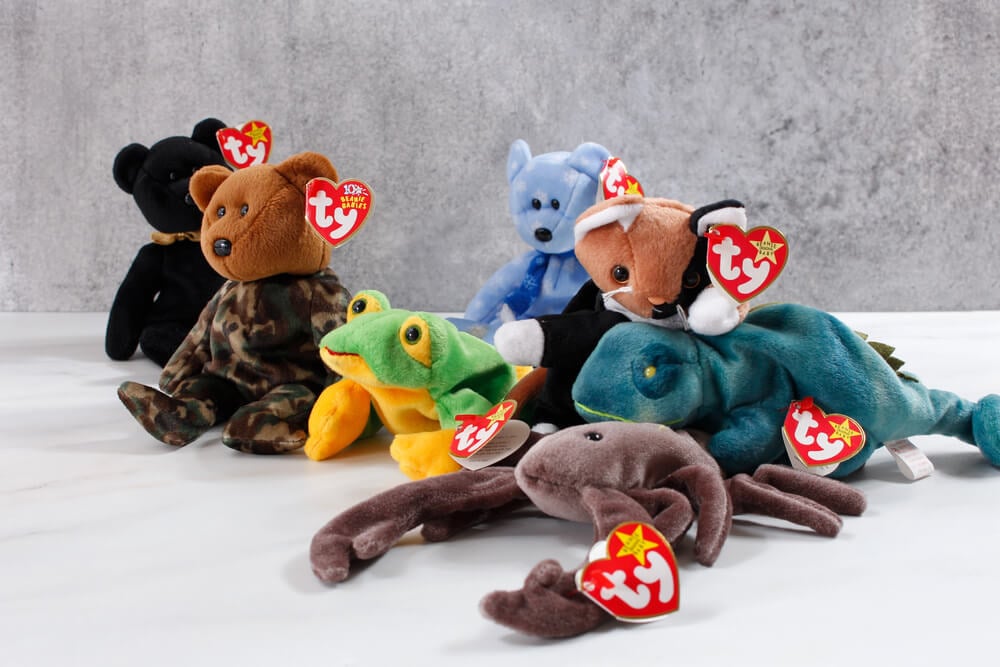
Ty’s small, underfilled plush animals triggered a genuine speculative frenzy in the mid-to-late 1990s, with certain retired styles like Princess the Bear and the original Peanut the Elephant commanding thousands of dollars at the market’s peak. Prices have since cooled dramatically, and most Beanie Babies are now worth only a few dollars, but a small number of early production errors and limited releases still draw serious collector interest.
Tag condition is critical, since a bent or removed “tush tag” can cut a piece’s value by more than half.
Tickle Me Elmo

Tiger Electronics’ laughing, vibrating Elmo doll caused shopping-mall stampedes during the 1996 holiday season, with resale prices briefly climbing into the hundreds of dollars for a toy that retailed around thirty. First-run 1996 units in original packaging are now the ones collectors chase, since later reissues and celebrity-signed variants exist in far greater numbers.
A working vibration motor and intact box art both factor heavily into resale price.
Furby

Tiger Electronics’ owl-like robot sold out repeatedly after its 1998 launch, thanks to a simulated language system that made each unit seem to develop its own personality over time. Rare color variants, including the white “Angel” Furby and early prototype units, are the most sought-after today, while common brown and gray models remain widely available and inexpensive.
Functioning electronics matter more than cosmetic wear, since a silent Furby loses most of its collector appeal.
Tamagotchi

Bandai’s handheld digital pet, released in Japan in 1996 and the United States in 1997, turned caring for a pixelated creature into a constant, beeping obligation for millions of kids. Original first-generation units in their clear plastic shells are now collected specifically for their egg-shaped design and the simplicity of their black-and-white screens compared to later color versions.
Working screens and intact buttons are the main value drivers, since the internal electronics were never designed for long-term durability.
Pogs and Slammers

The milk-cap game built around collecting and flipping small cardboard discs became a full-blown playground economy in the early 1990s, with kids trading entire binders of pogs the way earlier generations traded baseball cards. Complete sets tied to specific brands or cartoons, along with heavy metal “slammers” used to flip the stacks, are now sold in lots to collectors reconstructing full playground-era sets.
Individual pogs are worth little, but complete boxed sets in original packaging can command real money.
Skip-It

Tiger Electronics’ ankle-worn counting toy, which required players to hop over a weighted counter as it swung around one leg, became a schoolyard fixture after its 1994 release. Its mechanical hip counter and simple design mean most surviving units still function, which keeps demand from collectors who want a working example rather than a display piece.
Bright, unfaded plastic in the original 1990s colorway is what separates a premium listing from an ordinary one.
Polly Pocket Compacts

Bluebird Toys’ original Polly Pocket line packed entire dollhouses into palm-sized plastic compacts, a design praised for its engineering long before the brand was relaunched with larger, less intricate figures in 1998. The tiny metal-hinged compacts from 1989 through the mid-1990s are the pieces collectors specifically seek out, since the later plastic-hinged versions are considered a step down in craftsmanship.
Missing miniature accessories, which were easy to lose during play, significantly lower a set’s resale value.
Micro Machines

Galoob’s tiny die-cast vehicles let kids assemble entire fleets of cars, planes, and construction equipment for the price of a single regular-sized toy. Licensed sets tied to properties like Star Wars and James Bond are now the most collectible, particularly the Star Wars Micro Machines line that launched alongside renewed interest in the franchise in the mid-1990s.
Complete playsets with all original vehicles intact sell for far more than loose vehicles sold individually.
Sky Dancers

Galoob’s launch-and-fly fairy dolls, which spun into the air on a plastic ripcord mechanism, were pulled from some shelves in the late 1990s after reports of injuries from the spinning wings. That history, combined with a relatively short production run, has made complete boxed sets harder to find than many other toys from the same era.
Buyers specifically look for the launching base and undamaged wings, both of which were prone to breaking during normal use.
Talkboy

The cassette recorder with a variable-speed playback dial became a must-have after appearing in “Home Alone 2: Lost in New York” in 1992, and Tiger Electronics released a real consumer version to meet the demand it created. Working units with the pitch-control feature intact are the ones that draw the strongest interest, since the device’s appeal was always tied to its ability to alter recorded voices.
Original packaging referencing the film boosts value considerably.
Bop It

Hasbro’s handheld electronic game, released in 1996, issued rapid-fire spoken commands like “twist it” and “pull it” that players had to follow correctly to keep their streak alive. The original 1996 model, with its simpler command set and distinct blue-and-yellow housing, is what collectors specifically seek out, since later Bop It sequels expanded the design with additional actions and different electronics.
A functioning speaker and responsive controls are essential, since the toy is worthless as a collectible if it cannot actually play.
Tiger Electronics Giga Pets

Tiger’s line of handheld digital pets, including the Compu Kitty and Digital Doggie, competed directly with Tamagotchi and offered a wider range of species to raise. Complete original units with their protective cases and instruction booklets are the most desirable to collectors reconstructing full sets from the line.
As with other 1990s digital toys, functioning screens are the primary factor separating a collectible from scrap electronics.
My Pet Monster

Amtoy’s oversized, chained plush monster, originally released in 1986 and remaining a fixture through the early 1990s via reissues and a cartoon tie-in, is remembered as much for its slightly unsettling design as for its cuddliness. Original units with intact plastic-link chains around the wrists are the ones collectors specifically seek, since the chains were frequently removed or lost during play.
Faded orange fur is common on surviving examples and typically lowers resale value.
Starting Lineup Figures

Kenner’s licensed sports action figures, produced from the late 1980s through the early 2000s, packaged small player statues with individual cardboard stat cards, creating a hybrid between an action figure and a trading card. Figures of star players from their rookie-adjacent seasons carry the highest premiums, particularly when the included stat card remains uncreased.
Unopened blister packs are valued well above figures removed from their packaging.
Nickelodeon GAK

Mattel’s slimy, stretchy compound, marketed through Nickelodeon starting in 1992, came in variations like Fun Gak and glow-in-the-dark Nite Gak. Because the product itself was consumable and rarely survived intact, unopened original containers are now considerably harder to find than the toy’s original sales figures would suggest.
Sealed, unexpired-looking canisters with bright original packaging are what collectors specifically pay for.
Mighty Morphin Power Rangers Figures

Bandai’s action figures tied to the 1993 television series became one of the decade’s biggest toy licenses, selling out repeatedly during the show’s initial run. First-wave figures from 1993 and 1994, particularly the original six Rangers and Rita Repulsa, are the most valuable, especially in unpunched original packaging.
Later international reissues exist in far greater supply and sell for a fraction of the price of genuine first-wave American releases.
First Edition Pokémon Cards

Wizards of the Coast’s English-language Pokémon Trading Card Game launched in early 1999, and the “Base Set” cards printed with the small “1st Edition” stamp have become some of the most valuable trading cards of any era. A graded, near-mint first-edition Charizard has sold at auction for six-figure sums, though the vast majority of surviving cards are worth far less due to played condition or being unlimited-edition reprints.
Professional grading has become close to mandatory for any card claiming serious value.
Sea-Monkeys

Harold von Braunhut’s brine shrimp, sold as an instant “pet” through mail-order ads in comic books throughout the 1990s, are collected today less for the living creatures than for the vintage packaging and advertising ephemera surrounding the brand. Unopened original kits with their cartoon-illustrated boxes are the primary collectible, since the shrimp eggs themselves have a limited viable shelf life regardless of packaging condition.
Comic-book print ads for the product are also collected separately as pop-culture artifacts.
Troll Dolls

The wild-haired vinyl dolls, originally created in Denmark decades earlier, saw a major resurgence in the United States throughout the 1990s alongside a wave of licensed spin-offs and merchandise. Original Russ Berrie and Norfin-branded trolls from the era’s peak are the most collected, with rarity tied to hair color and outfit variations that were produced in smaller runs.
Sun-faded hair, a common issue with vinyl trolls displayed near windows, notably reduces value.
Super Soaker CPS Series

Larami’s compressed-air-powered water guns, especially the CPS 2000 and CPS 2500 released in the mid-1990s, are remembered as the most powerful water blasters the company ever mass-produced before regulatory pushback led to less forceful redesigns. Because the CPS line was discontinued and never fully replicated, functioning original units are genuinely scarce compared to later Super Soaker models.
Intact pressure chambers and pump mechanisms are essential, since a cracked chamber renders the toy unusable.
Totally Hair Barbie

Mattel’s 1992 Barbie doll, featuring hair extending to her ankles, became the best-selling Barbie doll of all time up to that point, according to the company. Mint-in-box examples with the original hair-styling accessories are the target for serious collectors, since the doll’s signature feature made loose, played-with hair particularly prone to tangling and damage.
Box graphics from the original release, rather than any later reissue, are what collectors specifically verify before buying.
Water Babies Dolls

Playskool’s water-filled, weighted infant dolls, introduced in the late 1980s and popular through the 1990s, were designed to mimic the heft and warmth of holding a real baby once filled with warm water. Because the vinyl shells were prone to leaking and mildew over time, dry, intact examples without water damage are considerably harder to find in good condition than their original sales volume suggests.
Original clothing and pacifiers, easily lost items, add to a doll’s resale value when present.
Lite-Brite

Hasbro’s light-up pegboard toy, which let kids create glowing pictures by pushing colored plastic pegs into a backlit grid, remained a steady seller throughout the 1990s alongside earlier decades. Complete sets with a full array of colored pegs and original picture templates are worth considerably more than units missing pieces, since replacement pegs were not sold separately at retail.
A functioning bulb is the other key factor, since the internal wiring in older units can fail with age.
Kenner Batman Action Figures

Kenner’s action figures tied to the early-1990s Batman films, including “Batman Returns” in 1992, expanded on the character’s toy line with an array of vehicles and villain figures aimed at the film’s darker tone. Figures still sealed on their original film-branded cardback packaging are the most collectible, while loose figures missing accessories sell for considerably less.
Cardback condition, including corner wear and creasing, is scrutinized closely by buyers.
Original Game Boy Color

Nintendo’s 1998 handheld, a color-screen successor to the original monochrome Game Boy, remains functional decades later thanks to a simple cartridge-based design that has proven far more durable than many other 1990s electronics. Specific launch-era color variants, along with region-exclusive and limited-run colorways, command the highest resale prices among collectors.
A functioning screen and clean cartridge slot are the baseline requirements for any unit sold as collectible rather than as scrap.
Easy-Bake Oven

Kenner’s toy oven, which used an ordinary incandescent light bulb to bake tiny cakes, went through several design revisions during the 1990s, including bright purple and teal color schemes that replaced the harvest-gold styling of earlier decades. Complete 1990s units, including their small baking pans and mix packets, are collected specifically for their color scheme, which is distinct from both the original 1960s design and the tray-loading redesign introduced in 2006.
A functioning bulb and heating element are required for the toy to be sold as a working example rather than a display piece.
When the Toy Box Becomes an Archive

What separates these objects from ordinary secondhand toys is not rarity alone but the specific childhood they represent for a generation now old enough to have disposable income and a garage to fill. Buying back a Tickle Me Elmo or a sealed Pokémon pack is rarely about the object itself; it is an attempt to purchase a fixed point in a memory that otherwise keeps drifting.
That impulse has built an entire secondary economy out of plastic and cardboard that manufacturers never intended to last this long. The irony is that durability, an afterthought in 1990s toy design, has become the single biggest factor determining what any of it is worth today.
More from Go2Tutors!

- The Romanov Crown Jewels and Their Tragic Fate
- 13 Historical Mysteries That Science Still Can’t Solve
- Famous Hoaxes That Fooled the World for Years
- 15 Child Stars with Tragic Adult Lives
- 16 Famous Jewelry Pieces in History
Like Go2Tutors’s content? Follow us on MSN.



