18 Royal Diadems Everyone Should Know
For thousands of years, rulers have worn something that transforms them from ordinary mortals into living symbols of power. A diadem is a crown, specifically an ornamental headband worn by monarchs and others as a badge of royalty.
These gleaming bands don’t just sit pretty on royal heads—they carry the weight of empires, the whispers of ancient gods, and enough drama to fill Netflix for decades. Here’s a list of royal diadems that have shaped history, sparked revolutions, and continue to dazzle the world today.
Diamond Diadem

The Diamond Diadem by the Royal Goldsmiths Rundell, Bridge & Rundell was created in 1820 for the 1821 coronation of King George IV. George IV wanted something spectacular for his famously over-the-top coronation. The result?
Pure brilliance. The gold and silver frame, measuring 7.5 centimetres (3.0 in) tall and 19 centimetres (7.5 in) in diameter, is decorated with 1,333 diamonds weighing a total of 320 carats, including a four-carat yellow diamond in the front cross pattée.
Between the crosses sit roses, thistles, and shamrocks—symbols of England, Scotland, and Ireland. Passed from Queen Adelaide to Queen Victoria and continuing through the generations to Elizabeth II, its popularity is undimmed.
The Diamond Diadem appears on British coins and currency, making it one of the most recognized pieces of royal jewelry worldwide.
Cambridge Lover’s Knot Tiara

Sometimes called the most romantic diadem in royal history, this piece tells a story of love, loss, and legacy. Queen Mary commissioned the piece, she “sacrificed a tiara from her own jewelry collection, the Ladies of England Tiara” and other diamond and pearl pieces from her jewelry box to use for the Lover’s Knot.
The design features 19 diamond arches, each topped with hanging pearls that catch the light like teardrops. Originally, the tiara had upright pearls too, making it even more spectacular—and heavy.
Diana famously complained it hurt her head. But she loved it anyway. After Diana’s death, it disappeared into palace vaults until 2015, when Kate Middleton brought it back into the spotlight.
Now it’s her signature piece.
Vladimir Tiara
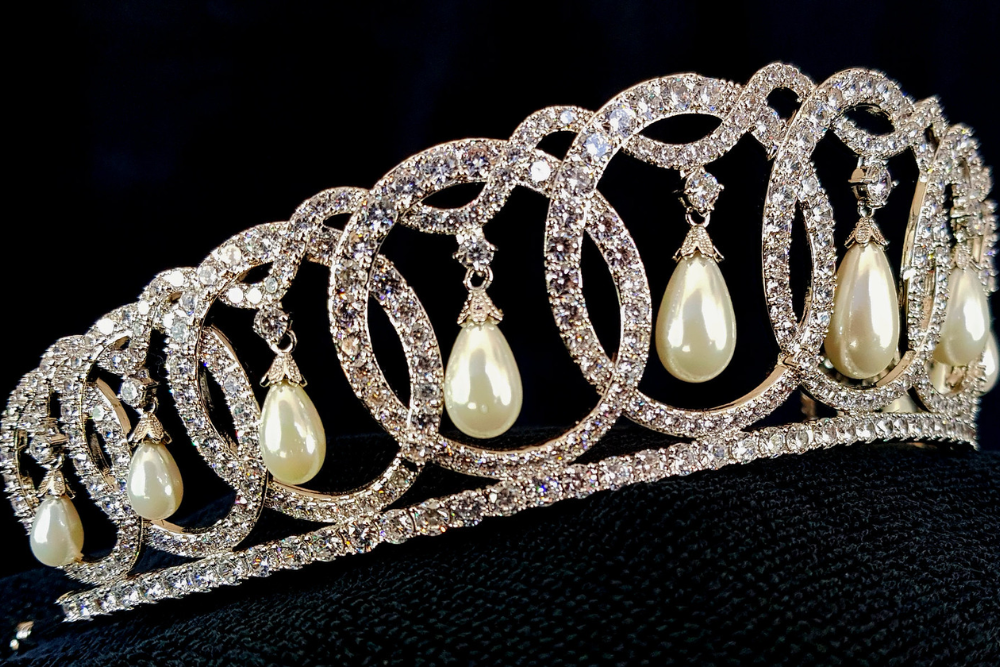
This diadem survived revolution, smuggling, and royal politics. Originally made for the Grand Duchess Vladimir of Russia in 1874 by court jeweler Bolin, the Vladimir Tiara was smuggled out of the country following the assassination of Tsar Nicholas II and his family in 1918 amid the revolution.
A British friend of the Romanov family literally broke into the abandoned palace to retrieve it. Talk about dedication.
The piece features interlocking diamond circles and can be worn with pearls, emeralds, or no drops at all. Queen Elizabeth II wore it countless times, proving that sometimes the best jewelry comes with the best stories.
Queen Mary Fringe Tiara

Created by Garrard for England’s Queen Mary in 1919, the Fringe Tiara has been worn by five generations of the British royal family. Originally a necklace from Queen Victoria, it was transformed into what would become the ultimate wedding tiara.
The piece’s timeless design has made it a popular choice for royal weddings. The late Queen Elizabeth II wore it for her 1947 nuptials to Prince Philip.
Her daughter, Princess Anne, chose it for her 1973 wedding to Mark Phillips, and Elizabeth’s granddaughter Princess Beatrice wore the piece as her “something borrowed”. The tiara’s versatility? It can convert back to a necklace.
Queen Mary knew what she was doing.
Spencer Tiara

Diana’s wedding tiara wasn’t borrowed from the royals—it was a Spencer family treasure. The tiara is reported to have been created originally in 1767 for Viscountess Montagu and remodelled by Garrard in the 1930s.
Like a royal version of a family recipe, it was assembled from various Spencer heirlooms over the years. The central motif supposedly came from a gift in 1919, with additional elements added later.
Three Spencer daughters wore it at their weddings, but Diana made it iconic. The smell of fresh flowers from her bouquet must have mingled with the weight of family history that July day in 1981.
Diadem of Princess Sit-Hathor Yunet
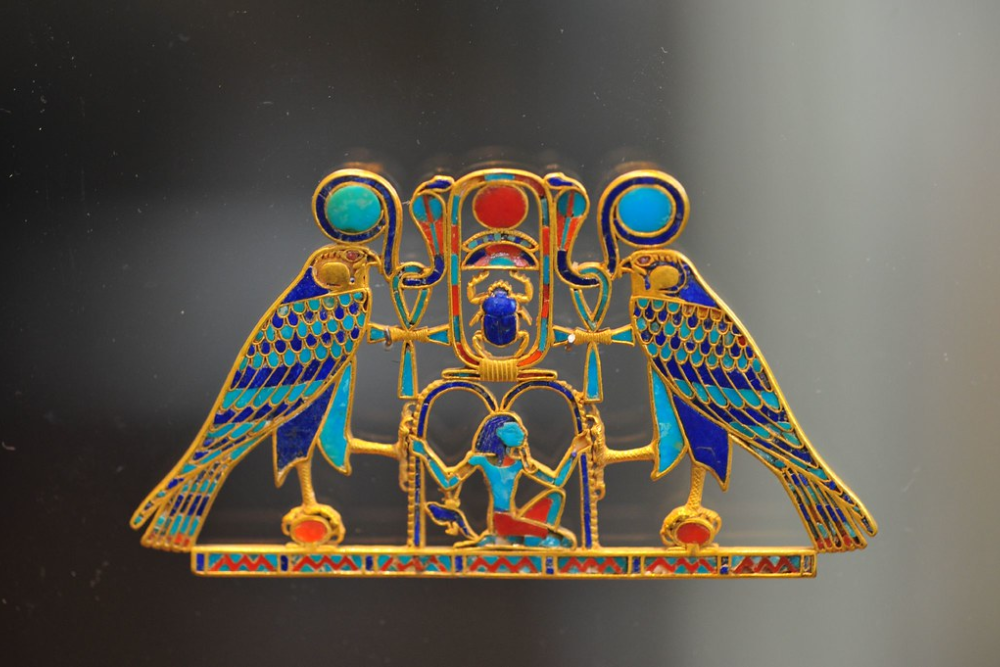
Step back nearly 4,000 years to ancient Egypt. The ancient head adornment is the oldest crown on this list, belonging to the daughter of an Ancient Egyptian King of the 12th Dynasty (possibly Senusret II).
Grave robbers had ransacked her tomb centuries ago, but they missed a hidden niche. When archaeologists finally found it in the 20th century, they discovered boxes of jewelry that had waited millennia.
The diadem of Sithathoriunet with a circular band of gold decorated with a uraeus or rearing cobra at the front and fifteen rosettes. That cobra wasn’t decoration—it was protection, ready to strike down anyone who threatened the pharaoh’s daughter.
Ptolemaic Gold Diadem

Following the death of Alexander the Great, Egypt was ruled by the Greek Ptolemaic dynasty. This incredible example of gold craftsmanship belonged most probably to a noblewoman of the ruling dynasty.
Created between 220 to 100 BC in Alexandria, it displays typical Greek styles, with the centrepiece being a Herakles knot. The Herakles knot wasn’t just pretty—ancient Greeks believed it had protective powers and symbolized fertility.
Alexandria was the Las Vegas of the ancient world, where Greek met Egyptian culture in spectacular fashion. This diadem perfectly captures that blend.
Imperial State Crown
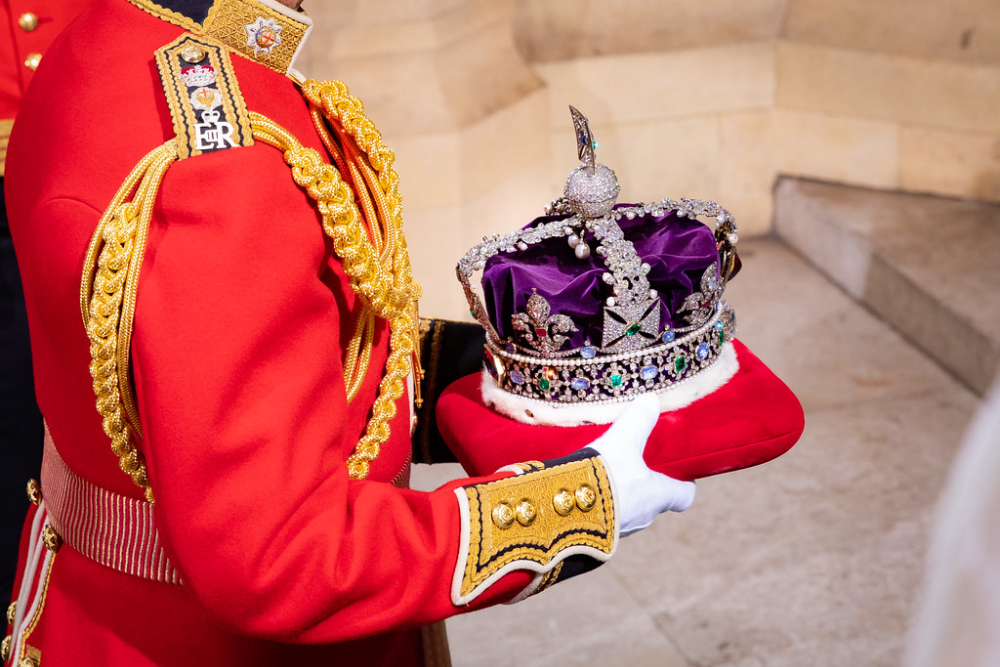
Not technically a diadem, but too spectacular to ignore. The current version was made in 1937, and was adjusted to fit the Queen in 1953. It is roughly 12″ tall, and weighs just over 2 pounds. Among its treasures:
- The Cullinan II diamond (a mere 317 carats)
- St Edward’s Sapphire (from a medieval king’s ring)
- The Black Prince’s Ruby (not actually a ruby)
- Three pearls that once belonged to Elizabeth I
Queen Elizabeth II wore this crown to every State Opening of Parliament. Imagine the neck strength required.
Greville Emerald Kokoshnik Tiara

Princess Eugenie chose this showstopper for her 2018 wedding, and who could blame her? The Greville Emerald Kokoshnik tiara, a loan from Her Majesty for Eugenie’s special day, is a diamond and platinum diadem featuring one 93-carat oval-cut emerald at the center and six smaller emeralds around the sides.
The Russian kokoshnik style was all the rage in early 20th-century Europe. French jeweler Boucheron created this piece in 1919 for British socialite Dame Margaret Greville, who clearly had excellent taste.
And deep pockets.
Crown of Baekje

Travel to ancient Korea for these flame-inspired masterpieces. These gold diadems were discovered in a tomb in 1971 and come from the Korean kingdom of Baekje, which was founded in 18 BC.
The Crown of Baekje refers to a pair of gold diadems with intricate branches shaped like flames and patterns resembling flowers at the top. The flame motifs weren’t random decoration—they represented the divine fire that legitimized royal rule.
Still, imagine trying to eat dinner wearing one of these. Definitely not practical for everyday royal duties.
Iron Crown of Lombardy

This may be the oldest Christian crown in history, made between the 4th and 5th century. Kept in Monza Cathedral, there is no clear knowledge for whom it was originally created. Legend claims it contains a nail from Christ’s crucifixion, worked into an inner iron band.
Holy Roman Emperors used it for centuries to crown themselves as Kings of Italy. Napoleon famously crowned himself with it in 1805, declaring “God gave it to me, woe to him who touches it.”
Napoleon clearly understood dramatic timing.
Holy Crown of Hungary

One of two Byzantine crowns that have survived to the present day, the oldest elements of this beautiful head adornment are believed to be from the 11th century. The crown has a distinctive tilted cross that gives it character—some say the cross bent during storage, others claim it was always that way.
The Holy Crown was used in almost all Hungarian coronations, with King Charles IV (Charles I of Austria) being the last one in 1916. It survived wars, theft, and decades hidden in Fort Knox during the Cold War.
Girls of Great Britain and Ireland Tiara

Queen Elizabeth II’s go-to tiara has humble origins. Commissioned with funds raised by a committee chaired by Lady Eva Greville, purchased from Garrard and manufactured by Wolff & Co., the “Girls of Great Britain and Ireland Tiara” was presented to Princess Victoria Mary of Teck (Queen Mary) as a wedding gift.
Women’s clubs across the British Empire pooled their money to buy it as a wedding present in 1893. Originally topped with pearls, it was later redesigned with diamonds.
This community-funded crown became one of the most photographed diadems in history, appearing on British currency for decades.
Monomakh’s Cap

The golden skullcap is the oldest crown kept in the Kremlin, originating from the late 13th or early 14th century. The fur trimmings were added later, most probably during the 16th century.
Legend says it was a gift from the Byzantine Emperor, though other theories suggest it came from the Khan of the Golden Horde. Either way, it crowned Russian rulers for centuries.
The last time the Monomakh’s Cap was used during a coronation ceremony was in 1682, during the dual coronation of Ivan V and Peter the Great. Peter the Great probably appreciated that it was warmer than most crowns.
Queen Adelaide’s Fringe Tiara

King William IV commissioned this diamond fringe necklace for his wife Adelaide in 1831, using stones that once belonged to his father King George III. The necklace could transform into a tiara—18th-century functionality at its finest.
Queen Victoria inherited it and loved wearing it as a tiara. She designated it a crown heirloom, ensuring it would pass down through generations.
The fringed design influenced countless later tiaras, proving that sometimes the simplest ideas are the most enduring.
Strathmore Rose Tiara
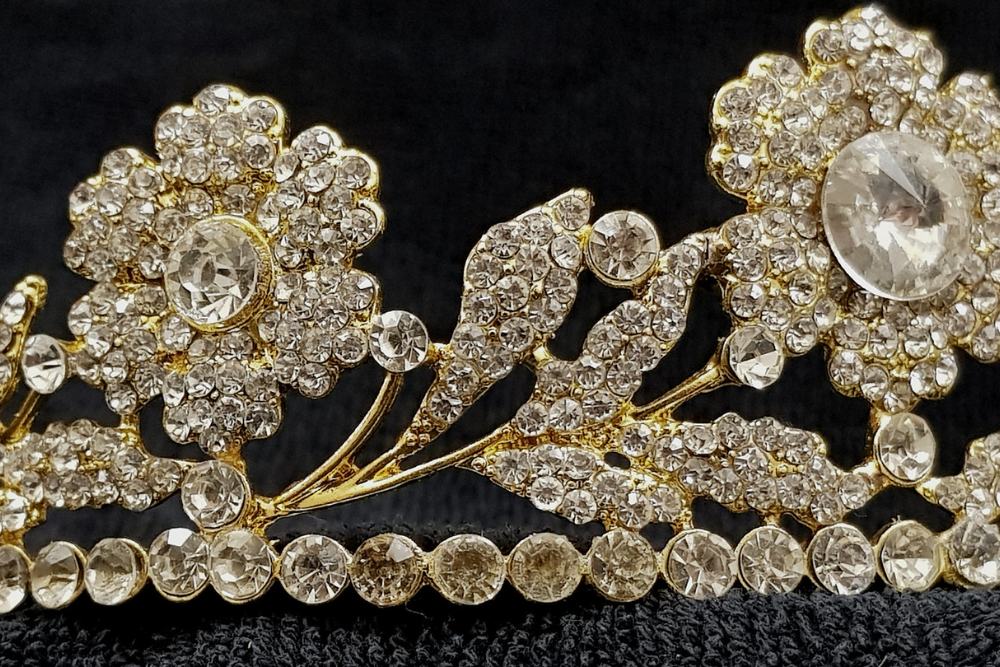
One of our favorites is the Strathmore Rose tiara, which was a wedding gift from her father, the Earl of Strathmore. The botanical crown features a garland of wild roses in diamonds set in gold and silver. This belonged to the Queen Mother and is rarely seen in public.
The rose motifs aren’t stylized garden roses—they’re wild roses, capturing something untamed and natural. The Queen Mother wore it for formal portraits in the 1920s, then to the opera in the 1930s.
Since then, it’s mostly stayed in the vault, making it one of the most mysterious royal diadems.
Belgian Nine Province Tiara

showcases a unique Art Deco-inspired design featuring interlocking diamond arches over a series of nine Antwerp-cut diamonds from the colony of Congo. Each stone represents the nine provinces of Belgium at the time. The tiara — made in 1926 by Van Bever — was a gift to Princess Astrid of Sweden upon her marriage to the future King Leopold III.
The nine diamonds tell a specific story about Belgian identity in the 1920s. Princess Astrid wore it for major events until her tragic death in 1935.
Queen Fabiola later made it her signature piece, wearing it to Vatican audiences and state visits.
Queen Victoria’s Small Diamond Crown

After the death of the Queen’s beloved Prince Albert, she wanted a more diminutive crown to wear atop her widow’s cap. In 1870, Garrard & Co. designed a band of brilliant, rose and mixed-cut diamonds crested by four each diamond-set crosses party and fleurs-de-lis.
This tiny crown became so associated with Victoria’s long widowhood that she left it to the crown forever. Queen Alexandra later had difficulty giving it up when her husband Edward VII died.
Even the most powerful women in history understood the comfort of familiar jewelry during grief.
Lasting Symbols
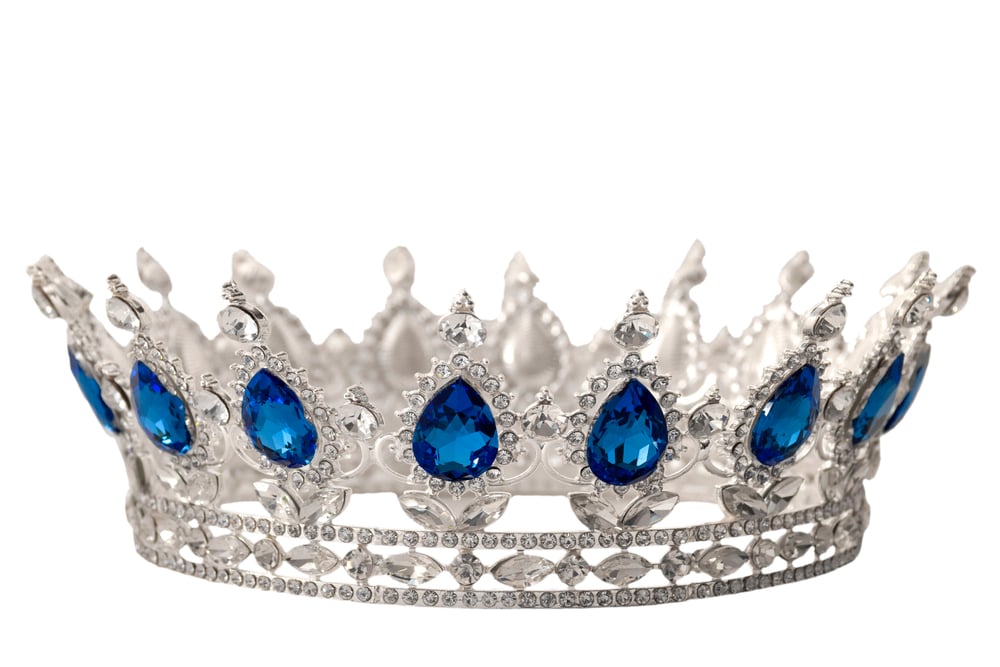
These diadems represent more than royal fashion—they’re tangible links to power, divinity, and human ambition across millennia. From ancient Egyptian burial chambers to modern state dinners, they’ve witnessed empires rise and fall, marriages celebrated and mourned, and the endless human desire to transform the ordinary into something transcendent.
Each piece carries forward not just diamonds and gold, but the accumulated weight of history itself.
More from Go2Tutors!

- The Romanov Crown Jewels and Their Tragic Fate
- 13 Historical Mysteries That Science Still Can’t Solve
- Famous Hoaxes That Fooled the World for Years
- 15 Child Stars with Tragic Adult Lives
- 16 Famous Jewelry Pieces in History
Like Go2Tutors’s content? Follow us on MSN.



