Ancient Discoveries That Rewrote History Books
Pull a school history textbook from the 1970s off a shelf and read the chapter on human origins. Then read the one on African kingdoms.
Then the one on when people first made art. Almost every page has since been corrected, stretched or quietly torn up.
Not because the authors were careless, but because somebody, somewhere, picked up a stone, cleared some sand or squeezed through a cave passage and found something that refused to fit.
That is how the story of the past actually changes. Not through debate alone, but through objects. A carved flake of rock.
A child’s skull in a box of quarry rubble. A gold rhino the size of your palm.
Each one forced experts to rethink what they thought they knew, and some of the most important ones came out of South African soil.
The finds below span three continents and more than three million years. Some made headlines overnight.
Others sat ignored for decades before anyone took them seriously. Every one of them changed the way the past gets told.
Blombos Cave and the First Drawing

Blombos Cave sits in a limestone cliff above the Indian Ocean near Still Bay, roughly 300 kilometres east of Cape Town. From the outside it looks like nothing much.
Inside, archaeologist Christopher Henshilwood and his teams have spent decades pulling out evidence that rearranged the timeline of the human mind.
For most of the 20th century, the textbooks said modern human behaviour, meaning symbols, art and decoration, appeared suddenly in Europe around 40,000 years ago. Blombos broke that idea apart. In 2002 the team published pieces of red ochre engraved with deliberate cross-hatched patterns, dated to about 75,000 years ago.
Then came shell beads made from tiny Nassarius snail shells, pierced and worn on a string. Then a full ochre-processing kit, stored in abalone shells, from around 100,000 years ago.
The biggest surprise arrived in 2018. A small silcrete flake carried a cross-hatched design drawn with an ochre crayon, roughly 73,000 years old. It is the oldest known drawing made by a human hand.
Think about what that means. People living on the southern Cape coast were making marks that meant something to them tens of thousands of years before anyone painted the famous caves of France.
The cave itself stays closed to the public to protect it, so the best you can do is drive the coast road near Still Bay and look out at the water. The first artists in the world may well have watched the same sunsets over the same stretch of sea that holidaymakers photograph today.
The Taung Child Nobody Believed
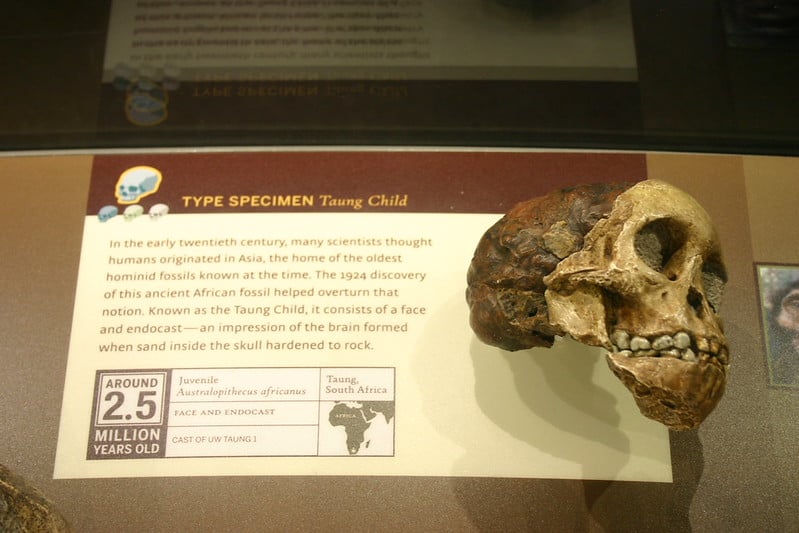
In 1924, quarry workers blasting limestone at Buxton near Taung, in what is now North West province, sent a crate of rubble to Raymond Dart, a young anatomy professor at the University of the Witwatersrand. Dart reportedly received the boxes while dressing for a wedding at his home. Inside one was a natural cast of a brain, and a face still stuck in stone.
Dart spent weeks chipping the face free with his wife’s knitting needles. What emerged was a child of about three, with a small brain but teeth and a skull position that pointed to upright walking. In 1925 he named it Australopithecus africanus, the southern ape of Africa, and argued that humanity began here.
The scientific establishment laughed. British experts believed humans came from Europe or Asia, and they had Piltdown Man, a supposed fossil from England, to prove it. Only in 1953 was Piltdown exposed as a forgery made from a medieval human skull and an orangutan jaw.
By then the Taung Child had been vindicated by further finds at Sterkfontein and elsewhere.
Even the cause of death turned out to be a story. In 2006 researchers showed that marks on the skull matched those left by eagle talons.
A bird of prey killed this child roughly 2.8 million years ago. The skull still lives at Wits University, and the Taung site forms part of the Fossil Hominid Sites of South Africa World Heritage listing.
Little Foot in the Storeroom
Some discoveries happen in the field. This one happened in a cupboard.
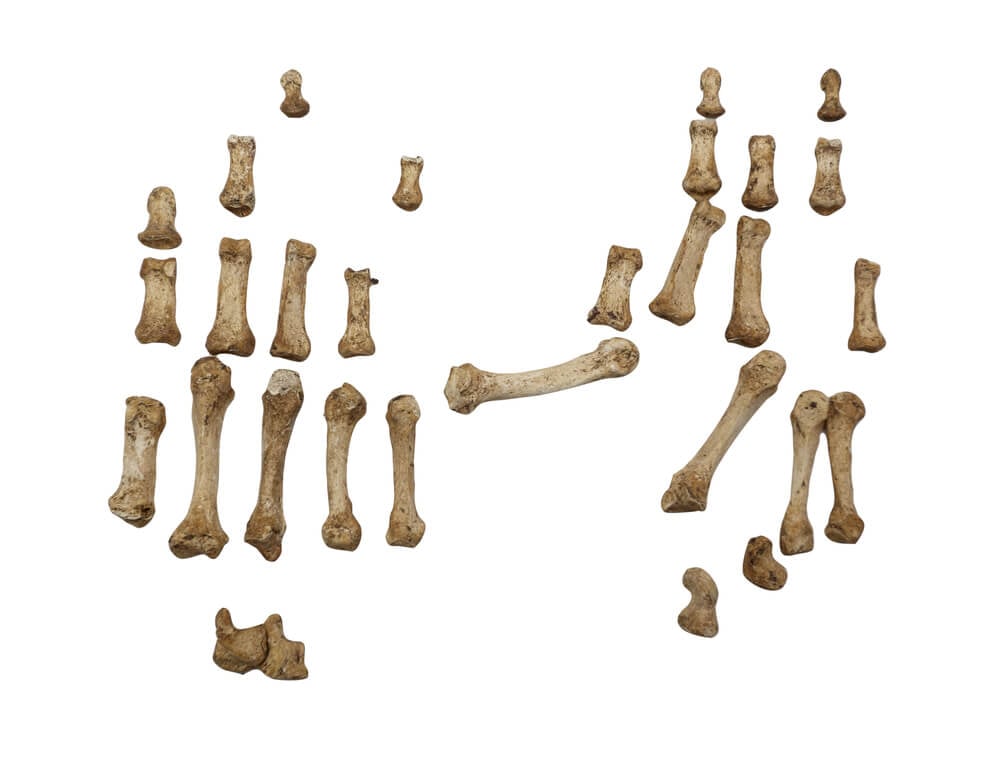
In 1994 palaeoanthropologist Ron Clarke was sorting through boxes of bones from Sterkfontein Caves that had been sitting in storage for years. He spotted four small foot bones that clearly belonged to an early hominin. In 1997 he found more in another box, including fragments of a shin bone with a clean break.
Clarke sent two assistants, Stephen Motsumi and Nkwane Molefe, into the cave with a cast of that broken bone and asked them to find its other half in the cave wall.
They found it within two days.
What followed took around 20 years. The skeleton lay encased in hard breccia, and the team freed it grain by grain.
When Little Foot was finally presented to the public in 2017, it was the most complete Australopithecus skeleton ever found. One dating study puts it at about 3.67 million years old, though that figure remains debated.
The lesson here is simple. Patience is a research method. If you visit the Cradle of Humankind and walk down into Sterkfontein, you are standing in a place where the slowest excavation in palaeontology produced one of its finest results.
Homo naledi and the Rising Star Cave
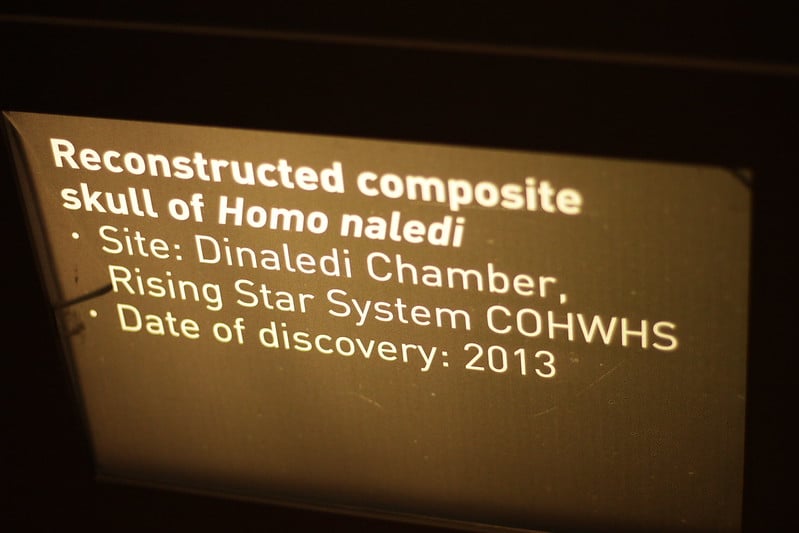
In 2013 two recreational cavers, Steven Tucker and Rick Hunter, squeezed through a gap about 18 centimetres wide in the Rising Star cave system, also in the Cradle of Humankind. Beyond it lay a chamber scattered with bones.
Lee Berger of Wits University put out a call on social media for slim scientists with caving experience. He picked six women from the applicants, and they became known as the underground astronauts.
Together with the wider team, they recovered more than 1,500 fossil specimens from at least 15 individuals, the largest single collection of hominin remains ever found in Africa.
The species, announced in 2015 as Homo naledi, looked like a puzzle assembled from different eras. It had a small brain, about the size of an orange, curved fingers suited for climbing, and feet and hands that looked surprisingly modern.
Most experts expected a find like this to be millions of years old.
It wasn’t. Dating published in 2017 placed the remains between roughly 236,000 and 335,000 years ago. That means a small-brained human relative was alive in southern Africa at around the same time early Homo sapiens appeared on the continent.
The find killed off a neat idea. Human evolution was never a straight line from small brains to big ones. It was a crowded, branching bush, and South Africa held more of those branches than anyone guessed.
Berger’s team has since argued that Homo naledi deliberately placed its dead in the cave, a claim that many scientists still dispute. The argument itself shows how much ground this one chamber has opened up.
Lucy Walks Out of Ethiopia
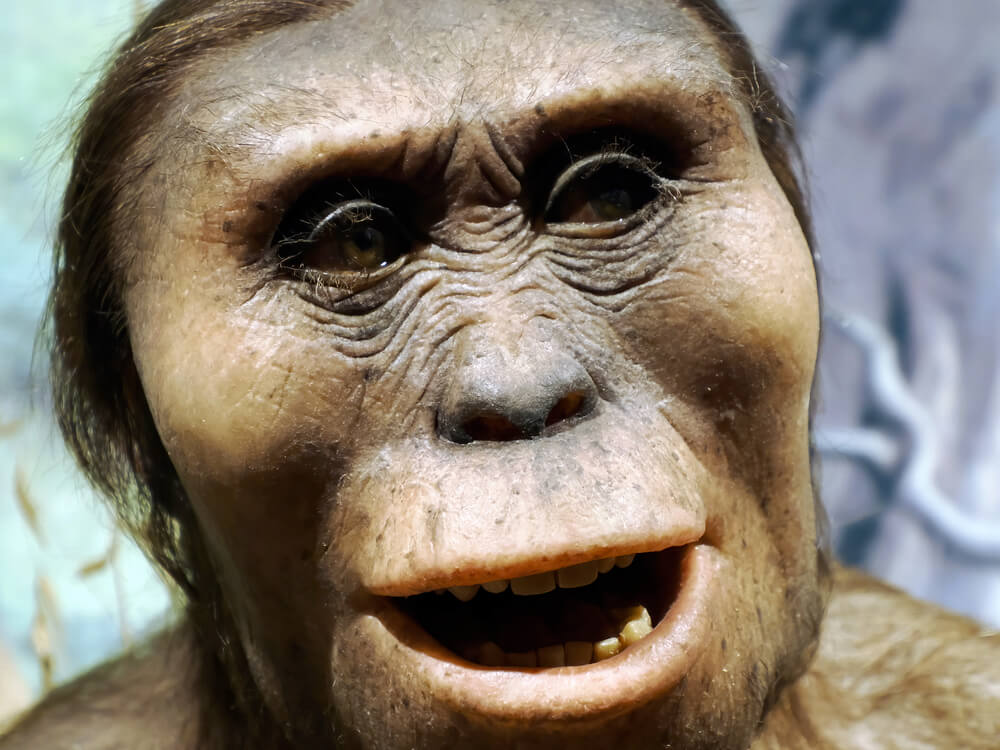
On 24 November 1974, Donald Johanson and his student Tom Gray were surveying a gully at Hadar in Ethiopia’s Afar region. Johanson spotted a piece of arm bone.
Within weeks, the team had recovered about 40 percent of a single skeleton.
That night at camp, the Beatles song Lucy in the Sky with Diamonds played on repeat, and the name stuck. In Ethiopia she is known as Dinkinesh, meaning you are marvellous.
Lucy, a member of Australopithecus afarensis, lived about 3.2 million years ago. Her knee joint and pelvis showed she walked upright.
Her skull, though, held a brain not much bigger than a chimpanzee’s.
That combination settled a long argument. Plenty of experts once assumed that big brains came first and that walking on two legs followed.
Lucy proved the opposite. Human ancestors stood up long before they grew large brains, and every human family tree drawn since has to start from that fact.
Göbekli Tepe, the Temple Before the Town
For generations, the standard story ran like this. People learned to farm, settled down, built villages and only then had the time and labour to construct monuments.
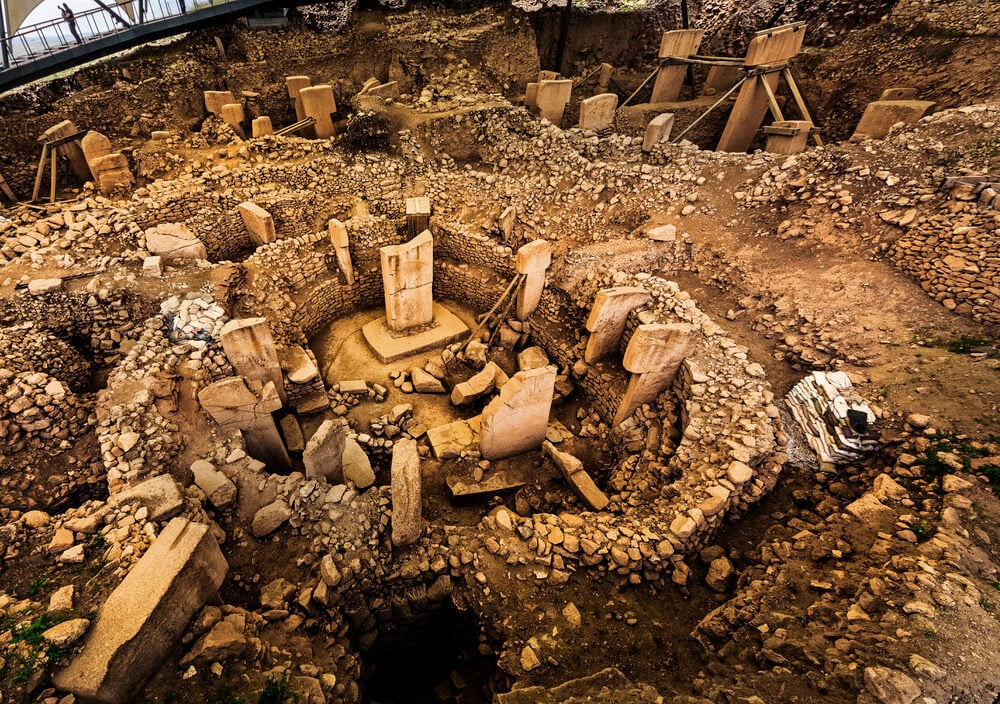
Göbekli Tepe, a hilltop in southeastern Turkey, flipped that order around. German archaeologist Klaus Schmidt began serious excavations there in 1995.
He uncovered rings of massive T-shaped limestone pillars, many taller than a grown adult, carved with foxes, boars, snakes, vultures and scorpions. The oldest structures date to around 9500 BCE, about 11,500 years ago.
That makes them roughly 6,000 years older than Stonehenge and older than writing, metal tools and the wheel. The people who raised these pillars were hunter-gatherers.
Schmidt summed it up as first came the temple, then the city. Later work has softened that line a bit, since excavators have since found signs that people lived on the site, not just gathered there.
But the core shock stands. Large groups of foragers organised themselves to quarry, carve and move stones weighing several tonnes, long before farming took hold. Monuments might have helped drive the change to settled life rather than simply following it.
The Painted Lions of Chauvet
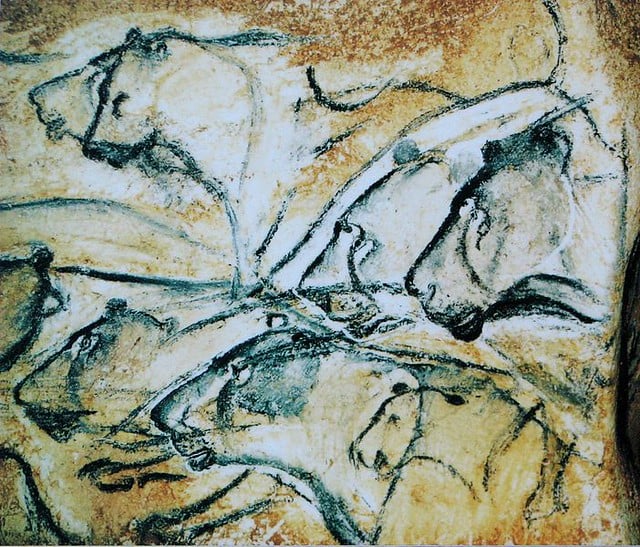
In December 1994, three cave explorers in the Ardèche region of southern France felt a draught coming from a pile of rocks. Jean-Marie Chauvet, Éliette Brunel and Christian Hillaire cleared the rubble and dropped into a cave system sealed for thousands of years.
The walls were covered in animals. Lions hunting in a pack. Rhinos with locked horns. Horses, mammoths, bears and owls. Some of the charcoal drawings have been dated to more than 30,000 years ago, and they show shading, perspective and a sense of movement that experts had assumed developed much later.
Before Chauvet, many scholars believed cave art evolved slowly from crude scratches into polished work. Chauvet showed that some of the oldest art in Europe was also among the most skilled.
Paired with Blombos, it tells a clear story. Artistic ability did not switch on overnight in one place. It was already old, and already widespread.
Ötzi Comes Down From the Ice
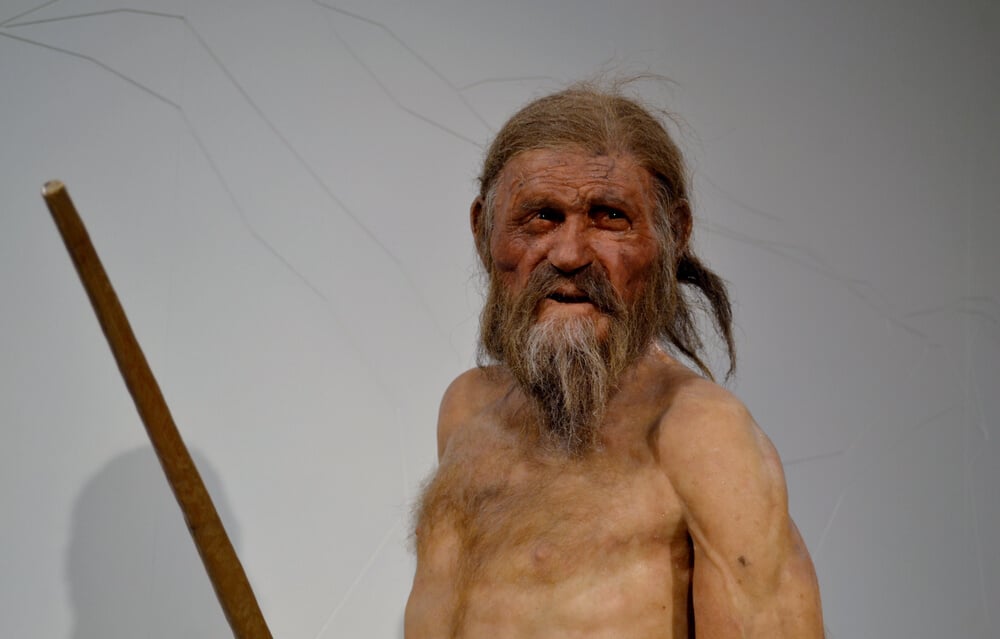
In September 1991, two German hikers, Erika and Helmut Simon, were crossing a pass in the Ötztal Alps on the border between Austria and Italy when they saw a brown shape sticking out of melting ice. They assumed it was a recently lost climber.
He had been lying there for about 5,300 years.
Ötzi, as he became known, is the oldest naturally preserved human body ever found in Europe. He carried a copper axe, a flint dagger, a bow still under construction, arrows, a backpack frame and a small kit of medicinal fungus.
He wore a bearskin cap, a grass cloak and leather shoes stuffed with hay. His skin bore 61 tattoos, many on spots where he likely suffered joint pain.
For a decade, everyone assumed he died of exposure. Then, in 2001, an X-ray revealed a stone arrowhead lodged in his left shoulder.
Ötzi was killed. Someone shot him from behind.
His copper axe also forced a rewrite. It showed that copper smelting was practised in the Alpine region earlier than many textbooks claimed.
Today Ötzi rests in a cold chamber at the South Tyrol Museum of Archaeology in Bolzano, where visitors look at him through a small window. He is the closest thing archaeology has to a witness who walked straight out of the Copper Age.
The Rosetta Stone Cracks a Code
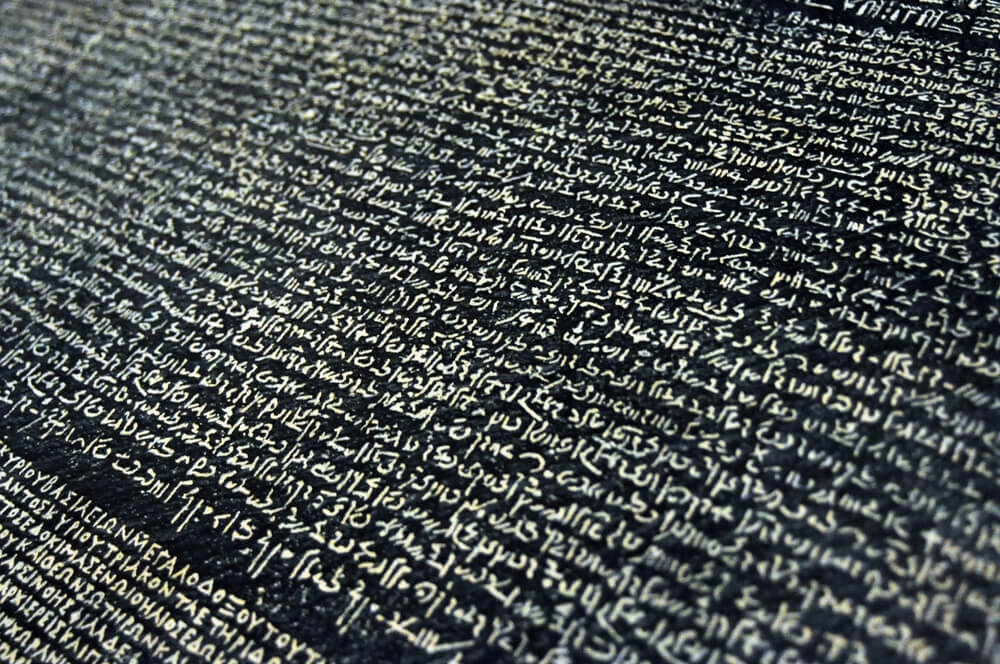
French soldiers rebuilding a fort near the Egyptian town of Rashid in 1799 found a dark granodiorite slab built into an old wall. It carried the same text written three times, in Egyptian hieroglyphs, in Demotic script and in ancient Greek.
The text itself is a fairly dull priestly decree from 196 BCE, honouring the young King Ptolemy V. The value lay in the comparison.
Scholars could read the Greek. If they could match it to the other two scripts, they could finally read hieroglyphs, which nobody had understood for over a thousand years.
British forces took the stone after defeating the French, and it has been in the British Museum since 1802. Thomas Young made early progress, but Jean-François Champollion broke the code in 1822 when he showed that hieroglyphs mixed sound signs with picture signs.
Overnight, thousands of temple walls, tomb paintings and papyri became readable. Egyptian history stopped being a matter of guesswork and Greek hearsay.
The pharaohs started speaking for themselves.
The Antikythera Mechanism
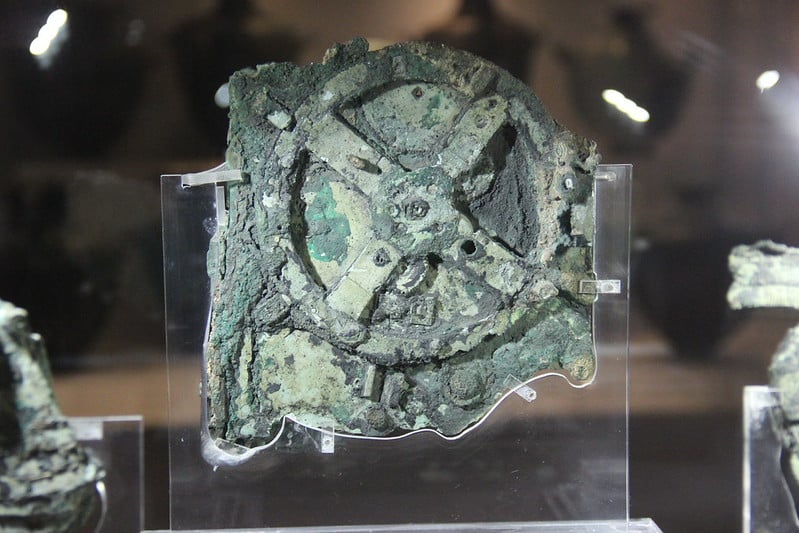
Sponge divers working off the Greek island of Antikythera in 1900 found a Roman-era shipwreck loaded with bronze and marble statues. Among the recovered objects was a lump of corroded bronze and wood that nobody paid much attention to.
In 1902 archaeologist Valerios Stais noticed a gear wheel inside it.
Decades of study, including high-resolution X-ray scans in the 2000s, revealed what the lump really was. A hand-cranked device, more than 2,000 years old, with dozens of interlocking bronze gears.
Turn the handle and it tracked the movements of the Sun and Moon, showed the phases of the Moon, predicted eclipses and even marked the four-year cycle of the ancient Olympic Games.
Nothing of comparable mechanical complexity is known again until the astronomical clocks of medieval Europe, well over a thousand years later. The mechanism proved that ancient Greek engineers worked at a level the textbooks had badly underestimated.
It also raises a sobering question you can sit with for a while. If one device survived by luck in a shipwreck, how many others melted down or rusted away without a trace?
The Terracotta Army
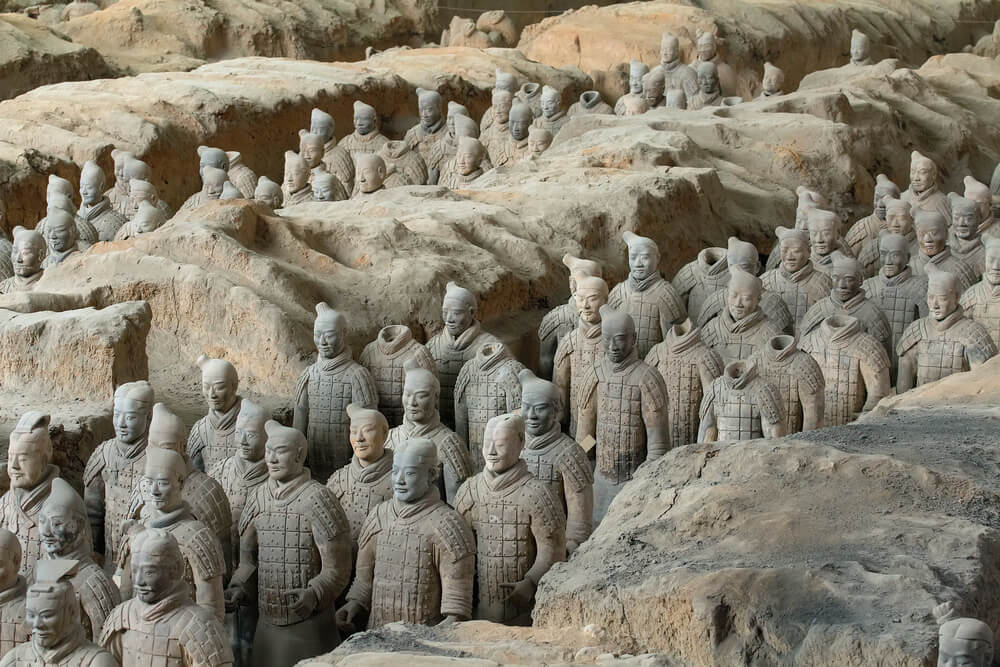
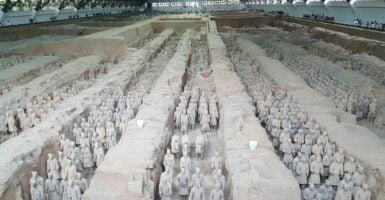
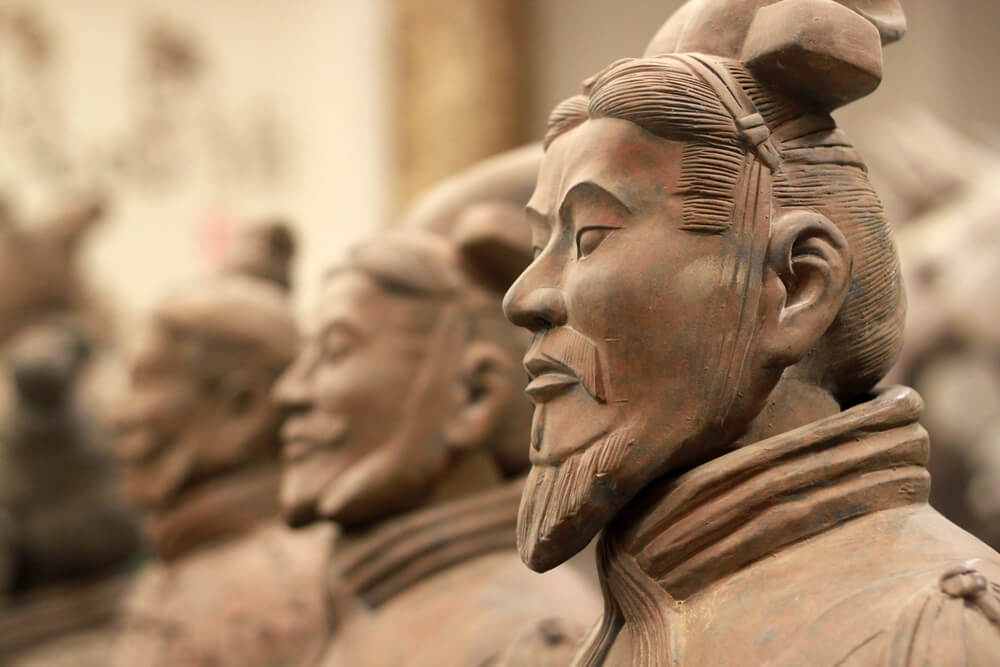
In March 1974, farmers digging a well near Xi’an in China’s Shaanxi province struck fragments of fired clay. They had found the edge of one of the largest archaeological sites on Earth.
The pits around the tomb of Qin Shi Huang, the first emperor of a unified China, who died in 210 BCE, hold an estimated 8,000 life-sized clay soldiers, along with horses, chariots and real bronze weapons. Each soldier has an individual face and hairstyle.
They were originally painted in bright colours, most of which flaked away soon after exposure to air.
Ancient Chinese historians had described the emperor’s vast tomb, but many modern readers treated those accounts as exaggeration. The Terracotta Army showed the old writers had told the truth.
The emperor’s own burial mound remains unopened, and Chinese authorities have chosen to wait until preservation methods improve. Sometimes the most responsible decision in archaeology is to leave the lid on.
The Dead Sea Scrolls
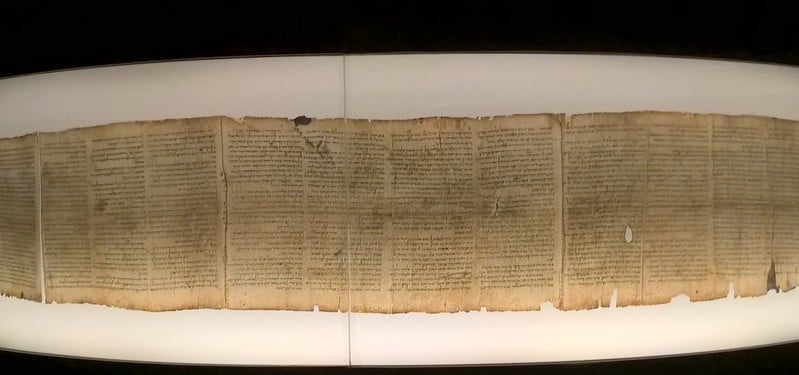
Late in 1946 or early in 1947, a young Bedouin shepherd searching for a stray goat in the cliffs at Qumran, near the Dead Sea, threw a stone into a cave and heard pottery break. Inside were clay jars holding ancient scrolls.
Over the following decade, searchers found eleven caves and fragments of roughly 900 manuscripts. They included the oldest known copies of books from the Hebrew Bible, some written in the third century BCE.
The Great Isaiah Scroll, nearly complete, is about a thousand years older than the medieval manuscripts that scholars had relied on until then.
The scrolls did two things at once. They showed that the biblical text had been copied with remarkable care over a millennium.
And they revealed that Jewish religious life around the time of Jesus was far more varied than anyone realised, with competing groups, rival calendars and texts that never made it into any Bible.
Sutton Hoo and the Not-So-Dark Ages

In 1939, landowner Edith Pretty asked a local self-taught excavator, Basil Brown, to examine the grassy mounds on her estate in Suffolk, England. In the largest mound, Brown found rows of iron rivets in the sand. The wooden ship they once held together had rotted away completely, but its ghost remained, a perfect impression about 27 metres long.
In the centre lay a burial chamber packed with treasure. A great gold buckle. Shoulder clasps inlaid with garnets. Silver bowls from the eastern Mediterranean.
And an iron helmet with a face mask that became one of the most recognised objects in British archaeology. Most experts believe the grave belonged to Rædwald, a king of East Anglia who died around 624 CE.
Before Sutton Hoo, the period after Roman rule in Britain carried the label the Dark Ages, imagined as a time of poverty and isolation. This single burial showed rich craftsmanship and trade links stretching thousands of kilometres.
Pretty donated the entire hoard to the British Museum. The story later reached a wider audience through the 2021 film The Dig.
Great Zimbabwe and a History Hidden on Purpose
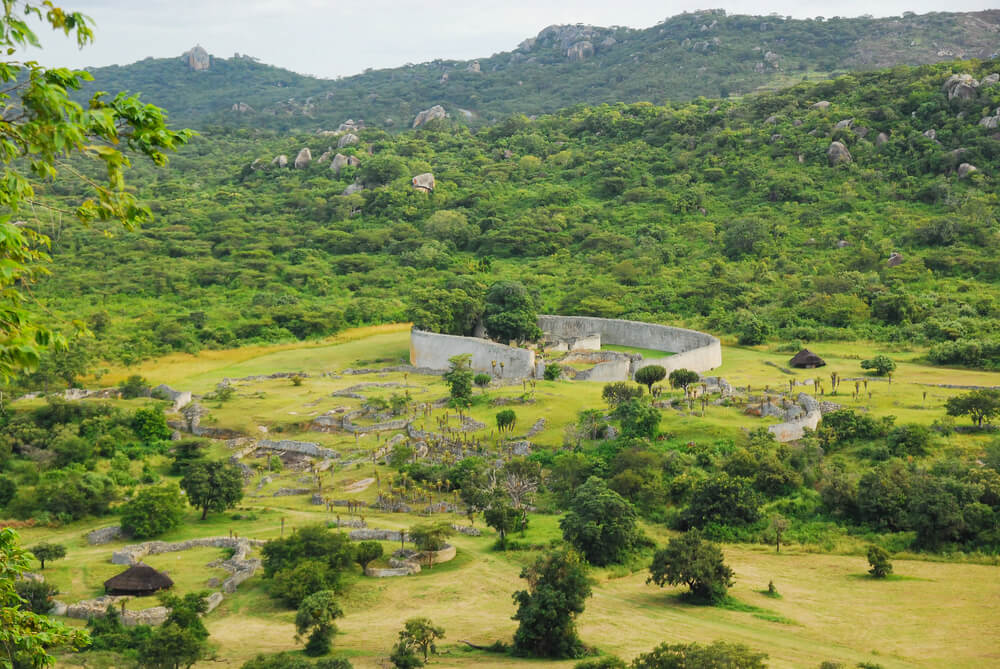
Great Zimbabwe’s stone walls rise about 11 metres in places, built from granite blocks fitted together without mortar. Between roughly the 11th and 15th centuries, it served as the capital of a wealthy Shona state that traded gold and ivory with the Swahili coast.
European visitors in the late 1800s refused to accept that Africans had built it. German geologist Karl Mauch claimed it was the palace of the Queen of Sheba.
Others credited Phoenicians or Arabs. In 1905 archaeologist David Randall-MacIver argued the site was medieval and African. In 1929 Gertrude Caton-Thompson confirmed it beyond reasonable doubt.
That should have ended the matter. It didn’t. The white minority government of Rhodesia found the truth politically awkward, and through the 1970s it pressured guidebook writers and museum staff to keep the origins vague. Some archaeologists left the country rather than comply.
This is why Great Zimbabwe belongs on any list like this one. Rewriting history is not only about new evidence.
Sometimes the evidence is already there, and the hard part is getting people to accept it. When Zimbabwe became independent in 1980, the country took its name from the site.
Mapungubwe and the Golden Rhino

On a flat-topped sandstone hill near the meeting point of the Limpopo and Shashe rivers, where South Africa, Botswana and Zimbabwe meet, a local guide led a small party of farmers to the top in 1932. Local people had long treated the hill as sacred and off limits. The farmers found gold.
The University of Pretoria began formal excavations the following year.
The most famous find is a small rhinoceros made of thin gold foil hammered over a carved wooden core. It is barely bigger than a hand.
Alongside it lay gold sceptres, a gold bowl, thousands of gold beads and glass beads that had travelled from the Indian Ocean trade network.
Mapungubwe flourished from about 1220 to 1290 CE. It was a kingdom with a clear social hierarchy, where the ruling elite lived on the hilltop and ordinary people lived below.
It traded ivory and gold through coastal ports with merchants from Arabia, India and beyond. Many historians see it as the first state in southern Africa and a forerunner of Great Zimbabwe.
For most of the 20th century, South African schoolchildren barely heard of it. The apartheid narrative depended on the idea of an empty interior, settled only recently, and a sophisticated African kingdom in the Limpopo Valley did not fit that story.
The finds stayed largely in university storerooms.
That changed after 1994. Mapungubwe became a World Heritage Site in 2003, and the national park built around it opened to visitors. The gold rhino is on display at the Mapungubwe Collection at the University of Pretoria.
If you go, stand in front of it for a full minute. A thing that small held up a lie for decades, and then quietly knocked it down.
What the Ground Still Keeps
Every discovery on this list was once buried, misfiled, ignored or dismissed. The Taung Child spent 25 years being called a mistake.
Little Foot sat in a box. Mapungubwe’s gold waited in storerooms while textbooks said nothing.
The history you learned at school was never the final version. It was the best guess at the time, and often the most convenient one.
So treat the past with a little suspicion and a lot of curiosity. Visit Maropeng and the Sterkfontein Caves.
Drive up to Mapungubwe and climb the hill. Stand in a museum and ask who found the object in the case, who doubted them, and how long it took for the truth to be accepted.
Somewhere, right now, a caver is feeling a draught through a gap in the rock. A student is opening an old box nobody has checked in thirty years.
The next chapter of the textbook is already in the ground, waiting for someone stubborn enough to dig it out.
More from Go2Tutors!

- The Romanov Crown Jewels and Their Tragic Fate
- 13 Historical Mysteries That Science Still Can’t Solve
- Famous Hoaxes That Fooled the World for Years
- 15 Child Stars with Tragic Adult Lives
- 16 Famous Jewelry Pieces in History
Like Go2Tutors’s content? Follow us on MSN.