Artworks that Broke Auction Records
Money does strange things to art. It turns canvas and pigment into headlines, transforms brushstrokes into investment portfolios, and makes otherwise sensible people gather in auction rooms to wave paddles like they’re conducting some elaborate financial orchestra.
But the most expensive artworks ever sold at auction tell a story beyond their price tags—one about obsession, legacy, and what we decide matters enough to preserve.
The art auction world moves in waves, sometimes logical, often not. Look at the list of the most expensive artworks ever sold at auction, and you’ll see more than just a parade of billionaires with good taste (or at least expensive taste).
You’ll see a history of ideas—what mattered to the artists who made them, what obsessed the collectors who chased them, and how we decide, decades or centuries later, which works still hold power.
There’s something theatrical about it all, this transformation of quiet studios into global spectacles.
Salvator Mundi

The record payment for a work is approximately US $450.3 million (which includes commission) for the work Salvator Mundi (c. 1500) generally considered to be by Leonardo da Vinci, though this is disputed.
The painting was sold in November 2017, through the auction house Christie’s in New York City.
This one carries mystery like a second coat of varnish. Salvator Mundi (Latin for “Savior of the World”) is shrouded in intrigue, as many scholars question whether the entirety of the composition can be attributed to da Vinci.
A 2018 Louvre analysis suggested the piece evolved, with Leonardo adding crucial details, including the hands, in later stages.
The painting shows Christ as savior of the world, holding a crystal orb—simple enough on the surface, but the authentication debates have followed it like shadows.
Acquired by an anonymous buyer, later revealed to be acting on behalf of Saudi Prince Bader bin Abdullah bin Mohammed bin Farhan Al Saud.
The masterpiece now falls under the stewardship of the Saudi Arabian Ministry of Culture.
Portrait of Elisabeth Lederer
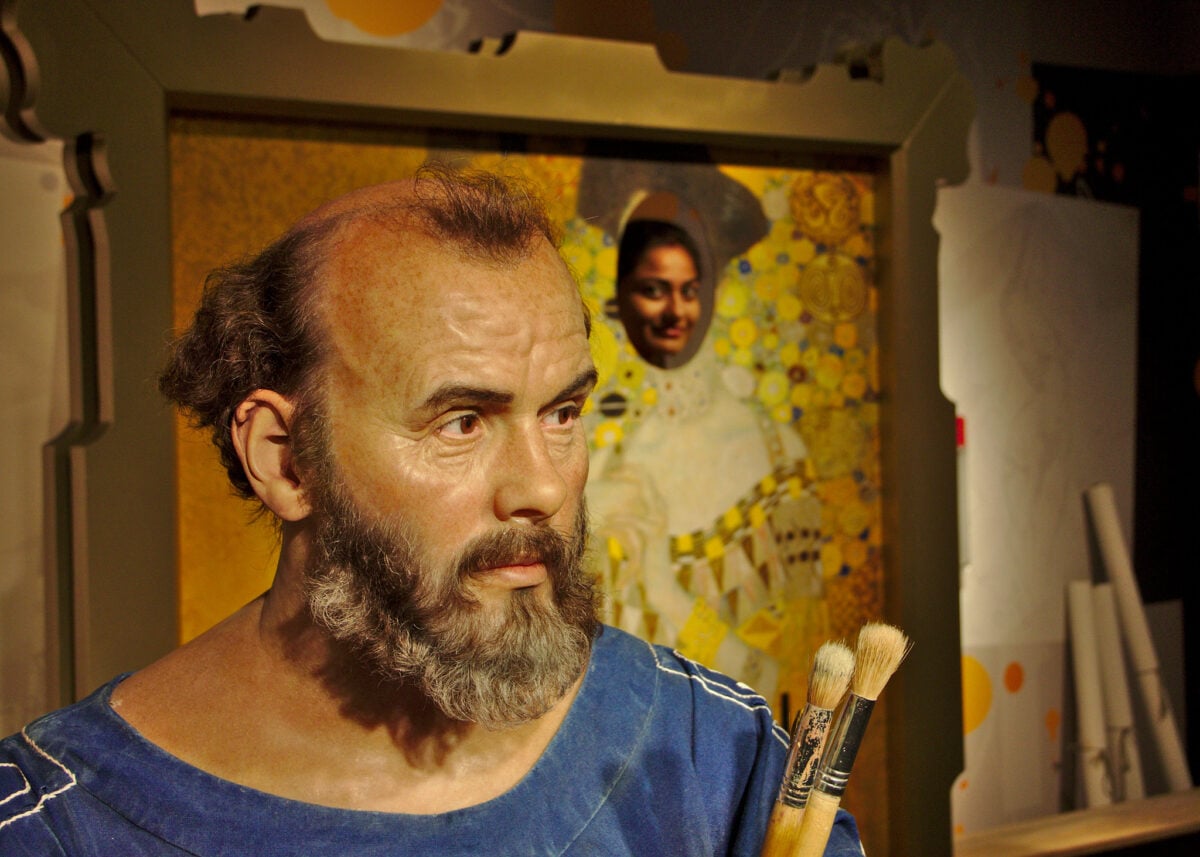
Early on, the headlining artwork by Gustav Klimt, “Portrait of Elisabeth Lederer,” became the most valuable work of modern art to ever sell at auction, reaching $236.4 million to gasps and applause from the room during the 20-minute bidding war.
This one just happened, literally hours ago as of this writing.
The portrait was one of the few by the Austrian artist that survived World War II intact.
It depicts the young daughter of one of Klimt’s patrons and was kept separate from his other paintings that were burned in a fire at an Austrian castle.
There’s something poetic about survival determining value—not just artistic merit, but the simple fact of still existing when so much else was lost.
Shot Sage Blue Marilyn

One of Andy Warhol’s many silkscreened representations of Marilyn Monroe was auctioned by Christie’s in New York for $195 million.
This particular Marilyn has a story that perfectly captures Warhol’s world.
In fact, the Shot Marilyns series got its name after American performance artist, Dorothy Podber, visited Warhol’s New York studio in 1964.
She saw the artworks and asked the American artist if she could shoot them.
Believing she meant taking pictures, he agreed.
Unexpectedly, the woman took out a revolver and shot through the forehead of Monroe’s likenesses with a single shot.
The sage blue version was the only one that escaped damage (it was stored elsewhere), which adds an odd twist to its value.
The winning bid was a gentleman in the room – who is reportedly Larry Gagosian – American art dealer and founder of Gagosian Gallery.
Women of Algiers (Version O)
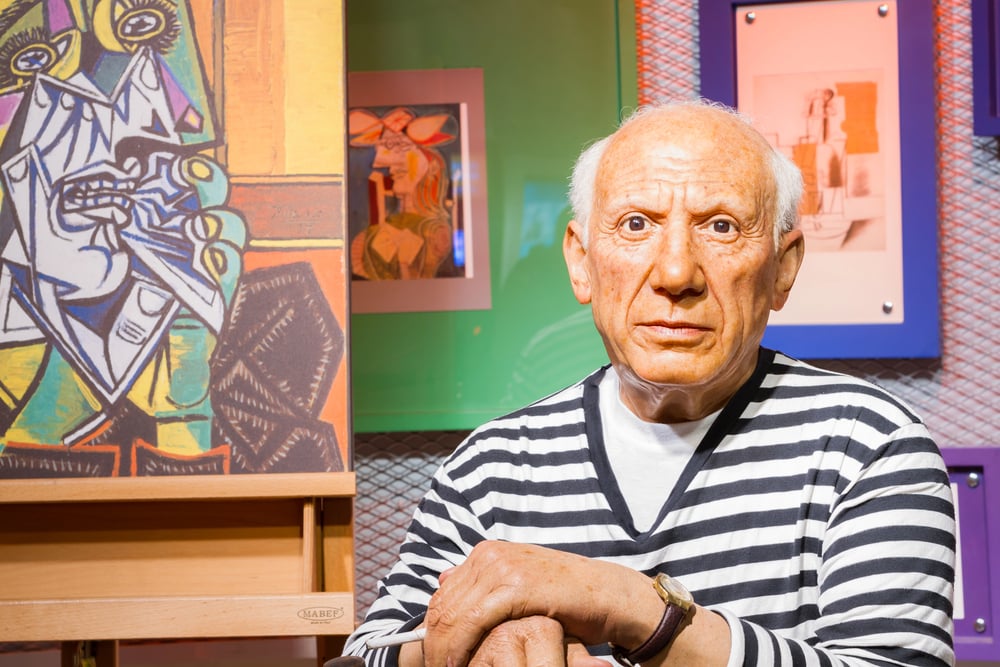
Pablo Picasso produced several series of paintings throughout his lifetime reimagining masterpieces by other famed artists in history, including The Women of Algiers by French Romantic painter Eugène Delacroix.
The 15-part series of oil paintings was created between 1954 and 1955, with Version O considered the most intricate and fully realized in the bunch.
The work set a new auction record at Christie’s New York, selling for $179.4 million—at the time, the most expensive painting ever sold.
It held that record until the Warhol came along.
The Standard-Bearer

This 1636 self-portrait of Rembrandt exudes the artist’s signature intensity and dramatic chiaroscuro.
Originally part of England’s royal collection before its acquisition by the Rothschild family, The Standard-Bearer was ultimately purchased by the Dutch government for $198 million in 2022, ensuring its place within the Netherlands’ national heritage.
Sometimes nations decide they can’t let certain things leave.
The Dutch government stepped in here, the way someone might rescue a family heirloom from an estate sale.
Nu Couché

Another work from Amedeo Modigliani’s reclining bare series made a splash at a 2018 Sotheby’s auction when it sold for $157.2 million.
Unlike other coveted works from the Italian artist’s scandalous series, this painting depicts a bare woman gazing over her shoulder at the viewer.
At the time of the sale, it set a record as the most expensive artwork ever sold at Sotheby’s.
Modigliani’s works caused riots when first exhibited—literally, police had to shut down his only solo exhibition in 1917 because crowds gathered outside the gallery window.
Les Poseuses, Ensemble (Petite version)

Similar to the manner in which the Van Gogh and Gauguin markets were recalibrated with Paul Allen collection offerings, it was the same story for Georges Seurat although to perhaps an even more dramatic effect.
The $149.2 million achieved for this work is more than four times the previous $35.2 million achieved for Paysage, l’Ile de la Grande-Jatte, an oil of the famous subject matter, sans people, that was sold in 1999 at Sotheby’s New York.
Among his short list of major works, Les Poseuses is one of the most distinctive for its bare depiction of the female body in front of Seurat’s most famous work, A Sunday Afternoon on the Island of La Grande Jatte.
The rare work belonged to Microsoft co-founder Paul Allen before being sold at a Christie’s New York auction in November 2022.
The early-20th-century masterpiece sold for a whopping $149 million.
Three Studies of Lucian Freud

Francis Bacon’s Three Studies of Lucian Freud (1969) briefly became the most expensive artwork ever sold at auction when it sold for $142.4 million at Christie’s New York in November 2013.
The triptych surpassed the previous record, held by Edvard Munch’s pastel The Scream, which sold for $119.9 million at Sotheby’s in 2012 (and which also appears on this list, above).
The piece had an unusual history: its panels were separated by a dealer in the 1970s and remained apart for 15 years before being reunited by a collector in 1989.
The work was expected to sell for over $85 million, but after a five-minute bidding war, it was secured by New York’s Acquavella Galleries.
Pointing Man

Alberto Giacometti’s Pointing Man (1947) became the most expensive sculpture ever sold at auction when it fetched $141.3 million at Christie’s New York in May 2015.
One of six casts made by the artist (not counting an additional artist’s proof), this particular Pointing Man had been held privately for 45 years before the sale.
Four of those casts reside in major museums, including the Museum of Modern Art in New York and the Tate in London, which made this auction a prime opportunity for collectors.
There’s something about the way Giacometti’s figures seem to exist in perpetual solitude that makes them magnetic.
Twelve Screens of Landscapes

Sold for $140.8 million at Poly International Auction Co., Ltd., Beijing in December 2017 · Qi Baishi’s Twelve Screens of Landscapes (1925) shattered records in 2017, selling for RMB 931.5 million ($140.8 million) at Beijing Poly Auction and making it the most expensive Chinese artwork ever sold at auction.
The bidding war lasted over 20 minutes, with more than 60 bid increments before a Chinese collector secured the 12-panel piece.
A similar version of Twelve Screens of Landscapes, painted around 1932 as a gift to Kuomintang general Wang Zuanxu, resides in the Chongqing Museum.
The set sold in 2017 was the only one in private hands at the time, making it a rarity.
Femme à la montre
Then, consider the most expensive work sold at auction: a Picasso painting that took in $139 million.
In 2022, an Andy Warhol “Marilyn” sold for $195 million.
This 1932 Picasso portrait from 2023 marked the year’s highest sale, though it represented a notable drop from 2022’s peaks.
The art market has its rhythms, and 2023 was clearly a quieter year than the record-breaking frenzy of 2022.
L’empire des lumières

A century after André Breton published his Surrealist Manifesto, René Magritte’s L’empire des lumières (1954) became the most expensive Surrealist artwork ever to sell at auction, achieving $121.16 million at Christie’s New York in November.
The painting—hailed as the “crown jewel” of American interior designer Mica Ertegun’s collection by the auction house—shattered the artist’s auction record, previously set at Sotheby’s London in 2022 for L’empire des lumières (1961), which sold for £59.42 million ($79.24 million).
Measuring approximately 5 by 4 feet, this painting is one of the largest works in Magritte’s famed “Empire of Light” series, which comprises 27 variations on the surreal theme of juxtaposed day and night imagery.
The serene scene features a house lit by a single streetlamp, its warm yellow glow reflected in a body of water below, while the sky above remains a daytime blue scattered with clouds.
Dame mit Fächer (Lady with a Fan)

Deemed “the star of the summer auction season in London” by Sotheby’s, Gustav Klimt’s final portrait, Dame mit Fächer (Lady with a Fan), was still on the easel when the artist suddenly passed away in 1918.
This painting, featuring an unnamed woman engulfed by flowers and peacocks, became the most expensive artwork ever sold at a European auction house, fetching £85.3 million ($106.8 million) at Sotheby’s London modern and contemporary evening auction this summer.
The work also set a new record under the hammer for the Austrian artist, beating the $104 million paid for Birch Forest (1903) at Christie’s in November 2022.
The work’s ascension since its last appearance at auction is remarkable: Dame mit Fächer (Lady with a Fan) was previously sold under the hammer in 1994 for $11.6 million.
Portrait of Dr. Gachet

In May 1990, under the direction of Christie’s auction house Chairman Stephen Lash, it was sold for $82.5 million ($198.6 million today) to Ryoei Saito, making it the world’s most expensive painting at that time.
This Van Gogh has one of the strangest post-sale stories.
Vincent van Gogh’s Portrait of Dr Gachet disappeared after it was sold at Christie’s in 1990, when it fetched $82.5m, then the highest price for any painting at auction.
The buyer was a Japanese businessman, who later said he would have the picture burnt with his body, but this didn’t happen when he died—and Van Gogh quietly returned to Europe.
The painting shows Van Gogh’s doctor during his final weeks, painted in June 1890, just before the artist’s death.
Stefan Koldehoff, a Cologne-based Van Gogh specialist and journalist, says in an article in the October issue of the German magazine Kunst, that the collector was believed to reside in Lugano and that Sotheby’s discreetly refers to him internally as “The Lugano Man”.
The Peculiar Mathematics of Desire
What drives these prices beyond reason or logic? The price, which includes fees, is the highest for a 20th century artwork sold at auction and the highest for an American artwork, topping the $179.4 million mark in 2015 for Pablo Picasso’s Les Femmes d’Alger (Version O) and $110.5 million in 2017 for a 1982 painting by Jean-Michel Basquiat.
The numbers climb not just because of artistic merit, but because of stories—the drama of survival, the mystique of disappearance, the romance of the artist’s final days.
We live in a time where the art market has moved past mere trophy hunting.
For the mega-rich, buying a major work of art is no longer only about aesthetics or investment.
Like the pharaohs of ancient Egypt, who built elaborate tombs as monuments to their immortality, the world’s wealthiest art buyers now desire eternal fame.
Museums ensure these works outlive their owners, but auction records ensure the buyers’ names get written into art history alongside the artists themselves.
The pattern repeats: a work emerges from private collections or estates, carries whispers of provenance and authenticity, then transforms into a cultural event.
The result says a lot about both the Van Gogh market and one of the biggest art market bubbles in history that burst in the late 1980s, when the Impressionist and modern art market imploded after years of frothy, speculative buying.
Yet the appetite returns, cycles through boom and relative quiet, always finding new heights that make the previous records seem almost modest by comparison.
These artworks that break auction records become more than paintings or sculptures—they become markers of what each era values most, what stories we choose to preserve, and how much we’re willing to pay to own a piece of something that will outlast us all.
The prices may be staggering, but in the end, they’re just another layer of the story, no more permanent than the brushstrokes underneath.
More from Go2Tutors!

- The Romanov Crown Jewels and Their Tragic Fate
- 13 Historical Mysteries That Science Still Can’t Solve
- Famous Hoaxes That Fooled the World for Years
- 15 Child Stars with Tragic Adult Lives
- 16 Famous Jewelry Pieces in History
Like Go2Tutors’s content? Follow us on MSN.