Defunct Social Media Platforms We Miss Using Today
Remember when social media felt like discovering secret neighborhoods on the internet? Each platform had its own culture, its own rules, its own way of connecting people who might never meet otherwise.
Some of these digital spaces vanished overnight, taking years of memories and communities with them. Others faded slowly, their user bases migrating elsewhere like digital nomads seeking the next great online frontier.
The platforms that disappeared weren’t always the worst ones. Sometimes they were just ahead of their time, or unlucky, or crushed by bigger competitors with deeper pockets.
What they left behind was something harder to quantify: the particular way they made you feel when you logged in, the specific kind of connection they fostered, the communities that formed around their unique features.
Vine

Six seconds changed everything. Vine forced creativity into a box so small that it became a different art form entirely.
The constraint wasn’t limiting — it was liberating. You couldn’t ramble or waste time.
Every frame mattered.
The platform created a generation of comedians who could tell complete jokes faster than most people could set up a punchline. And then Twitter killed it, deciding that longer videos were the future.
They weren’t wrong about video, but they missed what made Vine special: the constraint itself.
Google+
Google+ got a reputation as a ghost town, but that misses the point entirely — the people who used it loved it precisely because it wasn’t crowded (and Google’s insistence on forcing it down everyone’s throat through integration with every other service they offered, which backfired spectacularly, creating resentment before most people even tried it).
The Circles feature was brilliant: you could share different parts of your life with different groups without the awkward dance of managing multiple accounts or worrying about your boss seeing your weekend photos.
But Google treated it like a checkbox on their social media strategy rather than a community worth nurturing. So they shut it down.
The irony is that Google+ solved problems that people are still complaining about on other platforms today.
StumbleUpon
Imagine opening a door and finding yourself somewhere completely unexpected every time. StumbleUpon was the internet’s version of wandering through a city without a map, except every wrong turn led somewhere fascinating.
You’d start looking for information about gardening and end up reading about deep-sea creatures or watching a documentary about lighthouse keepers in Scotland.
The algorithm wasn’t trying to keep you engaged for maximum ad revenue — it was trying to surprise you. That made all the difference.
Social media became predictable after StumbleUpon disappeared. Everything felt calculated, targeted, designed to confirm what you already knew rather than show you something you’d never seen.
Friendster
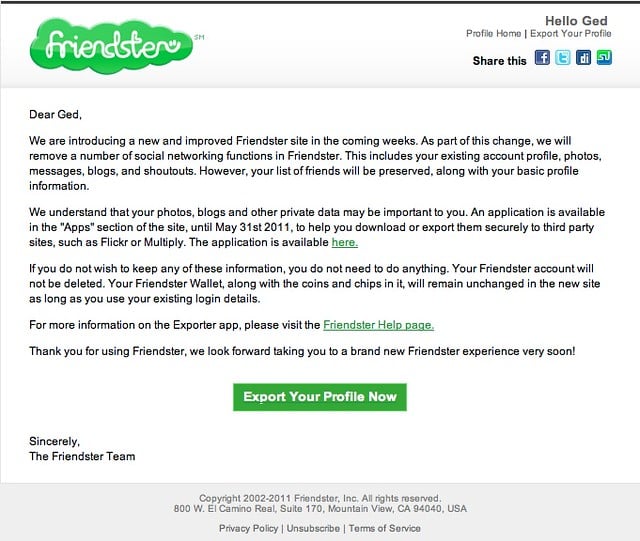
Friendster launched before Facebook existed. Before MySpace existed.
Before most people understood what social networking meant. It was the first platform to let you map your actual relationships online, to see how you connected to friends of friends, to discover that your college roommate somehow knew your cousin from summer camp.
The site couldn’t handle its own success. Servers crashed constantly.
Pages loaded like dial-up internet even on broadband connections. But for a brief moment, it felt like magic: seeing your social world visualized for the first time, realizing how small and interconnected everything really was.
Tumblr
Tumblr died the day it banned adult content, but that’s not the whole story (though it certainly accelerated the decline when a significant portion of its user base — and content creators who drove engagement — left practically overnight).
The platform’s real magic was how it blurred the line between social media and creative expression. You weren’t just posting updates about your life; you were curating an aesthetic, building a mood, contributing to conversations that happened through reblogs rather than comments.
The dashboard felt like flipping through a magazine that was created specifically for you, mixing your friends’ photos with art and poetry and random thoughts that somehow all fit together.
Instagram tries to replicate this, but it’s too polished. Too focused on influence rather than expression.
Orkut
Google’s first attempt at social media succeeded everywhere except where Google wanted it to succeed. Orkut was supposed to compete with Facebook in the United States.
Instead, it became the dominant platform in Brazil and India, creating vibrant communities that developed their own cultures and inside jokes and ways of communicating.
Google never seemed to understand what they had. They kept trying to make Orkut more like Facebook instead of embracing what made it different.
When they finally shut it down, millions of people lost not just a social media account, but a digital homeland that had shaped how they connected with others online.
Path

Path was social media with training wheels — in the best possible way. The app limited you to 150 friends, forcing you to be selective about who you connected with.
Every interaction felt intentional. Every post was shared with people who actually cared about your day-to-day life rather than performing for a broader audience.
The interface was gorgeous, focusing on moments rather than content creation. You weren’t trying to go viral or build a personal brand.
You were just sharing your life with the people who mattered most. Path died because it never figured out how to make money from intimacy.
Turns out, that’s a hard thing to monetize.
Pownce

Created by the people behind Digg, Pownce was Twitter with file sharing and better organization. You could send photos, links, files, and messages to specific groups of people.
It was like having a more sophisticated version of Twitter that actually let you have private conversations and share things beyond just text.
The platform lasted less than two years. Twitter was simpler and already had momentum.
But Pownce had features that people are still asking Twitter to implement today: better privacy controls, file sharing, the ability to organize followers into groups.
Sometimes being too early is the same as being wrong.
Plurk
Plurk presented your social feed as a horizontal timeline instead of a vertical scroll. That small change made conversations feel more like dialogue and less like shouting into the void.
You could see how discussions developed over time, following threads of conversation that branched and merged like actual human interaction.
The platform found success in Taiwan and other parts of Asia, but never broke through in Western markets.
The horizontal timeline was actually more intuitive for following complex conversations, but people were already used to scrolling vertically.
Plurk’s approach was better; it just came too late to change habits.
Ello

Ello launched as the anti-Facebook: no ads, no data mining, no algorithmic manipulation of your feed. It was supposed to be social media for people who were tired of being the product.
The manifesto was compelling, the design was clean, and the intention was genuine.
But good intentions don’t create network effects. Your friends weren’t on Ello, so you stopped checking Ello.
The platform pivoted to focus on artists and creators, which made more sense for their ad-free model, but it never recaptured the excitement of those early days when it seemed like social media might develop a conscience.
Peach

Peach felt like texting your friends through a social media app, but with more personality and fewer rules. You could share your mood, your location, what you were watching, what you were listening to — all through simple commands that felt like having a conversation with the app itself.
The platform had a brief moment of virality when early adopters fell in love with its playful approach to sharing.
But virality isn’t the same as staying power. Peach couldn’t figure out what it wanted to be beyond charming, and charm alone doesn’t sustain a social network when the novelty wears off.
Ping

Apple’s attempt at music-focused social media was doomed from the start, but the idea made sense: connect people through the music they loved, let them share discoveries and recommendations, create playlists together.
Music is inherently social, so why not build a network around it?
Ping failed because Apple couldn’t get licensing deals with major music services, because it was buried inside iTunes, and because Apple didn’t understand social media culture.
But the core concept was sound. Spotify’s social features prove that people do want to share music and see what their friends are listening to.
Yik Yak

Anonymous social media for college campuses worked exactly as well and as badly as you’d expect. Yik Yak created hyperlocal communities where people could share thoughts, jokes, and observations without the performance pressure of attaching their name to everything.
The anonymity led to genuine moments of connection — people supporting each other through difficult times, sharing resources, creating inside jokes that brought campuses together.
It also led to harassment, bullying, and the kind of behavior that emerges when people don’t have to face consequences for their words.
The platform couldn’t solve the moderation problem, so it died.
Looking Back Without Rose-Colored Glasses

These platforms didn’t disappear because they were perfect. They disappeared because social media is brutally competitive, because user attention is finite, because network effects create winner-take-all markets where being second place means being irrelevant.
Some made crucial mistakes, others were simply unlucky with timing or funding or the countless other factors that determine which digital communities survive.
But their absence left gaps that current platforms haven’t filled. The creativity constraints of Vine, the privacy controls of Google+, the serendipity of StumbleUpon, the intimacy of Path — these weren’t just features, they were different philosophies about what social media could be.
What remains is a landscape that’s more efficient, more profitable, and more predictable than what came before. Whether it’s better is a different question entirely.
More from Go2Tutors!

- The Romanov Crown Jewels and Their Tragic Fate
- 13 Historical Mysteries That Science Still Can’t Solve
- Famous Hoaxes That Fooled the World for Years
- 15 Child Stars with Tragic Adult Lives
- 16 Famous Jewelry Pieces in History
Like Go2Tutors’s content? Follow us on MSN.



