Famous Rivalries That Ended in Friendship
Competition brings out something primal in people.
It sharpens focus.
It fuels ambition.
Sometimes it turns opponents into enemies who can barely stand to be in the same room.
Every so often, something unexpected happens.
The heat of rivalry cools into respect.
Respect deepens into genuine friendship.
These transformations don’t happen overnight.
They’re never guaranteed.
When they do occur, they reveal something profound about human nature.
Even the fiercest competitors can recognize the shared journey that made them both great.
History is full of battles that ended not with bitterness but with bonds that lasted decades.
Let’s explore how some of the most intense rivalries evolved into unlikely friendships.
Larry Bird and Magic Johnson

The 1980s belonged to two men who seemed destined to hate each other.
Larry Bird, the small-town kid from Indiana with the deadly jump shot and trash-talking swagger, faced off against Magic Johnson, the charismatic showman from Los Angeles who made basketball look like performance art.
Their rivalry began in the 1979 NCAA championship game.
Magic’s Michigan State defeated Bird’s undefeated Indiana State team.
When they both entered the NBA, the animosity only intensified.
Bird’s Celtics and Magic’s Lakers met in the NBA Finals three times during the decade.
Their battles became the stuff of legend.
They didn’t socialize off the court.
They barely spoke beyond the necessary pleasantries.
Each saw the other as the one obstacle standing between them and ultimate greatness.
The media loved it.
Fans ate it up.
The NBA’s popularity soared.
The shift came gradually, starting with a commercial shoot in 1984 where they were forced to interact.
Then came the 1992 Dream Team.
Playing together for their country instead of against each other changed the dynamic entirely.
They started talking and discovered they had more in common than they’d ever imagined.
When Magic announced his HIV diagnosis in 1991, Bird was genuinely shaken.
Their friendship deepened from there, built on mutual respect that had always existed beneath the competition.
They became so close that Magic asked Bird to present him at his Hall of Fame induction.
Two men who’d spent a decade trying to destroy each other on the court became brothers off it.
Thomas Jefferson and John Adams
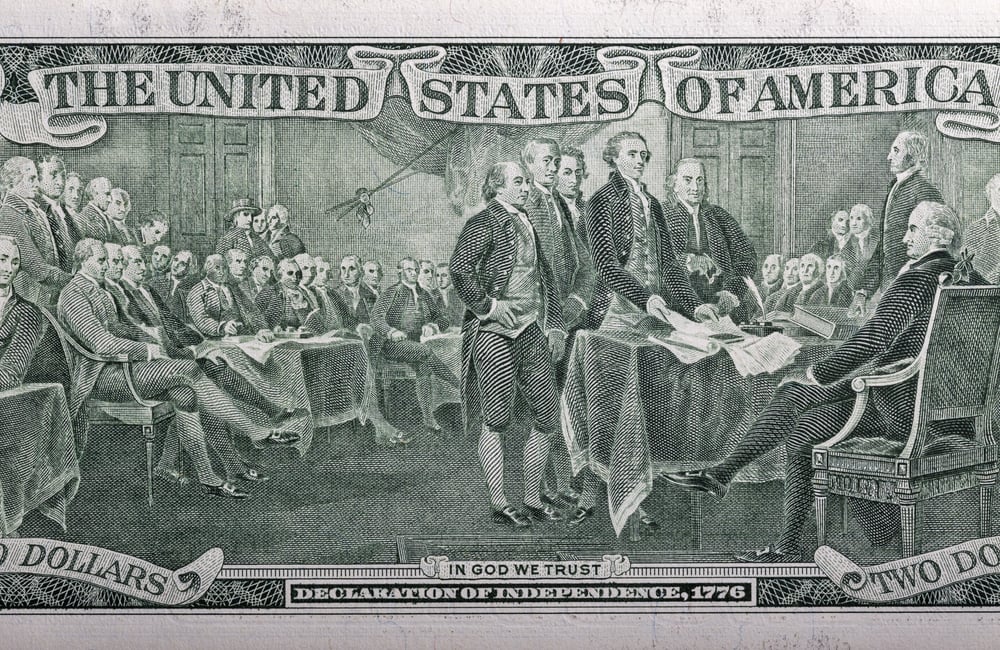
The friendship between these two Founding Fathers began during the American Revolution when they worked together on the Declaration of Independence.
By the 1790s, their political differences had torn them apart.
Adams, a Federalist who believed in strong central government, clashed with Jefferson’s Democratic-Republican vision of states’ rights and agrarian democracy.
Their dispute became personal and ugly, especially during the presidential election of 1800.
Adams’s supporters called Jefferson an atheist and a coward.
Jefferson’s camp labeled Adams a monarchist who wanted to crown himself king.
When Jefferson won, Adams left Washington before dawn on Inauguration Day, refusing to witness his rival’s triumph.
They didn’t speak for more than a decade.
The silence stretched on, heavy with resentment and wounded pride.
Their mutual friend, Dr. Benjamin Rush, worked behind the scenes to reconcile them.
In 1812, Adams finally broke the ice with a short letter.
Jefferson responded warmly, and suddenly they were corresponding regularly, writing hundreds of letters over the next fourteen years.
They discussed philosophy, politics, and the Revolution they’d helped create.
The anger faded, replaced by affection and the recognition that they’d both sacrificed enormously for the same cause.
In a final poetic coincidence, both men died on July 4, 1826—exactly fifty years after the Declaration of Independence was adopted.
Adams’s last words were reportedly, “Thomas Jefferson survives,” not knowing his old friend had died just hours earlier.
Chris Evert and Martina Navratilova

Tennis in the 1970s and 1980s was dominated by two women who couldn’t have been more different.
Chris Evert was the cool, composed baseline player from Florida, raised in tennis royalty with impeccable technique and ice-water composure.
Martina Navratilova was the emotional, aggressive serve-and-volley player who defected from Czechoslovakia seeking freedom and found it on the tennis court.
They faced each other eighty times over sixteen years.
For much of that time, they weren’t friends.
The rivalry was lopsided at first, with Evert winning most of their early matches.
Navratilova transformed herself physically and mentally, becoming arguably the greatest female player in history.
Their matches became epic, and the contrast in styles made every encounter compelling.
Evert was beloved by American crowds.
Navratilova often faced hostility as an outsider.
The competition was fierce, and the stakes were always enormous.
Off the court, they circled each other warily for years.
Respect gradually softened into friendship.
They started spending time together away from tournaments, talking about life beyond tennis.
When they both retired, the friendship deepened further.
Evert supported Navratilova through health challenges.
Navratilova was there for Evert during difficult personal times.
They’ve said publicly that they probably wouldn’t have achieved what they did without each other pushing them to improve.
The woman you’re trying to beat can also be the one who understands your journey better than anyone else.
Richard Nixon and Hubert Humphrey

The 1968 presidential election was brutal.
Nixon, the former vice president trying to resurrect his career after losing to Kennedy in 1960, faced Humphrey, Lyndon Johnson’s vice president, in a race dominated by Vietnam War protests and social upheaval.
Nixon won narrowly, and Humphrey returned to the Senate, where he became one of Nixon’s fiercest critics.
They represented opposite sides of American politics during one of its most divisive periods.
Something unexpected happened after Nixon resigned in disgrace following Watergate.
Humphrey, dying of cancer, reached out to the disgraced former president.
They spoke by phone, and Humphrey offered words of encouragement and forgiveness.
When Humphrey died in 1978, Nixon attended the funeral, visibly emotional.
Later, Nixon called Humphrey one of the most decent men he’d ever known in politics.
The gesture spoke volumes about both men.
Humphrey, facing his own mortality, chose grace over bitterness.
Nixon, stripped of power and legacy, received an act of kindness he hadn’t expected and probably didn’t deserve.
Their reconciliation was quiet and personal, overshadowed by larger historical events.
It showed that even political enemies can recognize their shared humanity in the end.
Tonya Harding and Nancy Kerrigan

This one’s complicated.
The 1994 attack on Nancy Kerrigan before the Olympics, orchestrated by people connected to her rival Tonya Harding, became one of the biggest sports scandals in history.
Kerrigan was clubbed in the knee after practice, and Harding’s ex-husband and bodyguard were eventually convicted.
Harding claimed ignorance but was banned from skating.
The public took sides immediately, with Kerrigan as the victim and Harding as the villain.
For decades, they didn’t speak.
Kerrigan had no interest in reconciliation, and Harding lived in infamy, her skating achievements forever tainted.
In recent years, something shifted.
They appeared together at a Fox sports special in 2014, awkwardly but civilly.
More recently, they’ve both softened their stances, acknowledging the media circus that consumed both their lives.
They’re not exactly friends, but the hostility has faded into something closer to mutual understanding.
That moment derailed both their lives in different ways.
Their story doesn’t have the warm resolution of Bird and Magic.
It shows how time and perspective can transform even the ugliest rivalries into something less toxic.
Sometimes the best you can hope for is moving from hatred to acceptance.
Why Old Enemies Make Peace

These stories share common threads.
Time softens edges that once seemed sharp.
Shared experiences create bonds that transcend temporary competition.
Distance provides perspective that’s impossible in the heat of battle.
Real rivals recognize something in each other that nobody else can see.
They recognize the sacrifice, the obsession, and the price paid for excellence.
Friendships born from rivalry carry a weight that ordinary friendships don’t.
They’re forged not despite the conflict but because of it.
More from Go2Tutors!

- The Romanov Crown Jewels and Their Tragic Fate
- 13 Historical Mysteries That Science Still Can’t Solve
- Famous Hoaxes That Fooled the World for Years
- 15 Child Stars with Tragic Adult Lives
- 16 Famous Jewelry Pieces in History
Like Go2Tutors’s content? Follow us on MSN.