History’s Most Convincing Royal Imposters
Throughout the centuries, plenty of people have tried to pass themselves off as royalty. Some did it for money, others for power, and a few just seemed to enjoy the thrill of fooling everyone around them.
These imposters didn’t just throw on a crown and hope for the best. They studied their targets, learned languages, memorized family trees, and convinced entire courts that they were the real deal.
Some of them came incredibly close to succeeding, and a handful even managed to fool historians for years after their schemes fell apart. Let’s look at some of the most impressive royal fakes who nearly pulled off the impossible.
False Dmitry I

A young man appeared in Poland in 1603 claiming to be the son of Ivan the Terrible, a Russian prince everyone thought had died years earlier. He had scars in the right places, knew details about the royal family that seemed impossible for an outsider to know, and spoke like someone raised in the Russian court.
The Polish nobility backed him with an army, and when he marched into Russia, thousands of people believed his story. He actually became Tsar and ruled Russia for about a year before his enemies caught up with him.
Even today, historians argue about whether he genuinely believed he was Dmitry or if he was just an incredibly talented actor.
Perkin Warbeck
This guy showed up in Ireland in 1491 dressed in fine silks and convinced half of Europe that he was Richard of Shrewsbury, one of the famous princes who disappeared in the Tower of London. He had support from the King of France, the Holy Roman Emperor, and even the King of Scotland, who gave him a royal cousin to marry.
Warbeck launched two invasions of England and maintained his story through years of questioning. When King Henry VII finally captured him, Warbeck supposedly confessed to being the son of a Belgian tax collector, but some historians think that confession was forced.
His performance was so convincing that people still write books trying to figure out if he was telling the truth.
Princess Caraboo

A young woman stumbled into a village in England in 1817 speaking a language nobody recognized and wearing exotic clothes. She used gestures and drawings to explain that she was a princess from a faraway island who had been kidnapped by pirates and jumped off their ship to escape.
For months, she lived with a wealthy local family who were completely charmed by her. She prayed in her strange language, refused to eat certain foods, and demonstrated archery skills that seemed genuinely foreign.
The whole charade fell apart when a Portuguese sailor recognized her language as gibberish and identified her as Mary Baker, a servant from Devon. She had invented an entire culture, complete with its own alphabet and religious practices, just to get free room and board.
Lambert Simnel
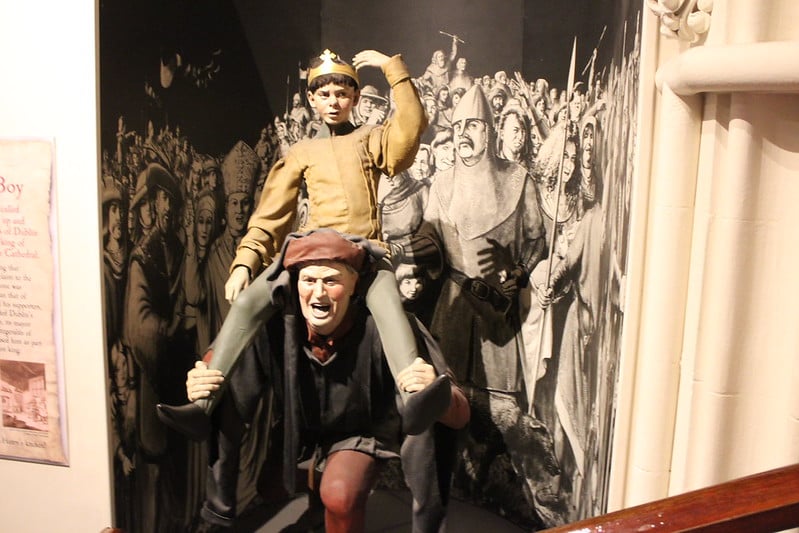
An Oxford-trained priest coached a ten-year-old boy to impersonate the Earl of Warwick in 1487, and the plan nearly worked. The boy learned to walk, talk, and act like nobility so well that Irish lords threw their support behind him and crowned him King of England in Dublin.
An army of about 8,000 men followed this child into battle against the real king, Henry VII. After the army was defeated, Henry did something surprising.
Instead of executing the boy, he gave him a job in the royal kitchens, possibly because he was impressed by how well the kid had been trained. Simnel eventually worked his way up to becoming the king’s falconer, which is a pretty good outcome for a failed imposter.
Anna Anderson

This woman spent over 60 years claiming to be Grand Duchess Anastasia, the youngest daughter of Russia’s last Tsar. She survived a death attempt in Berlin in 1920 and eventually started telling people she had escaped the execution of the royal family.
She knew personal details about the Romanov family that seemed impossible for a stranger to know, had scars that matched injuries Anastasia had suffered, and even spoke with a Russian accent. Some members of the extended Romanov family believed her completely, while others thought she was a fraud.
The mystery continued until DNA testing in the 1990s proved she was actually a Polish factory worker named Franziska Schanzkowska, but by then she had convinced thousands of people and lived as Anastasia for most of her life.
The False Margaret

A woman appeared in Norway around 1300 claiming to be Margaret, the Maid of Norway, who had supposedly died during a voyage to Scotland nearly a decade earlier. She spoke Norwegian, knew details about the royal family, and had enough supporters that the German authorities actually put her on trial to determine her identity.
The woman stuck to her story even under intense questioning and seemed genuinely confused about why people didn’t believe her. She was eventually burned at the stake for heresy, but not before creating a genuine succession crisis.
Some historians think she might have actually believed she was Margaret, possibly suffering from some kind of delusion or false memory.
Kaspar Hauser

A teenage boy wandered into Nuremberg in 1828 barely able to speak and carrying a letter claiming he was the secret heir to the Grand Duchy of Baden. He said he had been raised in complete isolation in a dark cell, knowing nothing about the outside world.
As he learned to communicate, he provided details that seemed to support the theory that he was royalty who had been kidnapped as an infant. European nobility took an interest in his case, and he received a fancy education.
Then someone stabbed him in 1833, and he died a few days later. Whether he was a genuine lost prince or a clever con artist remains one of Germany’s biggest historical mysteries.
Yury Otrepyev (False Dmitry II and III)

After False Dmitry I died, at least two more men showed up claiming to be the same resurrected prince. The second False Dmitry was so convincing that the first False Dmitry’s widow actually recognized him as her husband, which is either a testament to his skill or evidence that she was in on the scheme.
He set up his own royal court, collected taxes, and ruled parts of Russia for about two years. When he was killed, a third False Dmitry appeared, though this one didn’t fool nearly as many people.
The whole situation got so confusing that Russians started calling this period the ‘Time of Troubles,’ and it nearly destroyed their country.
The Tichborne Claimant
A butcher from Australia showed up in England in 1866 claiming to be Roger Tichborne, an heir who had been lost at sea over a decade earlier. He was much heavier than Roger had been and didn’t speak French, which the real Roger had spoken fluently.
Despite these obvious problems, Roger’s mother immediately accepted him as her son and gave him an allowance. The case went to court and became the longest trial in English history at that time, lasting 188 days.
Hundreds of people testified, and the courtroom drama captivated the entire country. He was eventually revealed to be Arthur Orton, a butcher’s son, but not before he had convinced Lady Tichborne and thousands of working-class supporters who wanted to believe in his story.
Harry Domela

A broke ex-soldier pretended to be a German prince in 1926 and lived a life of luxury for months before anyone caught on. He wore a monocle, spoke with an aristocratic accent, and showed up at fancy hotels where he signed for everything on credit.
People literally lined up to lend him money, invite him to parties, and introduce him to their daughters. The real prince was living quietly in another part of Germany and had no idea someone was using his identity.
When authorities finally arrested Domela, he became something of a folk hero because people admired the nerve it took to pull off such a ridiculous scheme. He wrote a bestselling book about his adventures and made more money from his confession than he ever did from pretending to be royalty.
The Marquise d’Andrésy

A young woman convinced French society in 1834 that she was a Spanish noblewoman who had survived a shipwreck. She had perfect manners, spoke multiple languages, and knew obscure details about European aristocracy that seemed to confirm her story.
Wealthy Parisians competed to host her at their estates, and she attended galas at the royal palace. After several months of living this fantasy, someone recognized her as the daughter of a French butcher who had run away from home.
She had learned everything she needed to know by reading books and watching wealthy people at public events. Her scheme didn’t last long, but it demonstrated how much people wanted to believe in a good romantic story.
The Lost Dauphin Claimants

After the French royal family fell during the Revolution, at least 100 different people claimed to be Louis XVII, the son of the executed King Louis XVI. The boy had died in prison as a child, but without proper proof of his death, imposters popped up all over the world for decades.
The most convincing was Karl Wilhelm Naundorff, a German clockmaker who knew details about the royal family’s private life that shocked even skeptical investigators. He fought legal battles for years, and his descendants continued claiming the French throne well into the 1900s.
DNA testing eventually proved that the original boy had indeed died in prison, but Naundorff had been so convincing that some people still don’t believe the DNA results.
Olive Wilmot (Princess Olive of Cumberland)

This woman spent years in the early 1800s claiming to be the secret daughter of the Duke of Cumberland, brother to King George III. She produced documents, letters, and witnesses who supported her story about being born in secret and raised by common people.
Several members of British high society believed her and tried to get Parliament to recognize her claim. The case dragged on for years and involved accusations of royal scandals, hidden marriages, and elaborate cover-ups.
She was eventually exposed as a fraud, but not before she had convinced enough important people that the government actually investigated her claims seriously. Her story tapped into public fascination with the private lives of royals and the possibility that they might have secret children hidden away.
Alexei Poutiatine

A man appeared in France in 1926 claiming to be the Grand Duke Alexei, heir to the Russian throne who supposedly died with his family in 1918. He had hemophilia, just like the real Alexei, and knew intimate details about the Russian imperial family’s daily life.
Some former servants and minor nobles recognized him and vouched for his identity. Unlike Anna Anderson, who claimed to be his sister, this man didn’t push his claim very hard and seemed content to live quietly under his assumed identity.
He died in 1970 still maintaining his story, though most historians believed he was actually an actor named Vassili Filatov. DNA testing would later prove that the real Alexei had died with his family, but this imposter’s performance was subtle and convincing enough that he lived out his entire life without being definitively exposed.
The Margravine of Ansbach

A woman named Sophia Dorothea once wore crowns but chose to vanish into quiet streets instead. Though born royal, she acted like anyone else just to survive a cruel marriage.
In 1686, she left her husband behind without warning. After that, new names became her shelter, one after another.
Kind lords gave her refuge, keeping her secret safe through silence. What made it strange? A true princess played poor – rare, maybe never seen before.
Acting ordinary meant hiding how she spoke, what she knew, even how she sat. Every gesture had to feel rougher, simpler, less sure.
Blending in required forgetting herself, day after slow day. A castle became her home when he finally found her – locked away there for three decades.
Not once did she lay eyes on her children after that. Royalty, it turns out, could feel like a trap just as much as a throne.
Billy the Kid Said He Was King

This tale twists oddly – a fellow in the American Southwest during the 1940s said he was both Billy the Kid and the secret child of a European noble. Though he skipped naming the actual royal line, he stuck to the idea that his mother was a fleeing princess hiding her unborn baby across oceans.
Rather than chasing riches or titles like others pretending to be royalty, he mashed two myths together, perhaps just to season his own past with drama. Skepticism followed him everywhere, yet still, the dream of blue blood found roots on dusty frontier soil where rank should have meant nothing.
What These Stories Tell Us

People believed these liars because deep down, they hoped the tales were real. Excitement over a missing noble coming home, dreams of secret lineage, or simply loving an unsolved puzzle – each reason gave the frauds room to grow.
What made some deceivers stand out wasn’t how they looked, but how carefully they copied lives; they watched, listened, learned until mimicry felt natural. Cameras on every corner now, records stored forever, genetic proof at hand – fooling everyone today? Almost unthinkable.
Still, those old cheats show one thing: long ago, who you claimed to have held weight, even when facts said otherwise.
More from Go2Tutors!

- The Romanov Crown Jewels and Their Tragic Fate
- 13 Historical Mysteries That Science Still Can’t Solve
- Famous Hoaxes That Fooled the World for Years
- 15 Child Stars with Tragic Adult Lives
- 16 Famous Jewelry Pieces in History
Like Go2Tutors’s content? Follow us on MSN.