Images of Abandoned Places with Hauntingly Beautiful Structures
There’s something about an empty building that refuses to stay quiet. A broken window, a rusted gate, floors reclaimed by moss — these details tell stories that occupied spaces never could.
Abandoned places carry a strange kind of beauty. Not the polished kind you’d find in a magazine, but something rawer and more honest.
The Yellow Ferris Wheel in Pripyat, Ukraine

Pripyat was built to house workers from the Chernobyl Nuclear Power Plant. When the plant exploded in 1986, the entire city was evacuated in hours.
Residents left meals on tables, toys on floors, and an amusement park that had never officially opened. The yellow ferris wheel became the symbol of that frozen moment.
It stands at the center of an overgrown fairground, surrounded by bumper cars hidden under decades of rust and leaves. Photos of this place have a quality that’s hard to name — part grief, part wonder.
You’re looking at something that was meant to bring joy and never got the chance.
Hashima Island, Japan

Hashima, also called Battleship Island because of its shape, was once one of the most densely populated places on earth. It was a coal mining facility off the coast of Nagasaki, and at its peak in the 1950s, thousands of people lived in towering concrete apartment blocks on a tiny strip of land surrounded by sea.
Mining stopped in 1974. Everyone left. The buildings didn’t.
Today, the concrete towers lean and crack. Sea walls still hold back the water.
Interior staircases collapse floor by floor. The whole island has a dreamlike quality — a fully formed city, completely empty, slowly being absorbed back into the ocean air.
Beelitz-Heilstätten, Germany
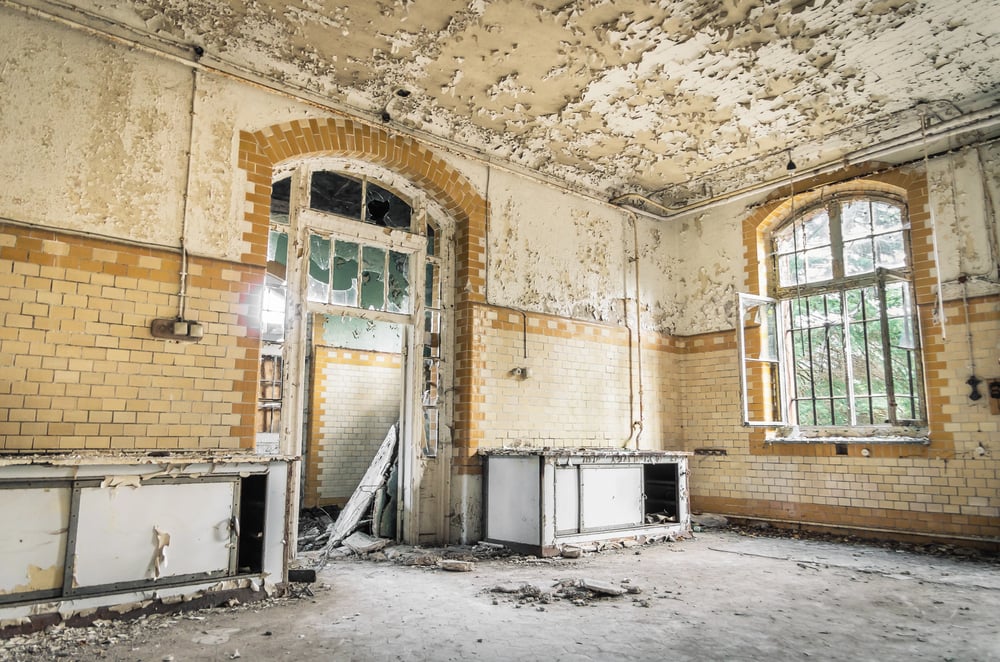
This sprawling sanatorium complex outside Berlin was built in the late 1800s to treat tuberculosis patients. It later became a military hospital during both World Wars.
Adolf Hitler was treated here after being wounded in 1916. Soviet forces used it after World War II.
When the Soviets withdrew in 1994, the complex was abandoned. Decades later, trees grow through the floors of the surgical wings.
Paint peels in long strips from ornate ceilings. The architecture itself is extraordinary — high arched windows, decorative facades, grand hallways — which makes the decay all the more striking.
A place built for healing, now completely still.
The Salto Hotel, Colombia
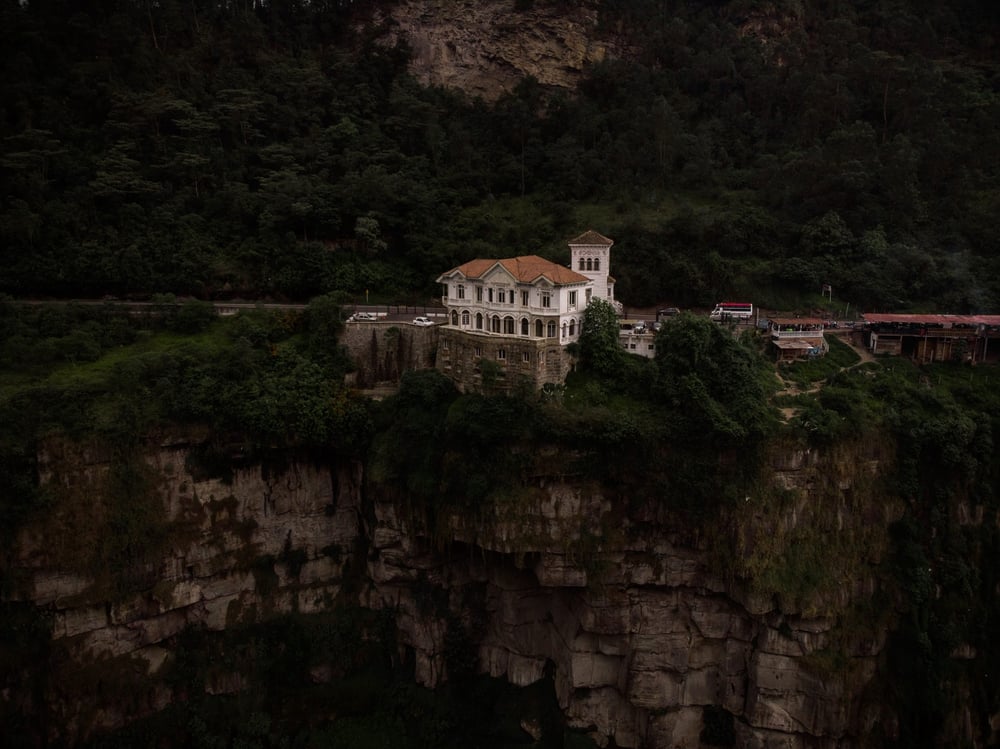
The Tequendama Falls Hotel sits at the edge of a waterfall near Bogotá that drops nearly 150 meters into a gorge. The hotel was built in the 1920s as a luxury destination for Colombia’s elite.
For decades it hosted presidents, artists, and wealthy travelers who wanted to wake up to the sound of falling water. It closed in the 1990s and has stood empty since.
The stone facade is dark with moisture from the falls. Vines creep up the walls.
Inside, chandeliers hang over empty ballrooms and staircases lead to rooms with no doors. It was recently converted into a museum, but photos from the years before restoration captured something extraordinary — a grand hotel dissolving back into the landscape that made it famous.
Michigan Central Station, Detroit
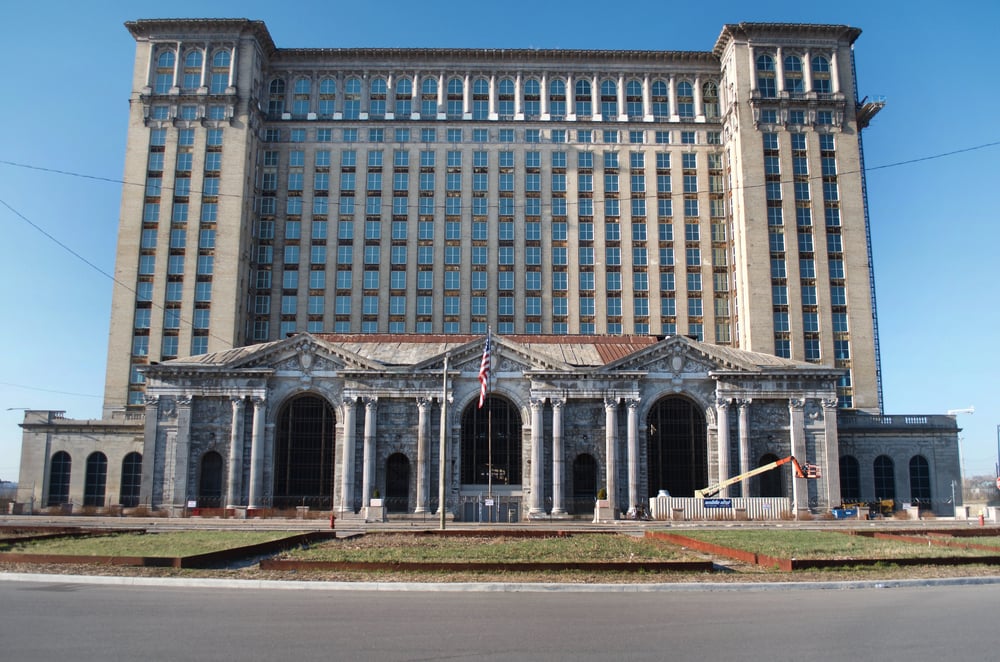
This station opened in 1913 and was once considered one of the finest train stations in the world. Eighteen stories of Beaux-Arts architecture, a grand waiting room with marble floors and soaring ceilings, and a tower that dominated the Detroit skyline.
The last train left in 1988. For the next three decades, the building stood exposed to the elements and to decades of theft and vandalism.
The marble was stripped, the copper was pulled out of the walls, and weeds pushed through the platform floors. Photos taken during those years show something remarkable — the bones of the building still imposing, the scale still overwhelming, even as glass and plaster fell away.
The station has since been purchased and restored, but the images from those abandoned decades remain some of the most compelling architectural photographs ever taken in America.
The Maunsell Sea Forts, England
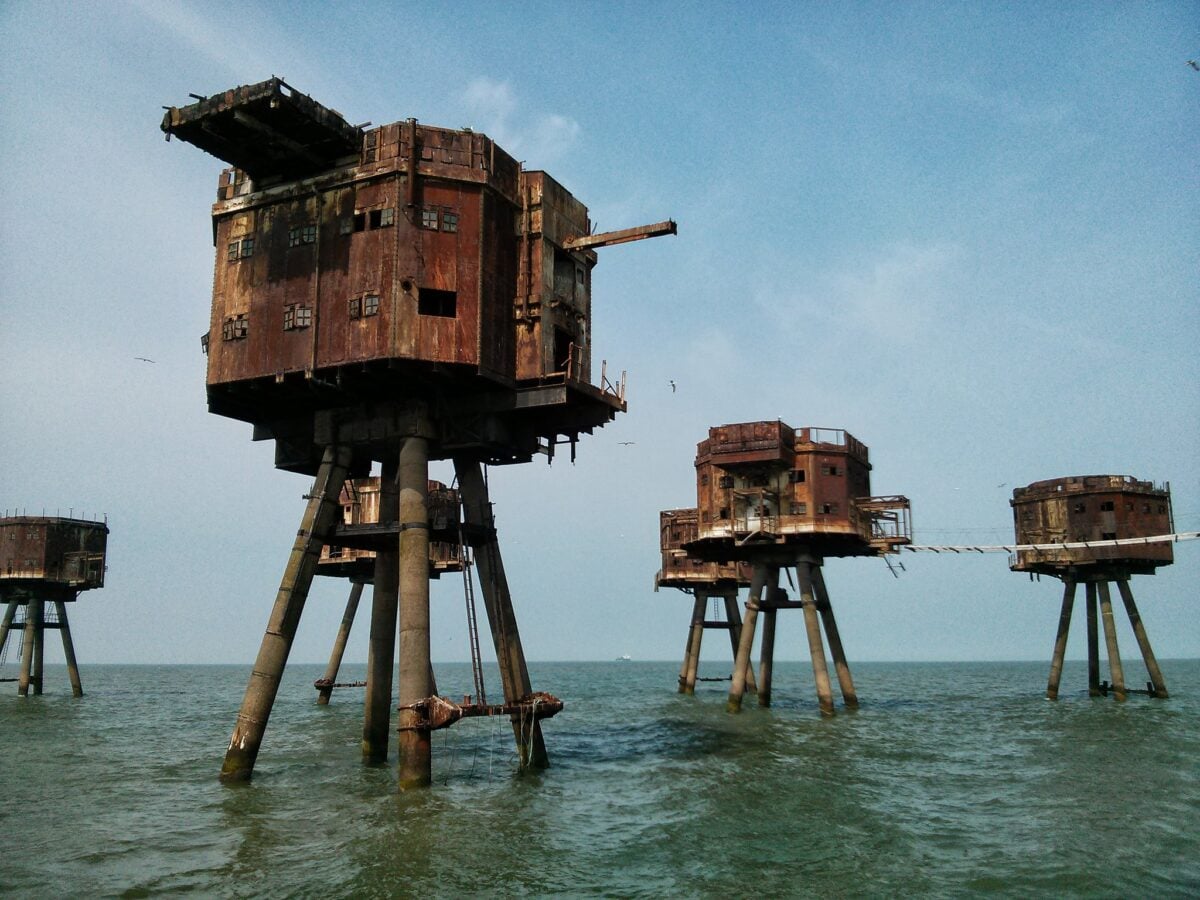
During World War II, Britain built a series of anti-aircraft platforms in the Thames Estuary. These weren’t ordinary installations — they were clusters of steel legs supporting platforms and gun towers, rising straight out of the sea like something from a science fiction novel.
After the war ended, the forts were decommissioned. Some were taken over by pirate radio stations in the 1960s. Eventually, most were abandoned entirely.
What remains are stark metal structures standing in open water, corroded and leaning, the sea churning around their legs. There’s nothing else around them. No land, no ships, no context.
They look like they shouldn’t exist.
The Floating Forest — SS Ayrfield, Australia

The SS Ayrfield was a steam collier that spent decades hauling coal in Australian waters. It was decommissioned in 1972 and sent to Homebush Bay in Sydney, a designated ship-breaking area.
But it was never broken up. Instead, it sat in the bay and slowly became something else.
Over the decades, mangrove trees took root in the hull and grew upward through the open decks. The rusted iron frame now carries a full canopy of green.
Photographs of the vessel show a forest growing out of a ship — two things that have no business being together, combined perfectly. It’s one of those images you have to look at twice to understand what you’re seeing.
Wonderland Amusement Park, China

Construction on this park began outside Beijing in the 1990s. The plan was to build the largest amusement park in Asia.
Halfway through, the project ran out of funding and was simply abandoned. What remained were half-built castles, the steel skeleton of a roller coaster, and a carousel shelter with no carousel.
For years, the surrounding farmland was plowed right up to the base of these unfinished structures, so photographs show peasant farmers working fields in the shadow of a half-finished fantasy castle.
The surrealism of that combination — medieval turrets rising above cornrows — made the images travel far beyond China. The site was eventually demolished, but the photos remain.
Varosha, Cyprus
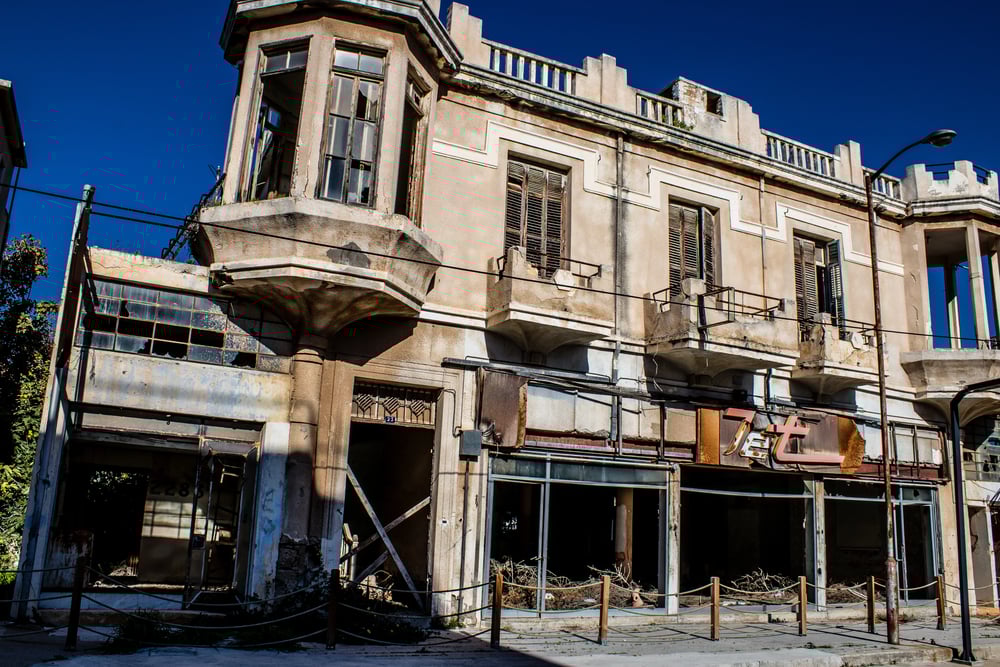
In 1974, the Turkish military advance on Cyprus caused the residents of Varosha, a beach resort district in Famagusta, to flee. The area was sealed off and has been almost entirely inaccessible ever since.
Hotels built in the 1960s and early 1970s still stand along what was once a popular tourist beach. The buildings are empty, the streets are empty, and the sand is empty.
Photographs taken over the walls show high-rise hotels with trees growing through their balconies. Palm trees in the courtyards have grown taller than the buildings they once decorated.
Time froze here in a specific, documented way. You can find old postcards of the same hotels, full of tourists, from the years before. The contrast is almost unbearable to look at.
The Buzludzha Monument, Bulgaria

Bulgaria built this monument to communism at the summit of a Balkan mountain in 1981. The structure is shaped like a flying saucer and took six years to construct, with thousands of workers hauling materials up the mountain by hand.
Inside, the walls were covered in enormous mosaic murals depicting scenes from communist history. When communism collapsed, the building was abandoned and stripped.
The copper was torn from the roof. Snow and wind pushed through the broken dome. The mosaics crumbled in patches.
What’s left is astonishing. The brutalist form still sits on the mountain peak above the clouds. Inside, fragments of the murals remain — figures and slogans barely holding on to the damaged walls.
Photographers have risked the unstable structure to document the interior, and the images are unlike anything else.
The Kolmanskop Diamond Town, Namibia
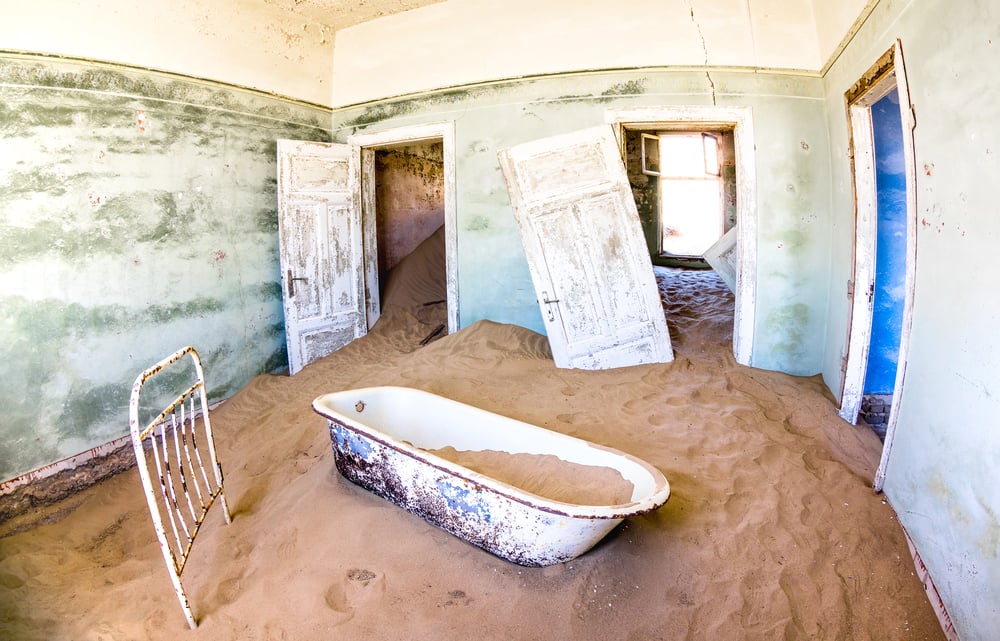
Out of nowhere in the early 1900s, diamond finds sprang up across the Namib Desert. A settlement named Kolmanskop popped into place fast, shaped by German miners.
Inside, there was a hospital plus a dancing hall, also classrooms and lanes for skittles. These homes wore the look of old German design from that era.
Empty mines spelled the end. By the 1950s, everyone had left. After that, sand crept over rooftops.
Now there is sand inside the homes. Up to the waist in certain spots it sits. Through window openings it slipped, then stiffened into slopes rising along the surfaces.
Open doorways meet solid mounds instead of hallways. Golden-toned brightness from the desert air wraps each image, softening rot – spaces seem shaped by art, not collapse.
The Dome Houses at Cape Romano, Florida
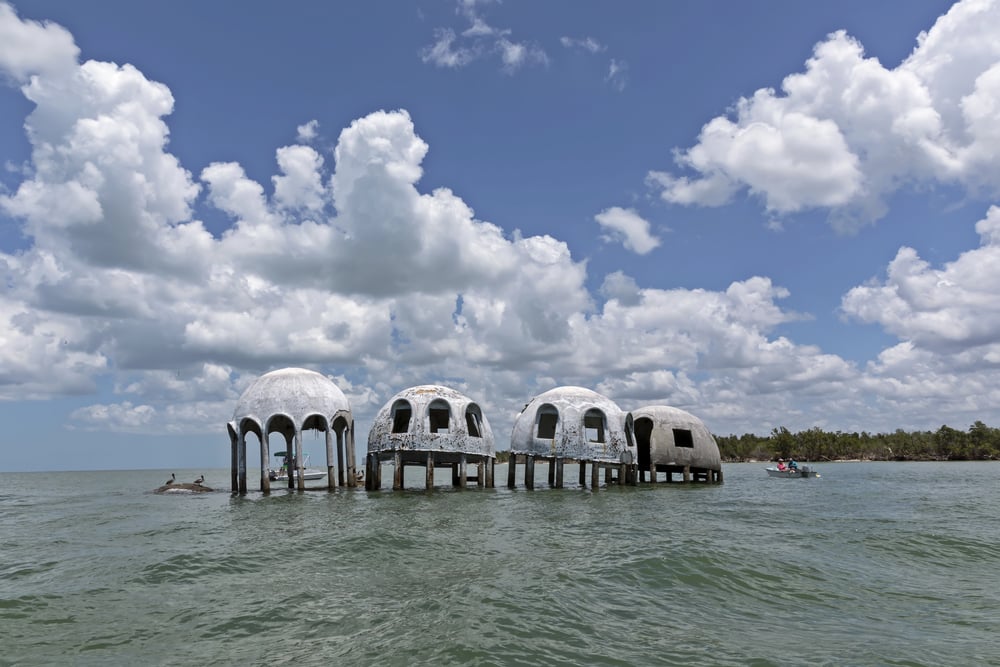
On a stretch of sand in Florida, four round domes made of concrete rose up back in 1982, meant to be someone’s house. Odd-looking since day one – low to the ground, bright white, shaped like perfect circles – they stood just where the waves meet land.
Years passed. Waves chewed at the land. Storms pounded harder each time.
The shore crept backward, slow but sure. Water swallowed ground once solid underfoot.
Domes that stood firm began tilting toward the sea. One by one they slipped closer to the edge. Now saltwater laps around their sides most days.
Only parts still peek above the surface. Open ocean wraps all sides, endless and gray. From kayaks or drones, photos capture the domes poking through ocean waves – resembling old wreckage despite being just four decades young.
On their curved tops, pelicans settle in. Near their edges, water shifts hue. A different world might have built these. Their presence feels out of time.
Kelham Island Steelworks, England
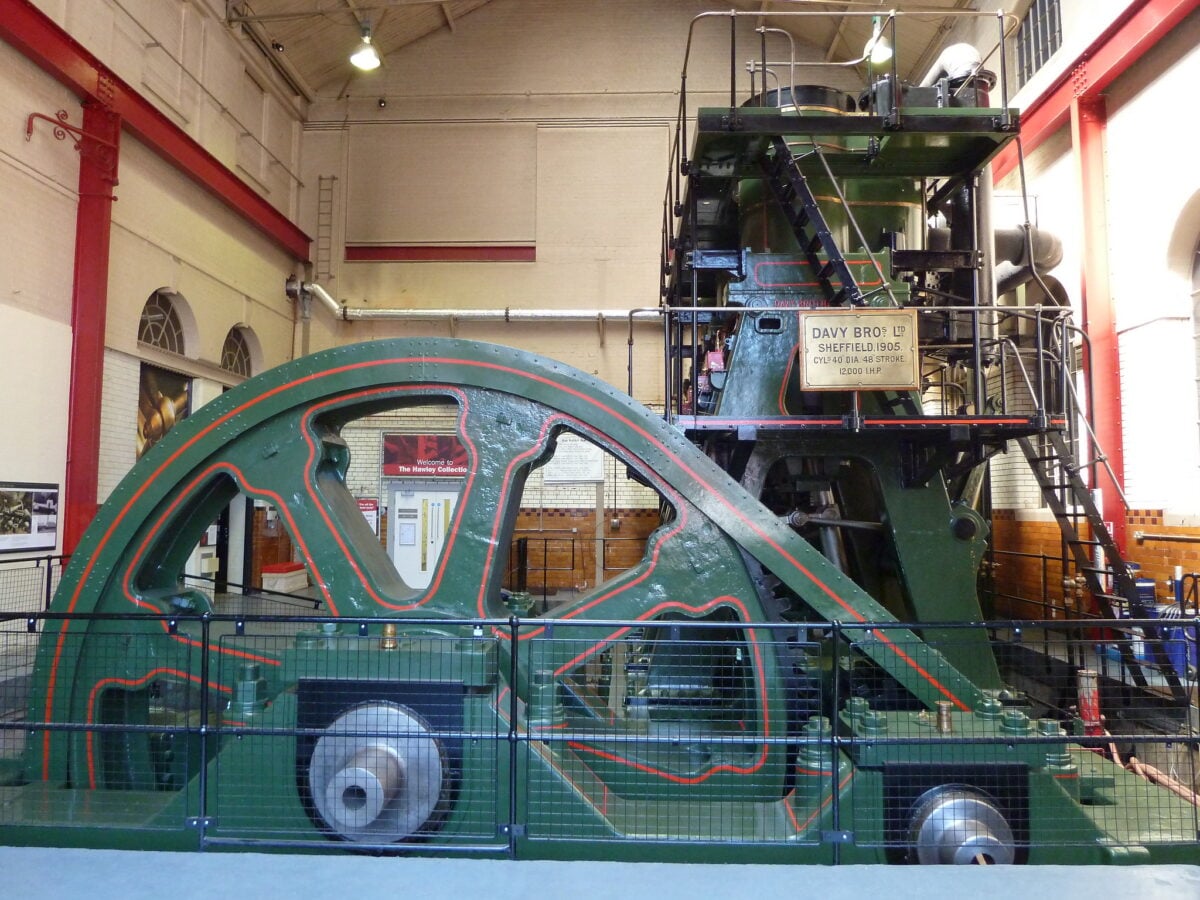
Steel tells Sheffield’s past, though the riverbanks grew quiet when demand faded. Not far from the Don, forgotten furnaces stand like relics of a louder time.
Once, Kelham Island throbbed with fire and motion, gears never pausing. Some corners now hold tools behind glass for visitors to see. Elsewhere, rust quietly spreads through spaces no one reclaims.
Pictures taken during that gap time – while ovens stayed cold yet whole, huge gears frozen just as someone walked away – held a sharp truth on empty factories. Not poetic wreckage, rather silence after sweat, daily routines, loud shifts now stilled.
Where Silence Becomes a Portrait

Odd how these spots twist time in your mind. A photo of a fallen-down dance hall, say, smears past and present together.
Once, music played there. People twirled under chandeliers that don’t hang anymore.
That buried home? Laughter echoed inside its walls. Kids scrambled up stairs no longer standing.
Morning after morning, travelers flooded that train platform – shoes tapping, voices rising, lives hurrying by. What sticks is not how things crumble, but what shows up when they do.
Not mere wreckage left behind. Spaces once packed with life, humming full. The photos still around prove those lives actually lived there.
More from Go2Tutors!

- The Romanov Crown Jewels and Their Tragic Fate
- 13 Historical Mysteries That Science Still Can’t Solve
- Famous Hoaxes That Fooled the World for Years
- 15 Child Stars with Tragic Adult Lives
- 16 Famous Jewelry Pieces in History
Like Go2Tutors’s content? Follow us on MSN.



