Places Where the Sun Plays by Different Rules
Most people are used to the sun rising in the morning and setting at night, following a pretty predictable schedule throughout the year. But in certain parts of the world, daylight doesn’t follow the typical pattern at all.
Some places experience months of continuous sunlight, while others are plunged into darkness for extended periods. These extreme daylight phenomena occur primarily in regions near the Earth’s poles, where the planet’s tilt creates unusual relationships with the sun.
These aren’t just quirky facts about remote locations. Real people live in these places, and they’ve adapted their entire lives around these wild daylight patterns.
Barrow (Utqiaġvik), Alaska

The northernmost city in the United States experiences one of the most dramatic daylight shifts on the planet. Starting in mid-May, the sun rises and simply refuses to set for about 82 days straight.
Residents hang blackout curtains in their bedrooms because the constant daylight can make sleep nearly impossible. When winter arrives, the opposite happens, and the sun doesn’t rise at all for about 65 days, leaving the town in continuous twilight and darkness.
Tromsø, Norway

This Norwegian city sits well above the Arctic Circle and deals with polar night from late November through mid-January. During this time, the sun never fully rises above the horizon, though there’s a period of twilight around midday that provides some light.
Come summer, Tromsø flips to the opposite extreme with the midnight sun lasting from mid-May to late July. The city has become a popular destination for people who want to experience these phenomena without venturing into completely isolated territory.
Svalbard, Norway

This Norwegian archipelago sits halfway between mainland Norway and the North Pole, making its daylight extremes even more intense than Tromsø. The midnight sun period here lasts for about four months, from mid-April to late August.
The polar night stretches from late October to mid-February, with no direct sunlight at all. Despite the harsh conditions, around 2,600 people call Svalbard home, many working in research stations or the coal mining industry.
Murmansk, Russia

The largest city in the world located above the Arctic Circle, Murmansk is home to roughly 300,000 people who experience polar night for about 40 days each winter. The period without sunlight runs from early December to mid-January.
During summer, the city enjoys continuous daylight from mid-May to late July. The ice-free port remains operational year-round, making Murmansk strategically important despite its extreme location.
Reykjavik, Iceland

Iceland’s capital doesn’t experience a complete polar day or polar night because it sits just below the Arctic Circle, but its daylight variation is still pretty extreme. During the summer solstice in June, Reykjavik gets about 21 hours of daylight, with the sun barely dipping below the horizon.
Winter solstice brings only about four to five hours of weak daylight. The Icelandic language even has special words for the different types of twilight that dominate their winter days.
Fairbanks, Alaska

This Alaskan city experiences nearly 22 hours of daylight at the peak of summer, with the sun setting around midnight and rising again just after 2 a.m. Winter brings the opposite, with less than four hours of weak sunlight during the darkest days of December.
The extreme daylight variation affects everything from gardening (vegetables grow absurdly large during the long summer days) to mental health. Many residents use special lamps during winter to combat seasonal depression.
Longyearbyen, Svalbard

The world’s northernmost town with a permanent civilian population, Longyearbyen experiences four months of total darkness and four months of constant daylight each year. The polar night lasts from late October until mid-February, while the midnight sun dominates from late April through late August.
Signs around town actually remind residents to carry rifles when venturing outside because polar bears pose a real threat in the perpetual darkness.
Kiruna, Sweden
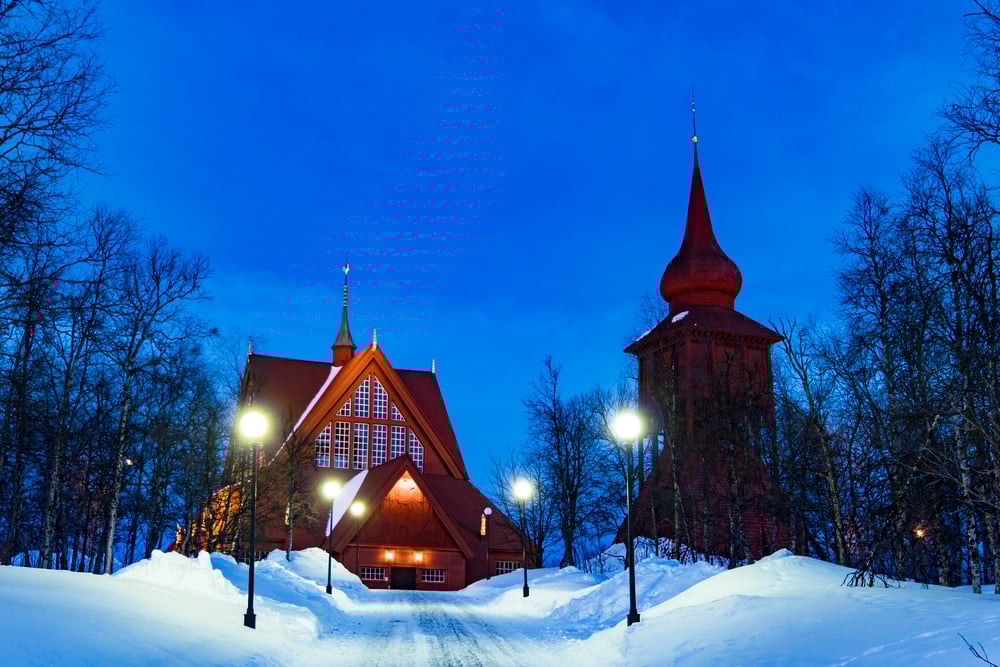
Sweden’s northernmost town experiences midnight sun from late May to mid-July, giving residents nearly two months of continuous daylight. The polar night period runs from mid-December to early January.
Kiruna sits on massive iron ore deposits, and mining operations continue around the clock during the summer months when the endless daylight allows for continuous work. The entire town is actually being relocated a few miles east because decades of mining have made the current ground unstable.
Hammerfest, Norway

This Norwegian town claims to be the northernmost town in the world, though that title is contested by other settlements. The midnight sun lasts here from mid-May to late July.
Polar night dominates from late November to mid-January. Hammerfest rebuilt itself after being completely destroyed during World War II, and the modern town has adapted well to the extreme daylight conditions with specially designed buildings and lighting systems.
Nuuk, Greenland

Greenland’s capital doesn’t experience true polar night, but winter days are incredibly short, with only about four hours of twilight in December. Summer brings nearly 21 hours of daylight in June.
The combination of extreme daylight variation and isolation creates unique challenges for the roughly 19,000 residents. Traditional Inuit practices have evolved alongside modern conveniences, creating a culture deeply adapted to the Arctic environment.
Alert, Nunavut

This Canadian military outpost is the northernmost permanently inhabited place on Earth, sitting just 508 miles from the North Pole. The sun doesn’t set from early April to late August, providing about five months of continuous daylight.
From late October to late February, Alert experiences polar night. Only a few dozen people live here, mostly military personnel and scientists, making it one of the most isolated communities on the planet.
Resolute, Nunavut

Another extremely northern Canadian community, Resolute experiences about four months of 24-hour daylight and about three months of polar night. The sun doesn’t rise above the horizon from early November to late January.
During the midnight sun period from late April to late August, the constant light allows for intensive research activities. The community was artificially established in the 1950s when the Canadian government relocated Inuit families there.
Norilsk, Russia

One of the most northern cities in the world, Norilsk is also one of the most polluted due to its massive nickel mining operations. The city experiences polar night for about 45 days each winter and midnight sun for about the same duration in summer.
Despite the extreme conditions and severe pollution, roughly 175,000 people live here. The city was closed to outsiders until 2001, and even now, special permits are required to visit.
Rovaniemi, Finland

Sitting right on the Arctic Circle, Rovaniemi experiences two months of midnight sun from early June to early July. The polar night here is less severe than in more northern locations, but December and January still bring only a few hours of twilight.
The city has capitalized on its location by marketing itself as the official hometown of Santa Claus, attracting tourists year-round. The extreme daylight patterns actually help with Christmas tourism because the winter darkness creates a perfect atmosphere.
Yellowknife, Canada

The capital of Canada’s Northwest Territories sits far enough north to experience significant daylight variation, though not as extreme as the highest Arctic locations. Summer brings about 20 hours of daylight, while winter days shrink to less than six hours.
The city is also one of the best places on Earth to see the northern lights, partly because of the long periods of darkness. Indigenous peoples have lived in this region for thousands of years, developing sophisticated ways to cope with the extreme seasons.
Qaanaaq, Greenland

One of the northernmost inhabited places in the world, Qaanaaq experiences midnight sun from April to August and polar night from October to February. The traditional Inuit community has about 650 residents who maintain hunting and fishing practices adapted over thousands of years to these conditions.
Modern amenities like electricity and the internet have arrived, but the extreme environment still dominates daily life. Dogsleds remain a primary mode of transportation during the dark winter months.
Dikson, Russia

On the edge of the Kara Sea lies a small Russian settlement known for its extreme northern position. For around ninety days each winter, sunlight never breaks the horizon – this stretch runs from November into February.
Summer flips the script, where daylight lingers nonstop between May and August. Once home to thousands during Soviet rule, only hundreds live there now. Even with so few people left, it still serves as a key spot for weather tracking and ship access. A quiet place today, yet vital for monitoring conditions above the Arctic Circle.
Inuvik, Canada

Midway through winter, daylight vanishes entirely near Inuvik – gone for nearly a month across late December and early January. Stretching under endless twilight each summer, the sun hangs without setting from just after June begins until well into July.
Built atop frozen soil that never thaws, houses and shops stand propped on tall supports drilled far down below the surface. Pipes needed to stay warm run overhead instead of buried, forming linked corridors that move water and waste from place to place. Life here moves differently – how people travel, keep supplies, gather together – all bent by cold, shaped slowly by years of relentless seasons.
Darkness and Light Shaping Existence

Out here where light behaves strangely, folks keep finding ways to make it work. Life goes on even when days stretch endlessly or vanish without trace.
What keeps things running is less about new gadgets and more about old lessons whispered from one generation to the next. When sunlight swings wild – flooding streets for weeks then disappearing – it shifts how homes are built, what grows in soil, how moods hold up.
Not magic, just adaptation playing out in real time. Those rhythms of dawn and dark? They write the rules everyone follows, whether they notice or not.
More from Go2Tutors!

- The Romanov Crown Jewels and Their Tragic Fate
- 13 Historical Mysteries That Science Still Can’t Solve
- Famous Hoaxes That Fooled the World for Years
- 15 Child Stars with Tragic Adult Lives
- 16 Famous Jewelry Pieces in History
Like Go2Tutors’s content? Follow us on MSN.



