The Hidden Meanings Behind Common English Idioms
Language carries stories in its pockets. Every phrase that survives long enough to become common once served a purpose that modern speakers rarely consider.
English idioms are particularly stubborn about revealing their origins — they present themselves as logical expressions while hiding centuries of forgotten context underneath. The disconnect between what these phrases literally describe and what they actually mean creates a fascinating archaeological record of human experience.
Some originated from medieval trades that vanished centuries ago, others from superstitions that once governed daily life, and still others from historical events that seemed momentous at the time but now exist only in the fossilized language they left behind.
Break a leg

Theater people refuse to say “good luck” before a performance. They’ll wish you broken bones instead.
This backwards blessing emerged from a profession built on superstition. Actors believed that wishing someone well would invite disaster, so they developed the habit of saying the opposite of what they meant.
The theater gods, apparently, could be fooled by reverse psychology.
Spill the beans

Ancient Greeks voted using beans (white meant yes, black meant no), and when someone accidentally knocked over the jar, they revealed the secret results before the official count. Democracy undone by clumsiness.
The phrase survived long after the voting method disappeared, but that moment of accidental revelation — the sudden exposure of what was meant to stay hidden — captured something universal about human nature. So even though modern secrets rarely involve legumes, the image of scattered beans still perfectly describes the moment when careful discretion falls apart.
Bite the bullet

Before anesthesia existed, battlefield surgeons handed wounded soldiers a lead bullet to clamp between their teeth during operations (and amputations, which happened frequently enough to warrant their own specific preparations). The lead was soft enough that desperate teeth could leave marks without breaking, and the intense focus required to bite down gave patients something concrete to do with their panic.
And yet the phrase evolved to mean something broader than surviving physical pain — it came to represent that particular moment when you stop negotiating with an unpleasant reality and simply endure it. The bullet became a metaphor for any situation that requires you to abandon hope of comfort and commit entirely to getting through something terrible.
Rule of thumb
This has nothing to do with domestic violence, despite persistent folklore. The phrase comes from craftsmen who used their thumb width as a rough measuring tool.
Carpenters, brewers, and other skilled workers developed their own body-based measurements for quick estimates. A thumb width was roughly an inch, which made it handy for approximations when precision tools weren’t available.
The phrase simply meant “a general guideline based on practical experience.”
Don’t throw the baby out with the bathwater

Medieval families bathed in the same tub of water, starting with the head of household and working down through social hierarchy. By the time they reached the youngest children, the water was so dark and murky that a small baby could theoretically disappear beneath the surface.
This German proverb (which Martin Luther may have originated) warns against discarding something valuable while getting rid of something worthless. The image works because it captures that moment of careless haste when good judgment gets overwhelmed by the desire to clean the house completely.
Mad as a hatter

Hat makers went insane from mercury poisoning. The mercury used in felt processing attacked their nervous systems, causing tremors, slurred speech, and erratic behavior.
The phrase existed long before Lewis Carroll wrote Alice in Wonderland. By the time the Mad Hatter appeared in literature, real hatters had been developing mercury-induced neurological disorders for decades.
Carroll wasn’t inventing a whimsical character — he was referencing an occupational hazard that everyone recognized.
Caught red-handed

Getting caught with blood on your hands meant you killed something (or someone) recently enough that the evidence hadn’t been washed away yet. Scottish law specifically used this phrase for poachers caught with freshly killed game.
The blood proved the crime had just occurred, making denial impossible. The phrase survived because that image — evidence so fresh it’s still wet — perfectly captures the concept of undeniable guilt.
Dead as a doornail

Doornails were the metal studs hammered flat against the wood on medieval doors, and once they were hammered flat (or “dead”), they couldn’t be removed or reused. Unlike regular nails that could be pulled out and straightened for future use, doornails were permanently finished — completely and irreversibly done.
The comparison works because it describes a specific type of finality that goes beyond simple death. Something that’s “dead as a doornail” isn’t just finished — it’s been deliberately rendered impossible to revive, flattened beyond any hope of restoration.
Turn a blind eye

Admiral Horatio Nelson literally did this at the Battle of Copenhagen in 1801. When his superior signaled him to withdraw, Nelson held his telescope to his blind eye and claimed he couldn’t see the order.
The tactic worked. Nelson continued fighting and won a crucial victory that might have been lost if he’d followed instructions. The phrase came to mean willful ignorance — pretending not to see something you have every reason to notice.
Barking up the wrong tree
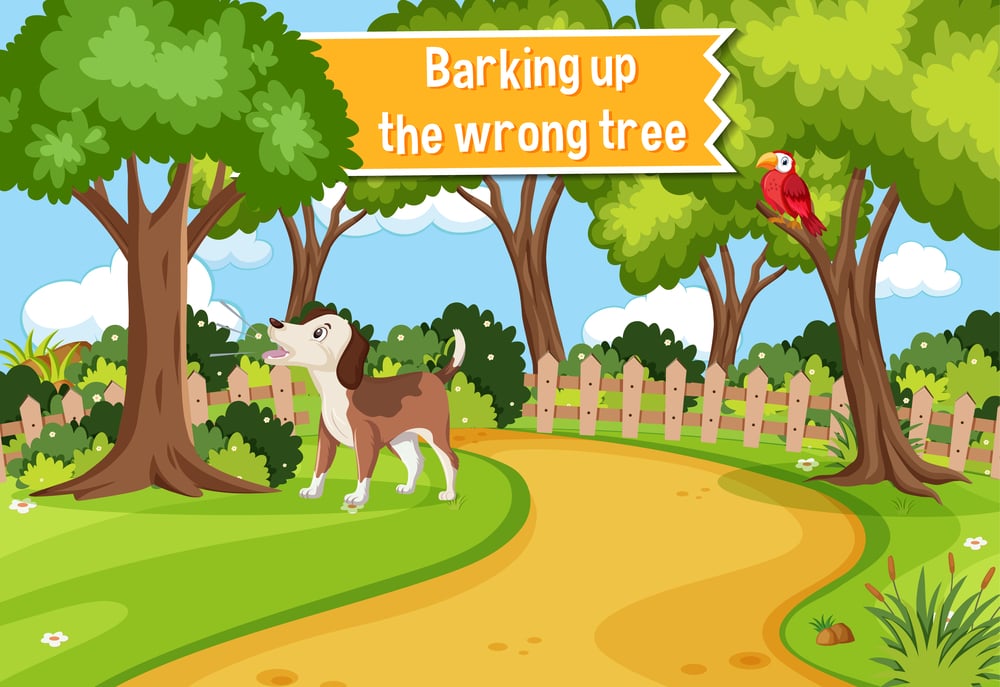
Hunting dogs occasionally lost track of their prey and continued barking at the base of a tree where the animal was no longer hiding. The image captures a specific type of futile persistence — continuing to pursue something with great energy and confidence while being completely wrong about where to direct that effort.
The dog’s certainty makes the mistake more embarrassing, which is exactly how the phrase functions in modern usage.
Don’t count your chickens before they hatch

Aesop told this story about a milkmaid who planned elaborate purchases based on projected egg sales, then tripped and broke all her eggs before reaching market (though some versions involve chickens directly). The moral warned against making plans based on profits that hadn’t materialized yet.
But the deeper wisdom here concerns the psychology of anticipated success — how detailed planning for uncertain outcomes can create a dangerous sense of ownership over things that don’t exist yet. The chickens represent any future benefit that feels guaranteed but remains vulnerable to circumstances beyond anyone’s control.
Let the cat out of the bag

Medieval farmers sold piglets at market, and dishonest vendors sometimes substituted cats instead, keeping the animal hidden in a bag until after payment. If the cat escaped prematurely, the scam was revealed.
The phrase survived because the image perfectly captures accidental exposure of deception. The cat represents any truth that someone wanted to keep hidden, and the bag represents whatever flimsy container was supposed to keep that truth from being discovered.
Cost an arm and a leg
Portrait painters charged based on how much of the subject they included in the painting. A portrait showing just the head and shoulders cost less than one showing the full body with arms and legs visible.
Wealthy clients who wanted impressive full-length portraits paid premium prices for the additional limbs. The phrase simply described expensive artistic choices, but it evolved to mean any purchase that requires a painful financial sacrifice.
Break the ice

Ships navigating frozen waters needed icebreaker vessels to clear a path before regular commerce could proceed. The icebreaking was necessary preliminary work that enabled everything else to happen.
Social interactions follow similar patterns — someone has to do the awkward preliminary work of establishing contact before normal conversation becomes possible. The phrase recognizes that initial social contact often requires deliberate effort to overcome natural barriers.
Pulling someone’s leg

Street thieves worked in pairs, with one person tripping pedestrians while an accomplice robbed them during the confusion. “Pulling your leg” meant you were being set up for something unpleasant.
The phrase softened over time to describe harmless deception rather than criminal activity, but the underlying dynamic remains the same — someone is deliberately misleading you, even if the consequences are now benign rather than dangerous.
Where language lives and breathes

These phrases persist because they captured something true about human experience that transcends their original context. A medieval doornail and a modern failed project share the same quality of irreversible finality.
Scattered voting beans and leaked corporate secrets create identical moments of unwanted revelation. The hidden histories make the idioms more interesting, but they don’t make them more useful.
What makes them useful is their ability to compress complex situations into images that everyone immediately understands, regardless of whether anyone remembers why a broken leg should bring good fortune or what mercury did to hat makers’ brains centuries ago.
More from Go2Tutors!

- The Romanov Crown Jewels and Their Tragic Fate
- 13 Historical Mysteries That Science Still Can’t Solve
- Famous Hoaxes That Fooled the World for Years
- 15 Child Stars with Tragic Adult Lives
- 16 Famous Jewelry Pieces in History
Like Go2Tutors’s content? Follow us on MSN.



