Vintage Advertising That Wouldn’t Fly Today
More than just a source of nostalgia, vintage advertising serves as a window into the attitudes, actions, and self-presentation of a more advanced society.
If you look at a magazine from the 1940s or 1950s, you’ll see happy faces, homes that seem unachievably perfect, and claims about products that seem almost ridiculous today.
For contemporary audiences, what used to seem endearing or convincing frequently feels completely out of place.
Advertisers were just functioning in a different world with different standards, blind spots, and presumptions; it’s not that they were attempting to offend.
These days, those glossy pages show not only inventiveness but also complacency—a readiness to disregard morality, inclusivity, and the truth in order to close a deal.
They demonstrate how much the persuasion industry has changed and how, at its best, advertising adapts to society rather than taking advantage of its flaws.
Several themes in vintage advertising that would never pass modern standards are examined in more detail here, along with what those errors reveal about the society that created them.
Gender Stereotypes and Household Roles

If there’s one image that defines mid-century advertising, it’s the housewife in pearls, beaming over a sparkling sink.
Entire industries built their marketing around the idea that a woman’s worth came from spotless laundry and satisfied husbands.
Ads for soap, kitchen appliances, and packaged food often portrayed women as naive, emotional, or dependent—grateful for a product that made her chores slightly easier.
The narrative wasn’t accidental.
Postwar America was invested in domestic stability, and advertising reinforced that ideal.
Women who had worked in factories during World War II were encouraged to return home, and marketing played a big role in that cultural push.
The message was simple: fulfillment came through service, not self-expression.
To a modern audience, those depictions feel condescending and outdated.
The smiling housewife became a symbol of suppression rather than aspiration.
Today’s brands know that consumers, especially women, demand representation beyond narrow archetypes.
They expect portrayals of leadership, independence, and partnership—not subservience disguised as satisfaction.
The evolution of advertising from idealizing domesticity to embracing empowerment marks one of the most visible social shifts of the last century.
Campaigns like Dove’s ‘Real Beauty’ or Always’ ‘Like a Girl’ directly challenged the stereotypes that their predecessors helped create.
It’s proof that advertising can shape culture just as easily as it can reflect it—and that progress often begins with changing the images we normalize.
Unchecked Claims About Product Safety or Effects

DepositPhotos
Mid-century ads were also defined by their audacity.
A bottle of tonic promised to ‘restore vitality overnight.’
A cream guaranteed to erase wrinkles or cure ‘nervous exhaustion.’
Even dangerous substances were sold with confidence and authority, often featuring actors dressed as doctors or testimonials claiming miraculous results.
Back then, consumer protection was minimal.
The Federal Trade Commission and Food and Drug Administration existed, but enforcement was limited and public awareness was low.
The culture prized convenience, novelty, and faith in science—so when a company claimed that its new chemical formula could fix your mood or clean your lungs, people believed it.
The result was a wave of advertising that treated speculation as fact.
Medical-sounding jargon was used to add credibility, even when the claims were dubious.
Some toothpaste ads implied they prevented disease; others suggested beauty products could change your social status.
It was marketing without restraint, powered by the assumption that the average consumer wouldn’t—or couldn’t—question authority.
Today, the opposite is true.
Modern audiences are skeptical, fact-checking is instantaneous, and regulators are strict.
Companies face heavy fines for false claims, and transparency is now a competitive advantage.
Labels are scrutinized, influencer endorsements must disclose sponsorships, and ‘clinically proven’ requires more than a catchy slogan.
The shift isn’t just legal—it’s philosophical.
Advertising has slowly learned that long-term trust matters more than short-term persuasion.
Honesty, backed by evidence, is now part of a brand’s value proposition.
Looking back at those old ads isn’t just amusing—it’s a reminder of why modern marketing ethics exist in the first place.
Racial and Cultural Insensitivity

Some of the most uncomfortable vintage ads are those that reveal society’s normalized racism and cultural insensitivity.
In the early to mid-1900s, advertisers routinely used caricatures, stereotypes, and demeaning imagery to sell everything from food to cleaning products.
Black, Asian, and Indigenous figures were often portrayed as comedic side characters, servants, or exotic novelties—rarely as individuals with dignity.
These ads reflected the power imbalance of the time.
They were created by agencies dominated by white men marketing to white consumers.
There was little thought given to how those depictions affected the people being caricatured, because those voices weren’t in the room.
By today’s standards, these portrayals are indefensible.
They trivialized identity, reinforced inequality, and normalized prejudice.
Yet they were widespread and uncontroversial for decades.
It wasn’t until civil rights movements gained traction in the 1960s and 1970s that advertisers began to reconsider representation.
The impact of that shift has been lasting.
Modern marketing teams now hire cultural consultants, conduct sensitivity reviews, and rely on diverse creative talent to avoid repeating history.
Brands understand that inclusivity is not performative—it’s essential to credibility.
When an ad misrepresents or stereotypes a community today, backlash is swift and public.
That cultural accountability is progress.
It doesn’t erase the harm done by older campaigns, but it ensures that the next generation of advertising carries a different kind of responsibility: to portray the world as it truly is, not as one group imagines it.
Glamorising Harmful Products

Few advertising trends illustrate ethical blind spots more clearly than the glamorization of harmful habits.
Nicotine companies, in particular, perfected the art of turning addiction into aspiration.
The rugged cowboy of Marlboro, the sophisticated couple lighting up after dinner, the smiling athlete with a stick in hand—all were part of a campaign to make it seem synonymous with confidence and success.
The same pattern extended to other risky products.
Alcohol was marketed as the solution to loneliness, diet pills as miracle cures, and even certain medications as lifestyle enhancers rather than medical tools.
The absence of warning labels or accountability allowed companies to profit from illusion.
Today, such marketing would face immediate regulatory rejection.
Public health education has rewritten the narrative.
Instead of associating products like nicotine with freedom or adventure, advertising now highlights health risks and discourages glamorization entirely.
The difference is monumental—a cultural acknowledgment that some things shouldn’t be sold with a smile.
This change also mirrors the rise of corporate social responsibility.
Modern brands are expected to act with conscience, not just creativity.
The notion that a company should protect its customers as well as its profits has become a cornerstone of good business.
Looking back, the old ads feel almost surreal—proof that unchecked capitalism once allowed persuasion to override morality.
Simplistic Visuals and Tone-Deaf Copy
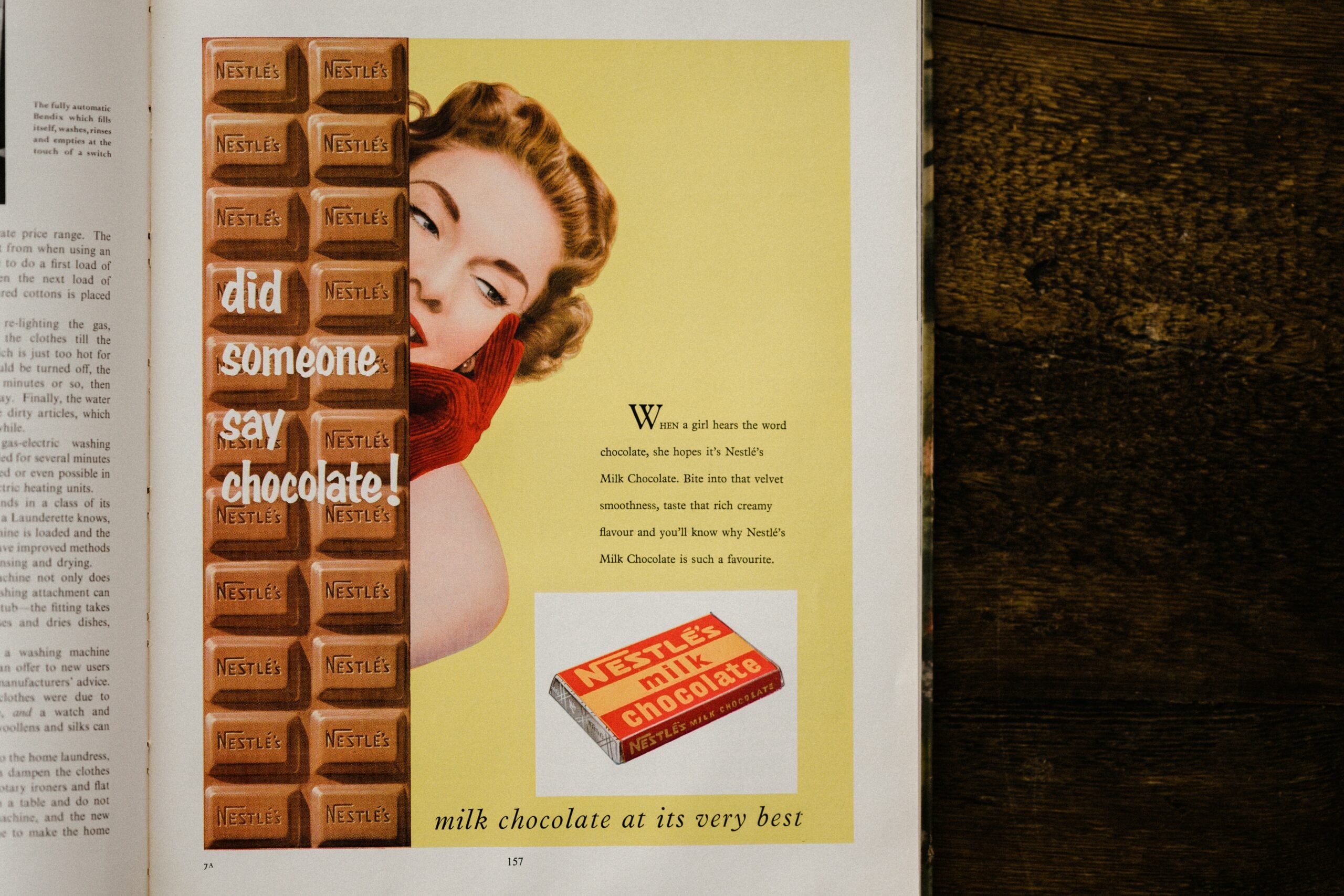
Beyond ethics, vintage advertising also reflects a very different aesthetic language.
Many mid-century campaigns relied on exaggerated imagery, emotional manipulation, and over-the-top slogans.
Smiling families, exaggerated reactions, and impossibly neat homes were the norm.
The tone was relentlessly upbeat—even when the product was trivial.
That style worked in an age of limited media choice, when consumers were more passive and less skeptical.
But today, it feels artificial.
Modern audiences are media-savvy and cynical; they crave authenticity and relatability.
Overly polished, one-note visuals now signal insincerity.
There’s also the issue of representation.
Older ads centered on a narrow demographic: white, middle-class, heterosexual families.
That exclusion now feels glaring.
Today’s audiences want to see diversity not as tokenism but as reality—people of all backgrounds, ages, and body types living ordinary lives.
The modern advertising landscape values storytelling over slogans.
Emotional nuance, vulnerability, and real-world imperfections now build stronger connections than the glossy perfection of the past.
The evolution reflects a broader cultural truth: people no longer buy the fantasy—they buy the feeling of being understood.
Why It Still Matters

The goal of thinking back on vintage advertising is to comprehend how advancement occurs, not to disparage the past.
Every out-of-date campaign serves as a reminder of what society used to accept and what it eventually came to reject.
After all, advertising doesn’t just happen.
It both influences and reflects the culture in which it lives.
The advertisements that are no longer relevant demonstrate how far we have come in appreciating honesty, decency, and compassion.
They serve as a reminder of the power of communication and the responsibility that comes with persuasion.
False medical claims, glamorized vices, and smiling housewives are all signs of a world that hasn’t yet questioned itself.
The striking thing is that those lessons are still relevant today.
Contemporary brands still balance risk and accountability, aspiration and authenticity.
Campaigns today are still driven by the same instincts that propelled those old advertisements: ambition, emotion, and simplicity.
Awareness makes a difference.
Yesterday’s advertisements tell us a story about who we were.
When done correctly, today’s greatest advertisements present us with a picture of who we can become: intelligent, considerate, and united by something more profound than catchphrases.
Looking back is important because every out-of-date message teaches us how to create a better one.
More from Go2Tutors!

- The Romanov Crown Jewels and Their Tragic Fate
- 13 Historical Mysteries That Science Still Can’t Solve
- Famous Hoaxes That Fooled the World for Years
- 15 Child Stars with Tragic Adult Lives
- 16 Famous Jewelry Pieces in History
Like Go2Tutors’s content? Follow us on MSN.