15 Historical Moments Caught by Mistake
History’s most memorable moments weren’t always planned photo opportunities. While photographers were setting up shots of dignitaries or documenting routine events, extraordinary things happened right in front of their lenses.
Sometimes the camera was pointing in the wrong direction, sometimes the timing was pure coincidence, and sometimes what seemed like a mundane assignment turned into front-page news. These accidental captures have given us some of the most powerful and iconic images in human history.
Here are 15 historical moments that photographers stumbled upon completely by chance.
The Hindenburg Disaster

Sam Shere was just doing his job, covering what should have been a routine landing at Lakehurst Naval Air Station in New Jersey on May 6, 1937. The German passenger airship Hindenburg had made this trip dozens of times before without incident.
Shere positioned himself with other reporters, expecting to photograph passengers disembarking and maybe grab a quote or two. Instead, he witnessed and captured one of the most shocking disasters of the 20th century when the massive airship erupted in flames, killing 36 people in just 34 seconds.
The Falling Man

Associated Press photographer Richard Drew was covering the immediate aftermath of the September 11 attacks, focusing on the chaos and emergency response around the World Trade Center. While photographing the scene, he captured an image that would become one of the most controversial and haunting photographs in modern history.
The image shows a person falling from the North Tower, and Drew didn’t even realize what he had captured until he developed the film later that day.
The Tank Man at Tiananmen Square

Jeff Widener of the Associated Press was recovering from a head injury in his hotel room at the Beijing Hotel on June 5, 1989, when he heard about renewed activity in Tiananmen Square. He grabbed his camera and headed to his balcony, expecting to document the movement of military vehicles.
Instead, he captured the iconic image of an unknown man standing defiantly in front of a column of tanks, creating one of the most powerful symbols of peaceful resistance ever photographed.
The Assassination of President Kennedy

Abraham Zapruder brought his 8mm Bell & Howell camera to Dealey Plaza in Dallas on November 22, 1963, simply hoping to get some nice footage of President Kennedy’s motorcade for his personal collection. The dress manufacturer had actually forgotten his camera at home that morning and only went back to get it at the urging of his assistant.
His 26.6 seconds of film would become the most analyzed piece of footage in American history, providing crucial evidence about one of the nation’s most tragic moments.
The Raising of the Flag at Iwo Jima

Joe Rosenthal of the Associated Press almost missed this shot entirely. On February 23, 1945, he was climbing Mount Suribachi when he learned that a flag had already been raised at the summit earlier that morning.
Disappointed that he’d missed the moment, he continued climbing anyway, hoping to get some general shots of the area. When he reached the top, a second, larger flag was being raised to replace the first one, and Rosenthal captured it without even looking through his viewfinder, creating what would become one of the most reproduced photographs in history.
The Execution of a Viet Cong Prisoner

Eddie Adams was following South Vietnamese General Nguyen Ngoc Loan through the streets of Saigon during the Tet Offensive in 1968, expecting to document routine military operations. Adams had his camera ready as they approached a captured Viet Cong officer, but he never anticipated what would happen next.
Loan suddenly pulled out his pistol and shot the prisoner in the head at point-blank range, and Adams captured the exact moment of execution, creating an image that would help turn American public opinion against the Vietnam War.
The Beatles Crossing Abbey Road

Iain Macmillan was hired to take a simple promotional photograph for The Beatles’ new album on August 8, 1969. The band wanted something quick and easy, so they decided to just walk across the street outside Abbey Road Studios where they had been recording.
Macmillan climbed a stepladder in the middle of the road and took six shots as the four musicians walked back and forth across the zebra crossing. The fifth shot became the album cover, but none of them realized they were creating one of the most parodied and iconic album covers of all time.
The Mushroom Cloud Over Nagasaki

U.S. Army photographer Charles Levy was aboard a B-29 bomber on a routine reconnaissance mission over Japan on August 9, 1945. The crew had no idea that another B-29, the Bockscar, was preparing to drop the second atomic bomb on Nagasaki.
Levy was photographing cloud formations and landscape features when the massive mushroom cloud suddenly appeared on the horizon, and he managed to capture one of the most historically significant images of the nuclear age from an unexpected vantage point.
The Watts Riots Begin
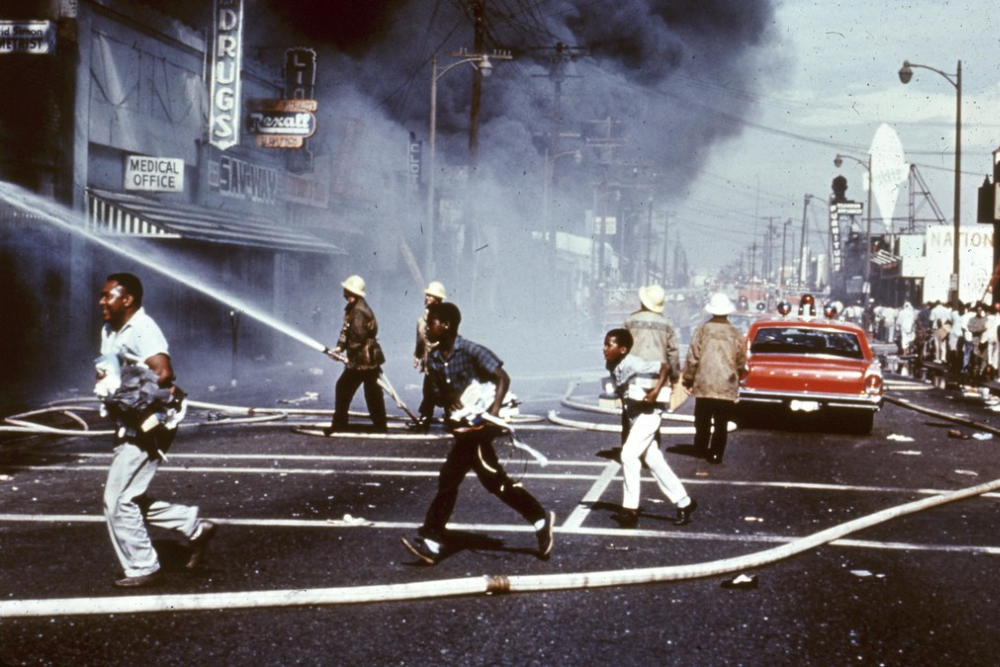
Los Angeles Times photographer Don Cormier was covering what seemed like a routine traffic stop in the Watts neighborhood on August 11, 1965. Officer Lee Minikus had pulled over Marquette Frye for suspected drunk driving, and Cormier was documenting the arrest as part of a story about police work in the community.
When Frye’s mother arrived and the situation escalated, Cormier found himself photographing the spark that would ignite six days of riots, resulting in 34 deaths and over $40 million in property damage.
The Lunch Atop a Skyscraper

This famous photograph of construction workers eating lunch while sitting on a steel beam 840 feet above New York City was actually a publicity stunt, but photographer Charles Ebbets didn’t know that when he took it on September 20, 1932. Ebbets was hired to document the construction progress of the RCA Building (now 30 Rockefeller Plaza), and he thought he was just capturing workers on their lunch break.
The image wasn’t published until the following month, and it became an enduring symbol of American determination during the Great Depression.
The Napalm Girl

Associated Press photographer Nick Ut was covering a routine South Vietnamese air strike on the village of Trang Bang on June 8, 1972. The military had assured journalists that the area had been cleared of civilians, so Ut expected to photograph the aftermath of bombing operations.
Instead, he captured 9-year-old Phan Thi Kim Phuc running unclothed down a road, her back severely burned by napalm, in an image that would help accelerate the end of American involvement in Vietnam.
The Challenger Explosion

NASA photographer Bruce Weaver was positioned at Kennedy Space Center on January 28, 1986, to document what should have been a routine shuttle launch. The Challenger mission had been delayed multiple times due to weather and technical issues, but launches had become so commonplace that most media attention focused on the fact that teacher Christa McAuliffe was aboard.
Weaver was tracking the shuttle through his telephoto lens when it exploded 73 seconds after liftoff, giving him the tragic task of documenting one of NASA’s darkest moments.
The Pulitzer Prize Vulture Photo

Kevin Carter was on assignment in Sudan in 1993, documenting the famine crisis for the New York Times. While photographing feeding centers and refugee camps, he came across a severely malnourished child who had collapsed on the way to a feeding station.
As Carter prepared to photograph the scene, a vulture landed nearby, creating a haunting composition that would win him the Pulitzer Prize but also generate intense controversy about the ethics of photojournalism and the photographer’s responsibility to intervene.
The Birmingham Campaign Fire Hoses

Bill Hudson of the Associated Press was covering civil rights demonstrations in Birmingham, Alabama, in May 1963, expecting to document peaceful protests and possibly some arrests. Instead, he found himself photographing Birmingham Public Safety Commissioner Bull Connor’s violent response to the protesters, including the use of fire hoses and police dogs against demonstrators, many of whom were teenagers.
Hudson’s photographs of high-pressure water hoses knocking down young protesters helped galvanize national support for the civil rights movement.
The Moon Landing Television Broadcast

NASA’s television cameras were positioned to capture Neil Armstrong’s first steps on the lunar surface on July 20, 1969, but the image quality was initially poor due to technical limitations and the camera’s inverted position. What viewers around the world saw was a grainy, ghostly figure moving across their television screens, quite different from the crisp footage NASA had hoped to broadcast.
This accidental aesthetic gave the moon landing its otherworldly, historic quality that made it feel like humanity was witnessing something truly extraordinary happening 240,000 miles away.
When Accidents Become History

These unplanned moments remind us that history often unfolds when we least expect it. The photographers who captured these images were simply doing their jobs, pointing their cameras at what seemed like ordinary events, only to witness extraordinary moments that would be remembered for generations.
Their accidental timing and positioning gave us windows into pivotal moments that might otherwise have been lost to memory, proving that sometimes the most important stories happen when nobody’s looking for them.
More from Go2Tutors!

- 16 Historical Figures Who Were Nothing Like You Think
- 12 Things Sold in the 80s That Are Now Illegal
- 15 VHS Tapes That Could Be Worth Thousands
- 17 Historical “What Ifs” That Would Have Changed Everything
- 18 TV Shows That Vanished Without a Finale
Like Go2Tutors’s content? Follow us on MSN.