15 Roadside Icons Lost to History
There was a time when driving across America meant something more than just getting from point A to point B. The highways were lined with things that made you slow down, pull over, or at least crane your neck hard enough to earn a stiff back.
Giant statues, glowing signs, themed motels shaped like wigwams — they were part of the landscape in a way that felt permanent, even when they weren’t. Most of them are gone now.
A few survive in scattered, surprising places. But the roadside America that millions of people grew up with — the one that made car trips feel like an event — has mostly faded into memory, old postcards, and grainy family photos taken through station wagon windows.
Here are 15 of the icons that didn’t make it.
Burma-Shave Signs

Before billboards took over, Burma-Shave ran a campaign unlike anything else on American roads. Starting in 1926, the shaving cream company planted sequences of small red signs along rural highways, each one carrying a line of a rhyming jingle, with the product name appearing at the end.
Drivers read them one by one as they passed. At the campaign’s peak, there were around 7,000 sign sequences across 45 states.
The jingles were witty, sometimes absurd, and occasionally safety-focused — “Don’t pass cars on curve or hill / If the cops don’t get you / The morticians will / Burma-Shave.” They felt personal in a way that modern advertising doesn’t.
Philip Morris acquired the company in 1963 and discontinued the signs almost immediately. A few replicas exist at museums, but the originals are long gone.
Howard Johnson’s Motor Lodges

The orange roof was unmistakable. Howard Johnson’s restaurants and motor lodges lined American highways from the 1930s through the 1970s, and at the chain’s height, there were more than 1,000 locations.
The consistency was the point — you always knew what you were getting, whether you stopped in Ohio or Florida. The Simple Simon and the Pieman logo stood out front.
The 28 flavors of ice cream were a genuine selling point. The seafood and fried clam strips had fans who planned road trips around them.
The chain collapsed slowly and then all at once. Franchising disputes, changing tastes, and competition from newer fast-food chains eroded the brand through the 1980s and ’90s.
The last original Howard Johnson’s restaurant, in Lake George, New York, closed in 2022.
The Giant Orange Juice Stands

California’s San Bernardino Valley had a produce marketing tradition that went all-in on spectacle. Giant orange-shaped roadside stands — some of them two stories tall, painted vivid citrus orange — sold fresh juice to travelers moving through the citrus belt on Route 66 and its surrounding roads.
The structures were called “programmatic architecture,” meaning the building itself advertised what was inside. You couldn’t miss a 20-foot orange sitting in a grove.
You weren’t supposed to. Most were demolished as the citrus industry shifted and the land got developed.
A handful survived into the late 20th century. Today, the original giant orange stands have nearly all disappeared, leaving just photographs and the occasional historical marker behind.
Dog N Suds Drive-Ins

Before fast food became the dominant model for road-trip eating, drive-in restaurants were everywhere. Dog n Suds was one of the bigger chains — more than 600 locations at its peak in the 1960s, concentrated in the Midwest and South.
The model was simple: pull in, order through a speaker, get your food on a tray that hooked over your window. The hot dogs and root beer were the main draws.
Carhops brought your order out to you. Kids pressed their faces against car windows watching the whole operation.
Drive-ins gradually lost out to walk-up counters that could serve more customers faster. Dog n Suds locations closed one by one through the 1970s and ’80s.
A tiny number of independently operated locations still exist, but the chain as a national presence is long gone.
Wigwam Village Motels

Frank Redford built his first Wigwam Village in Horse Cave, Kentucky in 1933. Each unit was a concrete teepee, roughly 14 feet wide at the base and tall enough to sleep two.
There were eventually seven villages scattered across the South and West, each one a cluster of white concrete cones surrounding a larger central building. Travelers stopped not just because they needed somewhere to sleep, but because sleeping inside a teepee was genuinely novel.
The motels photographed well and generated word-of-mouth in an era before social media. Most of the seven locations were demolished by the 1970s.
Three survive today — in Cave City, Kentucky, Holbrook, Arizona, and Rialto, California — but the others are gone, leaving only vintage postcards and the occasional roadside sign pointing toward land that’s now something else entirely.
Sambo’s Restaurants

Sambo’s opened its first location in Santa Barbara in 1957. By the late 1970s, the chain had grown to more than 1,100 restaurants across the country, making it one of the largest family dining chains in America.
The pancake-and-breakfast focus worked, and the decor leaned into a storybook theme that customers recognized immediately. The name became the problem.
As the civil rights movement progressed and awareness of the word’s history grew, protests and boycotts mounted. The chain began rebranding some locations, but the damage was done.
Sambo’s filed for bankruptcy in 1981, and the vast majority of locations closed within a few years. A single location in Santa Barbara, the original, still operates under the name and has been the subject of ongoing debate.
The rest of the network — those distinctive coffee-shop buildings that lined so many American roads — is gone.
Stuckey’s At Its Peak

Stuckey’s still exists, but the chain that millions of road-trippers remember from the 1950s through 1970s is something different from what you find today. At its peak, Stuckey’s had nearly 350 locations, mostly in the South and Southeast, all selling the same combination of pecan candies, pecan logs, and regional souvenirs under that familiar teal roof.
The roadside stops had a whole atmosphere — the candy cases, the postcards, the restrooms that were often the only clean option for miles. Pulling off the highway at a Stuckey’s felt like a ritual.
The chain’s original run ended in 1985 when it was sold and the network largely dismantled. A revival followed in the 1990s, and the brand survives today in a reduced form.
But the hundreds of original turquoise-roofed buildings are mostly gone, converted to other businesses or torn down entirely.
The Teepee Trading Posts Of Route 66
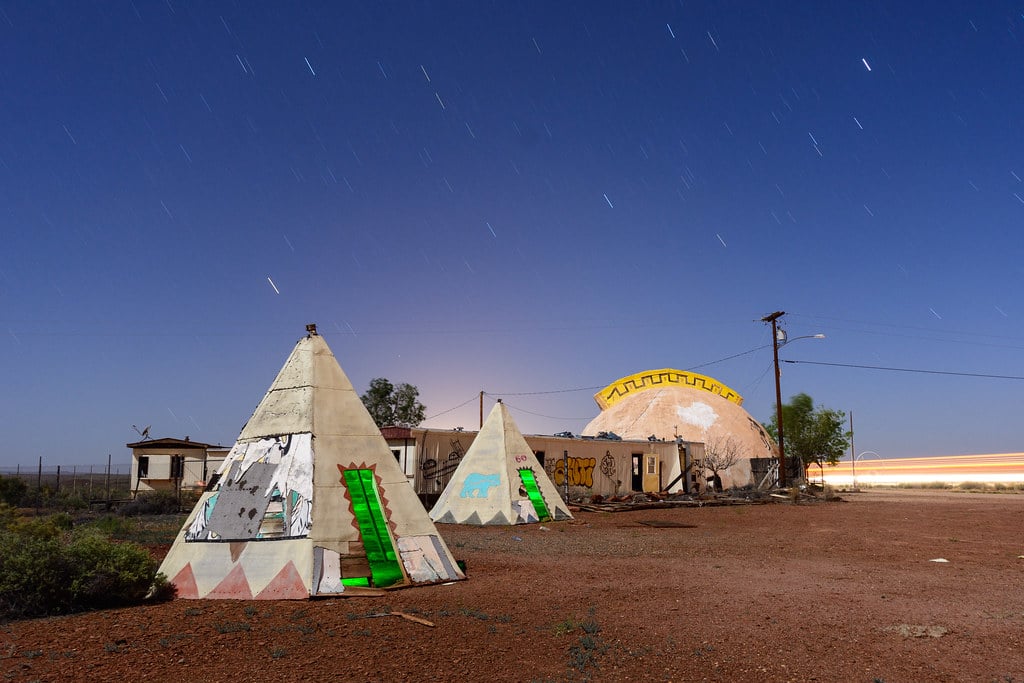
Route 66 was once lined with trading posts that sold Native American crafts, jewelry, and curios to westward-bound travelers. Many were built to look the part — teepee shapes, adobe-inspired facades, hand-painted signs promising authentic goods inside.
Some of the goods were authentic. Others were manufactured souvenirs that had nothing to do with local traditions.
Either way, the buildings became part of the landscape of the highway. As Route 66 was bypassed by Interstate 40 in the 1970s and ’80s, traffic dropped to almost nothing across long stretches.
Businesses that depended on drive-by customers couldn’t survive. Most of the trading post buildings were abandoned, and many collapsed or were demolished.
A few survive as ruins or museum pieces, slowly returning to the desert.
Nickerson Farms

Nickerson Farms occupied a specific niche on American interstates in the 1960s and ’70s — the full-service highway restaurant that felt like it had some regional character. The chain operated locations primarily in the Midwest, with a farm-themed design that distinguished it from the purely functional alternatives nearby.
The fried chicken was the menu anchor. The gift shops sold preserves and candy.
The restrooms were large enough to handle real highway traffic without making you feel like you were waiting in line at an airport. The chain never grew large enough to compete with the national brands moving in.
It folded in the early 1980s. Its locations were absorbed into truck stops or torn down.
The name has almost no recognition today outside of people who stopped there as children and never forgot it.
Muffler Men

Fiberglass giants started appearing alongside American roads in the early 1960s. The same few molds — originally created for a Uniroyal tire promotion — got repurposed endlessly.
An axe-wielding lumberjack became a cowboy. A cowboy became a chef.
A chef became a fisherman. Businesses bought them, dressed them up in regional costumes, and planted them out front where passing drivers couldn’t miss them.
At their peak, hundreds of these figures stood along American highways. They were 18 to 25 feet tall, always holding something, always staring blankly at the road.
The fiberglass cracked. The paint faded.
Zoning laws changed. Owners died or sold.
A dedicated community of enthusiasts has documented and preserved dozens of surviving figures, but the majority are gone — toppled by weather, scrapped for cost, or simply forgotten behind strip malls that replaced the businesses they once advertised.
The Sinclair Dinosaur Stations
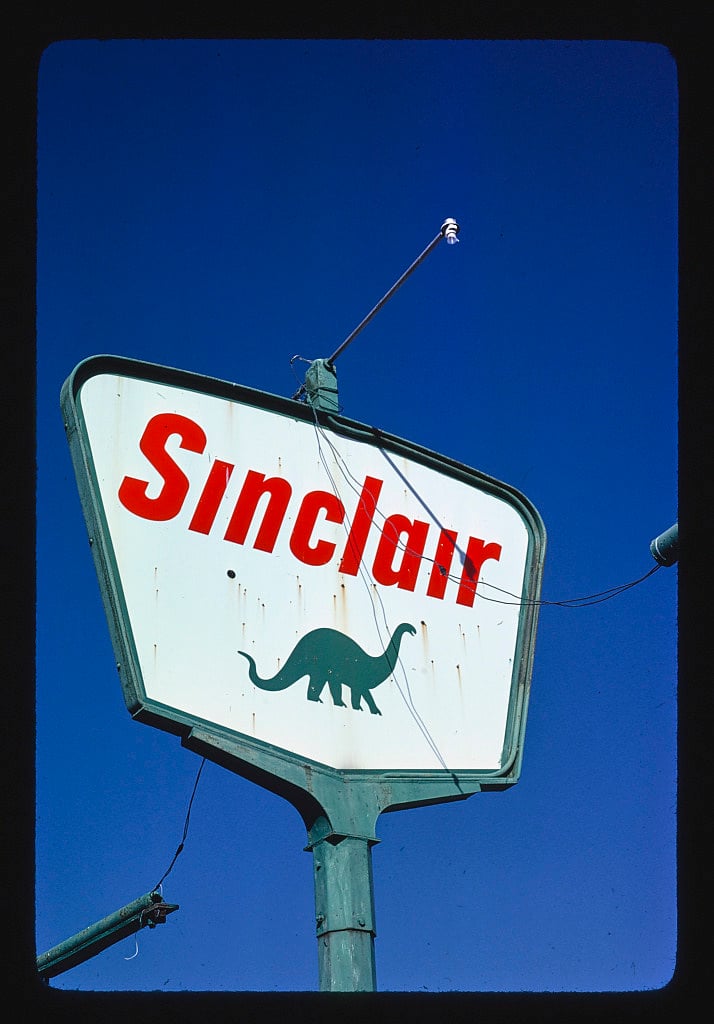
Sinclair Oil’s mascot was a green brontosaurus, a nod to the prehistoric origins of petroleum. The logo was everywhere, but the most memorable Sinclair stations took it further — large fiberglass dinosaurs stood on the property, sometimes life-sized, occasionally larger, always drawing cars to slow down.
The 1964-65 World’s Fair in New York featured Sinclair’s “Dinoland” exhibit, complete with full-scale dinosaur models that later toured the country. Some ended up at dealerships and stations as permanent fixtures.
When Atlantic Richfield acquired Sinclair in 1969, the brand slowly retreated in most markets. The dinosaur stations lost their novelty and, eventually, their dinosaurs.
A few Sinclair stations survive today in the western U.S., and the brontosaurus logo remains. But the era of the roadside dinosaur as a standard gas station feature is over.
Old A&W Drive-Ins
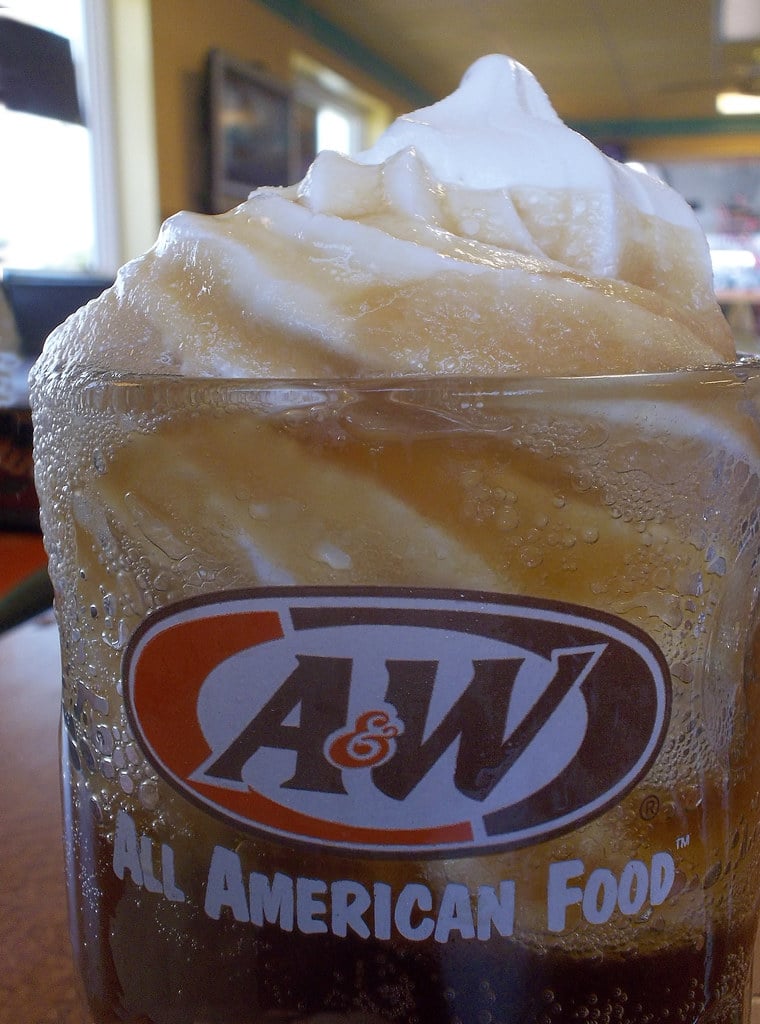
A&W is still around, but the version that defined American road culture for decades is not. The original A&W model — a standalone drive-in where carhops brought frosty mugs of root beer to your window — was essentially the template for fast food before fast food existed.
The chain franchised aggressively in the 1950s and ’60s. Families made a point of stopping.
The root beer came from a tap and was served cold enough to frost the glass. There was no indoor seating because you ate in your car, which was the whole experience.
Corporate restructuring, shifting land values, and the rise of indoor dining gradually killed the carhop model. Most of the classic drive-ins were torn down or converted.
A&W still operates, but almost entirely as a conventional counter-service restaurant, often sharing space with KFC. The root beer is the same.
The experience is not.
Phillips 66 Shield Stations
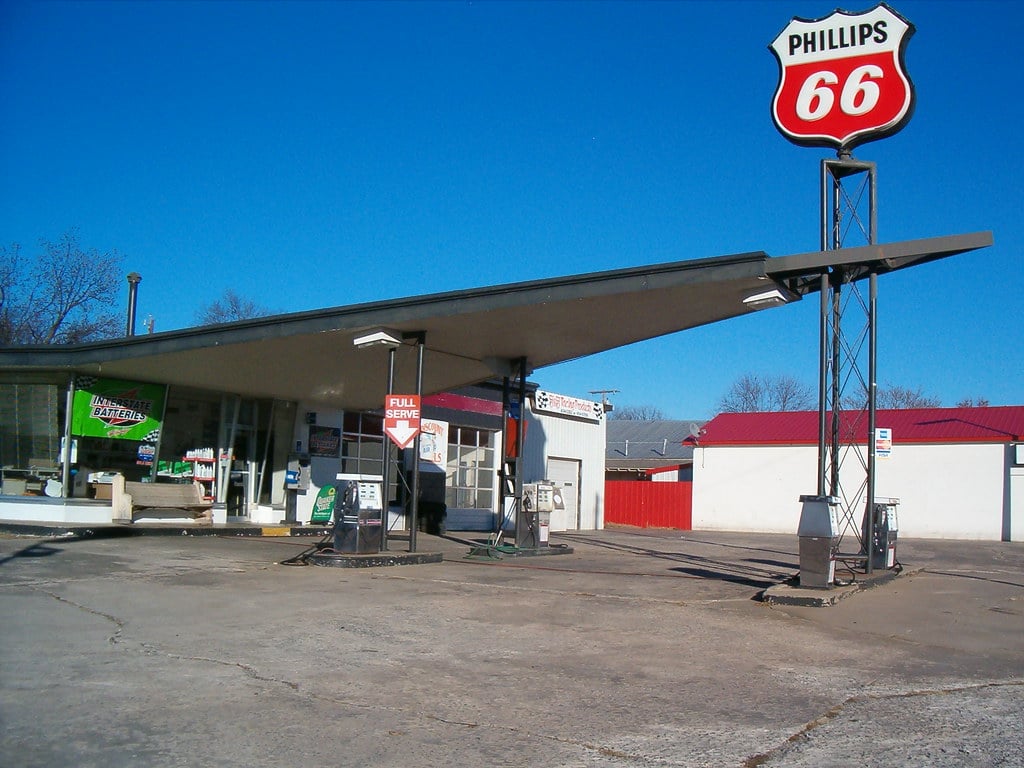
Back when gas pumps clicked louder than phones, Phillips 66 spots stood out not just by name but shape. Some wore slanted rooftops like folded paper, clean lines cutting across flat land – design folks later tagged “International Style.”
These forms matched the rush of mid-century roads, where speed shaped how buildings looked. Instead of curves, they chose edges.
The sign? A bold red-and-black shield planted on every pump, wall, and canopy. From the fifties into the seventies, you could spot one mile off, even squinting.
A vast presence marked the chain throughout the middle 1900s, its filling stops standing out plainly from the South into the nation’s heart. Travelers over decades came to recognize those spots – spot them, and you’d find steady costs along with a bathroom pass attached to a thick carved slab.
Through the 80s and into the 90s, big mergers thinned out gas stations across wide stretches of land. Instead of unique designs, most spots now wear bland roofs paired with small shops selling snacks and drinks.
Though Phillips 66 remains active today, the look and feel of roadside stops from decades past have mostly faded away.
Roadside Gravity Hills And Mystery Spots

Up a hill that seemed flat stood odd little places where things played tricks on your eyes. These pockets of confusion popped up along highways when families drove long distances just to see strange sights.
Fences went around tilted bits of earth, with painted boards shouting about laws of physics being broken. For a couple bucks, people stepped onto ramps that leaned the wrong way or saw water flow upward against common sense.
Strange feelings stuck – like the world was slightly off-kilter – even after walking back to the car. Strange hills began drawing visitors near Santa Cruz when a curious roadside stop started back in 1940 – still open today.
Yet across years that followed, many local versions popped up then vanished, each bumpier, odder, somehow more sincere than the last. Run by families, they counted on cars passing through and stories spreading slow from mouth to ear.
What happened inside defied telling, even when you understood how it worked. Off the beaten path, once-busy roadside curiosities lost their spark when freeways rerouted travelers elsewhere.
Few noticed when lights went dark one by one. Wooden frames sagged under weather and time.
Empty lots replaced what used to hum with oddball charm. That fleeting sense of wonder – brief, unpretentious, oddly satisfying – slipped away without warning.
Not many tried filling the gap. Those who did quickly realized something: simplicity like that doesn’t come back easily.
The Roads That Remember

Missing these spots means more than just missing old times. A different kind of journey lived in each one – unhurried, odd, open to discovery.
Roads once held objects with no clear profit – huge apples, stone huts shaped like tents, poem series on toothpaste foam – yet their unpredictability turned cross-country drives into something wild, not just a route on paper.
Out there, pieces remain for those who check. Faded paint peeks through desert dust – Wigwam Village stands quiet in Arizona.
Behind a used-car lot near Tulsa, one Muffler Man still waves, rust creeping at his joints. Far off an old highway in Georgia, a lone Stuckey’s keeps its bright blue roof like it never left.
These spots seem mailed from somewhere else entirely – even if that place only ever lived between exits. Nowhere near as much waits around corners.
The path keeps moving, though fewer spots catch your eye.
More from Go2Tutors!

- The Romanov Crown Jewels and Their Tragic Fate
- 13 Historical Mysteries That Science Still Can’t Solve
- Famous Hoaxes That Fooled the World for Years
- 15 Child Stars with Tragic Adult Lives
- 16 Famous Jewelry Pieces in History
Like Go2Tutors’s content? Follow us on MSN.