16 Facts About Titan, Saturn’s Most Mysterious Moon
There’s something almost unsettling about Titan. It sits over a billion kilometers from Earth, wrapped in a thick orange haze that hides its surface from plain view.
And yet, the more scientists study it, the more it feels oddly familiar — rivers, rain, seasons, and even the possibility of life. Here’s what makes this distant moon so hard to stop thinking about.
1. It’s Bigger Than a Planet
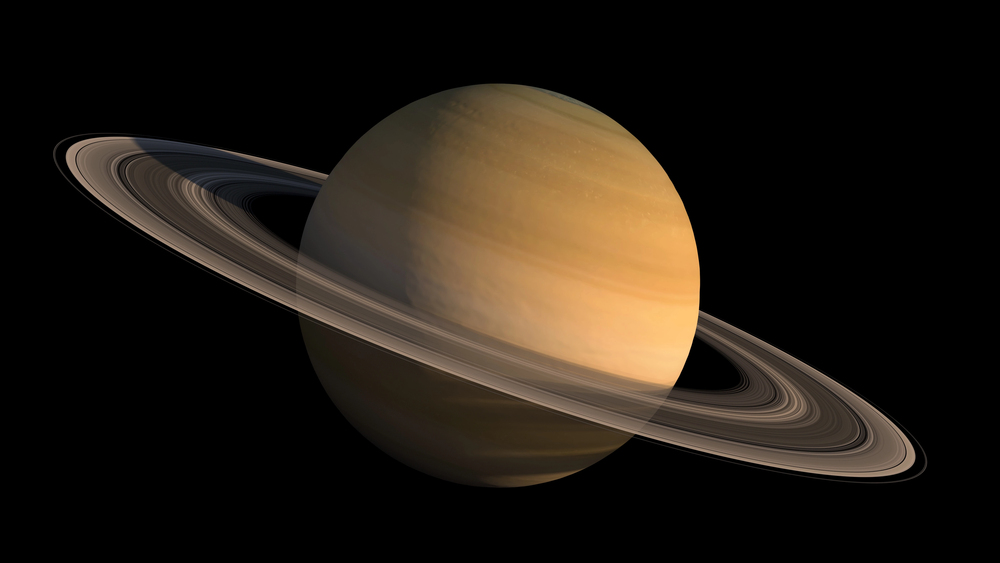
Titan is the second-largest moon in the solar system, right behind Jupiter’s Ganymede. But here’s the kicker: it’s actually larger than the planet Mercury.
If Titan orbited the Sun instead of Saturn, astronomers would almost certainly classify it as a planet outright. Size-wise, it simply belongs in that company.
2. The Atmosphere Is Thicker Than Earth’s
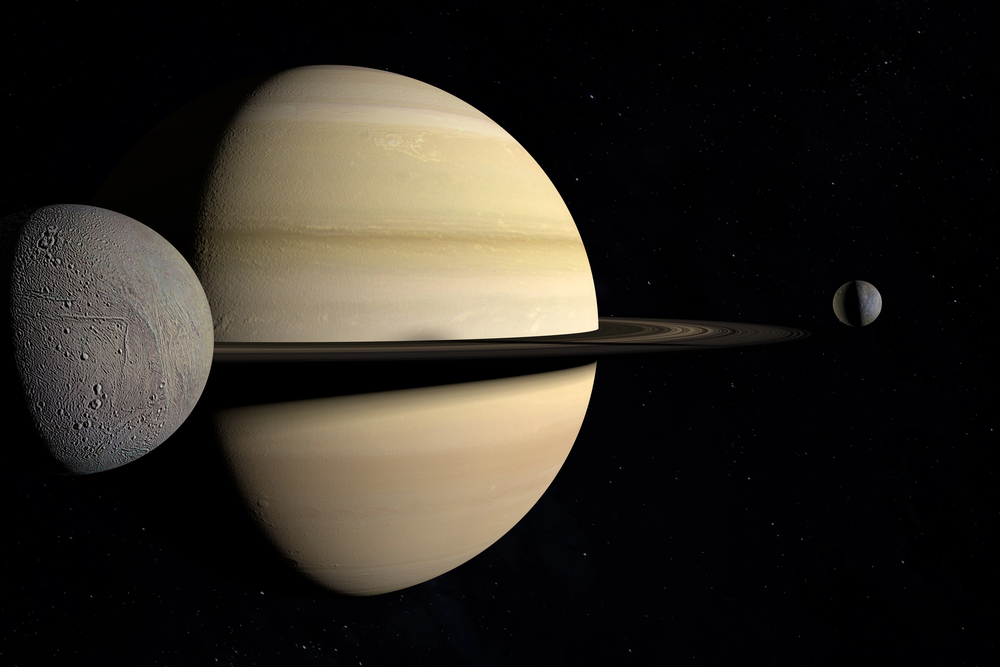
Most moons have no atmosphere at all. Titan has one that’s denser than Earth’s — about 1.5 times the surface pressure you’d feel on a typical day here.
It’s made mostly of nitrogen, which is the same main ingredient in Earth’s air. That shared quality has made scientists curious about Titan for decades.
3. Methane Does What Water Does Here
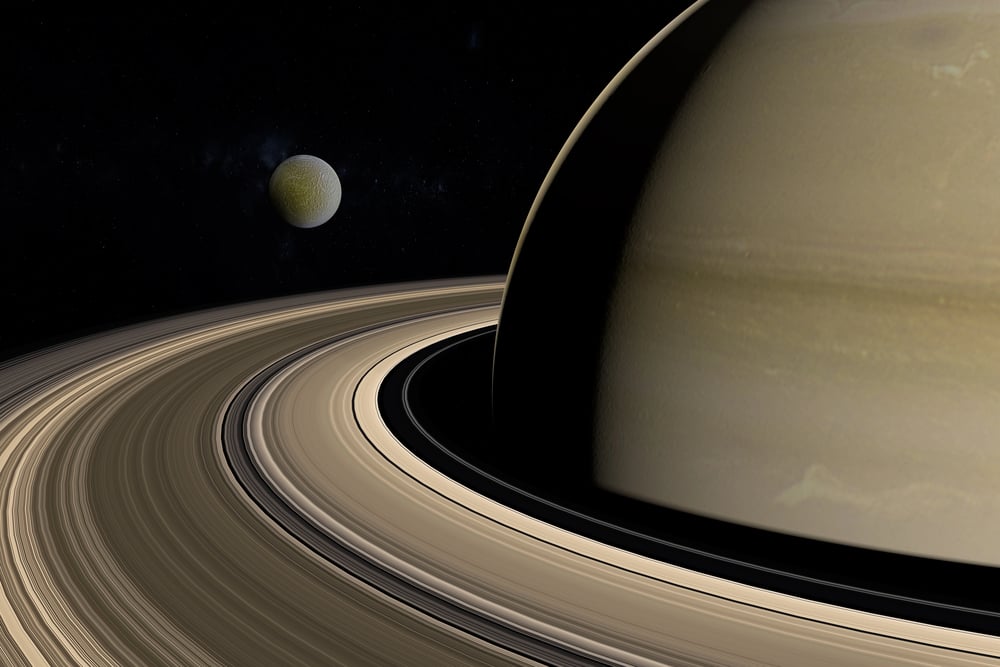
On Titan, methane plays the role that water plays on Earth. It evaporates from the surface, forms clouds, and falls as rain.
Rivers of liquid methane carve channels through the landscape. Lakes and seas of methane and ethane sit at the poles.
It’s the same water cycle you learned in school, just with a completely different substance running the show.
4. The Surface Temperature Is Around -179°C
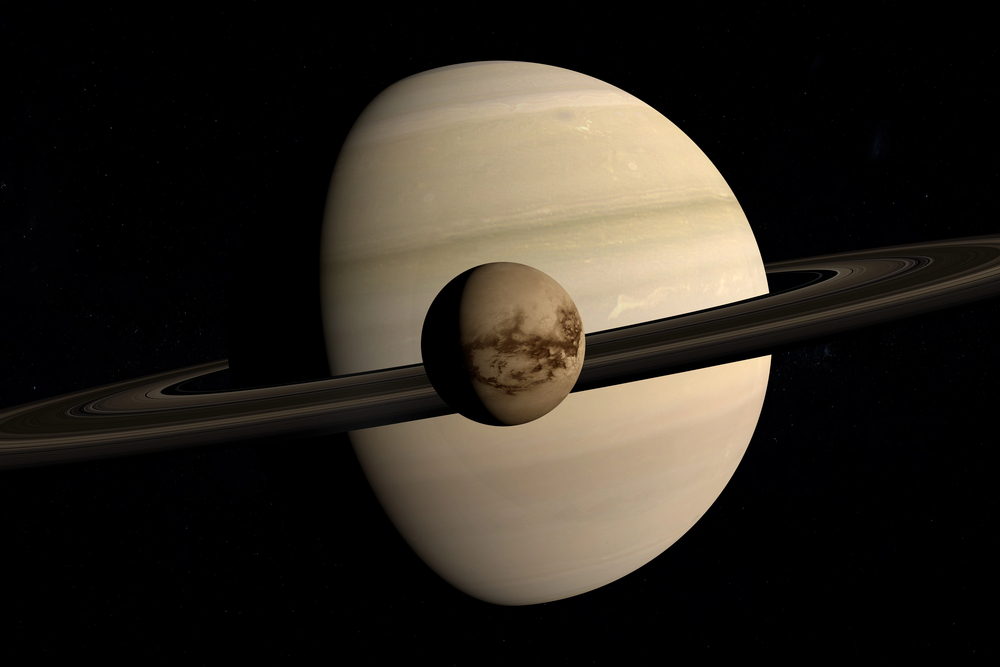
At that temperature, liquid water would be rock solid. The only liquids that survive at the surface are hydrocarbons — methane and ethane — which stay liquid in those extreme conditions.
The cold isn’t just dramatic, it’s the reason Titan’s chemistry works so differently from anything on Earth.
5. Humans Could Walk Around (With the Right Gear)
The surface gravity on Titan is about 14% of Earth’s — even lower than the Moon’s. And the atmospheric pressure, while thick with nitrogen and methane, isn’t toxic in the way that Venus’s air would be.
A person on Titan wouldn’t need a pressurized suit. Just insulated clothing and an oxygen supply.
In theory, you could walk across its surface and even strap on wings to fly, since the dense air and low gravity make human-powered flight mathematically possible.
6. It Has an Underground Ocean
Beneath Titan’s frozen surface, there’s strong evidence of a liquid ocean — probably a salty mix of water and ammonia. Scientists figured this out partly by watching how Titan flexes and wobbles as it orbits Saturn.
A fully solid moon wouldn’t move that way. The hidden ocean sits far below the surface, insulated by layers of ice, and it’s one of the reasons astrobiologists take Titan seriously.
7. Cassini Spent 13 Years Studying It
NASA’s Cassini spacecraft arrived at Saturn in 2004 and spent the next thirteen years orbiting the planet and making repeated flybys of Titan. It mapped the surface, measured the atmosphere, and detected those hydrocarbon lakes at the poles.
Cassini changed everything about how much detail scientists actually have about this moon. Before it arrived, Titan was mostly a mystery wrapped in orange fog.
8. The Huygens Probe Actually Landed There
In January 2005, the European Space Agency’s Huygens probe detached from Cassini and descended through Titan’s atmosphere. It transmitted data for about 72 minutes on the surface before going silent — longer than anyone expected.
The images it sent back showed a flat, rocky landscape with rounded pebbles of water ice, shaped by flowing liquid just the way river stones are shaped on Earth.
9. Titan Has Dunes Made of Organic Material
Near Titan’s equator, there are vast dunes that stretch for hundreds of kilometers. They look similar to sand dunes in Earth’s deserts, but they’re made of dark organic particles rather than silicon sand.
These particles likely form high in the atmosphere through chemical reactions and then drift down to the surface over time. The dunes are tall — sometimes over 100 meters high — and they follow the direction of Titan’s winds.
10. Its Orange Color Has a Scientific Explanation
That distinctive orange haze comes from a layer of complex organic molecules called tholins. They form when nitrogen and methane in the upper atmosphere get hit by ultraviolet radiation from the Sun and react together.
Tholins are interesting in their own right because they’re similar to the kinds of organic compounds thought to have existed on early Earth, before life appeared. Some researchers think studying them could tell us something about how life got started here.
11. Titan Has Seasons — Very Long Ones
Because it takes Saturn about 29 Earth years to orbit the Sun, Titan’s seasons last roughly seven and a half years each. Cassini was able to watch seasonal changes unfold in real time during its mission — cloud patterns shifted, the methane distribution near the poles changed, and the atmosphere itself transformed over those years.
Titan has a proper seasonal cycle, just stretched out to a timescale humans rarely think about.
12. There Are No Impact Craters, Relatively Speaking
Most solid bodies in the solar system are covered in craters from billions of years of impacts. Titan has very few.
The thick atmosphere burns up smaller objects before they can hit the surface, and whatever craters did form have been erased over time by geological activity, wind erosion, and flowing liquids. The surface looks young and active, not ancient and battered.
13. Ligeia Mare Is One of the Largest Seas Ever Found Off Earth
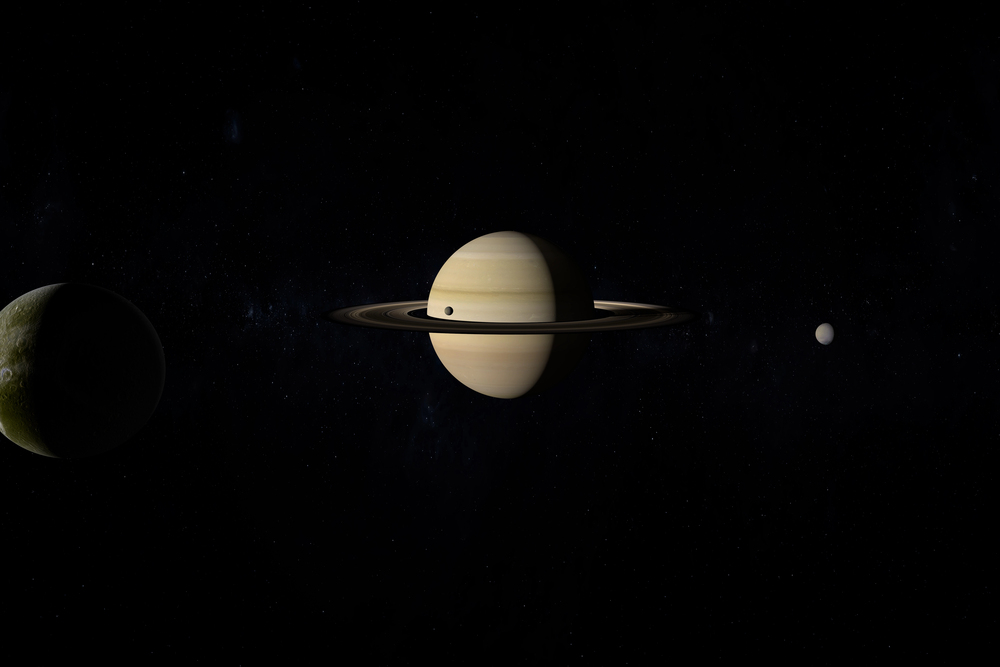
The hydrocarbon seas at Titan’s north pole have names — and some are enormous. Ligeia Mare is roughly the size of Lake Huron and Lake Michigan combined.
Kraken Mare is even bigger, potentially the largest known extraterrestrial sea in the solar system. These aren’t puddles.
They’re vast bodies of cold liquid sitting under skies that glow orange.
14. NASA Is Sending a Helicopter There
In the 2030s, NASA plans to launch Dragonfly — a rotorcraft lander designed to fly between different sites on Titan’s surface. It’ll take advantage of the dense atmosphere and low gravity to hop around in ways a rover simply couldn’t.
The mission will study Titan’s chemistry, especially the organic compounds in the dunes and near the impact craters, to understand how complex molecules form there. It’s one of the most ambitious planetary missions ever approved.
15. Life There Would Be Nothing Like Life Here
If anything lives on Titan, it wouldn’t use liquid water. It would use liquid methane.
Scientists have theorized about what such life might look like — breathing hydrogen instead of oxygen, metabolizing acetylene, producing methane as a byproduct. None of this has been observed, but the chemistry of Titan’s atmosphere shows some unexpected depletions in hydrogen and acetylene near the surface that don’t have a fully satisfying explanation yet.
Nothing confirms life, but the numbers are interesting enough to keep scientists asking questions.
16. It Might Be the Best Candidate for Life in the Outer Solar System
Europa and Enceladus get a lot of attention because they have liquid water oceans. But Titan offers something different — a whole world with complex chemistry, an active weather system, and two potential habitats: the surface (with its methane chemistry) and the underground ocean (with liquid water).
No other moon in the solar system offers that combination. It’s the kind of place where you’d want to look hard before concluding nothing is home.
A World That Refuses to Be Simple
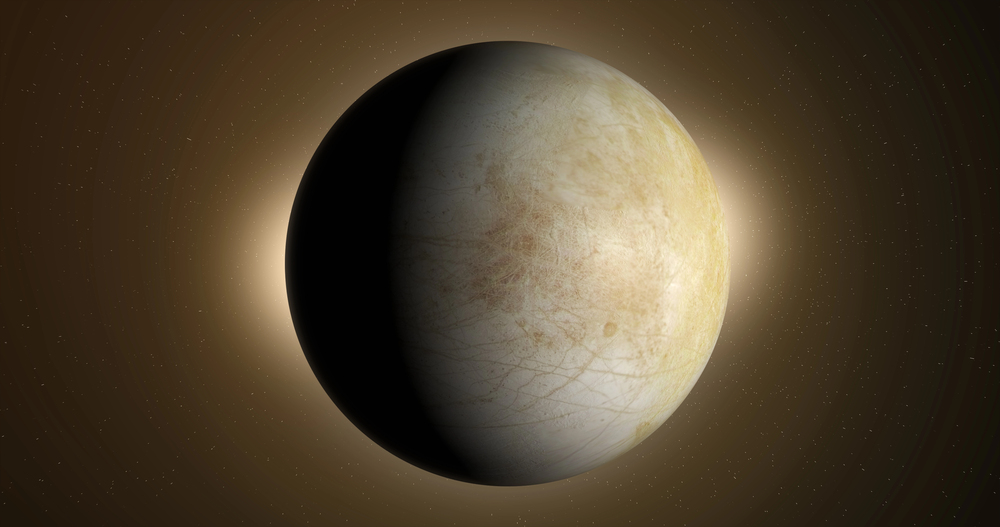
Titan doesn’t fit neatly into any category. It’s not a planet, but it behaves like one.
It’s not Earth, but its landscape follows rules you’d recognize. It’s cold enough to freeze water into bedrock, yet warm enough in its own way to keep things moving — rivers, rain, dunes, seasons.
The more data comes in, the more questions open up. And with Dragonfly on its way, the next chapter of Titan’s story is already being written.
Whatever scientists find when that rotorcraft finally touches down, it’s safe to say the answers won’t be boring.
More from Go2Tutors!

- The Romanov Crown Jewels and Their Tragic Fate
- 13 Historical Mysteries That Science Still Can’t Solve
- Famous Hoaxes That Fooled the World for Years
- 15 Child Stars with Tragic Adult Lives
- 16 Famous Jewelry Pieces in History
Like Go2Tutors’s content? Follow us on MSN.



