17 Tech Patents You Never Heard Of
Most patents live quietly in databases, filed and forgotten. They never become products.
They never make the news. But they do tell you something interesting about what engineers and companies were thinking about — or worrying about — at a given moment in time.
Some of these patents are strange. Some are creepy.
A few are genuinely clever. And at least one will make you wonder how it hasn’t shown up in your life already.
Amazon Wants to Ship Things Before You Buy Them

Amazon holds a patent for what it calls “anticipatory shipping.” The idea is to predict what you’re about to order — based on your browsing history, wish lists, and past purchases — and start shipping the item before you actually click buy.
The package would sit at a local distribution hub, waiting for you to complete the purchase. If you don’t buy it, the item gets rerouted or offered as a discount to push the sale.
It sounds like a logistical nightmare, but the math apparently works in Amazon’s head.
Google’s Pay-Per-Gaze System

Before Google Glass even launched, Google filed a patent for a system that charges advertisers based on whether users actually look at an ad — not just whether it appears on screen. The patent describes using eye-tracking technology in wearables to measure actual attention.
A glance at a billboard, a stare at a product placement — all billable. The patent also mentions detecting “emotional state” from pupil dilation.
Advertisers would have loved it. Everyone else, not so much.
A Self-Healing Phone Screen
Apple patented a display that repairs itself after cracking. The material in the screen flows back into place under heat or electrical current, smoothing out minor damage over time.
This has been a dream feature for anyone who’s ever shattered a phone screen within a week of buying it. The patent exists.
The product, unfortunately, does not — at least not yet.
Facebook’s Mood Prediction Engine
Facebook (now Meta) filed a patent for a system that infers your emotional state without you saying a word. It analyzes how you type — speed, pressure, error rate, the rhythm of your keystrokes — and cross-references that with facial expressions captured by your front camera.
The goal was to surface content that matches your mood or, more accurately, to target ads at emotional moments. The system can tell the difference between someone who is distracted and someone who is upset, and act accordingly.
Amazon’s Illness-Detecting Alexa

Amazon patented technology that allows Alexa to detect illness and emotional states from changes in your voice. A stuffy nose, a scratchy throat, a slower speech pattern — these are all signals the system can pick up on.
Once it identifies that you’re sick, it can offer relevant products. Cough syrup, for example.
Or tissues. The patent frames this as a helpful feature. Whether it feels helpful depends entirely on your comfort level with a speaker in your kitchen analyzing how you sound.
Google’s Sticky Car Hood
This one is strange in the best way. Google filed a patent for a car hood coated in a strong adhesive — similar to flypaper. The idea is that if a self-driving car hits a pedestrian, that person sticks to the hood instead of being thrown off and injured further by the fall or by oncoming traffic.
The patent includes a protective coating over the adhesive that breaks on impact. It’s a genuine attempt to solve a real problem, which makes it one of the more thoughtful entries on this list, even if the image of a person stuck to a car hood is hard to shake.
Sony’s Neural Game Controller

Sony filed a patent for a game controller that interfaces directly with the nervous system. The device, as described, sends ultrasonic pulses into the brain to create simulated sensory experiences — effectively allowing games to manipulate what you feel, see, or hear without actual physical input.
The patent dates back to the early 2000s, which makes it even stranger. Sony was thinking about this before anyone had a flat-screen TV.
Apple’s Talking Tattoo

Apple holds a patent for a flexible electronic skin tattoo designed to be applied to the throat. It includes a microphone, a transmitter, and a noise-canceling layer that filters out ambient sound.
The tattoo connects to your phone and lets you make calls by speaking quietly — almost subvocalizing — without holding anything up to your face. It also has the ability to detect lie patterns in the voice, which the patent mentions almost as a footnote.
IBM’s Charity Out-of-Office Reply

IBM patented an email system that, when you set an out-of-office message, prompts the sender to make a donation to a charity instead of just waiting for your return. The email recipient gets an automated message explaining the situation and offering a link.
IBM’s patent frames this as a way to reduce email pressure while doing something productive with inbox overflow. It never became a product but remains one of the more humane ideas in this list.
Motorola’s Throat Tattoo Microphone

Similar to Apple’s concept but slightly earlier and slightly stranger, Motorola filed a patent for an electronic tattoo that sits on the throat and functions as a microphone for your phone. It’s waterproof, sticks to skin, and can remain in place for extended periods.
The patent also mentions it can pick up subvocalizations — the faint muscle movements that happen when you think words without saying them out loud. That part moves it from a wearable into a different category entirely.
Amazon’s Worker Tracking Wristband

Amazon patented a wristband for warehouse workers that tracks hand movements in real time. Using ultrasonic tracking and haptic feedback, the device monitors where your hands are relative to inventory shelves. If your hand is moving toward the wrong bin, the wristband vibrates to redirect you.
Amazon described this as a way to improve efficiency. Critics pointed out it also means every motion a worker makes is logged, analyzed, and measurable.
Samsung’s Smart Contact Lenses

Samsung filed patents for contact lenses with a built-in camera, display, and wireless data connection. The lens projects images directly onto the retina and can record what the wearer sees.
The camera activates with a deliberate blink pattern. Samsung’s patents mention augmented reality overlays, navigation, and real-time information display.
Google Glass tried this with glasses and ran into cultural resistance. Contacts would be essentially invisible, which raises the question of whether the cultural resistance would even exist.
Google’s Blood Sugar Watch
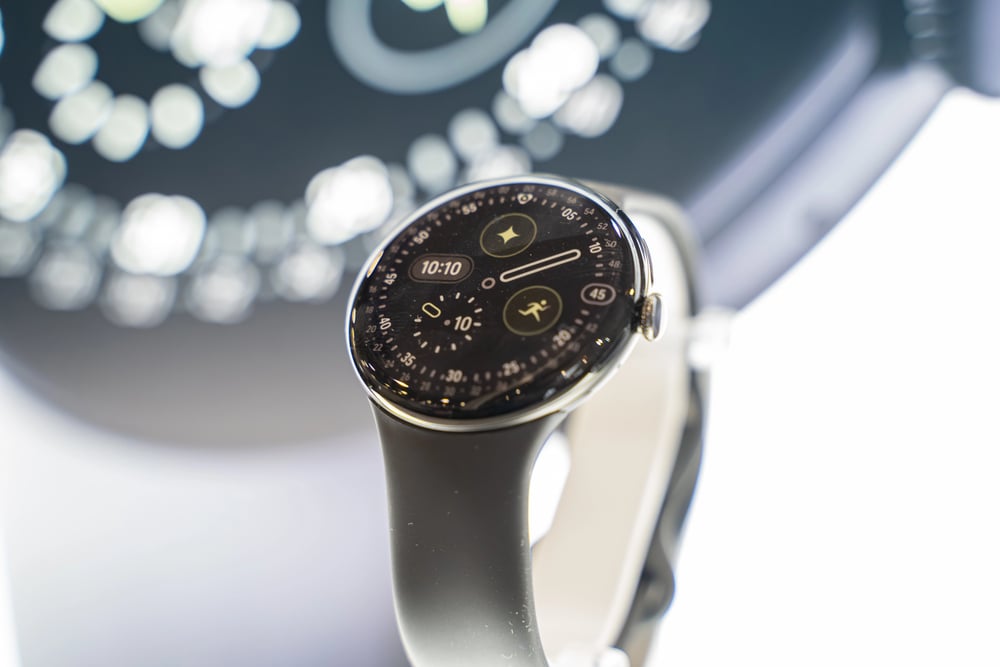
Google filed a patent for a non-invasive blood glucose monitor built into a watch strap. The device uses a tiny laser to pass light through the skin and measure glucose levels from the interstitial fluid just below the surface.
No needles. No strips.
For the hundreds of millions of people managing diabetes, this patent represents something genuinely significant. It has been filed.
It has been worked on. And it still hasn’t arrived in any consumer product.
Disney’s Humanoid Robot Patent

Out of nowhere, Disney holds dozens of patents tied to robotic systems. A closer look at one reveals plans for lifelike machines meant to chat with visitors inside parks – offering handshakes, locking eyes, reacting when touched.
Skin on these figures moves just like human flesh would under pressure, thanks to built-in flexibility features. These aren’t just ideas tossed around; the paperwork dives deep into how soft surfaces bend during physical contact.
Called “social robots,” they appear ready for real-world testing given how thoroughly each piece is mapped out.
Microsoft Tracks User Activity Through Productivity Metrics

A new patent from Microsoft outlines a plan linking worker performance to office rewards through a scoring method. When goals are met, staff might gain nicer seating, flexible hours, or entry to upgraded facilities.
Falling short means losing those benefits. This setup is presented as a way to encourage effort.
It paints a picture of an environment where how well you perform shapes your daily comforts. Your chair, your schedule, even your space depend on tracked results.
Numbers decide what you’re allowed. Achievement unlocks convenience.
Shortfalls bring limits. What you do follows you into how you work.
A Patent For Remembering The Dead

One tech firm working with artificial intelligence has put forward a legal claim on software designed to build chat systems using messages, online activity, recorded speech, and written correspondence left behind by someone who passed away. Instead of linking ideas with “and,” connections here appear through shifts in rhythm – a pause, then continuation, shaped more by silence than words.
The outcome speaks like the individual once did, answering queries while echoing patterns from earlier life. Not every step follows smooth logic; some parts lurch forward abruptly, others stretch thin before breaking.
Voice outputs match typed replies under protection described within official documentation. Hard facts sit beside unease, though clarity does not always bring comfort.
Possibility exists because tools now allow such creation – whether desired or not matters less than feasibility. Feelings shift unevenly across readers, yet development moves without waiting for agreement.
Questions linger longer than answers, piling up where law ends and imagination begins.
The Smell O Vision Patent That Still Exists

A whiff of smoke might drift from your controller if flames appear on screen. Over time, companies like Sony have submitted patent after patent for such scent-based tricks.
Picture a forest burning in a game, then catching a hint of charred wood through the air. When gameplay shifts to a kitchen scene, maybe you sense roasted garlic nearby.
Inside the gadget, a small capsule holds chemicals ready to vaporize when heated at just the right moment. A consumer version never made it to market.
Yet new patents continue to appear – proof that some person, in some place, still thinks it’s worth pursuing.
The Ones That Got Away

Every now and then, think about how patents point ahead, not back. Filing one means guarding a thought, even if it never gets made.
Companies do this just in case. Over time, some ideas slip into devices you hold.
Others shape features you use but never notice. A handful remain untouched – left frozen in digital drawers, odd yet whole, proof of questions once asked and answers dreamed up, strange or calm, long before anyone needed them.
What stands out most? Not a single idea here can’t happen. Maybe that’s exactly why it feels so odd.
More from Go2Tutors!

- The Romanov Crown Jewels and Their Tragic Fate
- 13 Historical Mysteries That Science Still Can’t Solve
- Famous Hoaxes That Fooled the World for Years
- 15 Child Stars with Tragic Adult Lives
- 16 Famous Jewelry Pieces in History
Like Go2Tutors’s content? Follow us on MSN.