20 Buildings That Were Designed for One Purpose and Used for Another
Architecture often outlasts its original intent. Throughout history, buildings have been reimagined and repurposed as society’s needs evolve, giving structures second lives that their original architects never envisioned.
These transformations preserve historic architecture while adapting spaces for contemporary demands.
Here is a list of 20 buildings that were originally designed for one purpose but found new life serving entirely different functions.
Tate Modern

London’s iconic modern art museum was originally the Bankside Power Station. Designed by Sir Giles Gilbert Scott in the 1950s, the massive industrial building with its distinctive chimney produced electricity until 1981.
The power station’s enormous turbine hall now serves as a dramatic exhibition space for large-scale contemporary art installations.
The High Line

This elevated linear park in Manhattan was originally a freight rail line built in the 1930s. After being abandoned in the 1980s, the 1.45-mile-long structure was transformed into an urban greenway featuring native plantings, walking paths, and gathering spaces.
The reimagined structure has revitalized neighborhoods along its path and become one of New York City’s most popular tourist attractions.
Zeitz MOCAA

The Museum of Contemporary African Art in Cape Town occupies what was once the world’s tallest grain silo complex. Built in 1921, the 42 concrete tubes that once stored grain have been carved into a spectacular cathedral-like central atrium surrounded by gallery spaces.
The industrial heritage provides a striking backdrop for the continent’s largest collection of contemporary African art.
Gasometer City

Vienna’s four massive gas storage tanks were built in the late 19th century but decommissioned in 1984. Rather than demolish these industrial landmarks, architects transformed them into a mixed-use development with apartments, offices, shops, and entertainment venues.
The cylindrical structures maintain their historic facades while housing thoroughly modern interiors.
MASS MoCA

The Massachusetts Museum of Contemporary Art occupies a sprawling 19th-century factory complex in North Adams. These buildings once housed the Sprague Electric Company, which manufactured electronic components for the military.
Now, the 26 interconnected structures provide over 250,000 square feet of exhibition space, making it one of America’s most prominent contemporary art museums.
Hagia Sophia

This architectural marvel in Istanbul has undergone multiple transformations since its construction in 537 CE. Originally built as a Greek Orthodox cathedral, it was converted to an Ottoman mosque in 1453 after the fall of Constantinople.
In 1935, it became a museum, and in 2020, it returned to functioning as a mosque while preserving its unique historical elements from multiple eras.
The Louvre

The world’s most visited museum began as a fortress in the late 12th century. It later served as a royal residence for French monarchs until Louis XIV moved the court to Versailles.
The palace was transformed into a public museum during the French Revolution, with I.M. Pei’s distinctive glass pyramid added in 1989 as a modern entrance to the historic structure.
Musée d’Orsay

This Parisian museum occupies the former Gare d’Orsay, a railway station built for the 1900 World’s Fair. When longer trains made the station obsolete, the Beaux-Arts building narrowly escaped demolition before being converted into a museum in 1986.
The grand central hall, once filled with steam locomotives, now displays impressionist and post-impressionist masterpieces beneath its magnificent glass ceiling.
Hearst Tower

In Manhattan, the Hearst Tower combines old and new in a striking fashion. The original six-story Art Deco building from 1928 was preserved as a base, with a dramatic glass-and-steel tower designed by Norman Foster rising 46 stories above it.
What was planned as a complete skyscraper faced construction delays during the Great Depression, leaving only the base built until its completion in 2006.
The Pentagon

The world’s largest office building was initially designed to house the War Department temporarily during World War II. Planners expected it would be converted to a records storage facility after the war ended.
Instead, it became the permanent headquarters of the Department of Defense, housing approximately 25,000 employees within its five concentric rings.
Alcatraz Federal Penitentiary

Before becoming America’s most notorious prison, Alcatraz Island in San Francisco Bay was home to a military fortress and the West Coast’s first lighthouse. After serving as a federal prison from 1934 to 1963, housing notorious criminals like Al Capone, the island transformed again.
Today it operates as one of America’s most popular national park sites, welcoming over a million visitors annually.
Park Hill

This massive housing complex in Sheffield, England was built in the late 1950s as a utopian solution to urban housing shortages. The brutalist “streets in the sky” fell into disrepair and became notorious for crime before an ambitious regeneration project transformed portions into upscale apartments, student housing, and business spaces while preserving the distinctive concrete structure.
The Silo Hotel
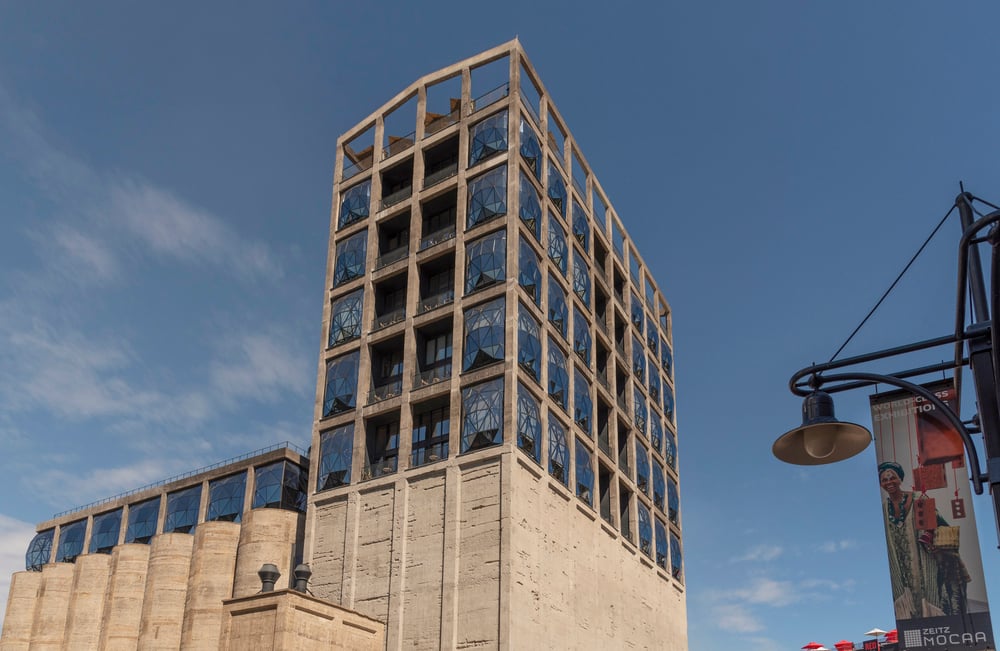
In Cape Town’s V&A Waterfront, a former grain elevator has been transformed into a luxury hotel. The 57-foot-tall concrete tubes that once facilitated grain movement now house striking geometric rooms with curved windows offering panoramic harbor views.
The building’s industrial heritage is celebrated through preserved machinery and exposed concrete surfaces juxtaposed with luxurious furnishings.
Faneuil Hall Marketplace

Boston’s historic meeting hall and market building from 1742 evolved from a simple market to becoming known as the ‘Cradle of Liberty’ for the revolutionary speeches delivered there. In the 1970s, the dilapidated market buildings were revitalized as a festival marketplace with shops and restaurants while preserving their historical significance, creating a model for adaptive reuse projects nationwide.
The Power Plant

Toronto’s contemporary art gallery occupies the former Hearn Generating Station that supplied electricity to the city from the 1950s until 1983. The massive industrial space with its soaring ceilings and distinctive brick chimneys now houses exhibition spaces for cutting-edge art installations.
The building’s industrial character provides a dramatic backdrop for contemporary artistic expressions.
The Roundhouse

This circular building in London was initially constructed in 1847 as a railway engine shed where locomotives could be turned around on a turntable. After years of abandonment, it was repurposed as a performing arts venue in the 1960s, hosting legendary performances by bands like Pink Floyd and The Doors before becoming a permanent creative hub for theater, music, and digital arts.
Venice Arsenale

For centuries, this massive shipyard complex was the heart of Venice’s naval power, employing thousands of workers to build the ships that maintained the city’s maritime empire. Today, the sprawling complex of docks, warehouses, and workshops serves as the primary venue for the Venice Biennale art and architecture exhibitions, with the industrial spaces providing dramatic settings for contemporary installations.
Battersea Power Station

London’s iconic coal-fired power station with its four distinctive chimneys ceased operations in 1983 after powering much of London for decades. After years of abandonment and failed redevelopment plans, the Art Deco masterpiece has been transformed into a mixed-use development featuring luxury apartments, office space, restaurants, and retail areas while preserving its architectural heritage.
Cincinnati’s Union Terminal

This Art Deco masterpiece opened in 1933 as a bustling railway station with a massive half-dome facade. As rail travel declined, the grand building narrowly escaped demolition before being transformed into the Cincinnati Museum Center, housing multiple museums beneath its spectacular rotunda.
The building’s original architectural details and murals depicting American industry have been carefully preserved.
Water Tower Place

Chicago’s landmark Gothic Revival Water Tower survived the Great Chicago Fire of 1871 and now stands as a visitor center and art gallery. The adjacent pumping station continues its original function but also houses a theater company.
Together, these utilitarian structures designed for municipal water infrastructure have become cultural landmarks and tourist attractions along Michigan Avenue’s Magnificent Mile.
Enduring Transformations

These architectural metamorphoses demonstrate our capacity to reimagine spaces rather than replace them. These buildings carry forward their historical DNA while serving entirely new functions, creating layered experiences that connect past and present.
As our urban needs continue to evolve, these successful adaptations provide inspiring templates for breathing new life into structures that might otherwise face demolition, proving that sometimes the most sustainable building is one that already exists.
More from Go2Tutors!

- The Romanov Crown Jewels and Their Tragic Fate
- 13 Historical Mysteries That Science Still Can’t Solve
- Famous Hoaxes That Fooled the World for Years
- 15 Child Stars with Tragic Adult Lives
- 16 Famous Jewelry Pieces in History
Like Go2Tutors’s content? Follow us on MSN.



