28 Illusions That Prove the Brain Fills In What Is Not There
Every moment you open your eyes, your brain intercepts millions of nerve signals and constructs what feels like a seamless view of reality. But that reality is a sophisticated lie—a reconstruction built from incomplete data, filled in with educated guesses based on evolutionary shortcuts and learned experience.
Visual illusions are the moments when these filling-in mechanisms become visible.
Your visual system does not passively receive the world; it actively predicts and invents it. When your eye encounters a gap, an edge without definition, or a pattern too ambiguous to settle on a single interpretation, your brain reaches into its archive of assumptions and supplies what should be there.
These 28 illusions demonstrate exactly how, and how often, you are actually seeing what your brain expects rather than what is truly in front of you.
Kanizsa Triangle
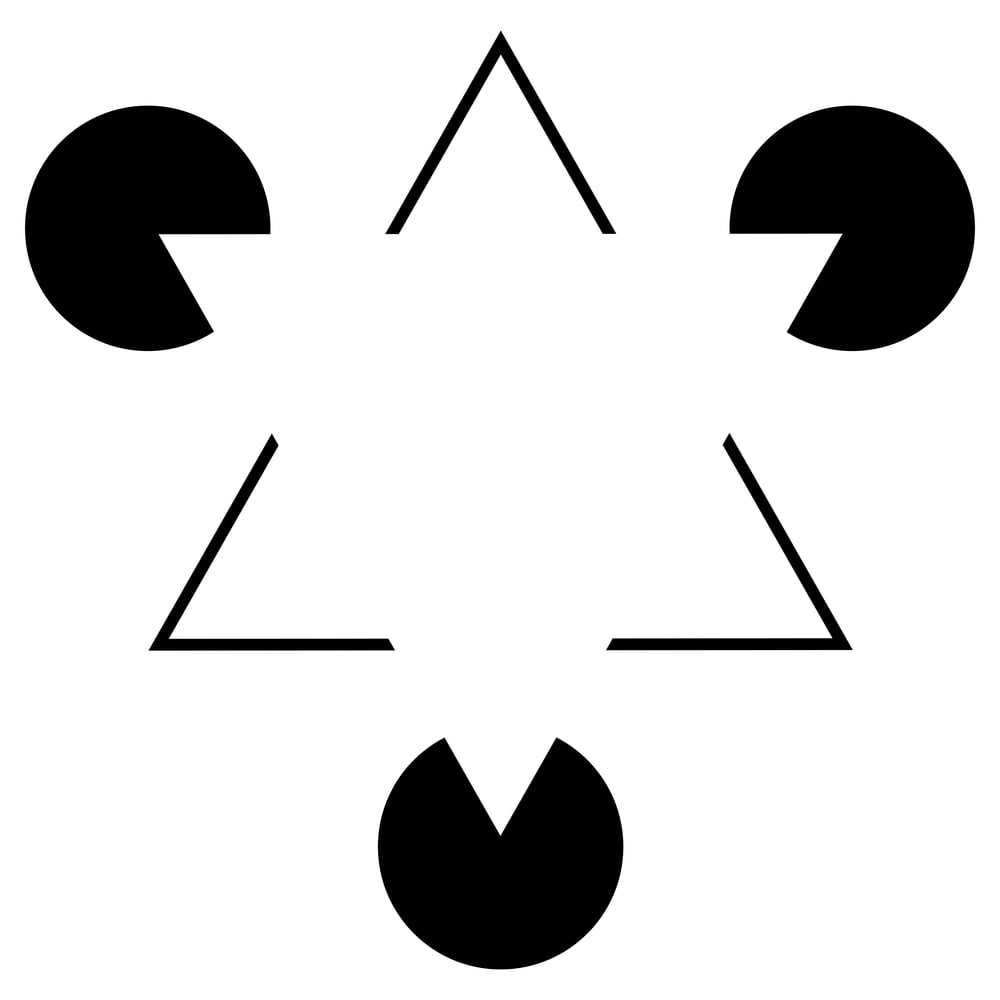
Three black circles with wedge-shaped notches facing inward create the unmistakable impression of a bright white triangle sitting on top of them, completely occluding their centers. No triangle has been drawn, no line connects the gaps—the triangle exists entirely in the space your brain fills in.
This illusion is so compelling that your visual cortex activates as though the triangle were physically present, demonstrating that the brain’s invented contours are processed as genuine edges.
Necker Cube
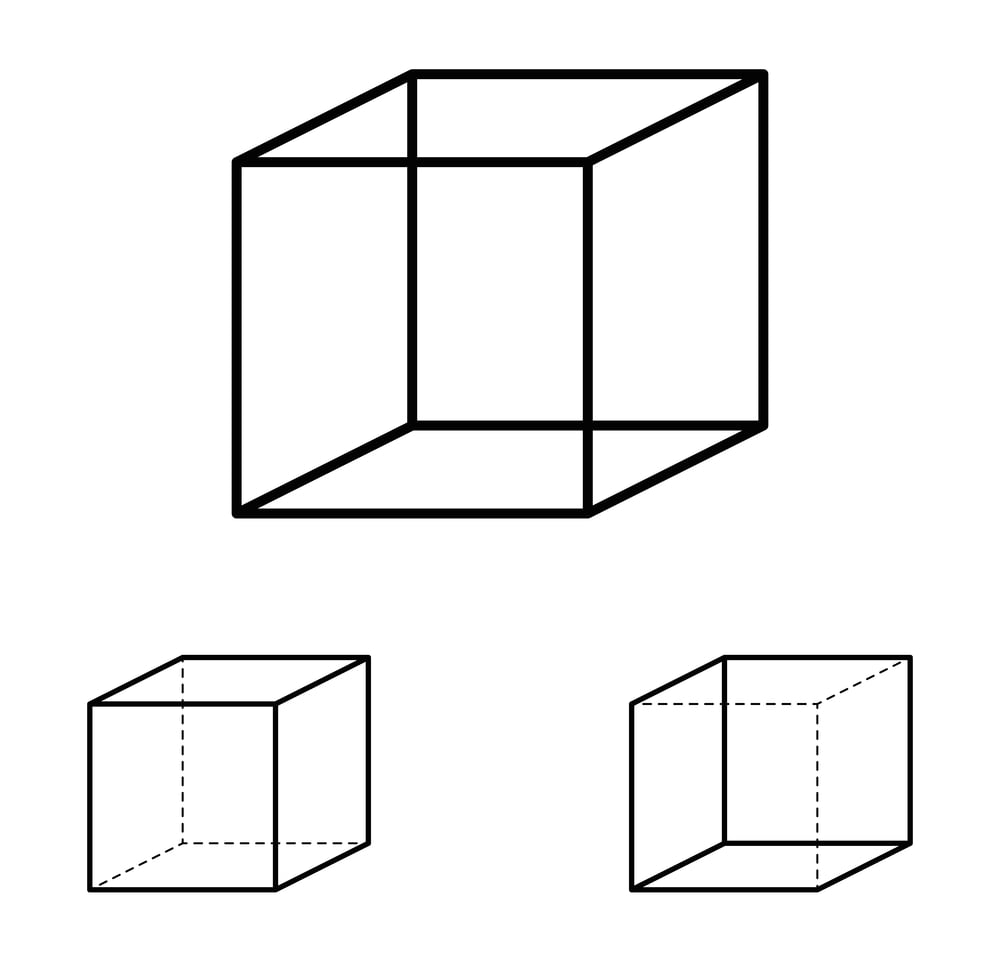
A simple wireframe cube with no shading, no depth cues, and no obvious front face flips between two interpretations the longer you stare at it. Sometimes the bottom-left square appears to be the front face; moments later, the top-right square takes its place.
Your brain cannot tolerate ambiguity, so it locks onto one solution, holds it for a few seconds, then involuntarily switches to the other—an oscillation that continues indefinitely because the image contains no information to settle the question.
Rubin Vase

A white space becomes a vase; the same white space becomes a background. Two black profiles facing each other materialize where the vase outline once was.
This is pure figure-ground reversal: your brain must decide which shape is the “object” and which is merely empty background, but the image gives it no legitimate way to choose. The two interpretations are equally valid, so your perception flips like a light switch.
Ponzo Illusion
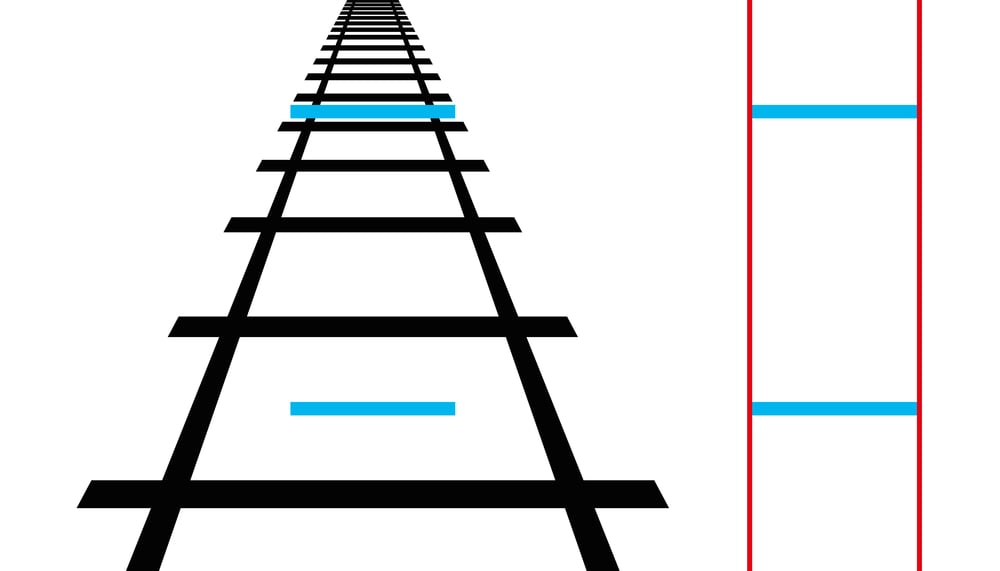
Two identical horizontal lines sit at different distances along two railroad tracks that converge toward a vanishing point. The line at the convergence point appears substantially longer, though a ruler proves they are the same length.
Your brain interprets the converging lines as receding perspective cues and assumes that an object casting the same visual angle at a greater distance must actually be larger—a size-constancy mechanism that works perfectly in the real world but fails here.
Müller-Lyer Illusion
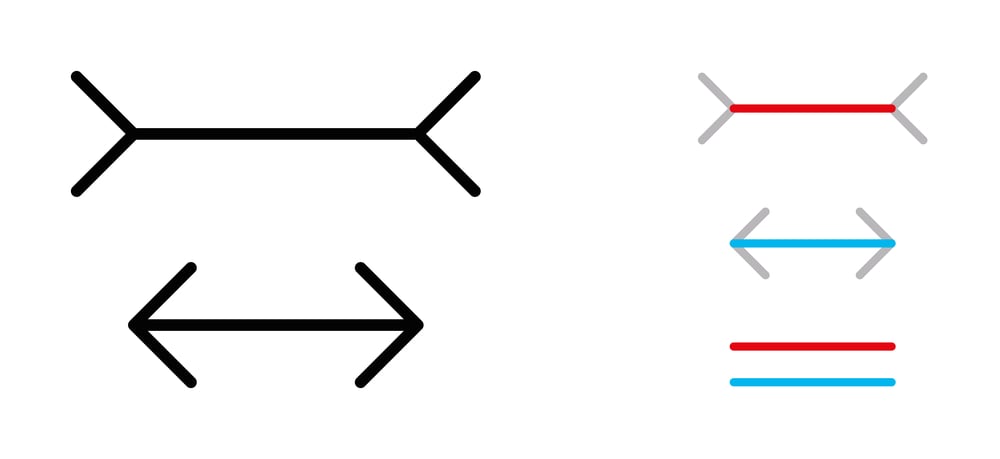
Two lines of equal length appear unequal when one has arrowheads pointing outward and the other has arrowheads pointing inward. The line with outward-pointing fins looks longer.
Your brain is filling in depth cues that aren’t there, interpreting the outward fins as a corner receding away from you and the inward fins as a corner advancing toward you, then applying size constancy rules to the perceived distances.
Ebbinghaus Illusion
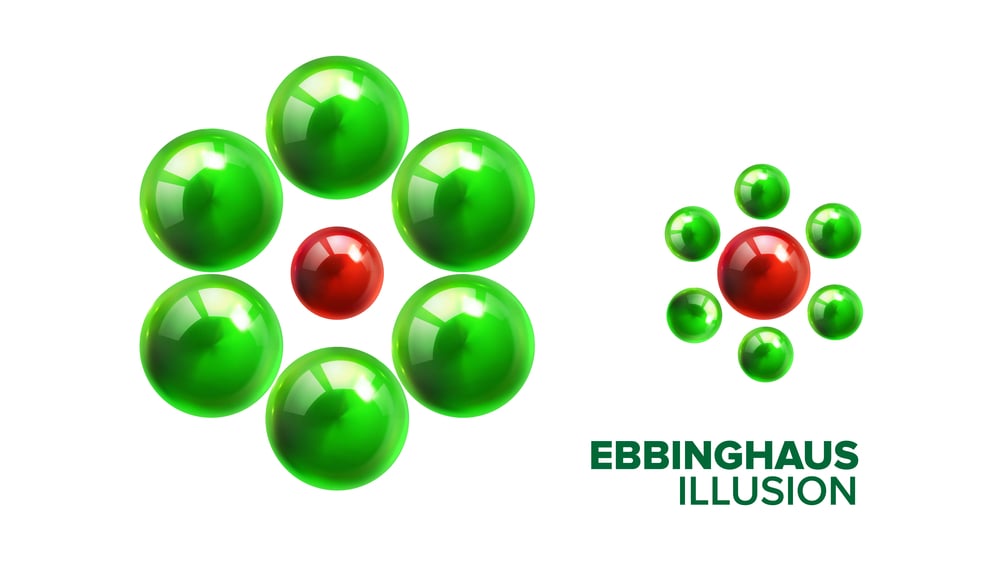
Two circles of identical size appear dramatically different when one is surrounded by smaller circles and the other by larger circles. The circle among small circles looks substantially bigger.
Your brain judges size not in absolute terms but relative to its context, using the surrounding objects as a reference scale—a filling-in process that overrides what your eye is actually measuring.
Hering Illusion
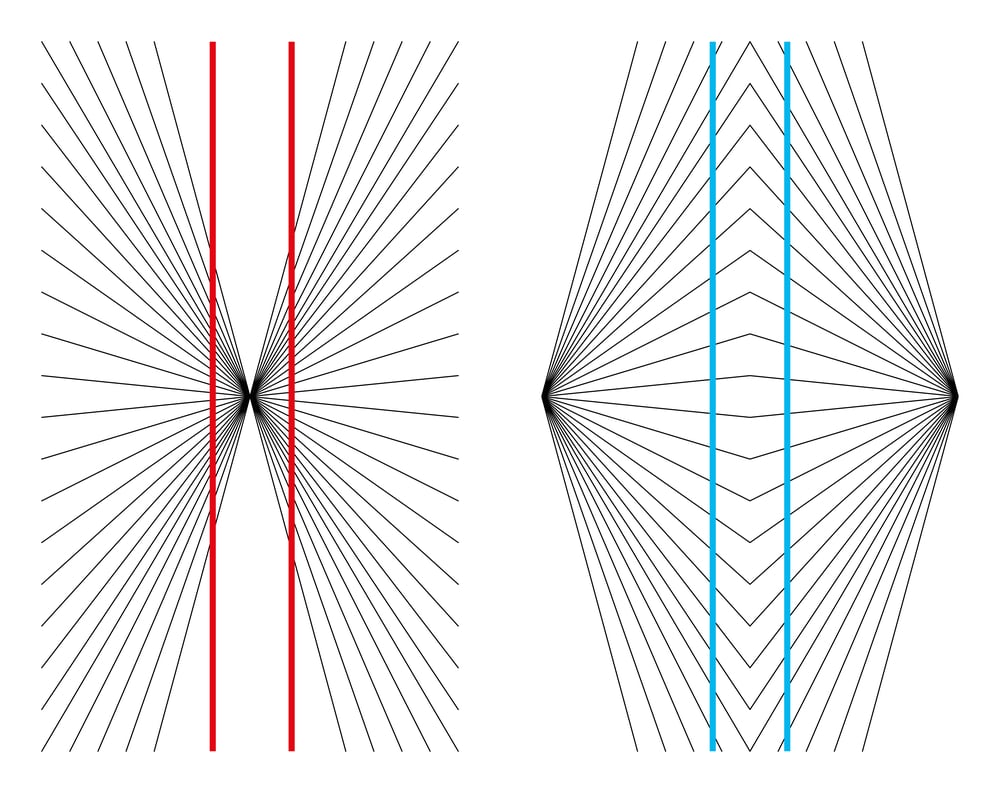
Two perfectly parallel straight lines appear to bow outward when overlaid on a radiating pattern of lines converging toward a center point. The radiating lines create such a powerful sense of perspective and three-dimensional depth that your brain distorts the parallel lines to make them consistent with the implied spatial structure.
It is filling in depth where none exists.
Zöllner Illusion
Diagonal lines placed across parallel horizontal lines make those horizontal lines appear to converge and diverge. The longer you look, the more the straight lines seem to tilt.
Your brain is interpreting the crossing angles as evidence that the lines are not actually parallel, overriding the basic geometric truth to maintain consistency with the local angle information.
Rotating Snakes Illusion
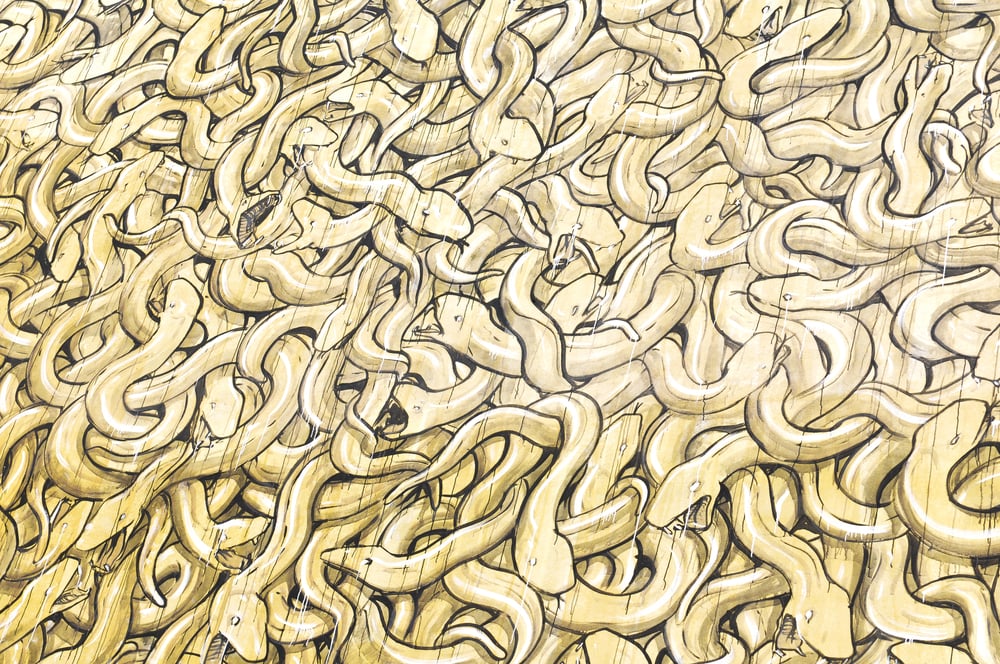
A completely static pattern of concentric circles appears to rotate, with different sections spinning in different directions depending on where your gaze falls. The illusion is created by repeating asymmetric luminance patterns that trigger motion-detector neurons in your visual cortex.
Your eye movements create the illusion, as your brain fills in smooth motion where only static edges exist.
Café Wall Illusion
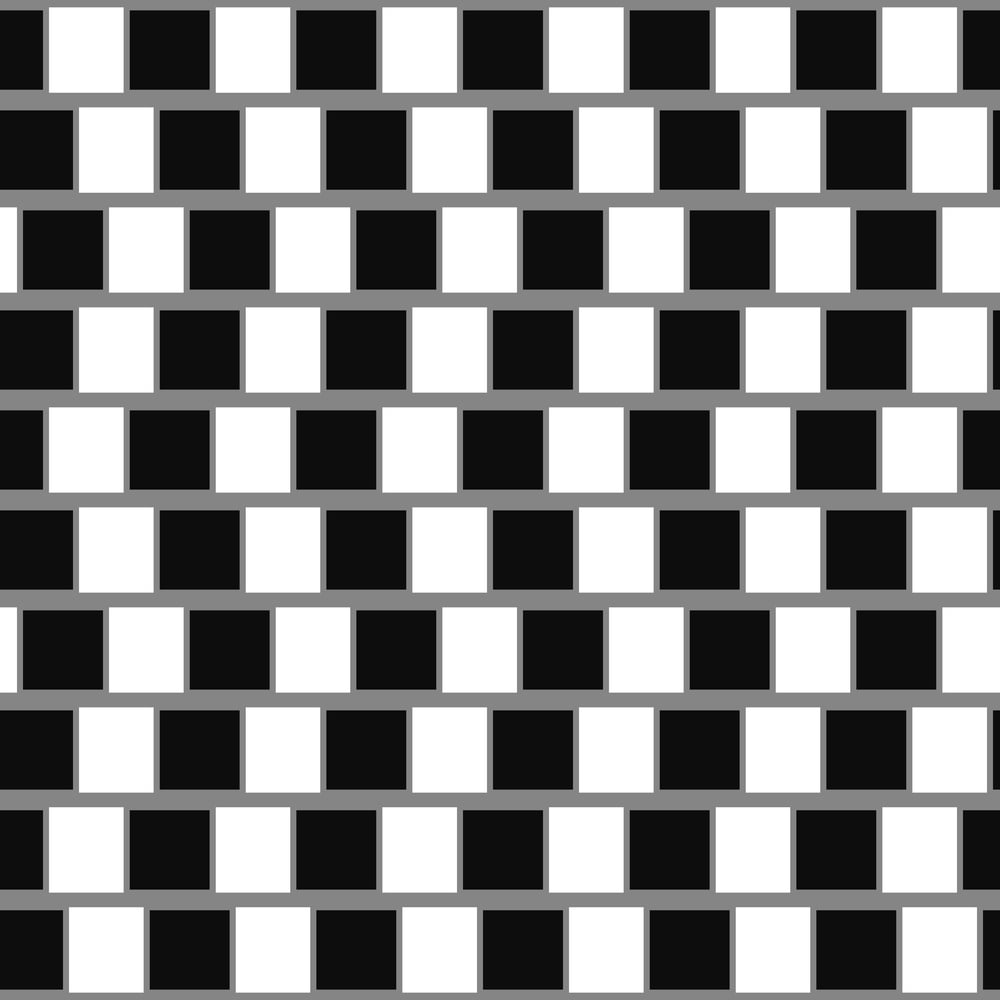
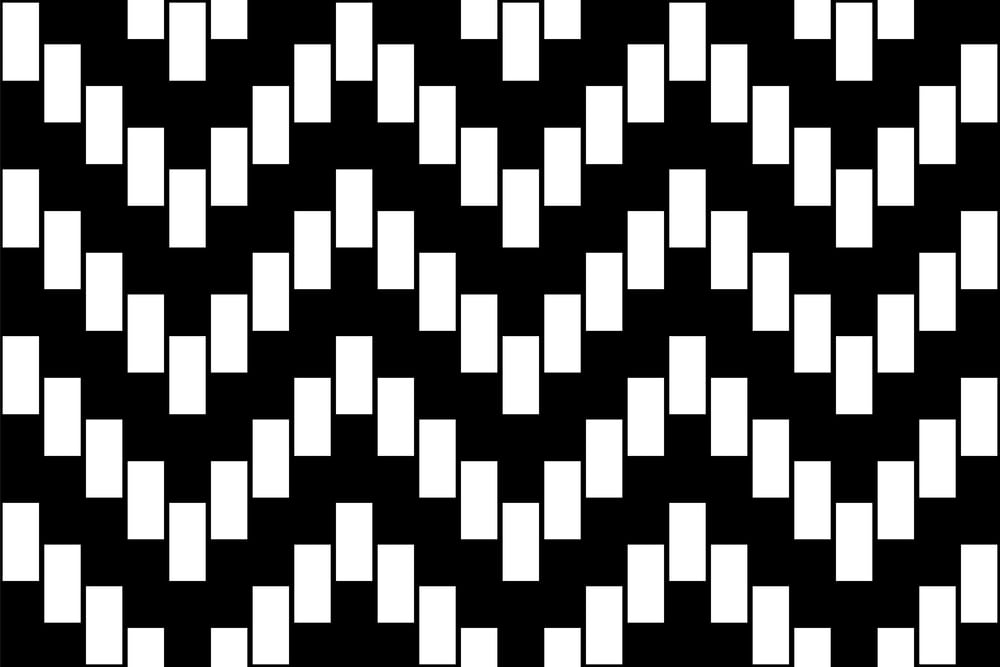
A checkerboard pattern made of offset alternating squares creates the overwhelming impression that the horizontal mortar lines are not parallel but instead form a wavy wedge pattern. The offset and contrast at each intersection fool your brain’s edge-detection systems into seeing slant where there is none.
Your brain fills in the distortion to match what the local pixel contrasts suggest.
Penrose Triangle

An impossible three-dimensional object is rendered in a flat two-dimensional drawing in such a way that each corner of the triangle, when examined individually, looks like a plausible connection. Your brain assembles these locally consistent corners into a globally impossible object, filling in a three-dimensional form that cannot exist.
It cannot resist interpreting lines as the edges of a solid structure.
Craik-O’Brien-Cornsweet Illusion

Two adjacent regions appear to have different brightness levels despite being precisely identical in luminance. An edge between them creates the illusion of a gradient, with one side appearing darker.
Your retinal ganglion cells encode images through their center-surround response properties, and your brain fills in a brightness gradient based on this encoded profile rather than the actual light hitting your eye.
Hermann Grid
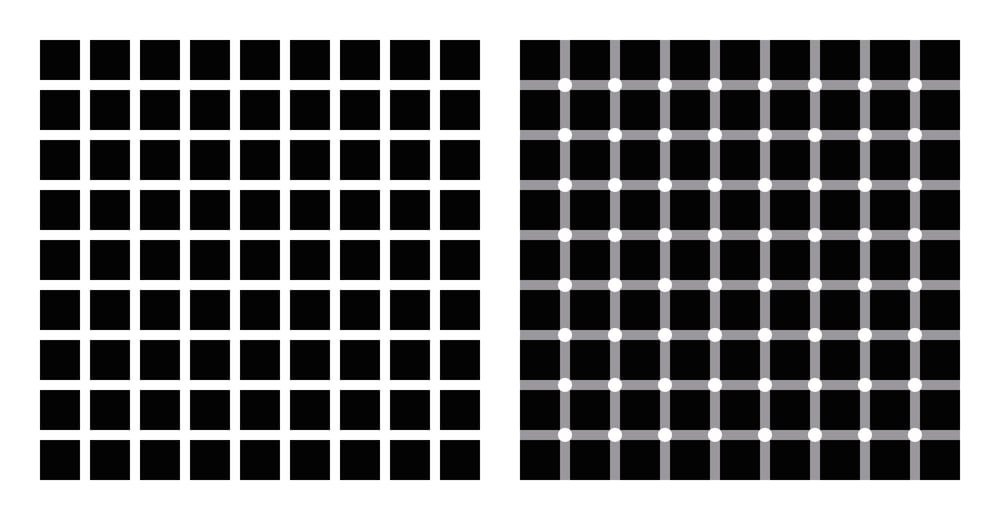
Gray smudges appear at the intersections of white lines on a black background, but vanish the instant you look directly at them. These phantom spots do not exist anywhere in the image.
Your brain is generating them through lateral inhibition in the retina: at intersections, the surrounding white area inhibits the ganglion cell response more than along the straight lines, and your brain fills in the illusory darkness.
Scintillating Grid
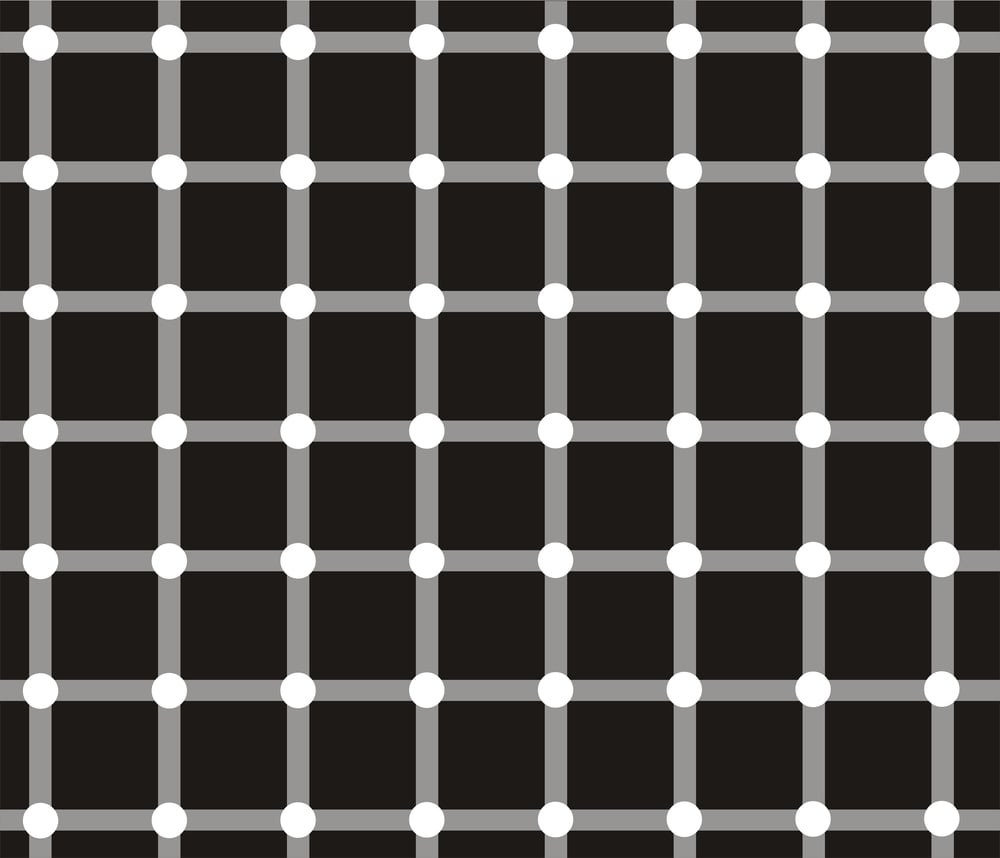
White dots at the intersections of gray lines on a black background appear to flash black at random, creating a dynamic shimmer that is more vivid than the Hermann grid. The dots themselves are actually white and stable, but your moving gaze and peripheral vision create a strobing effect that your brain fills in as flashing shadows.
This illusion does not occur when you look directly at a single intersection.
Spinning Dancer

A silhouetted figure of a woman appears to pirouette, but the direction of rotation is ambiguous—she can appear to rotate either clockwise or counterclockwise, and your perception will flip between interpretations. Your brain must infer which leg is in front and which side is closer, but the silhouette provides no depth cues to determine this.
The illusion is a bistable one that reveals how your brain fills in spatial depth where none is explicitly shown.
Duck-Rabbit
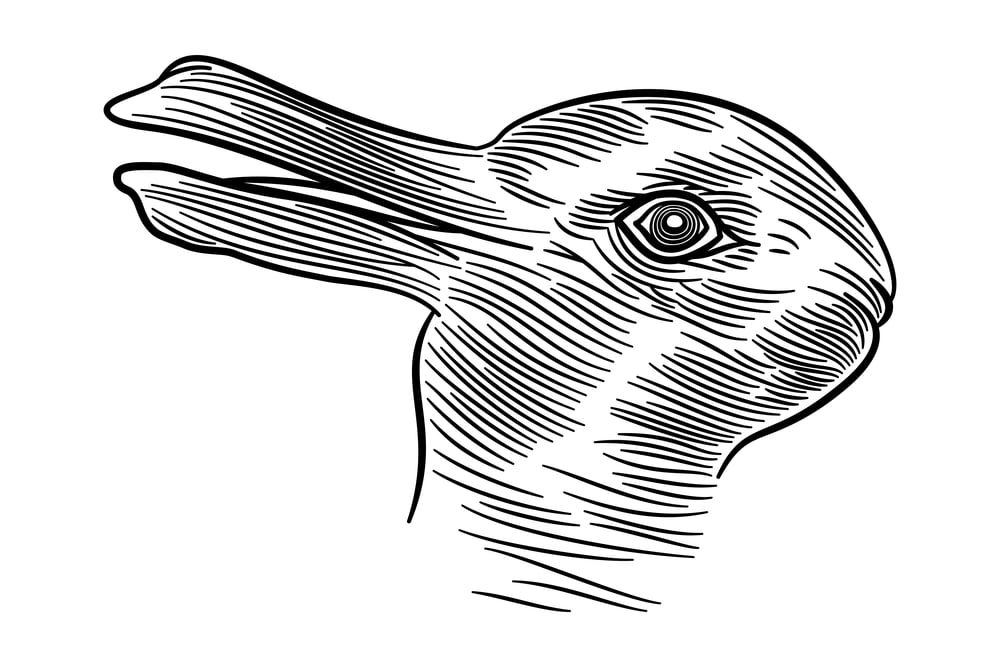
A drawing is a rabbit when the bump on the right is interpreted as an ear, and a duck when the same bump is interpreted as a bill. This ambiguous figure demonstrates that your brain does not simply decode what it sees; it actively interprets each part based on what it expects the whole object to be.
A single line can be a rabbit’s ear or a duck’s bill depending on which interpretation your brain locks onto first.
Lilac Chaser

Lilac-colored dots arranged in a circle appear to vanish one by one from your perception as you stare at the center, while a phantom green dot seems to chase the gap around the circle. No green dot is drawn, no dot actually vanishes.
Your brain is combining three phenomena—the phi phenomenon creating apparent motion, negative afterimages in the complementary color, and Troxler fading causing unchanging stimuli at the periphery to disappear from awareness.
Motion Aftereffect (Waterfall Illusion)

After staring at a downward-moving waterfall for a minute, a stationary object will appear to move upward. Your motion-detection neurons become fatigued responding to downward motion, so when you redirect them to a static image, the imbalance in neural firing leads your brain to fill in upward motion.
This illusion reveals that motion itself is not out there in the world but inside your brain’s computation.
Blind Spot Filling
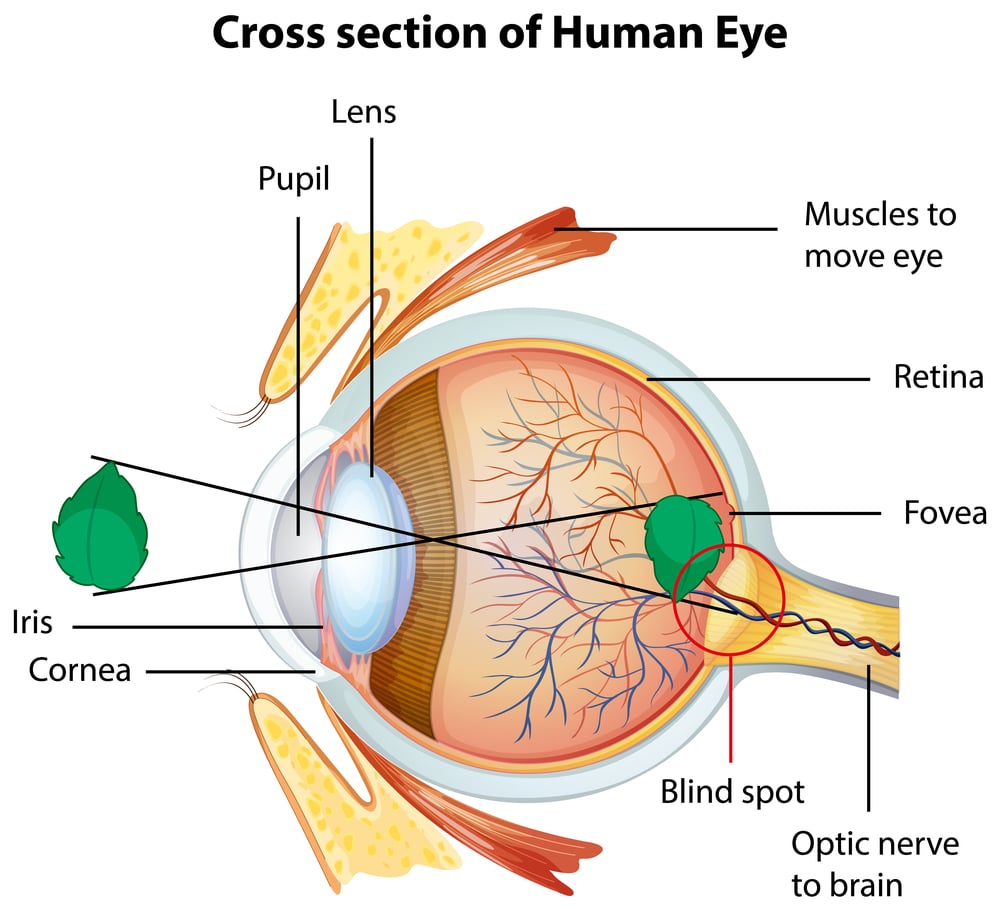
Your eye has a blind spot where the optic nerve exits the retina, creating a gap in the visual field that you never notice. If you position your gaze such that an image falls on this blind spot, it does not appear as a missing patch—your brain fills in the surrounding visual properties seamlessly, completing the picture without any sense that information is missing.
This is one of the most profound fills-in your brain performs every moment.
Ehrenstein Illusion
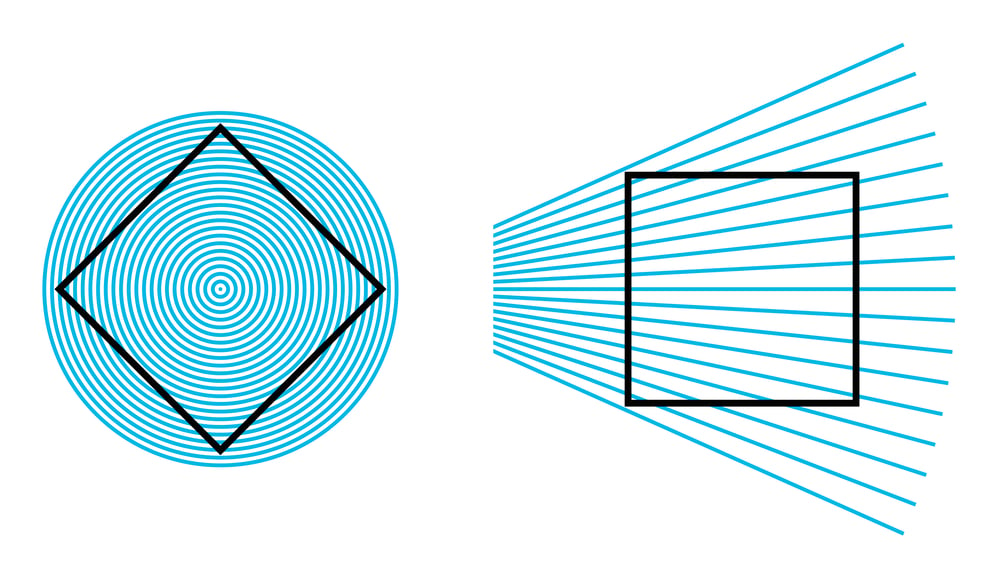
A bright disk appears in the center of a pattern of radiating lines, though no disk has been drawn. The radial lines converge toward a nonexistent center, and your brain fills in a point of convergence as a luminous object.
Your visual system is drawn toward the vanishing point and invents brightness to mark the location where all those lines would meet.
Troxler Effect
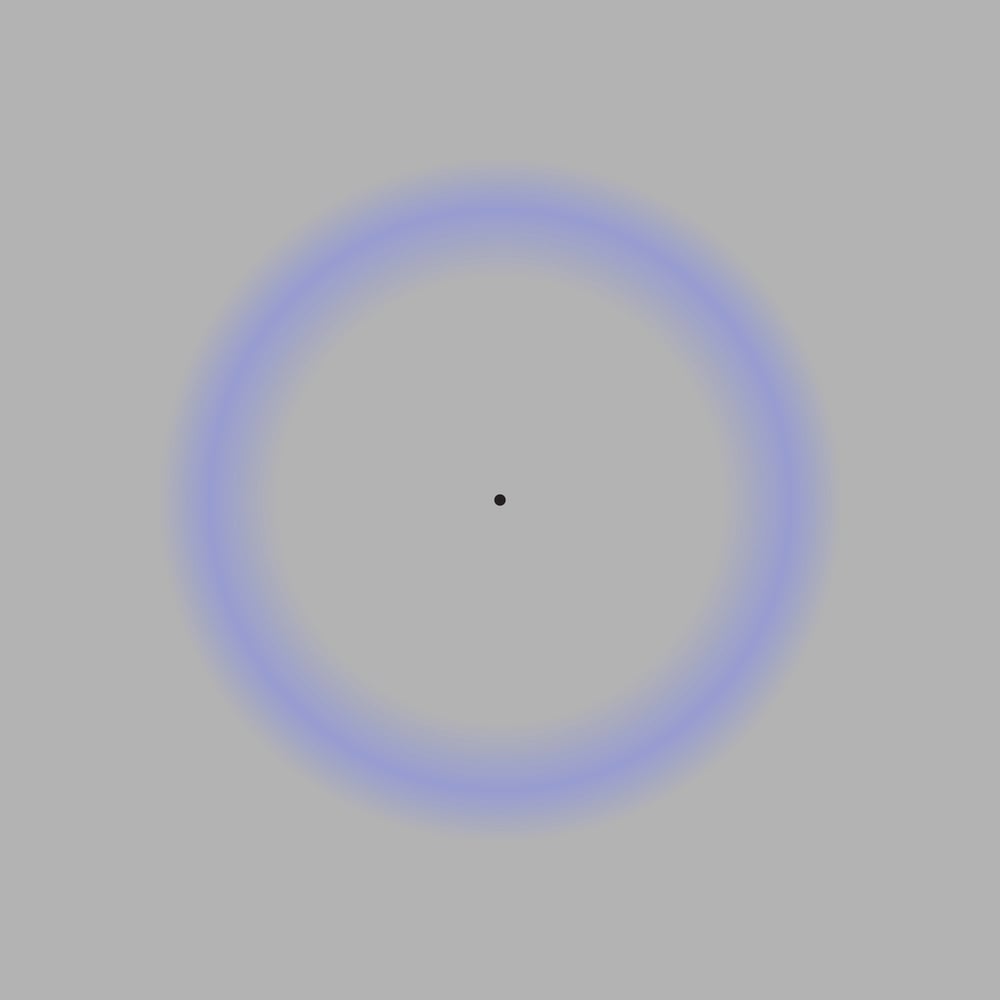
Fixate on a point while a stationary pattern sits in your peripheral vision. Within seconds, the unchanging pattern fades from awareness entirely, disappearing as though it were never there—until you move your eyes or blink, at which point it reappears.
Your brain suppresses stationary, unchanging information at the periphery, essentially filling in a blank. This reveals that perception is not a matter of detecting stimuli but of actively maintaining attention to them.
Ames Room

Viewed through a peephole, a distorted room creates the illusion that a person standing in one corner is a giant while a person in the other corner is tiny. As they move, they appear to grow or shrink in real time.
Your brain assumes the room is rectangular and applies size-constancy rules, interpreting the distorted perspective lines as distance cues. Your brain fills in the assumption of a normal room to explain what your eye is seeing.
Fraser Spiral
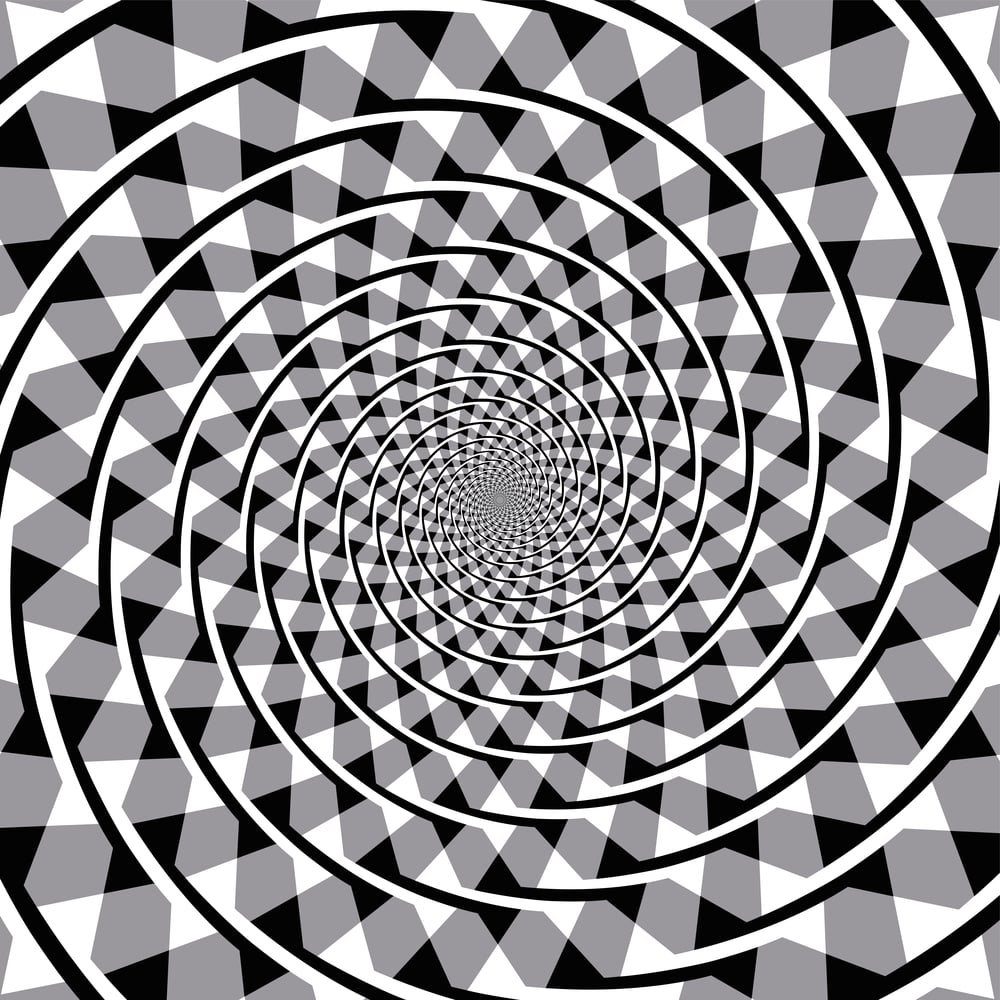
A spiral that is not a spiral appears to wind continuously inward or outward, but tracing any arc with your finger reveals it to be a series of concentric circles. Your visual system is interpreting the overlapping elements as a continuous spiral, filling in continuity where the image actually contains discontinuous segments.
This filling-in is so compelling that your finger will surprise you.
Orbison Illusion
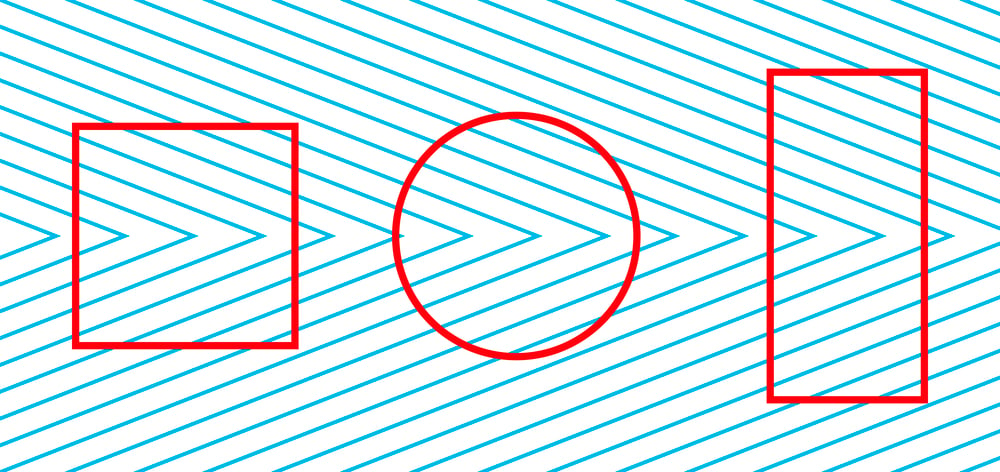
Curved lines appear distorted and bent when overlaid on a radiating pattern, though they are actually straight. The radiating lines fill your brain with a sense of three-dimensional perspective, and your visual system distorts the overlay to maintain consistency with that inferred spatial structure.
Straight lines that should be consistent with the perspective cues are subtly twisted by your brain.
Delboeuf Illusion
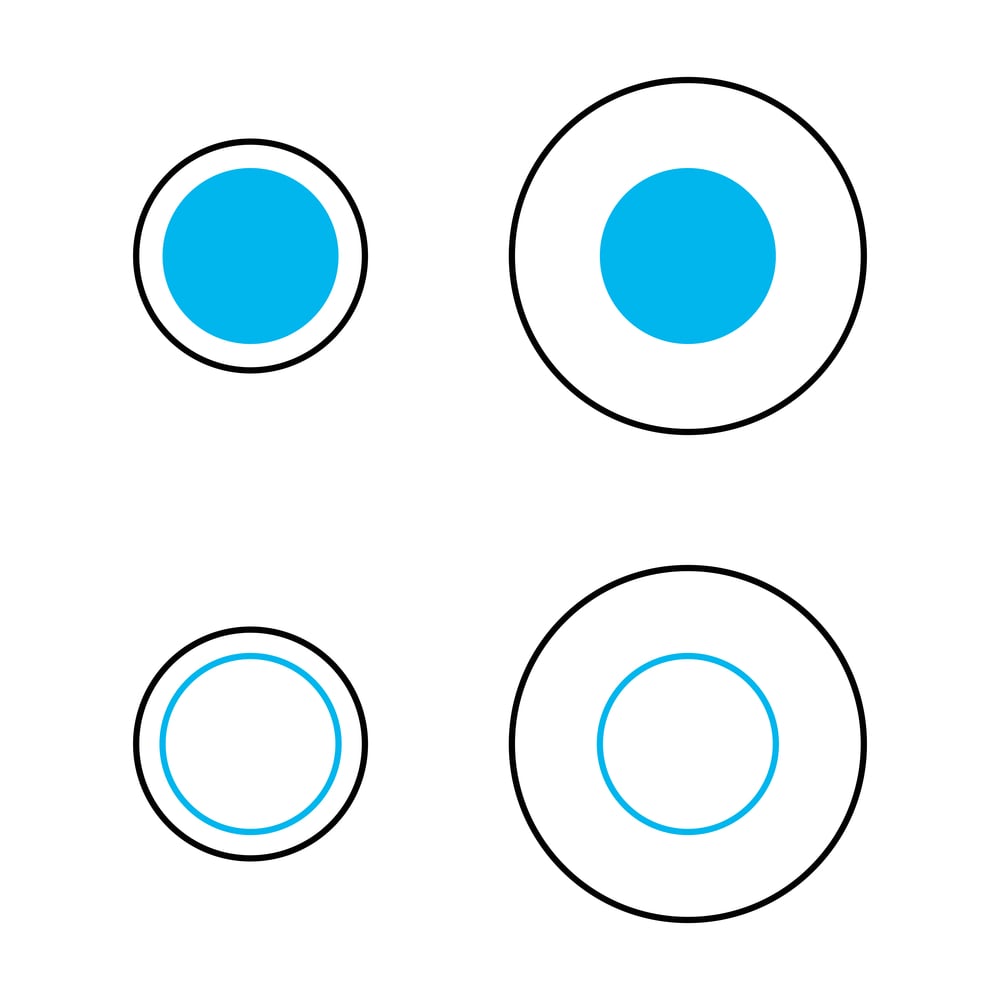
Two circles of identical size appear to be different sizes when one is surrounded by a large outer ring and the other by a small outer ring. The circle surrounded by the large ring appears smaller, while the circle surrounded by the small ring appears larger.
Your brain uses the surrounding context to fill in size judgments, causing nearby spatial relationships to influence how you perceive the central object.
Wundt Illusion
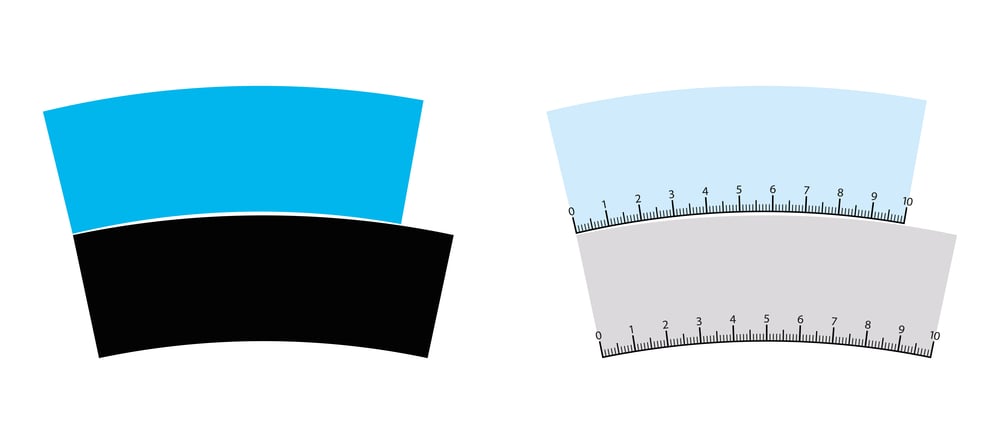
Parallel lines appear curved when cross-hatching or radiating lines are superimposed on them. The radiating structure fills your brain with depth information, and the parallel lines are perceptually distorted to be consistent with this inferred three-dimensional layout.
Your brain is filling in curvature to match the spatial structure implied by the crossing lines.
Neon Color Spreading
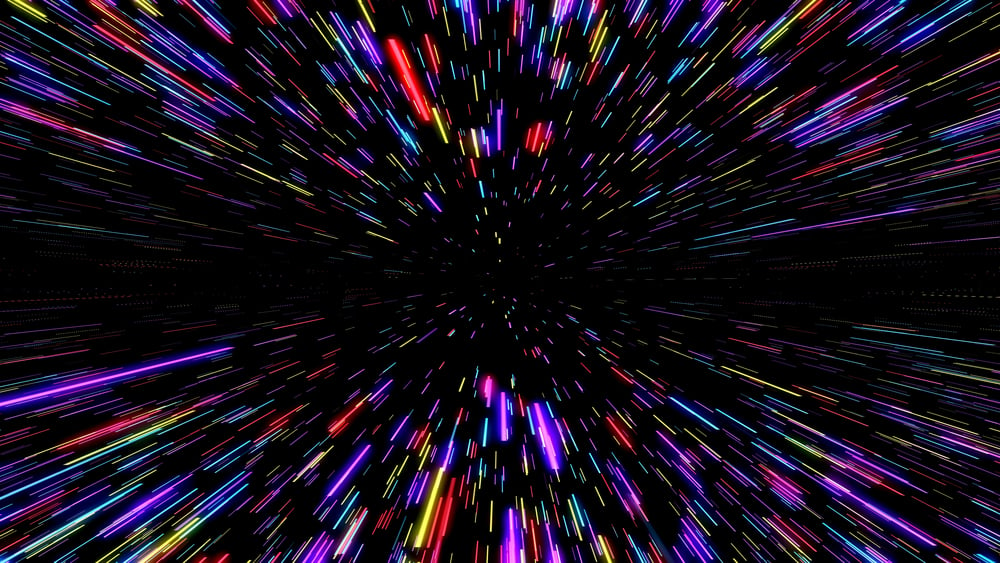
Colored line segments that are not connected to each other nonetheless appear to be filled in with a unified color spreading across the region between them. Your brain sees colored edges and fills in the region between them with that color, even though there is no luminance gradient in that area.
This illusion reveals that your brain constructs color through filling in, not just detecting it.
Perceptual Grouping

When simple shapes or dots are arranged in certain patterns, your brain automatically groups them into larger configurations, filling in relationships that connect separate elements. Proximity, similarity, and continuation all cause your brain to bind disparate pieces into wholes that are not explicitly drawn.
Your brain sees what it expects to see based on statistical regularities in the natural world.
What Your Brain Has Been Doing All Along

Every illusion in this list demonstrates the same fundamental principle: your brain does not reconstruct the world objectively but instead generates a prediction about what should be there based on incomplete sensory data. The filling-in is not a bug in your visual system but the core mechanism that allows you to see a coherent world despite the limitations of retinal input.
This process works so seamlessly in the real world that you never suspect it is happening. An illusion is simply the moment when your brain’s filling-in strategy produces a result that contradicts physical reality.
The illusions are not faults; they are proof that perception is a constructive act. You are not seeing the world—you are dreaming it while awake, and your predictions are so good that you mistake them for truth.
from Go2Tutors!

- The Romanov Crown Jewels and Their Tragic Fate
- 13 Historical Mysteries That Science Still Can’t Solve
- Famous Hoaxes That Fooled the World for Years
- 15 Child Stars with Tragic Adult Lives
- 16 Famous Jewelry Pieces in History
Like Go2Tutors’s content? Follow us on MSN.