Computer Lab Games That Defined Our Childhood
That classroom felt different somehow. Down the hall it waited, filled with the low buzz of screens flickering to life, air thick with dust and plastic warmth.
Usually some typing came first – basic stuff in a blank document. But once that was done – if the clock moved slow or the adult wasn’t strict – a window opened.
Twenty quiet minutes could mean riding dusty trails on a glowing terminal or moving unseen through shadows as a figure in red.
Out of nowhere, those games changed how a whole group of young people saw school and computers. History class felt like staying alive in pretend disasters.
Geography became chasing clues across continents. A lot of children experienced their very first video game through them.
Even now, after so much time has passed, they spark strong memories without really trying.
The Oregon Trail

No computer lab game casts a longer shadow. Created by three Carleton College student teachers—Don Rawitsch, Bill Heinemann, and Paul Dillenberger—in 1971 and later developed by the Minnesota Educational Computing Consortium (MECC), The Oregon Trail became the defining educational game of its era.
More than 65 million copies have been sold, making it the most widely distributed educational game of all time.
The premise was simple enough: lead your wagon party from Independence, Missouri, to Oregon’s Willamette Valley in 1848. What made it memorable was everything that could go wrong along the way.
Broken axles. Exhausted oxen. Rivers that looked shallow until they weren’t.
And, of course, dysentery.
The 1985 Apple II version introduced the hunting mini-game that most people remember—a crude but satisfying shooting gallery where you could bag far more bison than your wagon could ever carry. But the game’s real genius was its randomness.
Death came without warning and often without logic. You could do everything right and still watch your family succumb to cholera outside Fort Laramie.
That randomness actually reflected historical reality. Around 5-10% of real Oregon Trail pioneers died on the journey.
The game didn’t sugarcoat westward expansion, even if it mostly ignored the perspectives of Native Americans whose lands settlers were crossing.
“You have died of dysentery” became a meme decades before memes had a name.
Where in the World Is Carmen Sandiego?

Geography class was boring. Chasing an international super-thief across continents while gathering clues about her henchmen?
That was an entirely different proposition.
Broderbund released the first Carmen Sandiego game in 1985, bundled with a copy of the World Almanac that players actually had to reference to solve cases. The game created a female villain who was sophisticated, elusive, and genuinely cool—an unusual choice for the era that gave young girls someone to connect with, even if that someone was technically the bad guy.
By 1991, the franchise had sold over 2 million copies and spawned a PBS game show that ran until 1996. Lynne Thigpen as “The Chief” and the a cappella group Rockapella’s theme song became permanent fixtures in the memories of kids who watched.
The show won six Daytime Emmy Awards.
The games taught more than just capital cities and flag colors. They introduced deductive reasoning through clue-gathering.
If a witness mentioned someone asking about tulips and Dutch painters, you learned to book your flight to Amsterdam. The puns were terrible.
The learning was effective.
Number Munchers

If The Oregon Trail was the crown jewel of MECC’s catalog, Number Munchers was the scrappy workhorse that showed up more often. Released in 1986 for the Apple II, the game turned math drills into something kids actually wanted to do.
Your character—a green, square-shaped muncher—navigated a grid eating numbers that matched whatever criteria appeared at the top of the screen. Multiples of seven.
Prime numbers. Factors of 24.
Get the right ones, move on. Eat a wrong answer, lose a life.
Get caught by a Troggle—one of the game’s wandering enemies—and you’d lose a life too.
Teachers loved it because it reinforced multiplication tables and number sense. Kids loved it because it felt like a game, not homework.
Some teachers used computer time with Number Munchers as a reward for finishing tests early. Others had students compete for high scores.
The premise was dead simple. That was the point.
Kid Pix

Not every computer lab game was educational in the traditional sense. Kid Pix, released by Broderbund in 1991, existed purely to let kids create.
And destroy.
Craig Hickman developed the program after watching his three-year-old son struggle with MacPaint. The goal was a drawing application so intuitive that a toddler could use it without help.
Every brush made sounds—splats, pops, and squishes. Every tool produced something immediately satisfying.
And when you finished a drawing? You could blow it up with dynamite.
The “Undo Guy” who shouted “Oh no!” when you clicked the undo button. The talking alphabet stamps.
The hidden pictures that appeared when you erased in certain patterns. Kid Pix wasn’t trying to teach math or reading.
It was teaching creativity and experimentation.
Many graphic designers and artists who grew up in the 1990s point to Kid Pix as their first exposure to digital art tools. It won multiple software awards in 1991, including recognition from the Software Publishers Association for best user interface.
For a program made on a budget smaller than most video games of its era, it left an outsized mark.
Math Blaster

If Number Munchers was subtle about making math feel like a game, Math Blaster threw subtlety out the window. Created by educator Jan Davidson in 1983, the series combined arcade shooting mechanics with arithmetic drills in a way that felt genuinely exciting.
The 1993 version, Math Blaster Episode I: In Search of Spot, became the most iconic iteration. Players controlled a space-faring Blasternaut solving math problems to rescue their robot companion.
Get the answer right, blast the asteroid. Get it wrong, and you might drift into space.
By November 1985, the original Math Blaster had spent 92 weeks on Billboard’s Top Education Computing Software chart, landing at number two. The series went on to become the best-selling math software in history.
Schools bought it by the truckload. Parents who otherwise knew nothing about educational software recognized the name.
The franchise spawned spin-offs covering reading, science, and even algebra. Davidson & Associates grew into an educational software giant partly on the strength of this one concept: make the learning feel like playing.
Mavis Beacon Teaches Typing

She wasn’t real. That revelation hit hard for anyone who spent hours with Mavis Beacon Teaches Typing, the 1987 program that promised to turn hunt-and-peck typists into keyboard masters.
The Software Toolworks created “Mavis Beacon” as a fictional character to give their typing program a face. The image came from a Haitian model named Renee L’Esperance, who was paid $500 for the photo shoot and received no royalties from the program’s success.
A 2024 documentary called Seeking Mavis Beacon explored her story.
None of that backstory mattered to the kids racing virtual cars by typing accurately or competing against classroom friends for highest words-per-minute scores. The program tracked progress with surprising sophistication, adjusting lessons based on which keys you struggled with most.
By 1999, the series had sold over six million copies. Two versions appeared on the Top Selling Educational Software list in 2000.
For an entire generation, “typing class” and “Mavis Beacon” were synonyms.
The Incredible Machine

Building Rube Goldberg machines became possible for anyone with a PC after Sierra On-Line released The Incredible Machine in 1993. Kevin Ryan programmed it on a budget of just $36,000, and the result won awards and spawned a devoted following.
Each level presented a simple goal: drop a marble in a basket, turn on a fan, pop a balloon. Getting there required arranging an absurd collection of objects—trampolines, conveyor belts, magnifying glasses, even cats and mice—in precisely the right configuration.
Hit play and watch your contraption either succeed spectacularly or fail in hilarious ways.
The physics simulation was surprisingly sophisticated. Air pressure and gravity could be adjusted.
Objects interacted in ways that felt genuinely logical, even when the machines themselves were anything but. Teachers appreciated how the game taught cause and effect.
Kids appreciated how it let them build ridiculous chain reactions.
The “freeform” mode lets players ignore objectives entirely and just experiment. Many kids spent more time there than in the actual puzzles.
SimCity 2000
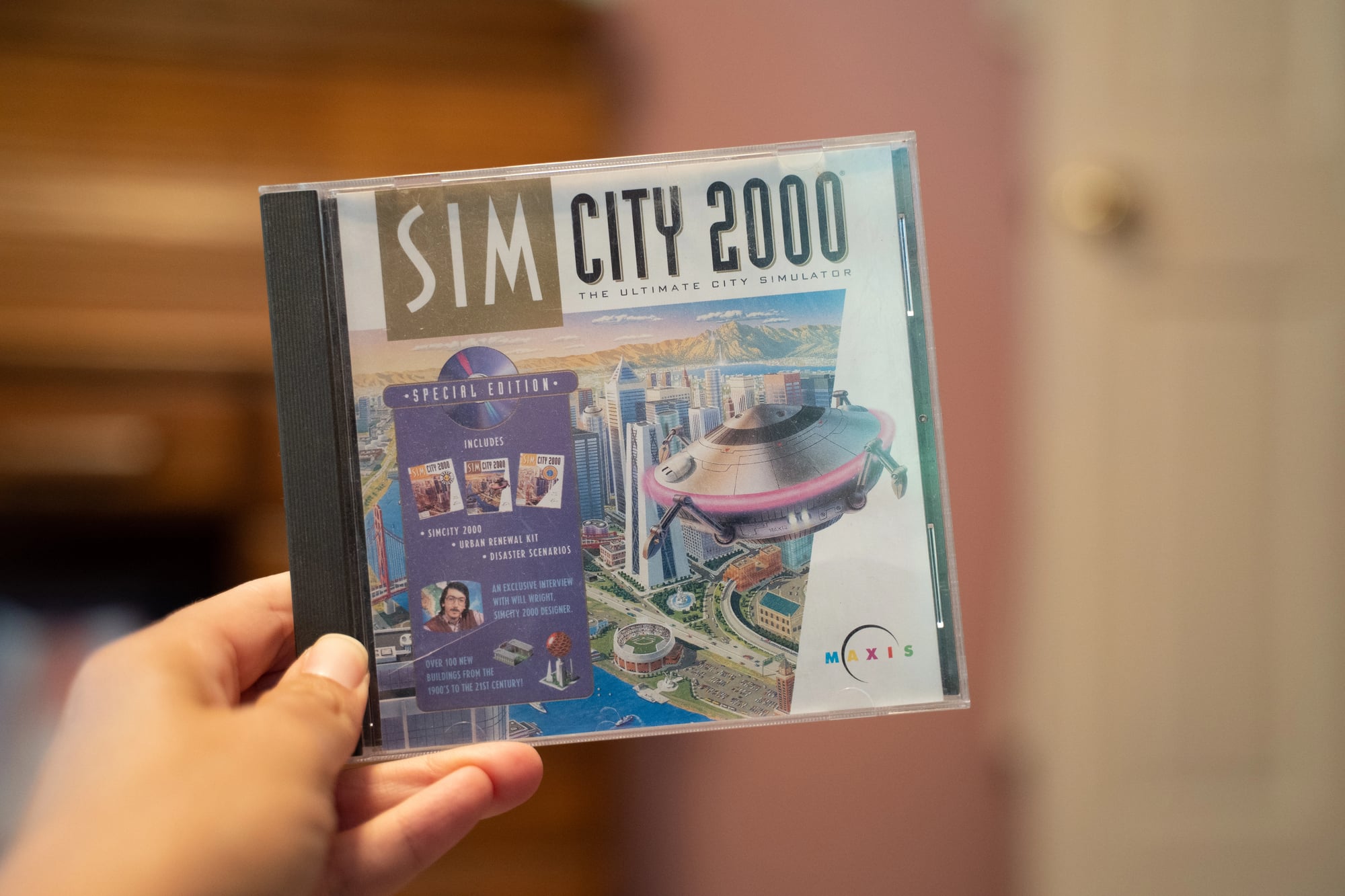
Will Wright’s city-building simulation wasn’t designed for classrooms, but it showed up there anyway. SimCity 2000, released by Maxis in 1993, improved on its predecessor with isometric graphics, underground infrastructure, and enough complexity to keep players busy for years.
Teachers found ways to justify it. Urban planning concepts.
Budget management. Environmental cause and effect.
The game made abstract civics lessons tangible. Want to know what happens when you build a coal plant upwind from residential zones?
Watch your pollution stats climb and your citizens complain.
Some schools let kids play SimCity 2000 openly as an “educational game.” Others had to be more creative about when they opened the program.
Either way, building a city from scratch and watching it grow—or crumble under mismanagement—provided a kind of hands-on learning that textbooks couldn’t match.
The game sold 1.4 million copies in the United States between 1993 and 1999, and 3.4 million worldwide by 2002.
The Magic School Bus Series
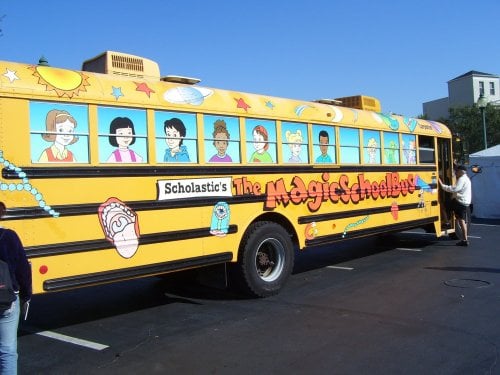
When the animated series hit PBS in 1994, Scholastic and Microsoft collaborated to release CD-ROM games that brought Ms. Frizzle’s impossible field trips to home computers. The Magic School Bus Explores the Solar System came out within two weeks of the show’s premiere.
Eight games followed over the next six years, covering topics from the human body to ocean life to rainforests. Each one used the same basic formula: explore freely, click on everything, complete mini-games, and collect items for a final challenge.
The bus served as a home base, transforming into whatever vehicle the journey required.
The games won multiple awards, including Software Publisher’s Association recognition for best elementary educational titles. They successfully translated the show’s sense of wonder and humor into interactive form.
Arnold’s anxious worrying. Carlos’s puns.
Ms. Frizzle’s cheerful willingness to shrink everyone down and send them through a digestive tract.
For science education specifically, these games hit a sweet spot between entertainment and actual information.
Putt-Putt and the Humongous Universe

Humongous Entertainment understood something that other educational game makers often missed: young kids don’t need math problems disguised as games. They need adventures that happen to teach things along the way.
Putt-Putt, the purple anthropomorphic car created by Shelley Day and developed starting in 1992, starred in a series of point-and-click adventures aimed at children aged 3-8. The gameplay was simple—click to move, click to interact—but the worlds were richly animated and full of personality.
Putt-Putt Saves the Zoo. Putt-Putt Travels Through Time.
Putt-Putt Goes to the Moon.
Each game sent players through colorful environments solving gentle puzzles and collecting objects. Hidden animations rewarded curious clicking.
The tone stayed consistently warm and encouraging.
Humongous Entertainment, co-founded by Ron Gilbert of Monkey Island fame and Shelley Day, applied point-and-click adventure design principles to children’s games. Pajama Sam tackled childhood fears like darkness.
Freddi Fish solved underwater mysteries. Spy Fox parodied James Bond for elementary schoolers.
Combined, the company’s games sold over 15 million copies and won more than 400 awards.
The games never talked down to their audience. That respect came through in every carefully animated detail.
Logical Journey of the Zoombinis

Pattern recognition and logical deduction got their own dedicated champion in 1996 when TERC and Broderbund released Logical Journey of the Zoombinis. The setup involved guiding 16 small blue creatures—each with different combinations of hair, eyes, nose color, and feet—through a series of increasingly difficult puzzles.
The first puzzle, Allergic Cliffs, required sorting Zoombinis across two bridges based on hidden rules about their features. Get it wrong, and a Zoombini bounced back with a sneeze.
Get it right, and you moved one step closer to safety. Each subsequent puzzle introduced new logical concepts: set theory, Venn diagrams, hypothesis testing.
The Washington Post noted that the game taught “how to think” rather than any specific skill. That was intentional.
TERC researchers designed each puzzle around mathematical reasoning concepts that would translate to real-world problem solving.
Players had to rescue all 625 possible Zoombini combinations to fully complete the game. Many kids never got there.
Many adults never got there either. The difficulty ramped up genuinely, not artificially, making later puzzles legitimate brain-teasers.
A 2015 remake funded through Kickstarter brought the game to modern devices. The National Science Foundation awarded TERC nearly $2 million to study how much “computational thinking” children developed while playing.
Reader Rabbit

Before many of these games existed, Reader Rabbit was already teaching kids to read. The Learning Company released the first Reader Rabbit game in 1984, making it one of the earliest educational software titles for home computers.
The series focused on language arts: letters, phonics, spelling, reading comprehension. The fuzzy orange rabbit guided players through activities designed for children from preschool through second grade.
By 1995, The New York Times noted that the flagship title was “unusual in crossing over from home use to in-school, curriculum-based learning.”
The games used repetition without making it feel repetitive. Short attention spans were accommodated with varied mini-games and frequent rewards.
Progress was tracked so kids could pick up where they left off.
By 2002, Reader Rabbit had become an “educational staple in schools and homes” with what the Times called a long tradition of “quality educational software.” The series eventually expanded far beyond reading to include math and other subjects, but reading remained its core identity.
JumpStart

Knowledge Adventure’s JumpStart series organized educational content by grade level, creating a kind of one-stop shop for parents and teachers looking for age-appropriate software. JumpStart First Grade.
JumpStart Kindergarten. JumpStart Third Grade.
Each title combined multiple subjects into adventure-game frameworks.
The games were enormously popular in the late 1990s and early 2000s. Schools purchased site licenses.
Parents bought copies for home use. The structure made sense: get one program that covered everything your kid needed for their grade level, wrapped in cartoon characters and point-and-click gameplay.
JumpStart Adventures: Third Grade – Mystery Mountain became particularly beloved, combining educational challenges with a legitimate mystery storyline. Players helped a girl named Polly solve puzzles to rescue robots scattered throughout a mountain hideout.
The franchise eventually merged with Math Blaster’s parent company, creating a combined catalog of educational titles that dominated the market for years.
Where the Pixels Still Glow

A classroom full of computers now feels like another world compared to 1995. Those green-glowing Apple II monitors have vanished without a trace.
Floppy disks once clicked and spun – now they sit forgotten. Today’s students tap away on sleek devices that would baffle past generations.
Yet one idea survived all these changes. Back then, some games quietly showed learning could be fun too.
It turned out children leaned into math, reading, history – when framed a certain way. Millions found connection through moments built just for them, despite coming from different worlds.
For folks in their thirties and forties today, hearing “dysentery” stirs something deep. Then there’s Carmen Sandiego – remember chasing her across maps?
Mavis Beacon once guided fingers tapping on keyboards. Solving that last Zoombinis riddle felt like cracking a code nobody else could.
And setting off dynamite in Kid Pix? That wasn’t random chaos – it was pure freedom drawn in pixels.
Back then, nobody realized those games were doing more than filling class hours. A whole crowd of young learners started understanding computers without even noticing.
Fun slipped in where lessons usually lived, long before that idea got a name. For plenty of children who later built websites, taught classrooms, or sketched interfaces, it began right there at clunky keyboards.
Screens have vanished from desks. What stuck was what happened behind them.
More from Go2Tutors!

- The Romanov Crown Jewels and Their Tragic Fate
- 13 Historical Mysteries That Science Still Can’t Solve
- Famous Hoaxes That Fooled the World for Years
- 15 Child Stars with Tragic Adult Lives
- 16 Famous Jewelry Pieces in History
Like Go2Tutors’s content? Follow us on MSN.



