Facts About the Vanished US Colony Of Roanoke
In 1587, over 100 English settlers arrived on Roanoke Island off the coast of what’s now North Carolina, hoping to build a new life in the Americas. Three years later, when supply ships finally returned, every single person had disappeared without a trace.
The only clue left behind was a single word carved into a wooden post, and to this day, nobody knows for sure what happened to them. The mystery of the Lost Colony has puzzled historians, archaeologists, and amateur detectives for over 400 years.
Here are the strange facts about one of America’s oldest unsolved mysteries.
The Settlers Arrived At The Worst Possible Time

Governor John White led 117 colonists to Roanoke Island in July 1587, which meant they had only a few months to build shelters, plant crops, and prepare for winter. The timing couldn’t have been worse for establishing a new settlement in unfamiliar territory.
They were supposed to go to the Chesapeake Bay area, but the ship’s crew refused to take them any farther and dumped them at Roanoke instead. The island had already seen one failed English colony just two years earlier, and the local Native American tribes weren’t exactly thrilled to see more English people showing up.
Virginia Dare Was The First English Child Born In America

Just days after the colonists arrived, Eleanor Dare gave birth to a baby girl on August 18, 1587. They named her Virginia after the Virginia territory where Roanoke Island sat.
She became the first English child born in what would eventually become the United States. Her grandfather was Governor John White, who would soon make a decision that separated him from his daughter and granddaughter forever.
Virginia Dare was only nine days old when White left the colony, and he never saw her again.
The Governor Left His Family Behind And Couldn’t Get Back For Three Years

Governor White sailed back to England in late August 1587 to get more supplies for the struggling colony. He left behind his daughter, newborn granddaughter, and all the other settlers with a promise to return quickly.
But when he reached England, he found the country preparing for war with Spain. Queen Elizabeth I had banned all ships from leaving English ports because she needed every vessel to fight the approaching Spanish Armada.
White tried desperately to return to his family but couldn’t get permission or find a ship willing to make the dangerous Atlantic crossing during wartime.
The Spanish Armada Delayed The Rescue Mission
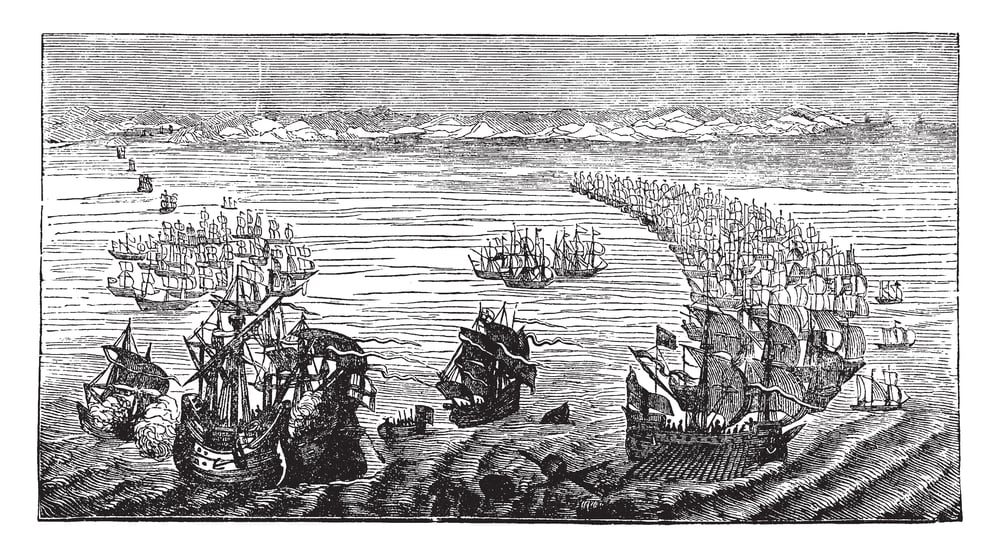
In 1588, Spain sent a massive fleet of 130 ships to invade England in what became known as the Spanish Armada. England needed every available ship and sailor to defend against this threat, which meant Governor White’s rescue mission got pushed aside.
The English navy defeated the Spanish fleet, but the victory came at a cost for the Roanoke colonists. By the time ships became available again and White could organize a return voyage, years had passed.
The delay would prove fatal for any hopes of finding the colonists alive.
The Only Clue Was The Word ‘CROATOAN’ Carved In A Post

When White finally returned to Roanoke in August 1590, he found the settlement completely abandoned. Houses had been taken apart carefully, suggesting the colonists left on purpose rather than fleeing in panic.
On a wooden post at the entrance to the fort, someone had carved the word ‘CROATOAN’ in capital letters. White had told the colonists before he left that if they had to move, they should carve their destination into a tree or post.
If they left under attack or in danger, they were supposed to carve a Maltese cross above the message, but there was no cross anywhere.
Croatoan Was A Nearby Island With Friendly Natives

Croatoan Island, now called Hatteras Island, sat about 50 miles south of Roanoke. The Croatoan tribe who lived there had been friendly with the English colonists, and one of their leaders, Manteo, had even traveled to England with earlier explorers.
White assumed his colonists had moved to Croatoan Island to live with this friendly tribe. It seemed like the most logical explanation, and White desperately wanted to sail there immediately to find his family.
Unfortunately, a massive storm hit before he could make the journey, damaging his ships and forcing him back to England.
A Severe Drought Made Survival Nearly Impossible

Scientists studying ancient tree rings discovered that the Roanoke colonists arrived during the worst drought in 800 years. The drought lasted from 1587 to 1589, making it almost impossible to grow crops or find fresh water.
Even the Native American tribes who knew the land well struggled to find enough food during this period. The English colonists, who didn’t know how to find food in this new environment, would have faced starvation.
This drought might explain why the colonists decided to leave Roanoke and join the Croatoan tribe, who would have had better knowledge of where to find food and water.
The Colonists Had Terrible Relations With Local Tribes

The English colonists had burned a Native American village just weeks after arriving at Roanoke. They suspected the villagers had stolen a silver cup from their earlier settlement, so they retaliated by destroying the entire village and its crops.
This wasn’t even the right village responsible for the theft, which made relations with the local tribes even worse. Several violent incidents had occurred between the English and various Native American groups in the area.
Some historians believe angry tribes might have attacked the colony after White left, though the careful dismantling of the settlement suggests otherwise.
Ships Kept Spotting Fires On The Coast But Never Investigated

For years after the colony disappeared, English ships sailing along the Carolina coast reported seeing large fires burning on shore. Some captains believed these might be signals from the lost colonists trying to get attention.
However, none of these ships stopped to investigate because they were on trading missions and didn’t want to risk the dangerous shoals and shallow waters near the coast. The fires could have been from Native American tribes, or they might have been desperate attempts by surviving colonists to signal passing ships.
Nobody bothered to check, and the fires eventually stopped appearing.
Archaeologists Found English Artifacts Mixed With Native American Sites

Modern archaeological digs on Hatteras Island have uncovered English items like sword handles, gun parts, and metal tools buried in Native American village sites from the late 1500s. These artifacts date to the exact period when the Roanoke colonists disappeared.
The items were found mixed with Native American pottery and tools, suggesting English people lived alongside the Croatoan tribe. Some of these artifacts show signs of being reworked or repaired using Native American techniques, indicating the English colonists might have integrated into the tribe rather than dying out.
Local Native American Legends Mention Pale-Skinned People

When English colonists returned to the area decades later to establish Jamestown, they heard stories from Native American tribes about people with light skin and European features living in inland villages. Some tribes told tales of people who could ‘talk from a book,’ which the English took to mean reading and writing.
A few Native American families in the region had members with gray eyes and lighter skin, which was extremely unusual and suggested European ancestry. These oral histories have fueled theories that at least some colonists survived by marrying into local tribes and moving inland away from the coast.
The Colonists Might Have Split Into Two Groups

Recent archaeological evidence suggests the Roanoke colonists might have divided into at least two groups when they left the island. One group likely went south to Croatoan Island, while another group may have traveled inland to live with tribes near the Chowan River.
Maps from that era show markings that might indicate English settlements in both locations. Splitting up would have made sense as a survival strategy, since it reduced the number of mouths to feed in any one location and increased the chances that at least some colonists would survive.
A Ring With A Lion Crest Turned Up 50 Miles From Roanoke

Archaeologists discovered a gold ring engraved with a prancing lion at a site near Cape Creek on Hatteras Island. The ring dates to the 16th century and matches the style worn by English gentry of that period.
Records show that several Roanoke colonists came from families whose coats of arms featured lions. The ring was found buried in a layer of soil from the late 1500s, right when the colonists would have arrived on the island.
This discovery provides physical evidence that at least some colonists made it to Croatoan Island as the carved message suggested.
The Lumbee Tribe Might Be Descendants Of The Colonists

The Lumbee people of North Carolina have maintained for generations that they descended partly from the Roanoke colonists. When Europeans first encountered the Lumbee in the 1700s, they found tribe members with European features, gray eyes, and English surnames like Dare.
The Lumbee spoke an English dialect mixed with their native language and practiced a form of Christianity. DNA studies have been inconclusive, but some Lumbee families have genetic markers suggesting European ancestry dating back to the late 1500s.
The tribe’s location, inland from Roanoke but within walking distance, matches where colonists might have traveled.
Spanish Spies Were Watching The English Colony

Spanish officials in Florida knew about the Roanoke colony and considered it a threat to their own colonial claims in the region. Spanish spy reports from 1588 mention plans to attack and destroy the English settlement at Roanoke.
One Spanish document describes a mission to ‘eliminate the English colonists’ before they could establish a permanent foothold. These reports have led some historians to theorize that Spanish soldiers from Florida might have attacked Roanoke, though no physical evidence of such a raid has ever been found.
The Spanish would have had both the motive and the means to wipe out the colony.
A Few Fragments From A Slate Tablet Dating Back To The Elizabethan Period Turned Up Far From The Coast
Fragments of an old writing slate turned up in damp earth beside the Chowan River, fifty miles from Roanoke. Not far offshore once stood a colony – now vanished – but here lay scraps of what scholars used back then to jot down thoughts.
Soil layers holding these shards match the years when settlers simply faded away. Copper flecks and iron spikes showed up nearby, relics from across the sea tucked into the same ground.
People may have walked west instead of perishing on the coast. Traces like these suggest quiet survival deep in unfamiliar woods.
That was the last time Governor White went looking. He did not come back after that
Though He Searched Once, John White Did Not Try Again To Locate His Missing Kin Or Settlers Afterward.

Residing in Ireland until death came circa 1593 – three years past the grim discovery – he spent those final days far from Roanoke. What remained were records filled with sharp observations on the deserted outpost.
Believing survival likely through integration with the Croatoan people, he held fast to that idea. A fierce storm plus unwilling sailors blocked any journey southward to confirm it.
Instead of proof, only words survive – their weight shaped by uncertainty and distance. These pages stand among the few direct glimpses into the moment a community simply faded.
Where The Mystery Stands Today

Over four centuries vanished, the fate of Roanoke’s settlers stays unclear. Split among tribes, some may have joined neighboring people – willingly or pushed by need.
Hunger took lives. So did sickness.
Or fights with those who resisted strangers. Others learned new ways, built families within villages far from their ships.
Digging turns up fragments – a clue here, a shard there – but meaning slips away just as fast. Truth blurs now, tangled like old roots beneath forest soil: part memory, part guesswork, part silence.
More from Go2Tutors!

- The Romanov Crown Jewels and Their Tragic Fate
- 13 Historical Mysteries That Science Still Can’t Solve
- Famous Hoaxes That Fooled the World for Years
- 15 Child Stars with Tragic Adult Lives
- 16 Famous Jewelry Pieces in History
Like Go2Tutors’s content? Follow us on MSN.