Fascinating Origins Of 15 MLB Team Names
Baseball team names carry stories that stretch back more than a century. Some honor local wildlife, others celebrate regional history, and a few emerged from pure marketing genius.
The origins range from obvious tributes to their cities to bizarre newspaper contests that somehow stuck around for generations.
These names have become so embedded in American culture that most fans never question where they came from. But the backstories reveal unexpected connections to everything from old-timey slang to long-forgotten local legends.
Yankees
The New York Yankees weren’t always the Yankees. They started as the Highlanders in 1903, named for their elevated ballpark location in Manhattan.
The nickname “Yankees” appeared in newspapers almost immediately — sports writers found it easier to fit in headlines. Yankees stuck. Highlanders didn’t.
Red Sox
Boston’s American League team needed to distinguish itself from the existing National League club, the Beacons (later the Braves). Owner John Taylor chose “Red Sox” in 1907, partly as a nod to the Boston Red Stockings, a team that had folded years earlier.
The color red was already woven into Boston’s baseball identity, so Taylor simply modernized the name.
What’s fascinating is how the decision came down to practicality: “Red Sox” fit better in newspaper headlines than “Red Stockings.” Sports journalism shaped more team names than most people realize, and this was one of the clearest examples where readability trumped tradition.
Dodgers
Brooklyn’s team earned their name through pure urban survival instinct — residents constantly dodged the borough’s notorious streetcar system. “Trolley Dodgers” captured something essential about navigating Brooklyn in the early 1900s, when electric streetcars crisscrossed the area like a mechanical spiderweb, and pedestrians developed an almost balletic ability to weave between them without getting flattened.
The name shortened to “Dodgers” naturally, the way spoken language always trims fat from phrases that get repeated daily.
Even after the team moved to Los Angeles in 1957, the name stuck, though the new city’s car culture made the reference completely meaningless. Sometimes a name becomes bigger than its origin story.
Giants
New York Giants manager Jim Mutrie called his players “my big fellows” and “my giants” during the 1885 season. The press picked up on it.
Fans started using it.
The name fit the team’s style and Mutrie’s personality. It stayed when they moved to San Francisco in 1958.
Cardinals
Here’s where team naming gets genuinely strange: St. Louis sportswriter Willie McHale was covering a 1900 game when he overheard a female fan commenting on the team’s new red-trimmed uniforms. She said they were “a lovely shade of cardinal,” and McHale decided that phrase belonged in his game report.
The name appeared in print, other writers picked it up, and what started as an offhand fashion observation from someone whose name nobody recorded became one of baseball’s most enduring identities.
The team had been called the Perfectos and the Browns before that moment (the Browns name would later transfer to the American League team that eventually became the Baltimore Orioles).
So a random compliment about uniform color, filtered through one sportswriter’s ear, outlasted multiple franchise moves and more than a century of baseball history. Fashion commentary became franchise identity.
Cubs
Chicago’s National League team carries a name that sounds inevitable now but came from the most mundane place possible: a newspaper writer got tired of writing “Colts” (their official name) in 1902 and started calling the young roster “Cubs” instead.
The Chicago Daily News sports section made the switch, other papers followed, and fans adopted it before management had much say in the matter.
What strikes you about this story is how organic it feels — the way a nickname develops in any group where someone gets called something often enough that it becomes more real than their given name. The official “Colts” designation felt like paperwork; “Cubs” felt like affection.
Pirates
Pittsburgh’s team earned their name through an act of bold player acquisition that bordered on theft, at least according to the Philadelphia Athletics. In 1891, Pittsburgh signed second baseman Lou Bierbauer away from Philadelphia after a contract dispute left him technically a free agent.
Philadelphia’s management accused Pittsburgh of “piratical” behavior.
The accusation was meant as an insult. Pittsburgh embraced it as identity.
Reds
Cincinnati claims the oldest professional baseball team name still in use. The Red Stockings formed in 1869, making them the first openly all-professional team in baseball history.
When they joined the National League in 1876, they kept the name but shortened it to “Reds” for newspaper convenience.
The name survived one of baseball’s stranger controversies: during the Cold War era of the 1950s, the team temporarily called itself the “Redlegs” to avoid any association with communism.
The change lasted about four years before everyone involved realized how ridiculous it was to let political paranoia rename a baseball team that had been called the Reds since before the Soviet Union existed.
Braves
The name honored the Tammany Hall political machine (whose symbol was a Native American brave), reflecting owner James Gaffney’s political connections in New York.
The name followed the team through relocations to Milwaukee in 1953 and Atlanta in 1966, even though the original political reference became meaningless outside Boston.
What started as a very specific nod to early 20th-century machine politics became a generic team identity that outlasted its own context by decades — and created ongoing debates about cultural sensitivity that the original namers never anticipated.
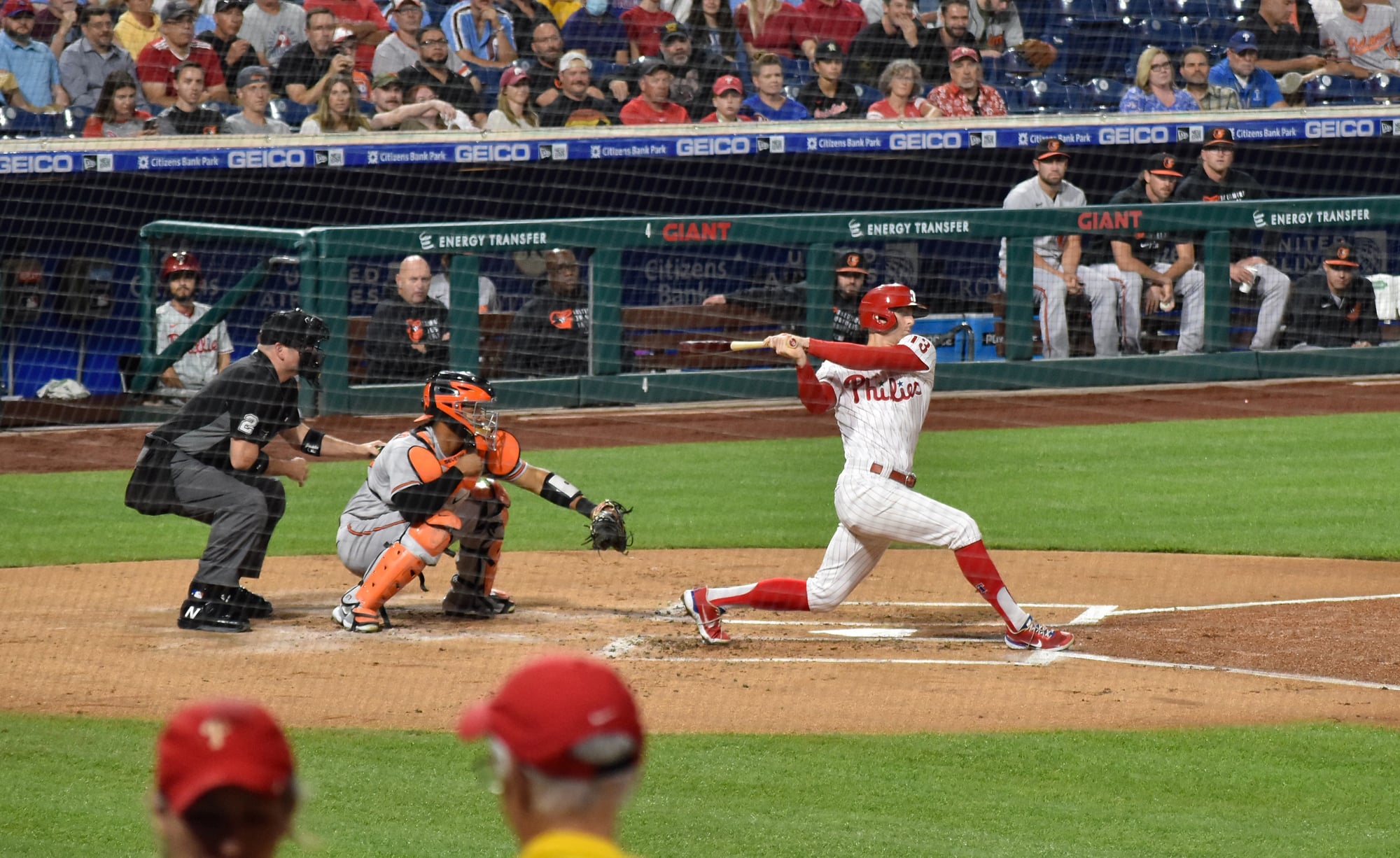
Phillies
Philadelphia’s approach to naming their National League team was startlingly direct: they called them the Phillies because they played in Philadelphia.
The name appeared as early as 1883, though the team also went by Quakers and Blue Jays at various points.
The simplicity worked. While other teams cycled through elaborate names and marketing schemes, Philadelphia stuck with geographic obviousness.
Orioles
Baltimore’s name comes from the state bird of Maryland — the Baltimore oriole. The connection seems natural now, but it took several attempts to establish.
An earlier Baltimore team used the name in the 1890s, and when the St. Louis Browns relocated to Baltimore in 1954, reviving “Orioles” felt like returning to something that belonged there.
Bird names work differently than other team names because they connect to place through biology rather than culture. The Baltimore oriole actually nests in Maryland, which gives the team name a kind of environmental authenticity that manufactured nicknames can’t match.
The bird and the city share more than just a name — they share habitat.
Athletics
Philadelphia Athletics owner Connie Mack wanted a name that sounded dignified and athletic without being too specific about any particular sport.
“Athletics” covered all bases — literally and figuratively. The name worked for a team, a club, an organization.
When the franchise moved to Kansas City in 1955, and later to Oakland in 1968, they kept the name but shortened it to ‘A’s’ for most purposes.
The formality of “Athletics” didn’t match Oakland’s culture, but the letter A translated anywhere.
Tigers
Detroit’s team name supposedly came from the Detroit Light Guard military unit, whose members were known as “Tigers” and wore yellow and black striped stockings.
The baseball team adopted similar uniform colors and inherited the nickname around 1895.
The military connection faded, but the name fit Detroit’s emerging industrial identity. Tigers suggested power, aggression, and the kind of determined energy that matched a city building cars and reshaping American manufacturing.
White Sox
Chicago’s American League team chose “White Sox” to distinguish itself from the National League Cubs and to echo the successful Boston Red Sox branding. Owner Charles Comiskey made the decision in 1900, and the name captured something clean and professional about his vision for the franchise.
The “Black Sox” scandal of 1919 turned the name ironic for a while, but it survived even that association. Sometimes a good name outlasts its worst moment and emerges stronger for having endured the test.
Astros
Houston’s team name reflects pure 1960s space-age optimism. When the Colt .45s moved into the Astrodome in 1965, they became the Astros — honoring the nearby Johnson Space Center and the city’s role in America’s space program.
The name captured Houston’s identity as a city reaching beyond Earth’s atmosphere.
The timing was perfect: NASA’s astronaut program was making Houston synonymous with space exploration, and the team name made that connection permanent. Few teams have ever tied their identity so directly to their city’s defining industry, and fewer still have chosen names that aged as well as this one.
The Poetry Of Place And Purpose
These names reveal something about how identity gets made and remade over generations. What starts as a newspaper convenience or a fashion comment becomes tribal identity.
Cities and teams grow into their names the way people grow into nicknames — until the name fits so well that imagining anything else becomes impossible.
The best team names capture something essential about their place and time while remaining flexible enough to mean something different to each new generation of fans. They become containers for memory, hope, and the kind of belonging that transforms strangers in matching shirts into temporary family.
More from Go2Tutors!

- The Romanov Crown Jewels and Their Tragic Fate
- 13 Historical Mysteries That Science Still Can’t Solve
- Famous Hoaxes That Fooled the World for Years
- 15 Child Stars with Tragic Adult Lives
- 16 Famous Jewelry Pieces in History
Like Go2Tutors’s content? Follow us on MSN.