Festivals Dedicated to Food Fights
You spent your childhood being told not to play with your food. Then you become an adult and discover entire festivals built around throwing perfectly good produce at strangers.
Tomatoes, oranges, grapes—if it grows, someone somewhere has organized an event where thousands of people gather to hurl it at each other. These festivals aren’t about waste or chaos, though both happen.
They’re celebrations rooted in history, tradition, and the universal appeal of sanctioned mayhem. Some commemorate historical events.
Others started as jokes that got out of hand. All of them offer something modern life rarely provides: permission to make a spectacular mess.
La Tomatina’s Red River

Buñol, Spain hosts the world’s most famous food fight every August. La Tomatina draws over 20,000 people who throw approximately 150 tons of overripe tomatoes at each other for exactly one hour.
The tomatoes arrive on trucks. A starting signal fires.
Then the town square transforms into a red pulp battleground. The rules are simple.
Squash the tomato before throwing it to avoid injuries. Don’t rip anyone’s clothes.
Stop immediately when the second signal sounds. The rest is pure chaos.
You slip on tomato pulp. Strangers pummel you from all sides.
The smell of crushed tomatoes fills the air. Your clothes will never be the same.
The festival started in 1945, though the origin story varies depending on who tells it. One version involves a parade scuffle where someone grabbed vegetables from a market stand and started throwing them.
Another mentions young people provoking established festival participants. Whatever happened, the tradition stuck.
Franco’s regime banned it for being too frivolous. After his death, La Tomatina returned bigger than before.
Battle of the Oranges in Ivrea

Ivrea, Italy stages a three-day orange fight each February during Carnival. Teams representing different neighborhoods face off in the town squares.
Some teams defend from carts while others attack from the ground. Thousands of pounds of oranges fly through the air in organized chaos.
The festival commemorates a medieval rebellion against a tyrannical lord. The oranges represent stones thrown during the uprising.
Teams take the competition seriously. They train, strategize, and coordinate attacks.
Bruises are common. The oranges are specifically sourced—usually from Sicily—and must be firm enough to throw but not rock-hard.
Spectators wear red caps for protection. Those caps signal you’re not participating and shouldn’t be targeted.
Participants wear protective gear: helmets, padding, whatever helps. The streets flow with orange juice and pulp.
Cleanup crews work for days after. The smell lingers.
But for those three days, the town belongs to the orange warriors.
Batalla del Vino in Haro
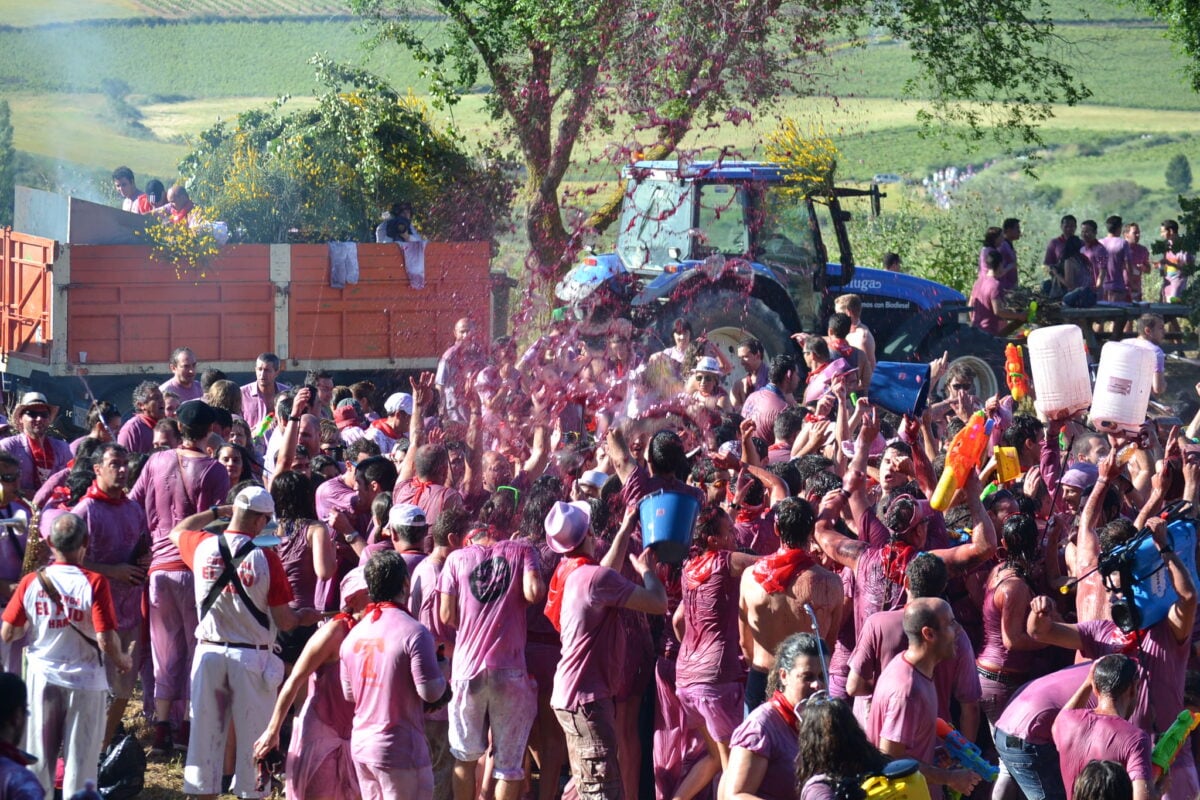
Haro, Spain celebrates Saint Peter’s Day each June with a wine fight that drenches everyone in red. Participants gather on Bilibio cliffs carrying jugs, water guns, spray bottles—anything that can hold and dispense wine.
At a signal, thousands of liters of red wine get thrown, poured, and sprayed. Everyone wears white clothes specifically so the wine stains show.
The goal is to end up as purple as possible. The more soaked, the better.
Wine gets in your eyes, hair, and mouth. You drink some accidentally, though that’s not really the point.
The point is the spectacle, the shared absurdity of good wine used as ammunition. The tradition dates back centuries, possibly to a property dispute between Haro and a neighboring town.
The wine fight symbolized marking territory. Now it’s pure celebration.
Local bodegas donate wine specifically for the fight. After an hour of wine warfare, everyone heads back to town to drink wine properly—from glasses, like civilized people.
The contrast makes both parts better.
Chinchilla Melon Festival

Chinchilla, Australia hosts a melon festival every two years that includes melon skiing, melon bungee, and yes, melon throwing. The melon toss competition requires accuracy rather than chaos.
Teams throw watermelons to each other, stepping back after each successful catch until someone drops it and the melon explodes. The festival celebrates the region’s melon-growing industry.
Tens of thousands of melons get used during the event. The melon skiing involves competitors being pulled behind vehicles on skis carved from giant watermelons.
The bungee drop has people launching melons from towers to hit targets below. Everything involves melons meeting their demise in creative ways.
The competition gets fierce. Teams practice beforehand.
The melons, slippery and heavy, test your reflexes and strength. Drop one and you’re eliminated.
The winning team might throw back and forth from distances of 50 feet or more before someone finally fumbles. The splatter when a melon hits concrete from that height spreads debris across an impressive radius.
Grape Fight in Mallorca

Binissalem, Spain turns its September grape harvest into a festival that includes trampling grapes and throwing them. The grape fights happen during the harvest celebration, with purple grapes flying in every direction.
The fruit stains skin and clothes a distinctive purple-red shade. The fights tie directly to the wine-making process.
Bins of grapes wait for traditional foot-stomping. Someone always starts throwing instead.
The practice spread until it became an expected part of the event. Grapes squish easily, exploding on impact.
They’re less painful than oranges but stain worse than tomatoes. Local vineyards participate, turning excess grapes into festival ammunition.
The stains wash out eventually, but you’ll find dried grape bits in your pockets and hair for days. The festival combines serious wine celebration with playful chaos.
During the day, you learn about traditional wine-making. By afternoon, you’re covered in grape juice and laughing at strangers who look just as ridiculous as you do.
Custard Pie Championships

Coxheath, England hosts annual custard pie throwing championships each May. Teams compete to hit opponents with pies from set distances.
Points depend on where the pie hits—face shots score highest. The pies are actual custard pies, made specifically for optimal throwing and splattering.
The event requires surprising skill. Throwing a pie so it hits face-first takes practice.
Too much force and it disintegrates in flight. Too little and it drops short.
The consistency matters too. The custard must stick but not injure.
The tin must release cleanly but not become a dangerous projectile. The championship format includes rounds, brackets, and serious judging.
Spectators cheer for their favorite teams. Contestants trash-talk.
The whole thing plays out like a legitimate sport, except everyone ends up covered in yellow custard. The surreal combination of athletic competition and slapstick comedy makes it oddly compelling.
You can’t take custard-pie throwing seriously, but the competitors certainly try.
Flour Wars in Galaxidi

Galaxidi, Greece celebrates Clean Monday (the first day of Lent) with a flour war. Thousands of people pack the town’s waterfront and throw colored flour at each other for hours.
The air becomes so thick with flour that you can barely see. Everyone emerges looking like rainbow ghosts.
The tradition supposedly began when merchants had excess flour they couldn’t sell, so they gave it away in the most entertaining manner possible. Whether that story is accurate or not, the flour war has become central to Galaxidi’s identity.
People travel from across Greece to participate. The colored flour—in blues, pinks, yellows, greens—creates psychedelic clouds.
You breathe flour. You taste flour. It gets everywhere: in your ears, between your toes, under your eyelids.
The harbor turns into a pastel battlefield. After the fight, everyone jumps in the sea to wash off.
The water near shore looks like someone dumped buckets of paint in it.
Tunarama Tuna Toss

Port Lincoln, Australia celebrates its tuna fishing industry each January with a tuna tossing competition. Competitors grab dead tuna by the tail and spin hammer-throw style before releasing.
The fish fly impressive distances when thrown correctly. The current world record exceeds 120 feet.
The competition requires technique, not just strength. You need to build momentum while keeping control of a slippery, heavy fish.
The tail grip is crucial. Too loose and the tuna flies off mid-spin.
Too tight and you can’t release smoothly. Athletes from various sports try their hand, including Olympic hammer throwers who understand the physics.
The fish are real tuna, usually donated by local fisheries. After throwing, they get processed for consumption rather than wasted.
The event highlights the town’s fishing heritage while providing entertainment. Watching someone helicopter-spin with a large tuna and then launch it down a field shouldn’t be as exciting as it is, but the absurdity makes it memorable.
Hurling the Silver Orb

St. Ives, England maintains a tradition of “hurling the silver orb” each February. Despite the name, it’s less about throwing and more about carrying a cork-and-silver-coated sphere through town while everyone tries to take it from you.
The person holding the orb when time expires wins. The tradition dates back centuries with unclear origins.
Some say it relates to pagan rituals. Others connect it to historical town celebrations.
Regardless, the modern version involves a crowd of locals fighting over an orb in the streets. You try to maintain possession while others grab, pull, and push.
It’s organized chaos with minimal rules. The orb itself is valuable, a silver-coated object that the winner gets to keep for the year.
This raises the stakes beyond bragging rights. Participants take it seriously despite the seemingly silly premise.
The whole town turns out to watch or join. For a few hours, St. Ives becomes a medieval battleground where possession of a small orb matters more than anything else.
Fastnacht Cream Cake Hurling

Several Swiss towns include cream cake throwing in their Fastnacht (carnival) celebrations. Participants throw cream-filled pastries at each other, at floats, and occasionally at dignitaries.
The cakes explode on impact, covering everything in white cream and crumbs. The tradition varies by town, but the concept remains consistent: use excess carnival treats as ammunition.
Some versions are more organized, with specific times and locations. Others happen spontaneously when someone decides a parade float needs decorating with cream cake debris.
The cakes are made specifically for throwing—slightly stale so they hold together in flight but fresh enough to splatter satisfyingly. Local bakeries produce hundreds or thousands depending on the town’s size.
The aftermath looks like a desert explosion. Cream drips from buildings.
Crumbs carpet the streets. Cleanup takes days, but for those few hours, the messier you get, the more festive spirit you’re showing.
Noche de Rábanos Radish Fight

Oaxaca, Mexico’s Noche de Rábanos (Night of the Radishes) centers on radish carving competitions, but the event sometimes includes radish throwing when festivities get rowdy. Oversized radishes grown specifically for the festival become both art supplies and potential projectiles.
The official event focuses on elaborate sculptures carved from giant radishes. Artists create nativity scenes, historical figures, and fantastical creatures.
But the atmosphere is carnival-like, and radishes are plentiful. When people start getting playful, radishes start flying.
The vegetables are large, firm, and leave a mark when they connect. The throwing isn’t officially sanctioned, making it more spontaneous than organized.
Security tries to prevent it, but the combination of crowds, excitement, and abundant ammunition makes some throwing inevitable. The radishes leave red stains and earthy smells.
By the event’s end, the plaza shows signs of both artistic achievement and vegetable warfare.
World Porridge Championship Melee
Carrbridge, Scotland hosts the World Porridge Championship each October. While primarily a cooking competition, tradition includes a “spurtle” (porridge-stirring stick) relay and occasional porridge flinging during celebrations.
Competitors have been known to playfully fling oatmeal when spirits run high. The porridge is hot, thick, and sticky—not ideal ammunition but memorably unpleasant when it hits you.
The flinging happens more as a spontaneous celebration than an organized activity. Someone wins, emotions run high, and suddenly porridge is airborne. It’s not sanctioned, but it’s become expected.
The sticky quality of porridge makes it particularly problematic. It clings to clothes, hair, and skin.
It cools quickly, turning from warm and gooey to cold and congealed. The oat smell lingers.
You’ll be finding dried porridge flakes for days after. But at the moment, covered in Scotland’s national dish at a competition celebrating that very food, somehow it all makes sense.
Ukweshwama First Fruits Ceremony

Out in the open, bare hands grab at a live bull during the Zulu Ukweshwama event. Boys take turns wrestling it before ending its life.
Fresh meat goes straight into their mouths, torn without tools. Though no one throws food here, bodies clash as they do at messy feasts elsewhere.
Harvest time brings another kind of gathering – the first fruits moment – where everyone shows up. Shared eating ties people together just as much as sowing or reaping does.
Food brings people together in ways that feel natural, even when traditions seem strict. This gathering carries deep meaning beyond what visitors might see on the surface.
Not performance nor show, it lives through those who take part each time. What stands out is how eating together shifts something quietly – rules loosen without being broken.
Moments like these appear everywhere, tied to meals that mark more than just hunger.
Where Food Meets Frenzy
For a little while, rules around food just disappear. These events let people toss things that should stay on plates.
Messiness becomes part of the point, even wanted. What gets scolded every day turns into cheers and laughter here.
After it ends, forks go back to carrying bites, floors must stay clean, and manners matter again. Still, during the madness, bodies move wildly, faces grin without thinking – pure play takes over.
Festivals work when old customs mix with wild chaos. History matters, yet silliness sneaks in just as much.
Sticky fingers, messy shirts, maybe a bump or two – common outcomes. The scent of fruit fights with dessert smells on your skin for nights.
Fabric soaks up spills; some things never wash out. You might recall the absurd laughs, that okay-to-be-chaotic vibe, and how fun it felt tossing snacks toward people who smiled back.
Rarely do we find such light in moments where rules get tossed, yet there it is – beauty hiding in what’s wildly disordered.
More from Go2Tutors!

- 16 Historical Figures Who Were Nothing Like You Think
- 12 Things Sold in the 80s That Are Now Illegal
- 15 VHS Tapes That Could Be Worth Thousands
- 17 Historical “What Ifs” That Would Have Changed Everything
- 18 TV Shows That Vanished Without a Finale
Like Go2Tutors’s content? Follow us on MSN.