Hidden Messages in Famous Paintings
Art has always been more than just pretty pictures hanging on walls. Throughout history, master painters have tucked away secret symbols, coded messages, and hidden meanings in their works like invisible treasure maps waiting to be discovered. These artistic easter eggs range from religious references and personal signatures to anatomical sketches and musical compositions embedded right in plain sight.
What makes these hidden messages so fascinating is how they’ve survived centuries, silently communicating with viewers who know how to decode them. Some were meant as subtle critiques of authority, others as personal jokes or signatures, and many served as deeper spiritual or philosophical commentaries that couldn’t be expressed openly.
Let’s dive into some of the most intriguing secret messages that famous painters cleverly concealed in their masterpieces.
Leonardo’s Musical Last Supper
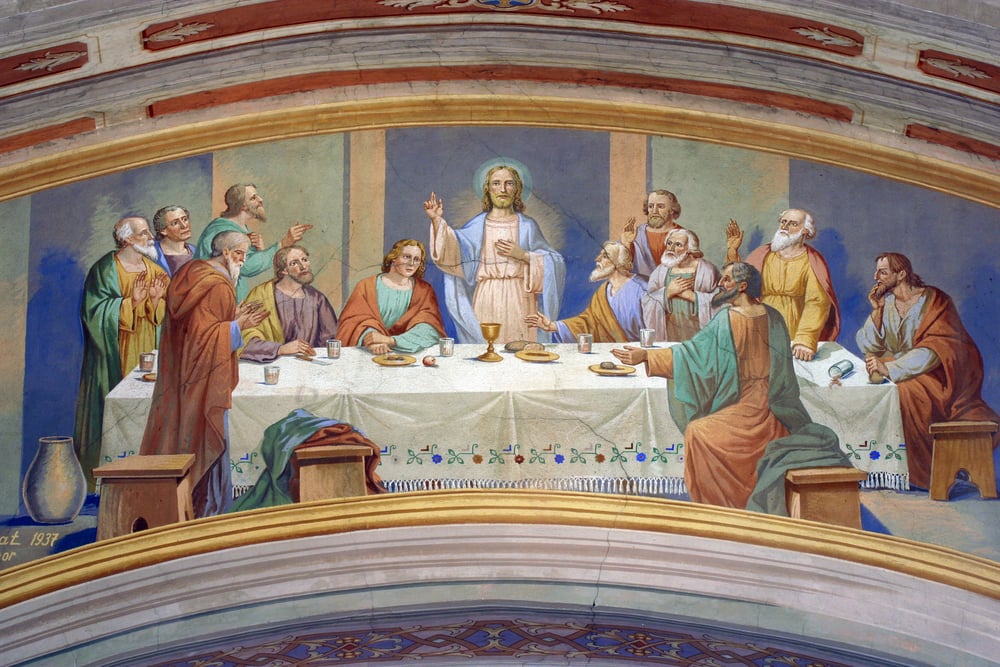
Leonardo da Vinci’s ‘The Last Supper’ contains what Italian musician Giovanni Maria Pala discovered could very well be a 40-second musical melody. If you draw the five lines of a musical staff across the painting, the apostles’ hands and the loaves of bread on the table align with the positions of music notes. The composition plays from right to left, following da Vinci’s characteristic writing style.
This musical theory isn’t entirely far-fetched since Leonardo was known to be a talented musician himself. The bread rolls and hand positions create what sounds like a requiem when played, which seems oddly appropriate for a painting depicting Christ’s final meal with his disciples.
Michelangelo’s Brain in the Sistine Chapel

— Photo by patrimonio
Michelangelo hid a scientific secret in his Sistine Chapel panel that isn’t well known. The reddish cloak behind the angels in ‘The Creation of Adam’ is shaped exactly like a human brain, with researchers now able to recognize specific parts like the pituitary gland. This wasn’t accidental doodling.
Michelangelo was an expert anatomist who dissected corpses to create anatomical sketches. Art historians believe this hidden brain image was his criticism of the Church’s attitudes toward the science and discovery happening around him. Pretty bold for a guy painting the Pope’s ceiling.
Van Gogh’s Secret Last Supper

Vincent Van Gogh’s ‘Cafe Terrace at Night’ seems like a simple scene of a French cafe lit up at night. However, art historian Jared Baxter theorized in 2015 that the painting is actually Van Gogh’s version of ‘The Last Supper’. There’s one central figure with long hair surrounded by 12 people, with one slipping into shadows, possibly symbolizing Judas.
Van Gogh wrote to his brother shortly after completing the painting that he had a ‘tremendous need for religion’, making the reference to The Last Supper very plausible. Baxter also found small crucifixes hidden throughout the painting. The religious symbolism was Van Gogh’s way of expressing his spiritual struggles through seemingly everyday scenes.
Caravaggio’s Wine Bottle Self-Portrait

Caravaggio’s ‘Bacchus’ looks like a straightforward portrait of the Greek god of wine. But using reflectography technology, art historians discovered a hidden image under the painting in 2009. On the bottom left, there’s a man trapped inside the wine carafe, sitting upright with his arm held up as if painting on a canvas.
Most experts believe this is Caravaggio’s self-portrait. In his personal life, Caravaggio was known for heavy drinking and terrible mood swings that led to fights and even murder. Maybe he painted himself trapped in the wine bottle to symbolize his battle with alcohol. It’s like a 17th-century cry for help hidden in a mythological portrait.
Botticelli’s Botanical Encyclopedia
— Photo by irisphoto11
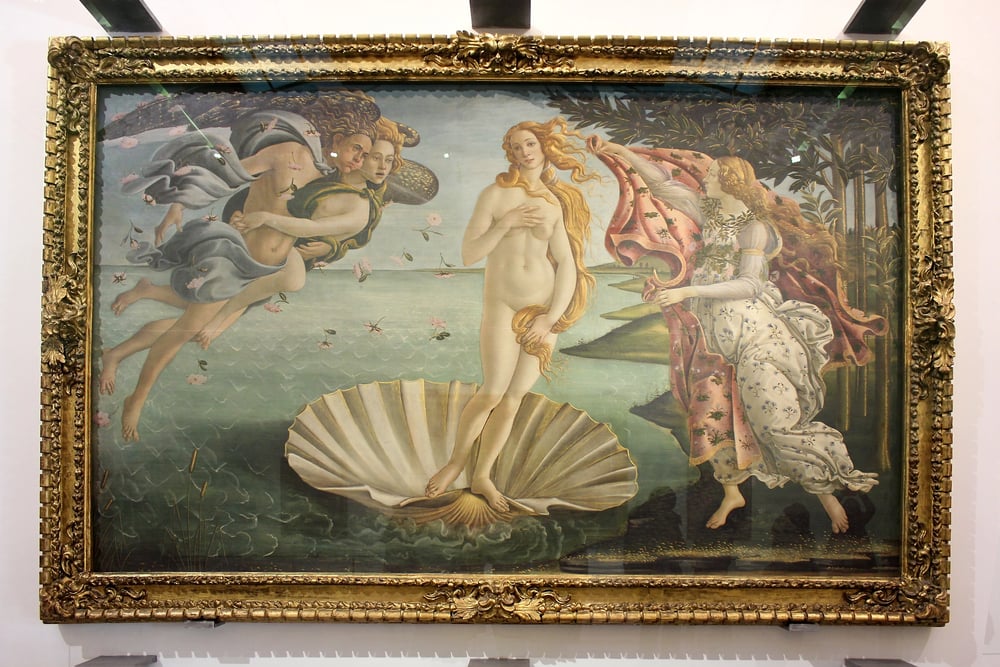
Sandro Botticelli, the artist famous for ‘The Birth of Venus’, had quite an affinity for plants. In his painting ‘Primavera’, you can find as many as 500 different plant species, all painted with enough scientific accuracy to make them recognizable to researchers.
This would have been painstakingly detailed work to accurately depict all these plants in a single painting. While the mythological figures in the painting don’t match any known story, art historians believe it depicts the stages of spring from right to left. Botticelli essentially created a Renaissance field guide disguised as mythology.
Van Eyck’s Mirror Witnesses

— Photo by Flik47
Jan van Eyck’s ‘Arnolfini Portrait’ features a convex mirror behind the couple that shows not only their reflection but also two additional figures standing in the doorway. Many art historians believe one of these figures is van Eyck himself, inserting himself as a witness to the scene.
Van Eyck couldn’t resist a cameo appearance, writing on the wall in Latin: ‘Jan van Eyck was here 1434’. This unusual signature style adds to the mystery of van Eyck’s role in the painting, possibly serving as a witness signature for what might be a marriage ceremony. It’s like the medieval version of photobombing your own artwork.
Holbein’s Skull Illusion

— Photo by Flik47
Hans Holbein the Younger’s 1533 painting ‘The Ambassadors’ contains a mind-bending illusion. The stretched, distorted image at the bottom of the painting appears to be a skull when viewed from the side. Historians believe the artwork was originally positioned beside a doorway so viewers walking past would be confronted with the grinning skull as a reminder of death.
This anamorphic skull serves as a memento mori, the artistic tradition of reminding viewers that death comes to everyone, no matter how wealthy or powerful. The ambassadors in the painting are surrounded by symbols of earthly knowledge and riches, but the hidden skull suggests none of it matters in the end.
Ghirlandaio’s UFO Mystery

Domenico Ghirlandaio’s 15th-century painting ‘Madonna with Saint Giovannino’ features what appears to be a UFO in the background. The unidentified flying object hovers in the sky near Mary’s left shoulder, detailed enough to stand out. Below it, a man on a ledge stares at the object while shielding his eyes from the sun.
While alien enthusiasts see this as proof of ancient UFO sightings, others believe the object represents a passage from the Gospel of Luke about angels appearing to shepherds. Either way, Ghirlandaio made sure this mysterious object would catch viewers’ attention for centuries to come.
Munch’s Secret Confession

— Photo by cajuncohen
Edvard Munch wrote a secret message on his famous painting ‘The Scream’. Using technology to analyze the handwriting, Norway’s National Museum confirmed that Munch wrote: ‘Can only have been painted by a madman.’ The barely visible sentence is written in pencil in the top left corner.
This hidden confession adds another layer to an already psychologically intense painting. Munch was responding to critics who suggested his work looked like the product of mental illness. Instead of defending himself publicly, he quietly agreed with them right on the canvas itself.
American Gothic’s Depression-Era Message

Grant Wood’s ‘American Gothic’ carries hidden messages related to the Great Depression. Painted in 1930 during the early years of economic hardship, the stern expressions of the farmer and woman reflect resilience amid struggle. The pitchfork isn’t just a farming tool but symbolizes hard work and protection, possibly warding off evil, which ties into America’s Puritanical roots.
The painting became an icon of American endurance partly because Wood embedded these subtle references to the economic challenges facing rural families. What looks like a simple portrait of Midwestern farmers actually captures the spirit of an entire generation fighting through tough times.
Vermeer’s Hidden Sensuality

Johannes Vermeer’s ‘The Music Lesson’ appears to show an innocent scene of a young woman learning piano. But the painting is actually full of hidden symbols related to intimacy and relationships. The positioning of the figures, the musical instruments, and even the way light falls across the scene all carry coded meanings about romantic desire.
During Vermeer’s time, music lessons were often excuses for young people to spend time alone together. The artist layered his domestic scene with subtle references that contemporary viewers would have understood as commentary on courtship and attraction.
Caravaggio’s Christian Fish Symbol

— Illustration by Flik47
Caravaggio may have hidden an underground Christian symbol in ‘Supper at Emmaus’ in the form of a loose twig sticking out from the woven fruit bowl. The frayed ends curve up and down to form the shape of a fish, or ‘Ichthys’, which was a covert sign of Christian belief used by followers who feared persecution. There’s even a fish-shaped shadow to the right of the bowl.
This secret symbol dates back to the second century when Christians needed coded ways to identify each other. Caravaggio was painting during the Counter-Reformation, so including hidden religious symbols would have been both spiritually meaningful and politically smart.
When Art Becomes Detective Work
These hidden messages transform famous paintings from simple visual experiences into complex puzzles that span centuries. Modern technology like reflectography has revealed secrets that were invisible to previous generations of art lovers. Each discovery adds new layers to our understanding of not just the artwork, but the artists themselves and the times they lived in.
Whether they were making political statements, signing their work, or just having fun with future viewers, these master painters created a treasure trove of secrets that continues to reward careful observation. The next time you visit a museum, remember that there might be more hidden in those masterpieces than meets the eye. Art history is full of painters who couldn’t resist leaving their own secret marks on immortality.
More from Go2Tutors!

- 16 Historical Figures Who Were Nothing Like You Think
- 12 Things Sold in the 80s That Are Now Illegal
- 15 VHS Tapes That Could Be Worth Thousands
- 17 Historical “What Ifs” That Would Have Changed Everything
- 18 TV Shows That Vanished Without a Finale
Like Go2Tutors’s content? Follow us on MSN.