Images Of 13 Most Stunning Medieval Castles Located In Central Europe
Medieval castles scattered across Central Europe tell stories that guidebooks can’t capture. Built between the 12th and 19th centuries, these fortresses served as military strongholds, royal residences, and symbols of power during an era when borders shifted like sand and kingdoms rose and fell with the seasons.
Today, they stand as some of Europe’s most photographed landmarks, their towers and battlements creating silhouettes against mountain backdrops and river valleys that have remained unchanged for centuries.
Neuschwanstein Castle

Neuschwanstein doesn’t care about authenticity. Built in the 19th century by Bavaria’s eccentric King Ludwig II, it’s a fantasy castle masquerading as medieval architecture.
Disney used it as inspiration for Sleeping Beauty’s castle. Millions visit annually for precisely that reason.
The dramatic Alpine setting sells the illusion completely. Perched on a rugged hill above the village of Hohenschwangau, its white limestone facade and soaring towers look exactly like what a fairy tale castle should be.
Prague Castle

Prague Castle sprawls across a hill above the Vltava River like a small city (which, historically speaking, it was — the largest ancient castle complex in the world, according to Guinness World Records, though that designation always feels slightly arbitrary when you’re standing inside what amounts to a walled neighborhood that happens to contain a cathedral, multiple palaces, gardens, and enough courtyards to get genuinely lost). The Gothic spires of St. Vitus Cathedral pierce the skyline in a way that makes the rest of Prague’s considerable architectural achievements look almost modest by comparison.
And when you consider that this complex has been continuously occupied for over a thousand years — serving as the seat of Bohemian kings, Holy Roman Emperors, and now the Czech Republic’s presidents — it becomes clear that some places simply refuse to become relics.
So it endures: part museum, part government building, part living monument to the stubborn persistence of power.
The castle’s silhouette changes depending on where you view it from. From Charles Bridge at dawn, it emerges from morning mist like something half-remembered from a dream.
Bran Castle
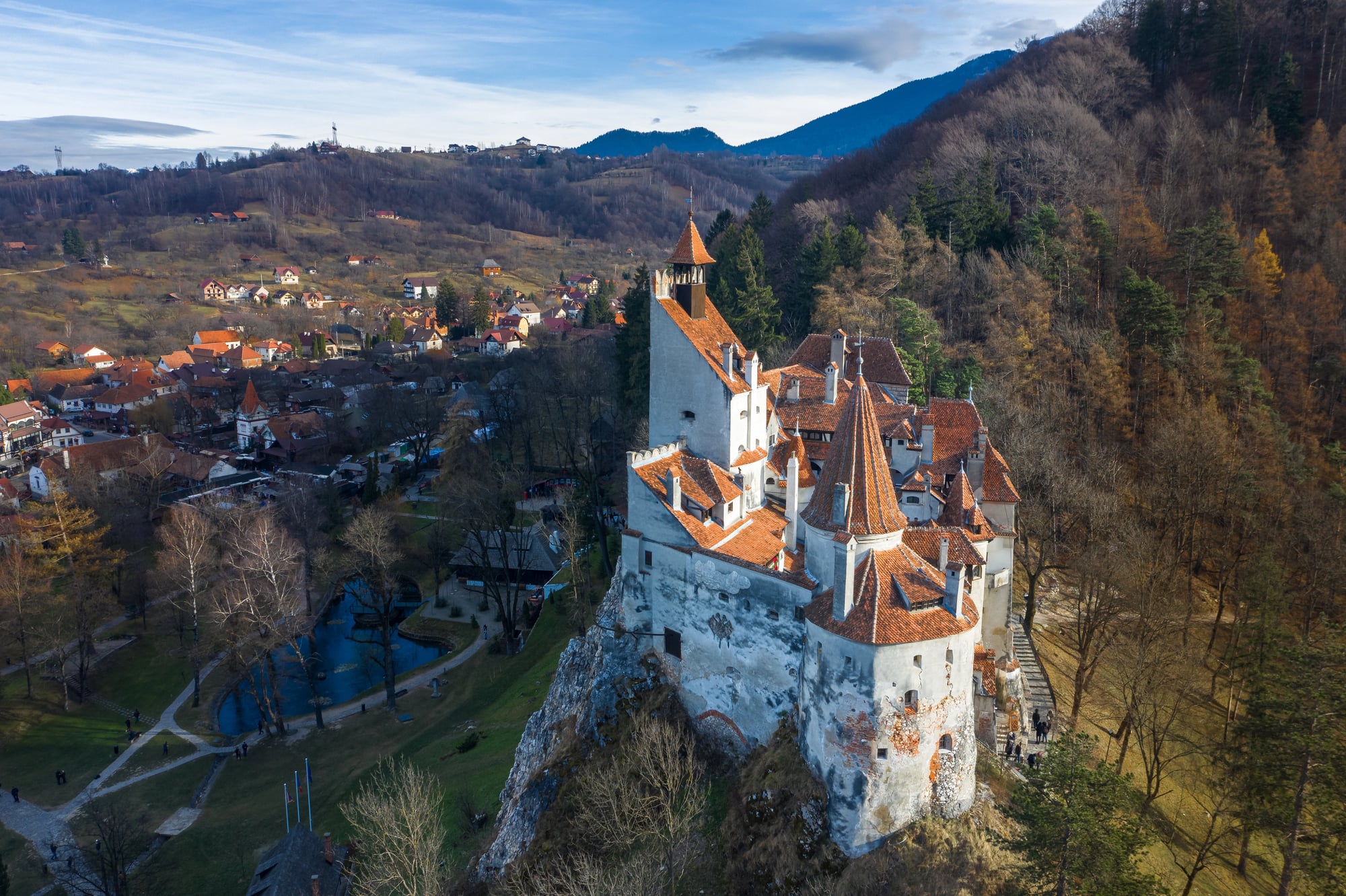
Bran Castle gets marketed as “Dracula’s Castle” despite having virtually nothing to do with either Bram Stoker’s novel or the historical Vlad the Impaler. It’s Romanian tourism at its most shameless, and it works brilliantly.
The castle perches on a rocky outcrop in Transylvania, its towers and turrets creating exactly the kind of Gothic atmosphere that vampire tourists expect.
To be fair, the 14th-century fortress has genuine medieval credentials. It served as a customs point between Transylvania and Wallachia, and its strategic position made it genuinely important during various conflicts.
The vampire connection just pays the bills better than medieval trade history.
Spiš Castle

Spiš Castle in Slovakia unfolds like a meditation on ruin and permanence — one of Europe’s largest castle complexes, spread across a hilltop in a sprawl that speaks not of single ambition but of centuries layered upon centuries, each generation adding towers and walls and courtyards until the original 12th-century fortress became something closer to a stone village perched against the sky.
The complex covers 41,426 square meters, though numbers don’t capture the way it commands the surrounding countryside, or how its broken walls and roofless halls create a landscape where imagination fills the gaps that time has carved away.
Walking through its courtyards feels like moving through archaeology made visible — not quite ruin, not quite restoration, but something suspended between memory and presence.
The UNESCO designation seems almost redundant here. Some places carry their own authority.
Karlštejn Castle
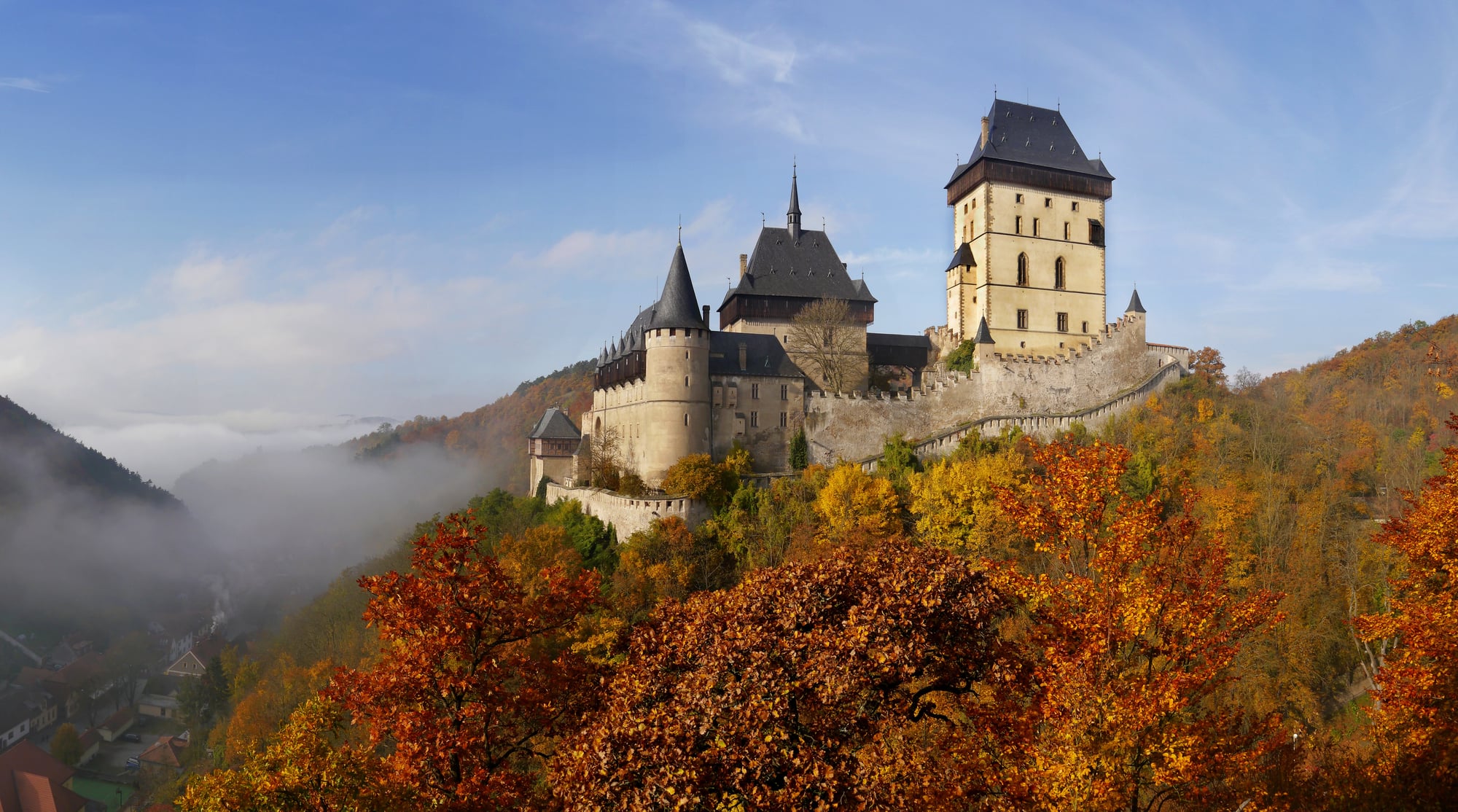
Charles IV knew exactly what he was doing when he built Karlštejn Castle. The Holy Roman Emperor needed a secure repository for the crown jewels and holy relics, and he wanted it visible from Prague.
The result is a Gothic fortress that rises from forested hills in perfect symmetrical tiers, each level more ornate than the last.
The castle’s chapel of the Holy Cross still contains original 14th-century wall paintings by Master Theodoric.
Over 100 panel paintings of saints and emperors cover the walls in what amounts to medieval Europe’s most concentrated display of Gothic portraiture.
Which is saying something, considering the competition.
Bojnice Castle
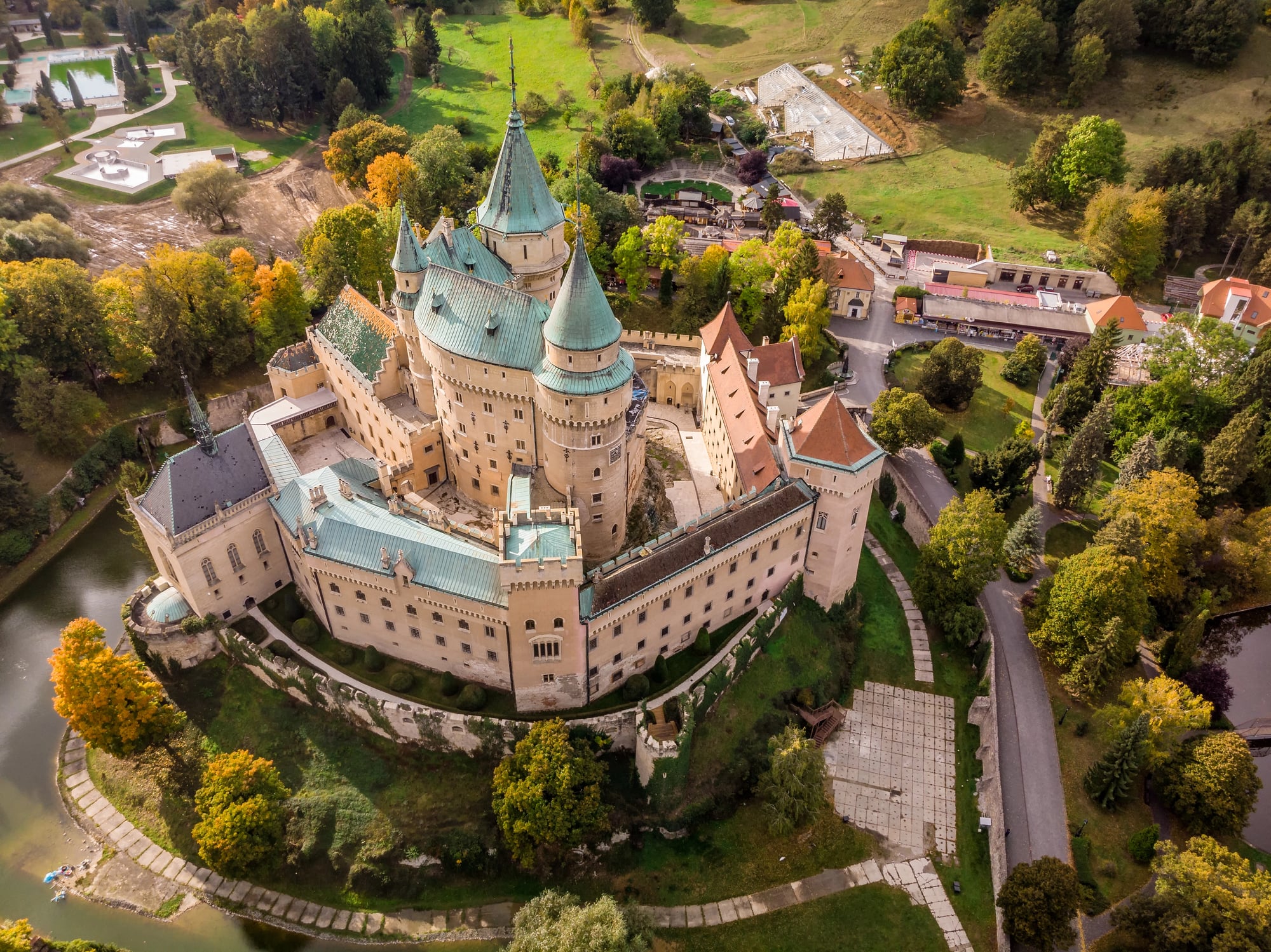
Bojnice Castle shouldn’t work as well as it does (a 19th-century Romantic reconstruction of a medieval fortress, built by a Hungarian count who clearly read too many fairy tales and had enough money to indulge his architectural fantasies, turning what had been a respectable 12th-century stone castle into something that looks like it was designed by committee of Disney imagineers a century before Disney existed).
The result manages to be both completely artificial and genuinely enchanting — its turrets and towers and perfectly manicured gardens creating a kind of medieval theme park that happens to sit on authentically ancient foundations.
And the fact that it’s Slovakia’s most visited castle suggests that most people don’t particularly care about architectural purity when the alternative looks this good in photographs.
And yet there’s something honest about its dishonesty: it presents itself as pure fantasy rather than claiming historical accuracy.
Which makes it easier to enjoy than places that take themselves too seriously.
But the May Festival of Ghosts and Spirits feels perfectly appropriate here. Some places are meant for theater.
Orava Castle
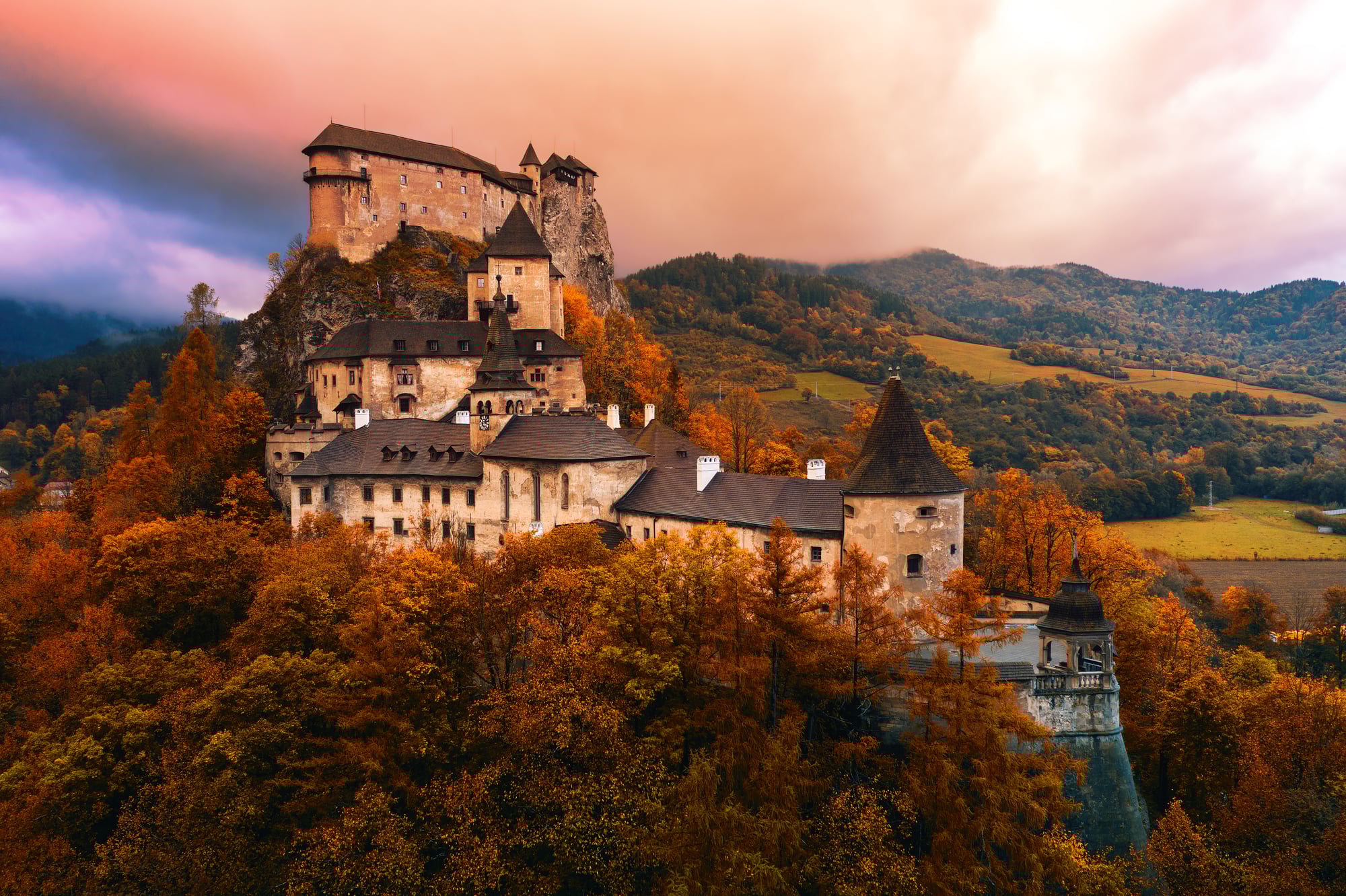
Orava Castle clings to a rocky cliff like it grew there naturally. Built on the site of an ancient wooden fortification, this Slovak fortress rises in dramatic tiers, each level representing a different century of construction.
The result is architecturally chaotic and visually spectacular.
The castle’s location made it a natural choice for filmmakers.
It stood in for Count Orlok’s castle in Werner Herzog’s 1979 remake of “Nosferatu,” and once you see its silhouette against the Orava River, the casting makes perfect sense.
Some buildings just photograph ominously.
Wawel Castle

Wawel Castle carries weight that has nothing to do with its architectural merits — though those are considerable enough, a collection of buildings spanning Gothic, Renaissance, and Baroque periods that rise above Krakow’s old town like a crown above a head.
Which is exactly the metaphor Polish kings intended when they made this hilltop complex their primary residence for five centuries.
The cathedral next door holds the tombs of Polish monarchs, and the castle’s chambers once witnessed decisions that shaped Central European history in ways that still echo today.
Walking through its courtyards means moving through spaces where the abstract concept of “national identity” took concrete form.
One stone and one royal decree at a time.
The Wawel Dragon legend adds the kind of mythological gravitas that every proper castle needs.
A fire-breathing monster, a clever cobbler, a kingdom saved through wit rather than sword — it’s the sort of foundational story that makes the present feel connected to something larger than itself.
Corvin Castle

Corvin Castle looks like Gothic architecture having a fever dream.
This 15th-century Romanian fortress pushes medieval design into almost fantasy territory, its towers and bridges and battlements creating silhouettes that seem too dramatic for reality.
John Hunyadi built it as both fortress and residence, and his architects clearly decided that subtlety was overrated.
The castle’s Great Hall spans 500 square meters with ribbed vaulting that soars overhead like stone lace.
Medieval banquets held here must have felt appropriately theatrical.
The building demands that kind of pageantry.
Malbork Castle

Malbork Castle doesn’t just dominate its landscape — it reshapes it entirely, the world’s largest brick Gothic complex spreading along the Nogat River in northern Poland like a medieval city that happened to be surrounded by walls instead of growing organically beyond them.
Which, in a sense, is exactly what it was: the headquarters of the Teutonic Knights, a military-religious order that controlled much of the Baltic coast during the 13th and 14th centuries.
And whose Grand Masters ruled from chambers that were simultaneously monastery cells and royal apartments.
The scale becomes overwhelming once you’re inside — courtyard after courtyard, hall after hall.
Enough space to house thousands of knights and craftsmen and administrators.
All of it built from red brick that glows like embers in late afternoon light.
But the most striking thing isn’t the size.
It’s how the entire complex feels like a single architectural thought.
Conceived and executed with the kind of unified vision that only comes from having unlimited resources and absolute certainty about your place in the world.
The Teutonic Knights lost that certainty eventually.
The castle outlasted their empire by centuries.
Peleș Castle
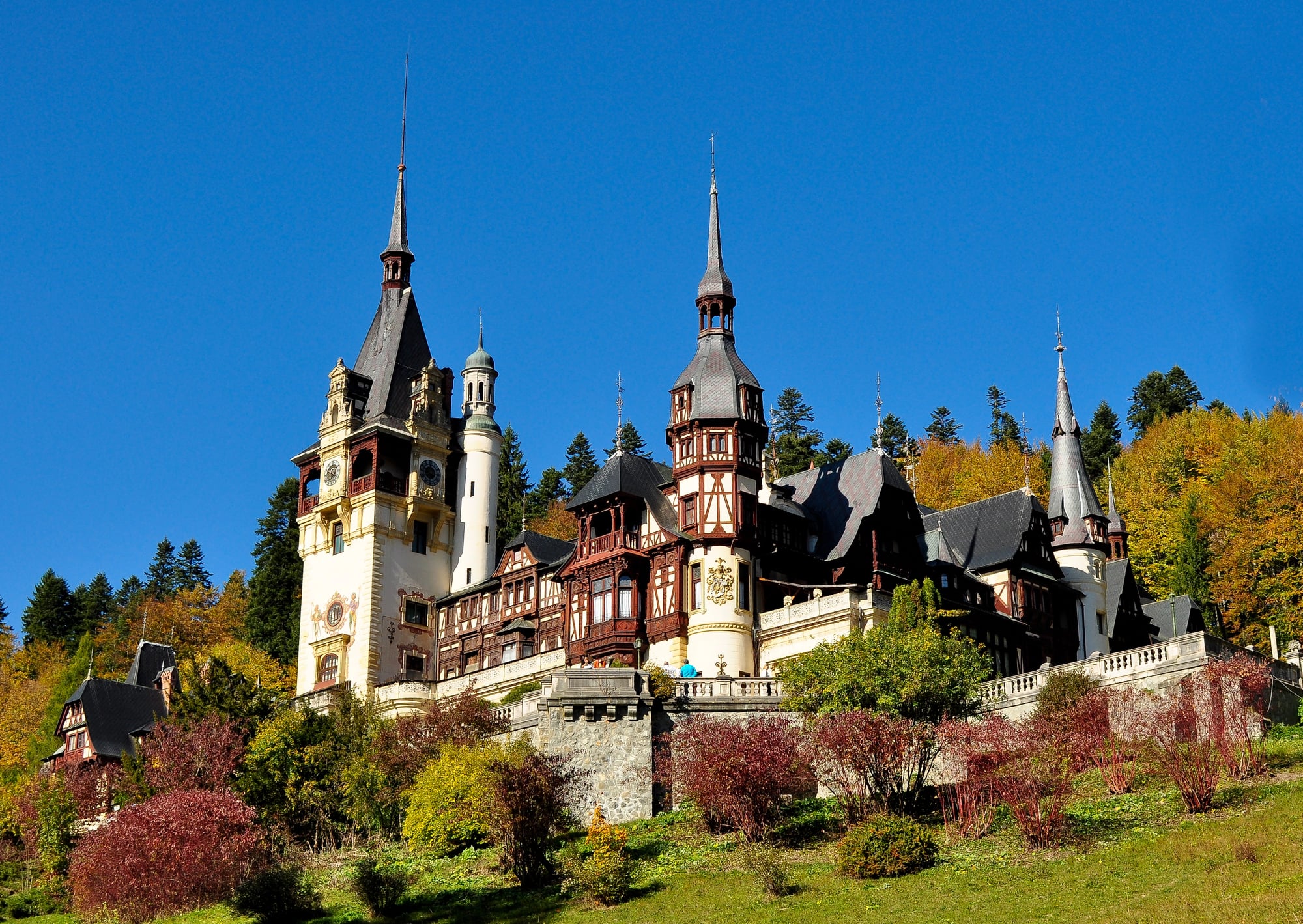
Peleș Castle represents 19th-century excess at its most unapologetic.Romania’s King Carol I wanted a summer residence in the Carpathian Mountains, and the result is a Neo-Renaissance fantasy with 170 rooms, central heating, electricity, and an elevator — installed in the 1880s when most of Europe was still lighting their castles with candles.
The interior decoration borders on the absurd.Each room represents a different cultural theme — German, Turkish, Moorish, French.
As if the entire castle were a kind of architectural world’s fair.The weapons room alone contains over 4,000 pieces of armor and weaponry from across Europe and Asia.
Ogrodzieniec Castle
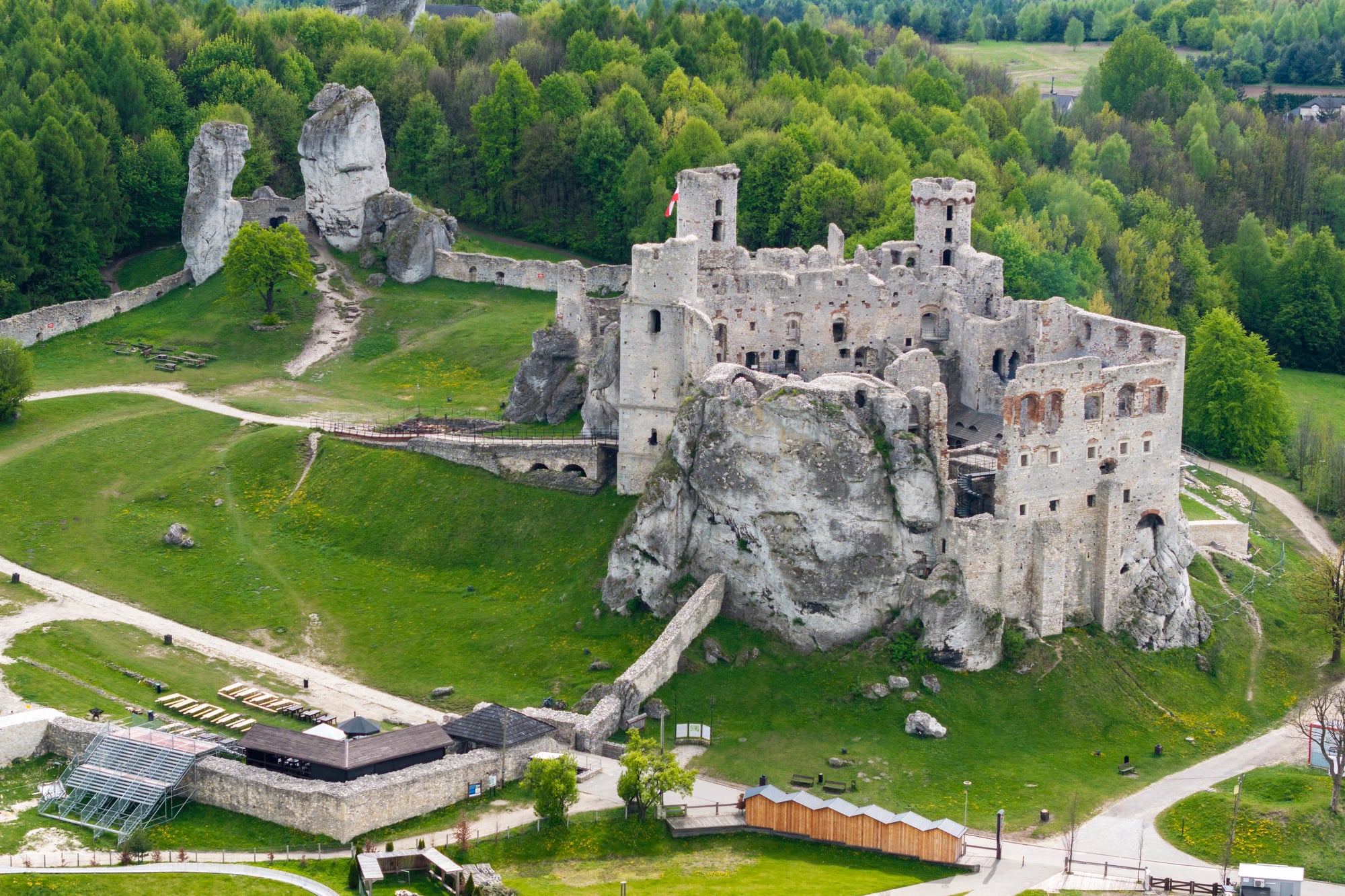
Ogrodzieniec Castle exists in a state of controlled ruin — its 14th-century walls rising from limestone cliffs in southern Poland like broken teeth.
Beautiful in the way that only genuine decay can be, where time and weather have carved away everything inessential and left behind forms that feel more like natural rock formations than human architecture.
The castle served as a Renaissance residence before Swedish forces destroyed it in the 17th century.And the Polish government has chosen to stabilize the ruins rather than rebuild them.
Which means visitors encounter something between monument and sculpture.History made visible through absence rather than presence.
Walking through its roofless halls and climbing its surviving towers creates the peculiar satisfaction that comes from seeing how stone endures long after wood and iron and human ambition have returned to dust.
The setting amplifies the effect.The Eagle’s Nests Trail connects dozens of similar ruins across the Kraków-Częstochowa Upland.
Creating a landscape where medieval fortifications emerge from limestone outcrops like architectural fossils.
Predjama Castle

Predjama Castle builds itself into a cliff face like it’s part of the rock formation.
This Slovenian fortress literally grows out of a cave mouth, its walls blending seamlessly with the limestone cliff behind it.
The effect is so dramatic that it feels like architectural magic, though the practical advantages were obvious enough.
The cliff provides natural fortification.
And the cave system behind the castle offered escape routes and storage space.
The castle’s most famous resident, Erazem of Predjama, used those caves to smuggle supplies during a year-long siege in the 15th century.
According to legend, he taunted his attackers by throwing fresh cherries down from the walls, proving that his supply lines remained intact.
Where Legends Take Stone

These castles represent more than medieval architecture — they’re proof that human ambition, given enough time and stone, can reshape entire landscapes.
Some stand as museums, others as romantic ruins, a few as active archaeological sites where each excavation reveals new layers of history.
What unites them isn’t architectural style or historical period, but their stubborn refusal to disappear quietly into the past.
Central Europe’s castles endure because they were built to endure.
Conceived by rulers who thought in centuries rather than decades.
Walking through their halls today means encountering that kind of permanence made visible — stone by stone, tower by tower, a landscape where the medieval world still casts shadows long enough to reach the present.
More from Go2Tutors!

- The Romanov Crown Jewels and Their Tragic Fate
- 13 Historical Mysteries That Science Still Can’t Solve
- Famous Hoaxes That Fooled the World for Years
- 15 Child Stars with Tragic Adult Lives
- 16 Famous Jewelry Pieces in History
Like Go2Tutors’s content? Follow us on MSN.



