Insects that Have Super Strength
You probably don’t think much about the tiny creatures crawling around your backyard. But if you scaled up some of these insects to human size, they’d put Olympic weightlifters to shame.
The strength-to-weight ratios these small animals achieve defy what seems physically possible. Their power comes from unique body structures, specialized muscles, and mechanical advantages that evolution perfected over millions of years.
Dung Beetles
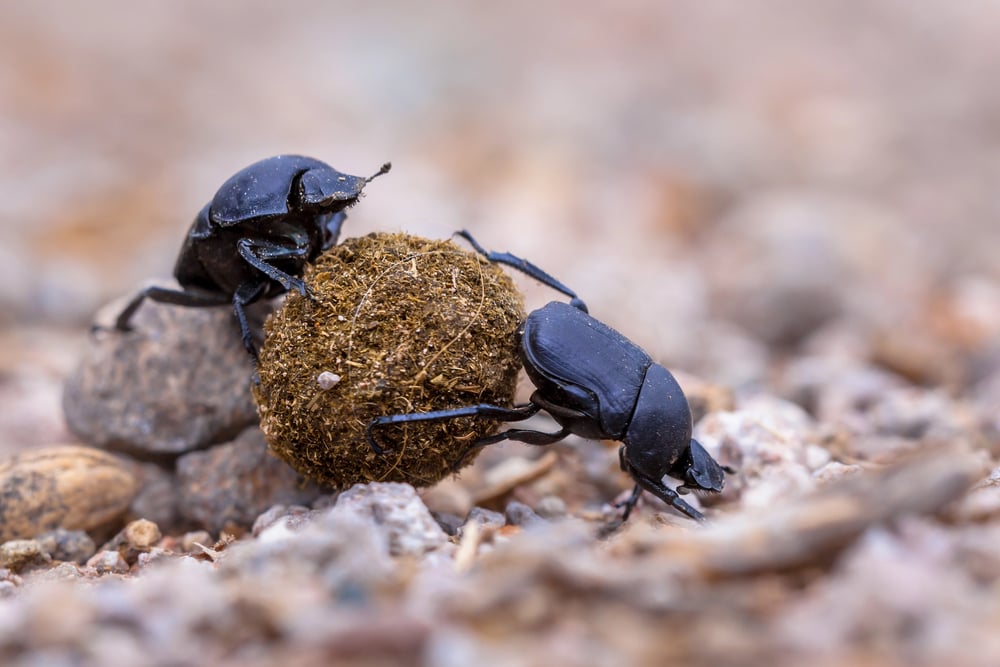
The horned dung beetle holds the title for strongest insect on Earth. These beetles can pull objects weighing 1,141 times their own body weight.
That’s like you dragging six fully loaded double-decker buses behind you. They need this strength for a specific reason.
Male dung beetles fight each other in underground tunnels, competing for mates. The tunnels are narrow, so pushing contests determine the winner.
The beetle that can generate more force wins the female. This intense competition drove the evolution of their extreme strength over generations.
Leafcutter Ants

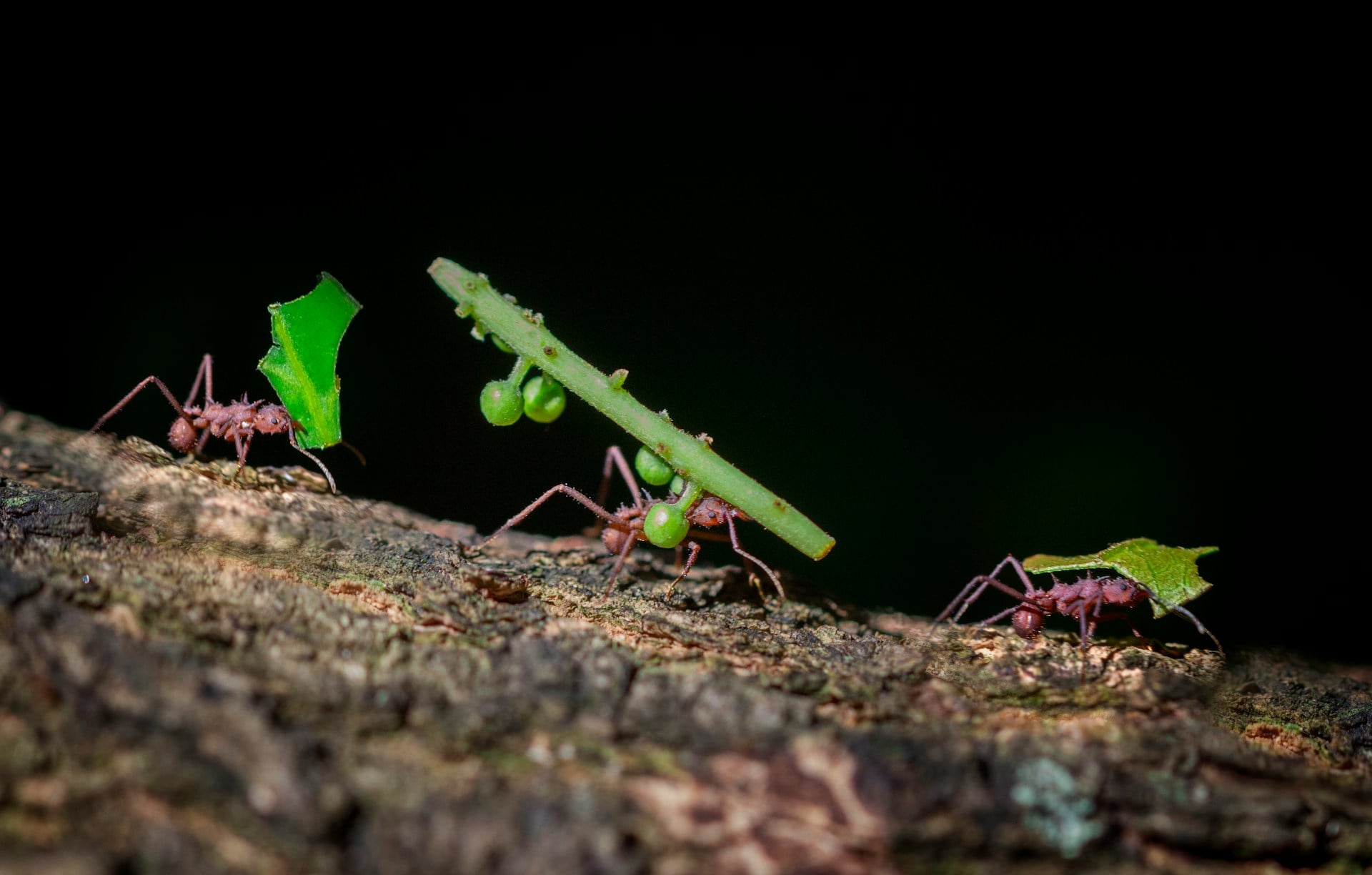
These ants slice through leaves with their powerful mandibles and then carry pieces back to their colony. A single leafcutter ant can carry a leaf fragment weighing 50 times its body weight.
The leaf pieces they carry often measure several times larger than their own bodies, creating the visual of a tiny creature beneath a massive green sail. The ants don’t eat the leaves though.
They take them underground and use them to cultivate fungus gardens. The entire colony depends on this farming system, which means the ants must maintain a constant flow of leaf material.
Thousands of ants work together, creating visible highways through forests where they march in organized lines.
Rhinoceros Beetles

The rhinoceros beetle can lift 850 times its own weight. That horn on its head isn’t just for show.
Males use those horns to fight other males, flipping opponents off branches during territorial disputes. Their strength comes from their body structure.
The exoskeleton acts as an external frame, and their muscles attach in ways that create massive mechanical advantages. The beetle’s compact body design concentrates force efficiently.
When you watch these beetles in action, the power they generate seems impossible for something so small.
Trap-Jaw Ants

These ants snap their jaws shut faster than any other predatory appendage in the animal kingdom. The speed reaches 145 miles per hour.
The force generated when those jaws slam together measures 300 times the ant’s body weight. But here’s the interesting part.
Trap-jaw ants also use their jaws as an escape mechanism. When threatened, they point their jaws at the ground and snap them shut.
The force launches the ant into the air, flinging it away from danger. Scientists measured these jumps at heights reaching 8 inches, which is significant when you consider the ant’s tiny size.
Atlas Beetles

The atlas beetle ranks among the largest beetles in existence, but size isn’t their only impressive feature. These beetles can carry 4 grams, which equals roughly 850 times their body mass.
Males battle each other using their distinctive horns, and the strength required for these contests shaped their evolution. Their larvae also demonstrate remarkable power.
They burrow through dense rotting wood, creating tunnels as they feed. The force needed to move through decomposing timber requires specialized jaw muscles and body strength that develops during the larval stage.
Tiger Beetles

Speed and strength combine in tiger beetles. They run faster than any other insect relative to body size, reaching speeds where they actually go temporarily blind because their eyes can’t process visual information quickly enough.
But they also possess incredibly strong mandibles that crush prey instantly. The mandibles work like tiny hydraulic presses.
When a tiger beetle catches its prey, those jaws deliver a bite force that exceeds many larger predators when adjusted for body size. The beetle’s entire head contains specialized muscles dedicated to powering those jaws.
Stag Beetles
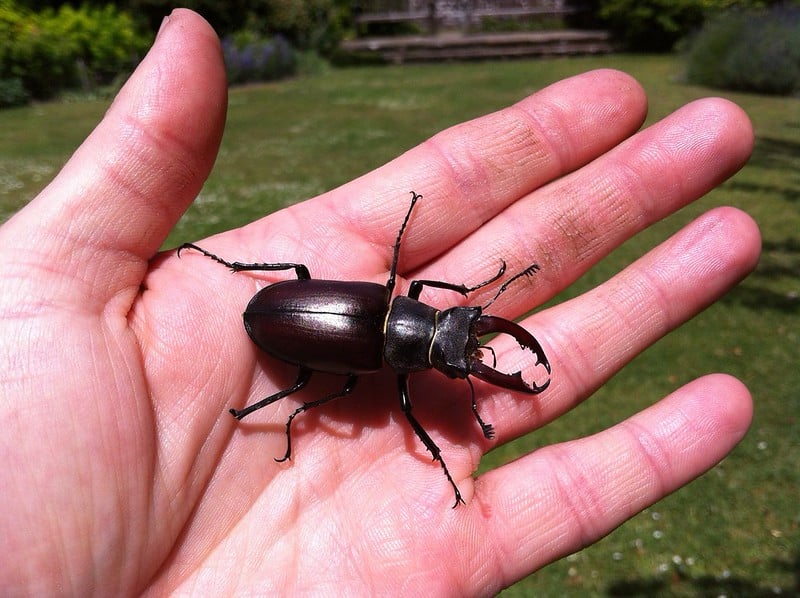
Stag beetles get their name from the impressive antler-like mandibles males develop. These mandibles function as weapons during mating battles.
A stag beetle can generate crushing forces with those mandibles that measure many times their body weight. The battles between male stag beetles look dramatic.
They grapple with each other, trying to lift and flip their opponent. The beetle that gets underneath can use those powerful mandibles to hoist the rival into the air and throw them off the fighting surface.
These contests require not just strong jaws but powerful legs and core muscles.
Ironclad Beetles
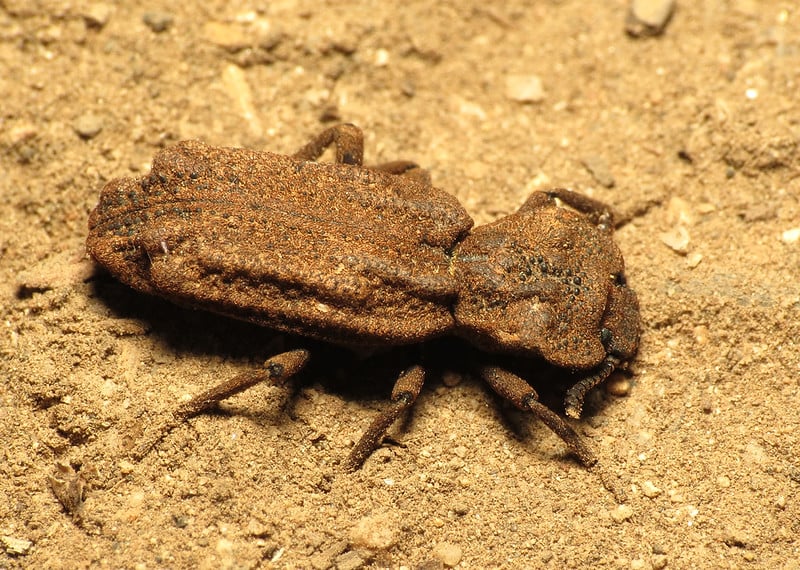
The diabolical ironclad beetle earned its name honestly. This beetle can withstand being run over by a car.
Its exoskeleton is so tough that entomologists struggle to pierce specimens with standard mounting pins. Scientists discovered the secret lies in the way the beetle’s shell components interlock.
The pieces fit together like puzzle parts, distributing force across the entire structure rather than concentrating stress at single points. This design allows the beetle to survive crushing forces that would destroy most other insects.
The strength isn’t about lifting or pulling, but about resisting compression that would pulverize softer creatures.
Fire Ants

Individual fire ants aren’t notably strong, but when they work together, they accomplish feats that seem impossible. Fire ant colonies build living bridges with their bodies, creating structures that can span gaps and support the weight of thousands of ants marching across.
They also form rafts during floods. The ants link their bodies together, trapping air bubbles beneath the raft.
This structure floats and can support the entire colony for weeks. Each ant grips multiple other ants, and the collective strength of these connections creates a flexible but sturdy platform that bends with waves but doesn’t break apart.
Weaver Ants
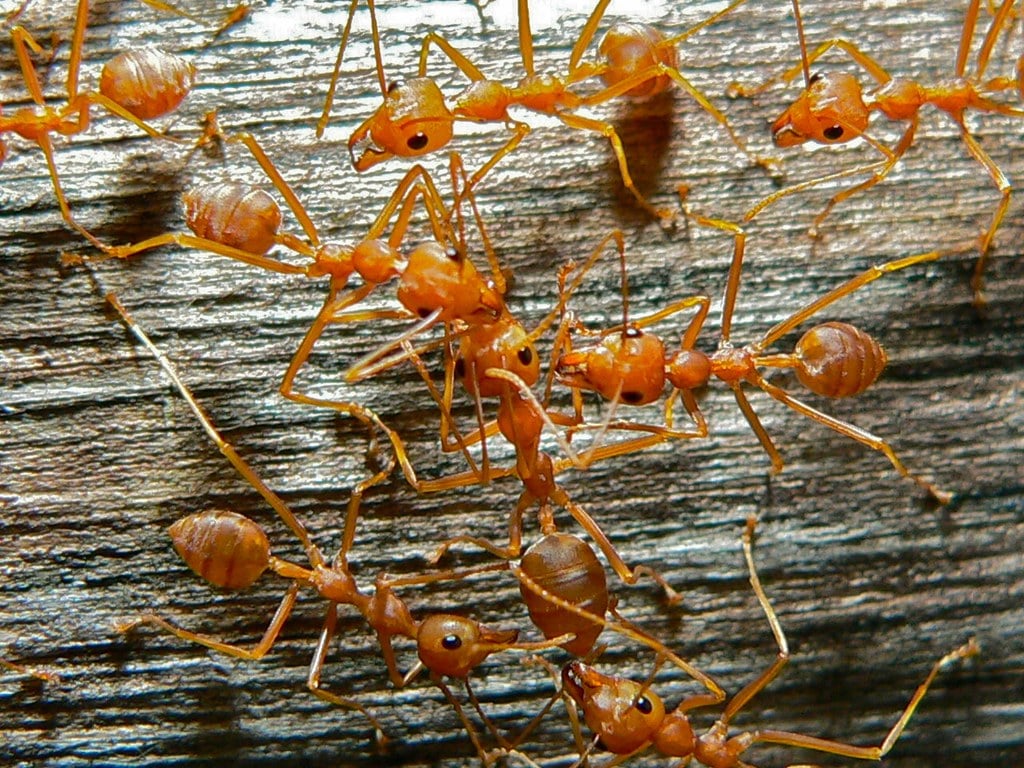
These ants build nests by weaving leaves together using silk produced by their larvae. The construction process requires impressive strength and coordination.
Worker ants form chains, each ant gripping another, and together they pull leaves into position. Individual ants can pull with forces measuring many times their weight.
When you see a chain of weaver ants pulling a leaf, each ant is exerting maximum force, and the combined effort can bend and position leaves that dwarf the insects themselves. The construction crews work for hours, maintaining tension until other workers arrive with larvae that produce the silk threads to bind the leaves permanently.
Hercules Beetles

The Hercules beetle grows up to 7 inches long, making it one of the largest flying insects. Despite this size, it can lift 850 times its own weight.
The horns that give males their distinctive appearance serve as weapons and tools during fights with rivals. Their flight muscles also demonstrate extraordinary power.
Getting a body that large and heavy airborne requires tremendous force. The Hercules beetle’s wing muscles generate rapid contractions that beat the wings fast enough to achieve sustained flight.
Watching these massive beetles fly feels surreal because their bulk suggests they shouldn’t be able to leave the ground.
Goliath Beetles

These beetles rank among the heaviest insects on Earth. Adults can weigh over 3.5 ounces, which is substantial for an insect.
But even at this weight, they can fly. The power needed to lift that mass requires flight muscles that generate exceptional force.
Their larval form also impresses. Goliath beetle larvae grow large by eating enormous amounts of rotting wood and plant material.
They burrow through their food source, using strong mandibles and body muscles to tunnel through dense substrate. The larvae can weigh even more than the adults before they pupate.
Bess Beetles

These beetles live in rotting logs and tunnels they create through the wood. Both adults and larvae work together, which is unusual for insects.
The adults can move through incredibly dense wood, using their heads as battering rams and their legs to push and pull. Parents care for their young, which is rare among beetles.
They chew wood into smaller pieces for the larvae to consume. This parenting behavior requires strength to process the tough wood fibers and patience to feed the slow-growing offspring.
The family units stay together for months, with everyone contributing to expanding and maintaining the tunnel system.
Ant Lions

The larval form of the ant lion creates cone-shaped pits in sandy soil. When prey walks near the edge, the ant lion throws sand to cause an avalanche that pulls the victim down to the bottom of the pit.
The mandibles that catch and hold prey generate tremendous crushing force relative to the larva’s size. But the real strength shows in how they construct and maintain these traps.
The ant lion throws sand by flicking its head, and it must move hundreds of sand particles to create each pit. The precision and force needed to shape these traps and keep them functional requires specialized muscles that can generate rapid, powerful movements repeatedly.
What Makes Them So Strong
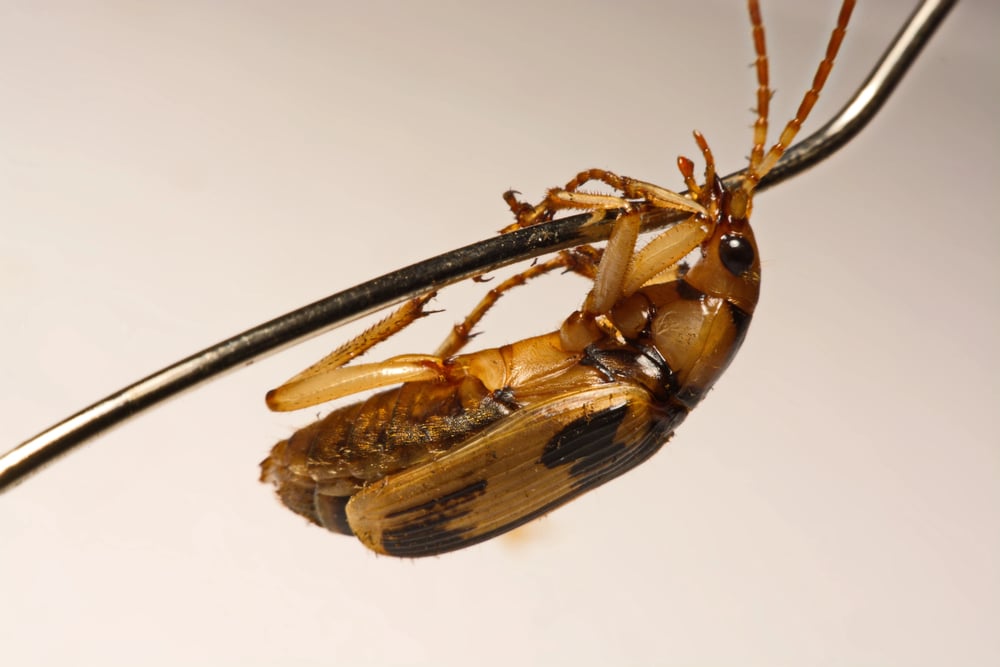
The power you see in these insects comes from fundamental physics. As animals get smaller, their strength-to-weight ratio increases.
Muscle force relates to cross-sectional area, but body weight relates to volume. When you shrink an animal, the volume decreases faster than the cross-sectional area, creating these impressive ratios.
But that’s not the whole story. Insects also evolved specialized structures that maximize mechanical advantage.
Their exoskeletons provide attachment points for muscles in ways that create leverage. The materials that make up their bodies, particularly the exoskeleton, possess surprising strength and flexibility that lets them handle extreme forces without breaking.
The Tiny Titans Around You
Out here, you’ll find them nearly everywhere – hot sands, thick jungles, even right beyond the glass at home. Strength isn’t just show; it helps them grab meals, hold ground, win partners, shape shelters.
Nature didn’t hand out power by chance. Every tough leg or grip came because failing meant vanishing.
Look again when a beetle pushes something heavy. That little creature is doing work beyond its size.
Strength hides where people least expect it. An ant hauling food shows how much effort fits into small forms.
Size does not always show ability. What seems ordinary might be extraordinary up close.
More from Go2Tutors!

- The Romanov Crown Jewels and Their Tragic Fate
- 13 Historical Mysteries That Science Still Can’t Solve
- Famous Hoaxes That Fooled the World for Years
- 15 Child Stars with Tragic Adult Lives
- 16 Famous Jewelry Pieces in History
Like Go2Tutors’s content? Follow us on MSN.