Interesting Facts About Nördlingen in Germany
A quiet hush settles over Nördlingen, where crooked timber homes tilt toward worn stone paths. Above them, a church steeple cuts through the skyline, standing tall among terracotta roofs.
Encircling it all, an old stone wall holds tight like a loop stitched into time. Charm slips in quietly here, carried on cobblestones and centuries.
Tradition does not shout – it simply stays. Something odd hides under Nördlingen, unseen from pastry cases or cobbled plazas.
A huge dent in Earth marks where space rock struck millions of years back. Cafes stand above ground, forged fast by chaos falling from the sky.
A quiet charm runs through this little town, revealing why it stands out across Germany. Its character unfolds slowly, noticed only when you stop rushing.
Not flashy, never loud, yet full of moments that stick. What seems ordinary at first glance hides something rarer.
Few expect much upon arrival – which might be exactly why it leaves such an impression.
Built Inside a 15-Mile-Wide Meteorite Crater
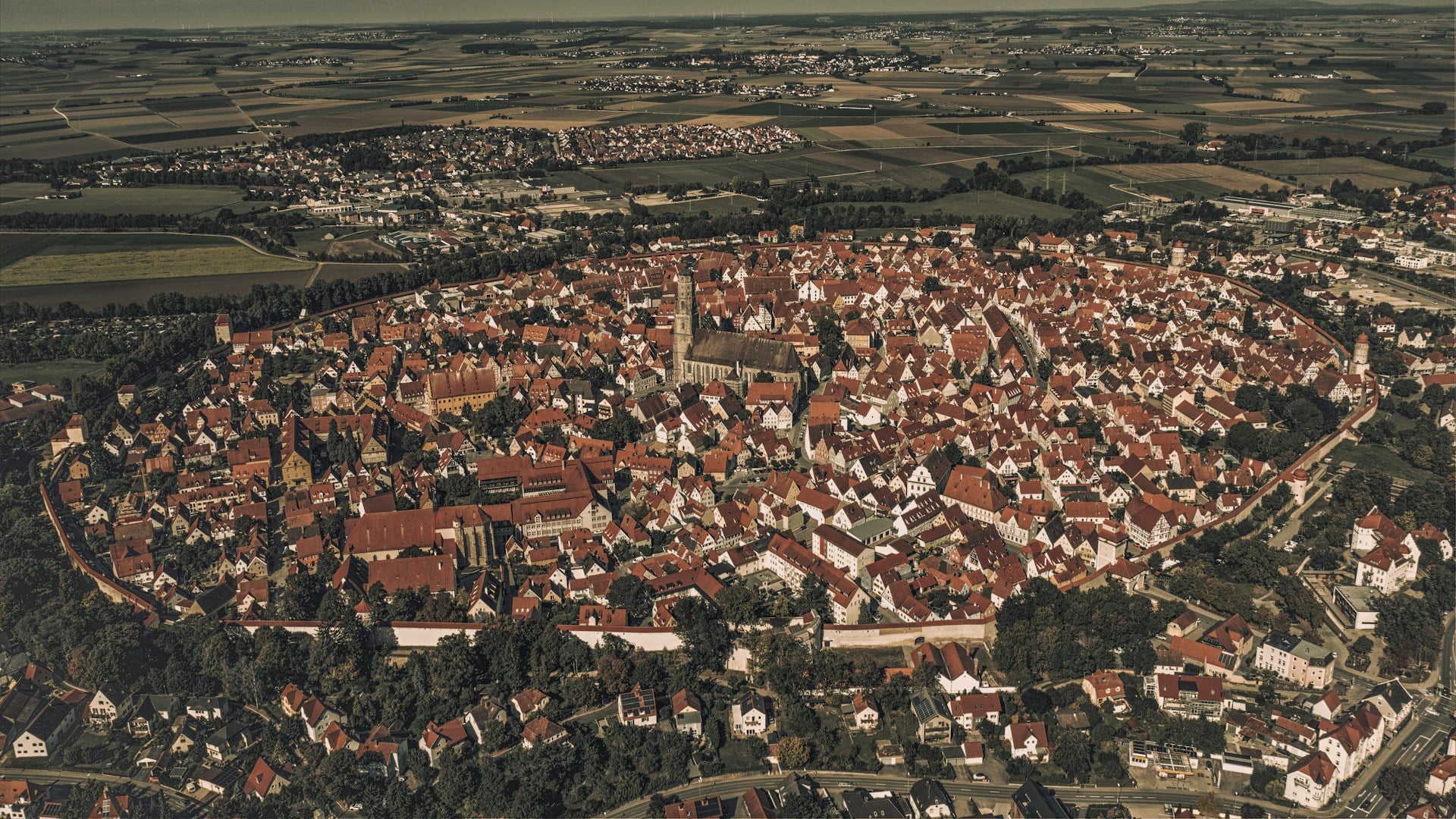
Nördlingen sits within the Nördlinger Ries, a nearly circular depression about 15 miles across. For centuries, locals assumed the basin was volcanic in origin.
The shape was too precise to ignore, yet the explanation remained uncertain until the mid-20th century.
In the 1960s, geologists confirmed that the Ries was created by a meteorite impact after discovering high-pressure minerals such as coesite — a substance formed only under the intense shock of extraterrestrial collisions. The impact would have released energy equivalent to millions of atomic bombs, flattening everything within miles.
Today, the crater’s rim forms gentle hills surrounding the town. Unlike dramatic craters seen in desert landscapes, the Ries is subtle, softened by farmland and forests.
That understatement makes the revelation even more compelling: a peaceful Bavarian town rests at the center of a prehistoric cosmic scar.
Buildings Made from Impact Rock

The meteorite did more than carve out the landscape. It also created a unique rock known as suevite, formed from melted and compressed debris during the collision.
This stone became a primary building material for Nördlingen’s medieval structures.
Many of the town’s walls, homes, and public buildings are constructed from this impact rock. Embedded within it are microscopic diamonds created by the extreme pressure of the strike.
These diamonds are far too small to sparkle in the sunlight, yet their presence adds a layer of quiet wonder to the architecture.
It is rare to find a place where geology and urban design are so directly intertwined. In Nördlingen, the town quite literally built itself from the remains of an asteroid.
The Tower Called ‘Daniel’

St. George’s Church, Nördlingen dominates the skyline with its 295-foot tower, affectionately nicknamed ‘Daniel.’ Climbing the tower’s 350 steps rewards visitors with sweeping views across the circular town and the broader crater basin.
From above, the town’s shape becomes strikingly clear. The near-perfect ring of defensive walls and radiating streets mirrors the geometry of the crater beneath it.
The view connects medieval planning with ancient geology in one sweeping panorama.
The tower has stood since the late 15th century, surviving wars and shifting political eras. Even so, its true claim to fame lies in the suevite stone from which it was built — stone forged in a celestial collision long before human history began.
One of Germany’s Fully Walkable Medieval Walls

Nördlingen is one of the few towns in Germany where visitors can still walk the entire medieval city wall. Stretching about 1.6 miles, the wall remains intact, complete with towers, gates, and a covered walkway.
Constructed primarily in the 14th and 15th centuries, it once served as a defensive barrier against invading armies.
Walking the wall today feels less like a museum visit and more like stepping into a living stage set. The rooftops cluster neatly inside the ring, while farmland stretches outward toward the crater’s rim.
The structure reflects a time when protection and planning defined urban life.
That preservation did not happen by accident. Unlike many European cities heavily damaged in later conflicts, Nördlingen retained much of its historic core, allowing its medieval character to endure with unusual completeness.
A Pivotal Moment in the Thirty Years’ War
In 1634, Nördlingen became the site of a major clash during the Battle of Nördlingen, part of the broader Thirty Years’ War. Imperial and Spanish forces defeated Swedish and Protestant troops in a battle that altered the balance of power across central Europe.
The conflict brought devastation to the region. Populations declined sharply due to warfare, famine, and disease.
For Nördlingen, the battle marked a turning point that shaped its political and economic trajectory for decades.
Even centuries later, the town’s quiet streets carry echoes of that turbulent period. Its survival, despite the upheaval, underscores how communities adapt and endure through sweeping historical change.
A Training Ground for the Space Age

During the 1960s, the Ries crater attracted an unexpected group of visitors: NASA astronauts preparing for the Apollo missions. Understanding impact geology on Earth helped scientists interpret lunar rock samples and crater formations observed on the Moon.
The terrain around Nördlingen provided a practical classroom. Astronauts studied rock layers and impact debris to better recognize similar features in extraterrestrial environments.
The connection between a medieval town and space exploration might seem improbable, yet it is rooted in shared geological processes.
In a subtle way, Nördlingen contributed to humanity’s exploration beyond Earth. The same force that shaped its foundation also shaped parts of the lunar surface.
A Town That Feels Cinematic

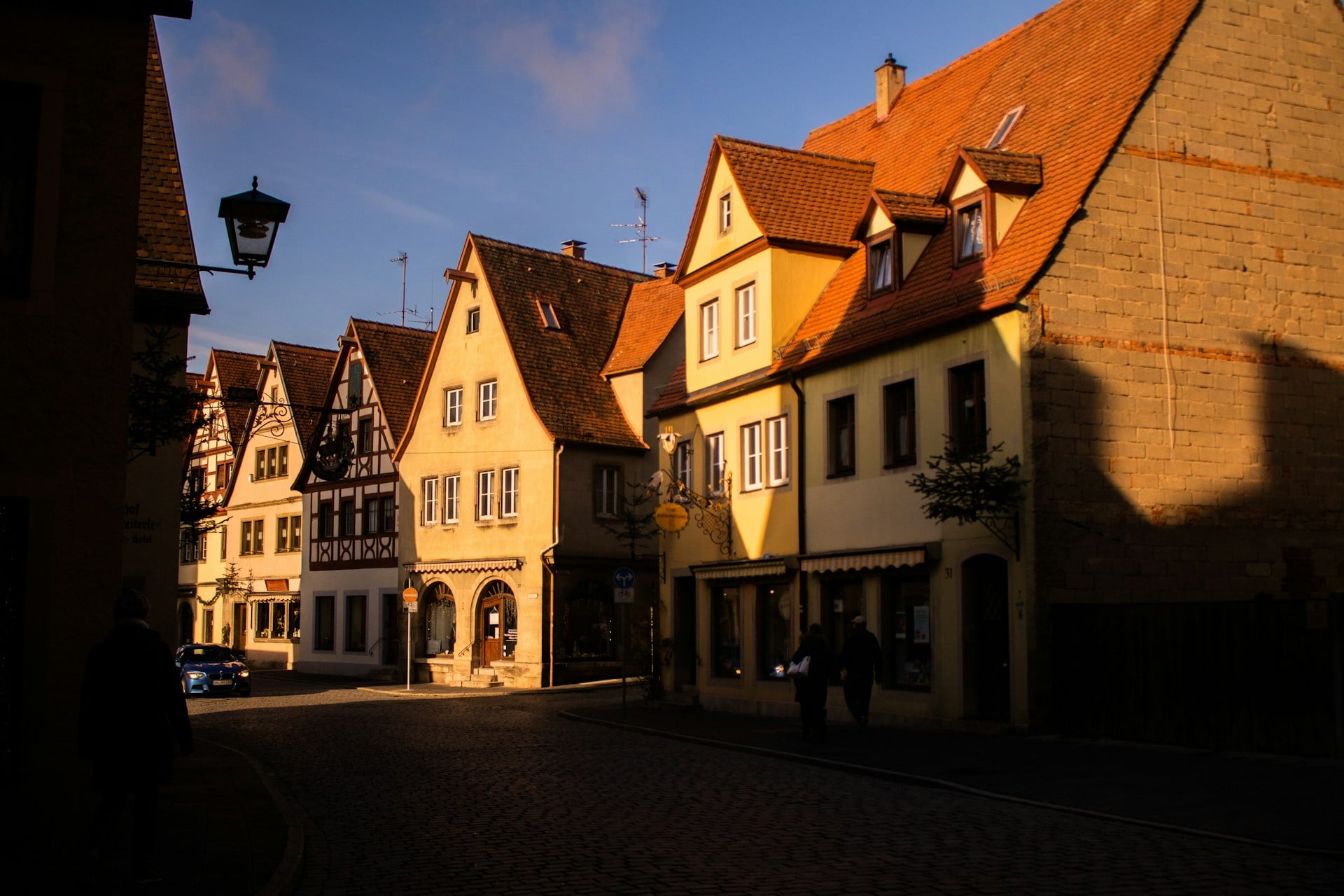
The preserved walls, narrow lanes, and central church tower give Nördlingen a distinctly cinematic quality. Its orderly symmetry and historic texture have drawn attention from filmmakers and creators seeking authentic medieval settings.
There is a visual harmony here that feels deliberate. The circular layout, the warm tones of stone, and the steady presence of ‘Daniel’ at the center create a composition that looks almost designed for storytelling.
Yet nothing about it was staged. The geometry emerged from natural catastrophe, then was refined through centuries of human planning.
That layered origin gives the town a depth that fictional cities often try to imitate.
Everyday Life on Ancient Ground
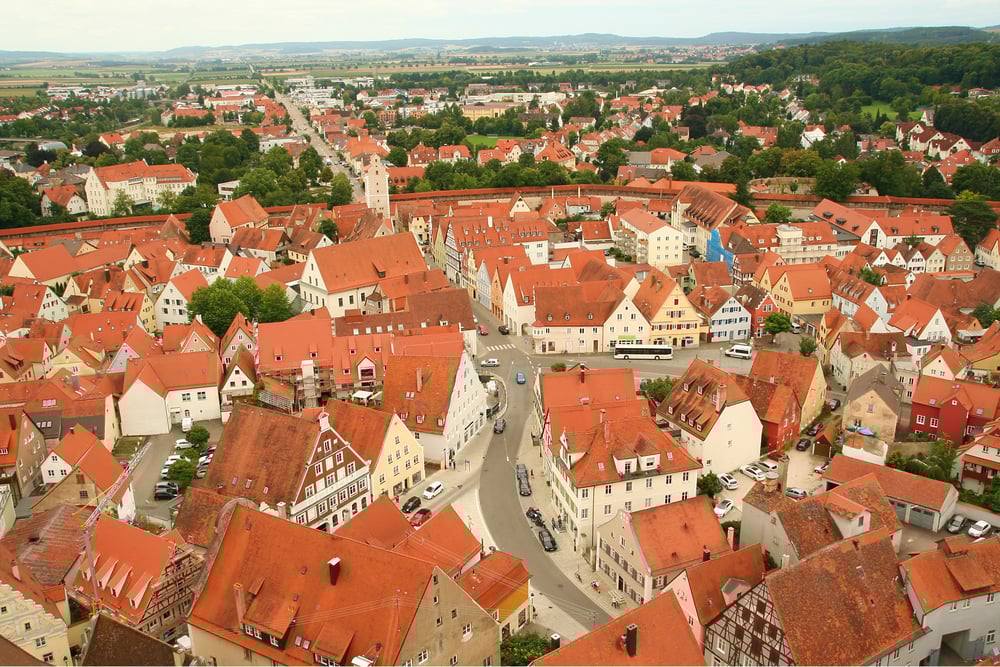
Despite its unusual origins, Nördlingen is not a relic frozen in time. Around 20,000 people live and work within its walls today.
Markets operate in the town square, schools open their doors each morning, and festivals bring music and color to the streets.
The coexistence of daily life with ancient geology is what makes the town especially compelling. Residents walk across stone shaped by an event that predates human civilization, often without a second thought.
The extraordinary has blended seamlessly into the ordinary.
That quiet normalcy may be Nördlingen’s most striking feature. It proves that history does not always sit behind glass cases or museum barriers.
Sometimes it forms the very ground beneath a town’s foundations.
Where Past and Present Quietly Intersect

Long before clocks ticked, a flash tore through the sky. The ground gave way beneath fire and force.
Stone forged in that chaos later rose into arches and battlements. Wars twisted through town when muskets cracked at dawn.
Decades passed, then men in suits pored over fractured terrain, eyes fixed on craters far away.
Now the town grows, yet stays rooted inside its old stone rim. Not merely design, those round walls echo an older loop buried under soil.
From Nördlingen rises proof: calm ground may hold traces of sky-fire and stubborn lives – stacked, unbroken, quietly guiding what comes next.
More from Go2Tutors!

- The Romanov Crown Jewels and Their Tragic Fate
- 13 Historical Mysteries That Science Still Can’t Solve
- Famous Hoaxes That Fooled the World for Years
- 15 Child Stars with Tragic Adult Lives
- 16 Famous Jewelry Pieces in History
Like Go2Tutors’s content? Follow us on MSN.